.svg)


.svg)
- The global coworking market reached $20.96 billion in 2025, with over 42,000 spaces worldwide and corporate adoption accelerating across industries.
- Coworking spaces cost up to 70% less than traditional office leases in major metros, with 97% of U.S. cities favoring coworking on a per-desk basis.
- Enterprise teams now represent 35% of coworking memberships, shifting the market from freelancer-first to a core corporate real estate strategy.
- The "third workplace" trend is reshaping demand, with 65% of new memberships targeting spaces within a 15-minute commute from home.
- Private offices and focus pods are outpacing open-plan seating by 3:1 as space design evolves toward purpose-driven, hospitality-first environments.
The way organizations think about office space has changed permanently. Return-to-office mandates continue making headlines, but the data tells a different story: 55% of corporations now use flexible workspace solutions, and that number is climbing. Coworking spaces sit at the center of this shift, offering workplace leaders a way to reduce real estate costs, support distributed teams, and give employees professional environments without the rigidity of long-term leases.
This guide breaks down what coworking spaces are, how the market has evolved through 2026, and how to evaluate whether coworking belongs in your workplace strategy. You'll find updated market data, cost comparisons, implementation frameworks, and the design trends reshaping what these spaces look and feel like.
What coworking spaces are (and aren't)
Coworking is a flexible workspace arrangement where individuals from different companies share a common office environment, accessing shared facilities, services, and infrastructure. Unlike traditional offices designed for a single organization, coworking spaces bring together diverse professionals while providing the amenities and structure of a professional workplace.
The concept gained mainstream traction in 2005 when software engineer Brad Neuberg opened the first official coworking space in San Francisco, though early "hackerspaces" date back to Berlin in the mid-1990s. Since then, coworking has grown into a global industry supporting remote workers, hybrid teams, and distributed organizations of every size.
What separates coworking from other flexible workspace options is its community-driven approach. Traditional office leases prioritize control and exclusivity. Coworking spaces are designed to facilitate networking, knowledge sharing, and collaborative opportunities while giving employees access to professional environments wherever they're located.
Key characteristics of coworking spaces
- Shared infrastructure: Equipment, utilities, reception services, and conference rooms
- Flexible membership options: Daily, weekly, monthly, or annual access
- Community focus: Networking events, skill-sharing sessions, and collaborative programming
- Professional amenities: High-speed internet, printing services, phone booths, and kitchen facilities
- Diverse membership: Freelancers, remote employees, digital nomads, startups, and enterprise teams
Understanding different coworking models
Not all coworking spaces serve the same purpose. Understanding the different models helps workplace leaders match solutions to their team's needs and budget.
Open coworking spaces
Open coworking spaces feature shared desk arrangements in large, collaborative environments. These spaces prioritize community interaction and networking, making them a strong fit for individual contributors and small teams seeking connection. They're closely related to hot desking models, where employees don't have assigned seats and choose available desks each day.
Best for: Remote workers, freelancers, and teams focused on creative collaboration
Corporate coworking spaces
Corporate coworking spaces provide structured environments with quiet zones and enhanced privacy. These spaces cater to businesses requiring formal meeting capabilities and dedicated work areas, often with higher-end finishes and stricter access controls.
Best for: Client-facing teams, consulting professionals, and organizations requiring confidentiality
Full-service coworking spaces
Full-service coworking spaces deliver comprehensive office experiences, including private offices, conference rooms, reception services, and premium amenities. They function as complete office replacements with the flexibility of month-to-month terms.
Best for: Growing teams, companies testing new markets, and organizations seeking office-like environments without long-term commitments
Industry-specific and niche coworking spaces
Specialized coworking spaces cater to specific industries or demographics, providing tailored equipment, compliance features, and relevant networking opportunities. This segment has grown significantly: roughly 20% of spaces opened in the past year target specific verticals, from legal and healthcare to female-focused and developer-focused communities.
Best for: Professional services, regulated industries, and teams requiring specialized infrastructure

Wondering whether coworking delivers measurable value for your team? This deep dive covers the financial, cultural, and operational benefits that make coworking a strategic advantage.
Read the full breakdown
The 2026 Coworking market landscape
The coworking industry looks fundamentally different than it did even two years ago. Post-WeWork consolidation has reshaped operator strategy, and the market is now dominated by larger, tech-enabled platforms backed by major real estate players.
Market size and growth trajectory
The numbers reflect sustained momentum:
- Market size: $20.96 billion in 2025, with projections reaching $82-93 billion by the mid-2030s
- Global footprint: Over 42,000 coworking spaces worldwide, expected to reach 44,000 by end of 2026
- User base: 5.5 to 6 million coworking members globally
- Growth rate: 14.1% annual compound growth rate
- Operator profitability: 58% of operators reported profitability in early 2025, with only 18% operating at a loss
The post-WeWork operator landscape
WeWork's bankruptcy restructuring in 2023-2024 didn't shrink the coworking market. It redistributed it. IWG (parent company of Regus and Spaces) now operates over 1,000 U.S. locations. CBRE acquired Industrious in 2025 for approximately $400 million, consolidating facilities management and flex space under one roof. Convene has carved out a niche in legal and professional services. Mindspace continues expanding in Europe and the U.S.
A key structural shift: 40% of new locations opened in 2025 use management agreements rather than traditional leases, meaning landlords and operators share risk instead of operators shouldering it alone. This model is more sustainable and signals long-term market stability.
For organizations evaluating their options, the WeWork alternatives landscape now includes a wide range of operators, from global chains to boutique local spaces. Platforms like Gable give teams access to 20,000+ premium workspaces across 900+ cities through a single booking interface, so companies can tap into this fragmented market without managing relationships with dozens of individual operators.
Corporate adoption is accelerating
Coworking is no longer a freelancer phenomenon. Enterprise teams now account for roughly 35% of coworking memberships, and 78% of large companies operate hybrid models that require flexible space options. JLL predicts that by 2030, 30% of all office space will be consumed flexibly.
This shift means coworking has moved from a tactical perk to a core component of corporate real estate strategy. Finance teams are evaluating flex space alongside traditional leases, and workplace leaders are building portfolios that blend owned offices with on-demand coworking access.
The cost case for coworking spaces
Long-term office leases create fixed costs regardless of how many people show up on a given day. Coworking spaces flip that model, aligning expenses with actual usage.
How coworking compares to traditional leases
The cost gap is significant and well-documented. Research from Coworking Cafe found that coworking is 70% cheaper than traditional office space in markets like Sunnyvale, CA, and 61% cheaper in Miami. Across the U.S., 97% of cities favor coworking on a per-desk cost basis.
Here's where the savings come from:
- Zero capital expenditure: No furniture, equipment, or build-out costs (traditional offices run $150-200 per square foot for build-out alone)
- Included overhead: Utilities, maintenance, cleaning, and facility management are bundled into membership fees
- Flexible scaling: Add or reduce capacity with minimal notice, paying only for what you use
- Predictable budgeting: Fixed monthly costs with transparent pricing, no surprise maintenance bills
Typical coworking pricing in 2026
Costs vary by location, amenity level, and membership type:
- Hot desks (shared space): $100-$500 per month
- Dedicated desks: $200-$800 per month
- Private offices: $400-$2,000+ per month
- Day passes: $20-$50 for occasional use
Premium locations in major metros command higher rates, while tier-2 and tier-3 cities offer more affordable options. For a detailed comparison, see our analysis of flexible spaces vs. office leases.
Access 20,000+ premium workspaces in 900+ cities. Book coworking spaces, track usage, and control budgets from a single platform, with no upfront credits or long-term commitments.
Learn more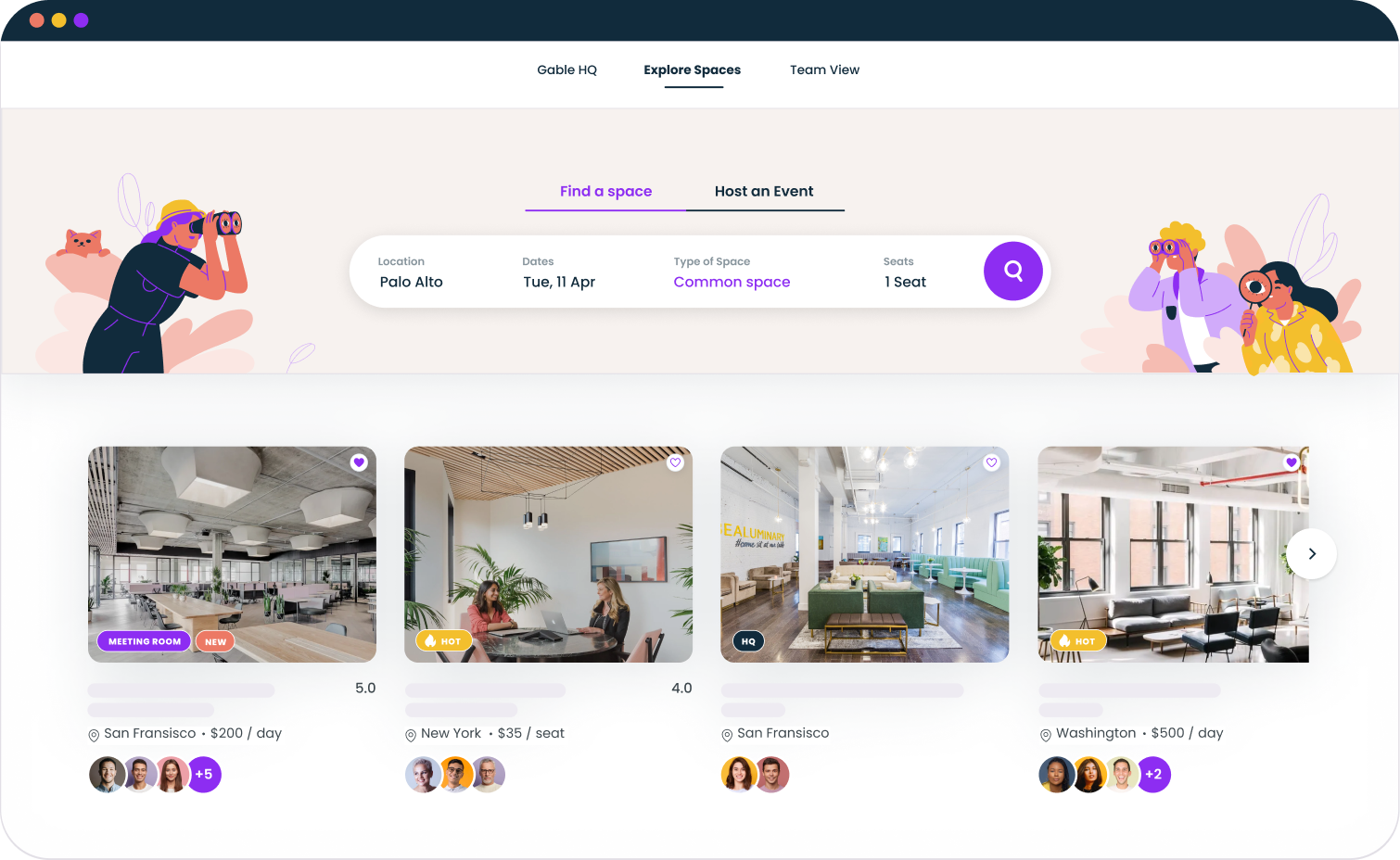
Key benefits of coworking spaces for workplace leaders
Beyond cost savings, coworking spaces deliver measurable impacts on flexibility, employee satisfaction, and organizational agility.
Operational flexibility and scalability
Unlike traditional leases that lock companies into fixed space commitments for 5-10 years, coworking offers dynamic capacity management:
- Rapid scaling: Add or reduce workspace capacity with minimal notice as headcount changes
- Geographic expansion: Test new markets without committing to long-term real estate
- Project-based usage: Access specialized spaces for specific initiatives or team offsites
- Seasonal adjustments: Accommodate fluctuating workforce requirements without carrying excess space
This flexibility is especially valuable for companies navigating the hub-and-spoke office model, where a central headquarters is supplemented by satellite locations closer to where employees live.
Employee satisfaction and retention
The modern workforce prioritizes flexibility. Coworking spaces address this by providing professional environments that support both productivity and well-being:
- 85% of coworking users report higher motivation compared to working from home
- 88% say coworking reduces feelings of isolation
- 74% demonstrate improved productivity
- 80% pass work or leads to fellow coworking members
For workplace leaders focused on talent attraction, offering coworking access signals that the organization trusts employees to choose where they do their best work.
Access to premium amenities and technology
Coworking spaces invest in infrastructure that would be cost-prohibitive for many organizations to build independently:
- Enterprise-grade connectivity: High-speed internet supporting video conferencing and large file transfers
- Professional meeting rooms: Equipped with presentation technology and conference room technology
- Reception services: Professional front-desk support and visitor management
- Commercial-grade equipment: Printing, scanning, and AV systems
- Comfort features: Ergonomic furniture, natural lighting, and kitchen facilities
Networking and collaboration opportunities
Coworking spaces create environments where organic networking happens naturally. Over 80% of coworking users report expanding their professional networks, leading to new business opportunities, partnerships, and talent connections.
For distributed teams, coworking spaces also serve as gathering points. When team members in the same city book the same space, they get face-to-face collaboration time without requiring everyone to commute to a central headquarters.
The "third workplace" trend reshaping coworking in 2026
One of the most significant shifts in the coworking market is the rise of the "third workplace," a professional space that's neither home nor corporate HQ, located close to where employees live.
The 15-minute commute standard
Data from 2025-2026 shows that 65% of new coworking memberships target spaces within a 15-minute commute from home. Employees don't want to trade a long commute to headquarters for the isolation of working from their kitchen table. They want a professional environment nearby.
This trend is driving coworking growth in suburban and smaller markets. Medium-sized U.S. cities are seeing sharp demand increases as remote workers who relocated during the pandemic seek local professional spaces. The "15-minute city" concept, where daily needs are accessible within a short trip, now extends to workspace.
What this means for workplace leaders
If your team is distributed across multiple cities or regions, the third workplace trend has direct implications for your real estate strategy:
- Reduced commute friction leads to higher space utilization and employee satisfaction
- Suburban and tier-2 city coverage matters as much as having spaces in major metros
- Hyper-local access can replace or supplement expensive central offices
- Commuter benefits can be restructured around coworking access rather than transit subsidies alone
Design evolution: From open plans to purpose-driven spaces
The aesthetic of coworking spaces has shifted dramatically. The ping-pong-table-and-beer-tap era is over. In 2026, coworking design is driven by productivity, comfort, and intentional space zoning.
Private offices and focus pods lead demand
Demand for private offices and focus pods is outpacing open-plan seating by 3:1. Members want spaces that respect different work styles, and operators are responding with:
- Quiet zones and focus rooms for concentrated, individual work
- Sound-managed environments with acoustic panels and white noise systems
- Phone rooms and huddle spaces for calls and small meetings
- Flexible configurations that let members move between collaborative and solo settings throughout the day
This mirrors broader office design trends in corporate real estate, where activity-based working is replacing one-size-fits-all floor plans.
Hospitality-first experiences
Coworking operators are borrowing from the hospitality industry. Spaces now feature concierge-level service, gourmet food and beverage options, and design elements that feel more like boutique hotels than traditional offices. WELL certification and biophilic design (incorporating natural elements like plants, natural light, and organic materials) are becoming standard rather than premium add-ons.
Sustainability as a baseline
Environmental consciousness is no longer a differentiator; it's an expectation. Coworking operators are investing in green building certifications, renewable energy, waste reduction programs, and sustainable materials. For organizations tracking ESG reporting metrics, choosing coworking partners with strong sustainability practices supports corporate responsibility goals while reducing the environmental footprint of distributed work.
Potential challenges and how to address them
Coworking offers significant advantages, but workplace leaders should plan for common friction points.
Privacy and security
Shared environments require thoughtful security protocols, especially for organizations handling sensitive data.
Mitigation strategies:
- Choose spaces with private office options and locking doors for confidential work
- Require VPN usage on shared networks
- Set clear device policies for screen privacy and document handling
- Book dedicated meeting rooms for sensitive discussions
Noise and distractions
Open coworking environments can create distractions, though 2026 space design has largely addressed this through zoning and acoustic management.
Optimization approaches:
- Select spaces with dedicated quiet zones and focus rooms
- Encourage noise-canceling headphones for focused work
- Schedule coworking visits strategically (collaborative tasks in open areas, deep work in private spaces)
- Use booking platforms that show space types and noise levels before reserving
Limited branding and customization
Coworking spaces restrict customization, which can be a concern for client-facing teams or organizations with strong brand identities.
Adaptation strategies:
- Combine coworking with dedicated office space in a hybrid portfolio
- Use portable branding elements for client meetings
- Choose spaces whose aesthetic aligns with your organizational culture
- Reserve full-service spaces with private offices for client-facing work
How to evaluate coworking for your organization
Implementing coworking as part of a workspace strategy requires a structured evaluation process.
Step 1: Assess your current workspace utilization
Start with data. Analyze occupancy rates, usage patterns, and space utilization metrics for your existing offices. If your space sits half-empty most days, coworking can absorb that excess capacity at a fraction of the cost.
Key questions to answer:
- What's your average daily occupancy rate?
- Which teams or roles need in-person collaboration most frequently?
- Where do your employees live relative to your current offices?
- What's your total cost per desk today?
Step 2: Evaluate location and accessibility
The location of coworking spaces directly impacts adoption. Prioritize:
- Proximity to employees: Spaces within 15-minute commutes see the highest usage
- Transportation access: Public transit, parking, and accessibility features
- Client convenience: Professional settings with easy access for external meetings
- Network breadth: Coverage across the cities and regions where your team is distributed
Step 3: Match amenities to team needs
Different teams need different things. Map your requirements against what's available:
- Workspace variety: Open areas, private offices, meeting rooms, phone booths
- Technology infrastructure: High-speed internet, AV equipment, printing
- Professional services: Reception, mail handling, visitor management
- Comfort features: Ergonomic furniture, natural lighting, temperature control
- Community programming: Networking events, wellness programs
Step 4: Build a cost-benefit analysis
Compare coworking expenses against your current real estate costs, and quantify the softer benefits:
- Direct costs: Membership fees, additional services, travel expenses
- Indirect savings: Reduced management overhead, eliminated maintenance costs
- Productivity gains: Output improvements from better-matched work environments
- Retention impact: Reduced turnover costs from improved employee satisfaction
- Flexibility value: Ability to scale up or down without lease penalties
For a framework on building this case, see our guide to workplace analytics ROI.
Implementation best practices
Once you've decided coworking fits your strategy, these practices help maximize the return.
Set clear policies and guidelines
Establish comprehensive policies covering:
- Usage guidelines: When and how employees should use coworking spaces
- Expense procedures: Booking, payment, and budget limits by team or role
- Professional conduct: Behavior expectations and brand representation
- Security protocols: Data protection and confidentiality requirements
- Booking coordination: How to schedule spaces and coordinate with teammates
If you're rolling out a new policy, our guide on communicating office policy changes covers how to do it without eroding trust.
Support employee adoption
Help employees get the most from coworking through onboarding and ongoing support:
- Show them how to find and book appropriate spaces
- Explain how to access amenities and technical support
- Share tips for productive coworking (choosing the right space type for the task, coordinating with teammates)
- Create feedback channels so you can identify and resolve issues quickly
Track usage and optimize over time
Implement systems to monitor coworking usage, measure satisfaction, and spot optimization opportunities:
- Usage patterns: Frequency, duration, and space type preferences by team
- Employee satisfaction: Regular surveys and feedback collection
- Cost efficiency: Expense tracking against budgets and ROI targets
- Collaboration outcomes: Whether coworking is facilitating the in-person interaction you're aiming for
Workplace analytics platforms can consolidate this data across both owned offices and coworking spaces, giving you a single view of your entire real estate portfolio.
Measuring coworking success
Clear metrics help you demonstrate ROI and refine your approach over time.
Financial metrics
- Cost per employee: Total coworking expenses divided by active users
- Space utilization rates: Percentage of booked time versus available capacity
- Real estate savings: Reduction in traditional office space requirements and associated costs
- Budget adherence: Actual spend versus planned budgets by team and location
Employee and engagement metrics
- Adoption rate: Percentage of eligible employees using coworking regularly
- Satisfaction scores: Feedback on space quality, location convenience, and amenity value
- Collaboration frequency: How often distributed teammates use coworking to meet in person
- Retention correlation: Whether coworking access correlates with lower turnover in distributed roles
Operational metrics
- Booking efficiency: Time required to find and reserve appropriate spaces
- Administrative burden: Hours spent managing coworking logistics per month
- Issue resolution: Speed and effectiveness of addressing problems (space quality, billing, access)
Where coworking fits in your 2026 Workplace strategy
Coworking spaces aren't replacing corporate offices. They're complementing them. The most effective workplace strategies in 2026 blend owned offices for culture-building and large-team collaboration with coworking access for distributed employees, satellite teams, and flexible day-to-day work.
The data supports this approach: corporate adoption is at an all-time high, costs are significantly lower than traditional leases, and employee satisfaction metrics consistently favor organizations that offer workspace choice. As the market matures through operator consolidation and design innovation, the quality and reliability of coworking spaces will only improve.
For workplace leaders, the question isn't whether coworking belongs in your portfolio. It's how much of your portfolio should be flexible, and how you'll manage it effectively.
From coworking bookings to office desk reservations and event planning, Gable gives workplace leaders one platform to manage people, spaces, and data across every location.
Get a demo