.svg)


.svg)
- Most analytics ROI cases focus only on real estate savings; that's less than half the picture
- Soft benefits like time saved and collaboration quality account for 40-60% of total ROI
- Unified data across offices, flex space, and events compounds returns that siloed tools can't match
- Quick wins show up in 6-9 months; strategic ROI stabilizes at 12-18 months
- The CFO doesn't need a dashboard; they need a defensible number tied to a business outcome
Workplace analytics ROI isn't about proving that data is useful. Everyone already knows that. The real question is whether the money you're spending on sensors, platforms, and integrations comes back as measurable savings, better decisions, or both. For most organizations in 2026, the answer is yes, but only if you're measuring the right things and connecting data across the full workplace ecosystem.
Why workplace leaders are making analytics a strategic priority
Three years ago, the pitch for workplace analytics was simple: figure out how many desks you actually need. That's still part of it. But the conversation has shifted from "how do we cut costs" to "how do we make defensible decisions about a portfolio that changes every quarter."
Hybrid work made office demand unpredictable. Nick Bloom's research confirms what most of us see firsthand: attendance patterns vary by team, by week, by season. Executives want answers, not anecdotes. They want to know whether the New York lease renewal is justified, whether the London office needs a second floor, whether the Austin coworking budget is actually driving collaboration or just subsidizing coffee.
That pressure is why analytics has moved from a "nice to have" line item to a strategic capability. European businesses alone could save $243 billion by reducing wasted space in office buildings, according to a World Green Building Council study. Globally, the number climbs to $1.5 trillion. The opportunity isn't theoretical. It's sitting in your lease portfolio right now.
The four pillars of workplace analytics ROI
Most ROI conversations start and end with real estate savings. That's a mistake. Cost reduction is the easiest pillar to quantify, but it's not the only one, and it's often not the largest. Here's a more complete framework.
Pillar 1: Cost discipline. Direct savings from space consolidation, lease renegotiation, and energy optimization. This is the number your CFO already expects.
Pillar 2: Operational stability. Shifting facilities management from reactive (someone complains about a broken room) to predictive (you know which rooms need attention before anyone notices). This reduces maintenance costs and prevents the small frustrations that erode trust in the workplace program.
Pillar 3: Collaboration quality. Removing the friction that keeps people from working together effectively. Time wasted finding desks, booking rooms that are already taken, or showing up on a day when their team isn't there.
Pillar 4: Employee experience. The hardest to quantify, the easiest to ignore, and arguably the most valuable over a multi-year horizon. Retention, engagement, and the kind of satisfaction that keeps people from updating their LinkedIn profiles.
Let's break each one down.
Cost discipline: Real estate savings that compound
This is where most organizations start, and for good reason. Real estate is typically the second or third largest line item on the P&L. Even modest improvements in utilization translate to significant dollars.
One global consumer marketplace company saved $600K annually by using occupancy data to close a Connecticut office ($100K/year) and rightsize their New York footprint (projected $500K/year). That's not a hypothetical model. It's a decision that came directly from looking at badge data and booking patterns.
The math isn't complicated. If your average cost per desk runs $12,000-$18,000 per year (a reasonable range for major metros), and 30% of those desks sit empty on any given day, you're burning through six figures annually at even a mid-sized office. Analytics doesn't create the savings; it makes the case for action that everyone's been avoiding.
Where it gets interesting is the compounding effect. Once you have reliable utilization data, you can negotiate leases from a position of strength. You know exactly how much space you need, when you need it, and what happens if demand shifts. That's a fundamentally different conversation than "we think we might need less space."
For organizations running a hub-and-spoke model, analytics also reveals whether satellite locations are earning their keep. Sometimes the answer is to close a spoke and redirect that budget to on-demand flex space. Sometimes the answer is to double down because the data shows that spoke is driving 3x the collaboration density of your headquarters. You can't know without the data.
Operational stability: From reactive to predictive
Facilities teams spend a disproportionate amount of time responding to problems that better data would have prevented. Meeting rooms that are "booked" but empty. Cleaning crews servicing floors that nobody used. HVAC running at full capacity in a half-occupied building.
Occupancy analytics implementations have shown a 30% reduction in energy consumption when space usage data drives building operations. That's not just a cost saving; it's an ESG reporting metric that matters to boards and investors.
The meeting room problem deserves its own paragraph. No-show rates for booked conference rooms hover around 30-40% in most hybrid offices. That means a third of your meeting space is reserved but unused at any given time, while teams wander the halls looking for somewhere to meet. Analytics surfaces this pattern. Auto-release policies fix it. But you can't implement the fix without first proving the problem exists at scale.
Predictive facilities management also changes the staffing equation. Instead of scheduling cleaning and maintenance on a fixed rotation, you allocate resources based on actual usage patterns. Monday and Tuesday are packed? Staff accordingly. Thursday is a ghost town? Redeploy those hours. The savings are real, and they accumulate quietly over months.

Not sure which numbers actually matter for your analytics business case? This guide breaks down the five metrics that connect workplace data to financial outcomes.
Read the guide
The hidden productivity ROI: removing collaboration friction
Here's where the conversation gets uncomfortable for finance teams, because the numbers are large but the measurement is indirect.
A WorkTech Academy analysis found that a financial services company achieved 14.3x ROI on their workplace app by reducing employee task time by just four minutes per day. Four minutes. That's the time spent finding an available desk, checking whether a meeting room is actually free, or figuring out which floor their team is on.
Four minutes sounds trivial until you multiply it across 5,000 employees, 250 working days, and an average loaded cost of $75/hour. That's $6.25 million in recovered productivity per year. From four minutes.
The collaboration friction problem runs deeper than desk-finding, though. In a hybrid environment, the biggest waste isn't an empty chair; it's a wasted commute. Someone drives 45 minutes to the office only to discover their team is working remotely that day. They spend eight hours on video calls they could have taken from home. That's not a space problem. It's an information problem. And it's exactly what workplace analytics solves when occupancy data connects to team schedules.
The collaboration angle also matters for space design decisions. Analytics can tell you whether your open floor plan is actually generating spontaneous interaction or just generating noise complaints. It can show you that 80% of meetings happen in rooms designed for six or fewer people, which means your 20-person boardroom is an expensive monument to quarterly all-hands that happen four times a year.
Measuring what matters: A framework for calculating your ROI
The formula itself is straightforward: (Total Benefits minus Total Costs) divided by Total Costs, multiplied by 100. The hard part is defining "total benefits" in a way that's honest and defensible.
Hard benefits are the ones you can tie directly to a line item. Real estate cost per square foot (before and after). Energy cost per occupant. Meeting room utilization percentage. No-show rates. Cleaning and maintenance spend per occupied floor. These are the numbers that survive a CFO's scrutiny because they show up on an invoice.
Soft benefits are the ones that matter just as much but require a different kind of proof. Employee satisfaction scores. Retention rates among teams with optimized workspace access. Time-to-collaborate metrics. Reduction in "wasted commute" days. These won't appear on a balance sheet, but they show up in engagement surveys, exit interviews, and the speed at which teams ship work.
Here's my position: soft benefits account for 40-60% of total workplace analytics ROI. Organizations that ignore them are systematically undervaluing their analytics investment, which leads to underfunding, which leads to the kind of half-implemented platform that nobody trusts.
The counterargument is fair. Soft benefits are easier to game and harder to audit. But that's an argument for better measurement, not for ignoring the category entirely. If your analytics platform can show that teams with access to flexible workspace options have 15% lower attrition, that's a number worth presenting, even if it requires a few assumptions about replacement cost.
A practical measurement timeline:
- Weeks 1-6: Establish baselines. Current occupancy rates, cost per desk, meeting room utilization, energy spend, employee satisfaction scores. You can't measure improvement without a starting point.
- Months 2-6: Implement quick wins. Auto-release for no-show meeting rooms. Cleaning schedule optimization. Team coordination tools. Measure the delta.
- Months 6-12: Scale interventions. Lease renegotiations based on utilization data. Portfolio consolidation decisions. Flex space budget reallocation. This is where the big numbers start to materialize.
- Months 12-18: ROI stabilizes as occupancy patterns settle and optimization efforts compound. By this point, you should have a clear, defensible number to present to leadership.
Why siloed data kills your ROI
Here's the problem I see most often: organizations buy an occupancy sensor for the headquarters, a booking tool for the satellite offices, a separate platform for coworking access, and a spreadsheet for event budgets. Each tool generates its own data. None of them talk to each other.
The result is four partial pictures that don't add up to a complete view. You can tell the CFO that headquarters occupancy is 62% on Tuesdays, but you can't tell them whether the teams using coworking spaces on Tuesdays are doing so because headquarters doesn't have the right room types, because their commute is too long, or because they simply prefer the coffee. Without that context, the 62% number is interesting but not actionable.
Unified analytics, where office data, flex space bookings, event attendance, and team schedules feed into a single platform, is what turns data into decisions. Gable's approach connects these data streams so workplace leaders can ask questions across the full portfolio, not just one building at a time, and get answers that account for how people actually move between spaces.
Companies like Colliers US have avoided $8 million in capital expenditures by making data-driven portfolio decisions. Mann+Hummel saw a 30% increase in space utilization in their Singapore offices after implementing occupancy analytics. These aren't organizations that got lucky. They're organizations that connected enough data points to see patterns that were invisible in siloed reports.
Gable brings together office management, on-demand workspaces, events, and AI-powered insights into a single platform, so your analytics tell the full story.
Learn more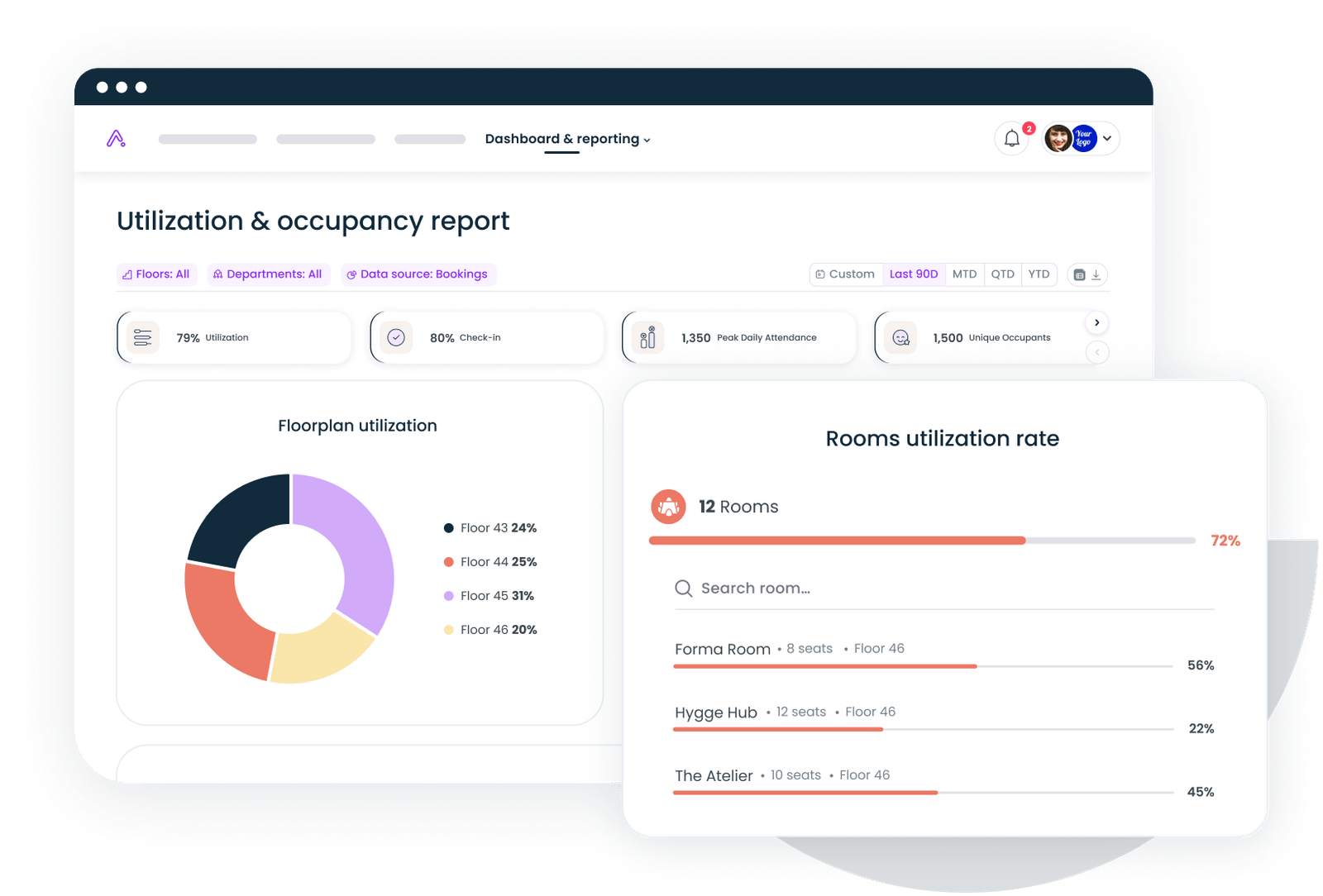
Common pitfalls that erode analytics ROI
Buying the platform is the easy part. Getting value from it is where most organizations stumble.
Low adoption is the number one ROI killer. If employees don't book desks through the system, your occupancy data is incomplete. If managers don't use the dashboards, decisions still get made on gut feel. Adoption isn't a technology problem; it's a change management problem. Treat it accordingly.
Misaligned metrics waste everyone's time. Tracking occupancy without connecting it to cost data tells you how full the office is but not whether that matters financially. Tracking satisfaction without connecting it to retention tells you people are happy but not whether that happiness is worth the investment. Every metric needs a "so what" attached to it.
Short timeframe expectations lead to premature cancellation. Some organizations expect ROI in 90 days. That's unrealistic for anything beyond the simplest quick wins. The real value of workplace analytics compounds over quarters, not weeks. If your executive sponsor doesn't understand the timeline, set expectations before you launch, not after the first quarterly review.
Privacy concerns, if mishandled, can tank the whole program. Employees who feel surveilled won't engage with the tools. Be transparent about what you're tracking and why. Aggregate data, not individual movements. Privacy-first design isn't just ethical; it's practical, because a platform nobody trusts is a platform nobody uses.
Getting started: A practical roadmap for first-year ROI
If you're building the business case for workplace analytics, or trying to extract more value from a platform you've already bought, here's a phased approach that works.
Phase 1: Baseline (Weeks 1-6). Audit your current state. What's your average occupancy rate? What's your cost per desk? How many meeting rooms have no-show rates above 25%? What does your energy bill look like on low-attendance days versus high-attendance days? You probably have some of this data already, scattered across badge systems, utility bills, and booking tools. Consolidate it.
Phase 2: Quick wins (Months 2-6). Target the interventions with the fastest payback. Meeting room auto-release policies. Cleaning schedule optimization based on floor-level occupancy. Team coordination features that reduce wasted commutes. These won't transform your portfolio, but they'll generate enough savings to justify the next phase and build internal credibility.
Phase 3: Strategic decisions (Months 6-18). This is where analytics earns its keep. Lease renegotiations backed by 6+ months of utilization data. Portfolio consolidation or expansion decisions. Flex space budget allocation based on actual usage patterns rather than headcount formulas. Building a business case for the CFO becomes dramatically easier when you have two quarters of clean data behind you.
Phase 4: Continuous optimization (Ongoing). Analytics isn't a project; it's a capability. The organizations that get the most ROI are the ones that treat workplace data the way finance treats financial data: as a living input to every major decision, reviewed regularly, and acted on consistently.
The real payoff isn't a number on a spreadsheet
Workplace analytics ROI is real, measurable, and often larger than organizations expect. But the most valuable outcome isn't a specific dollar figure. It's the shift from reactive to proactive decision-making.
When you have reliable data, you stop guessing about whether to renew a lease. You stop arguing about whether the office is "full enough" to justify its cost. You stop making space decisions based on the loudest voice in the room. Instead, you make decisions based on evidence, and you can defend those decisions when someone challenges them.
That's the ROI that doesn't fit neatly into a formula but changes how your organization operates. The companies that figure this out in 2026 won't just save money on real estate. They'll build workplaces that are genuinely better for the people who use them, and they'll have the data to prove it.
Gable brings together office, flex space, event, and team data so you can stop guessing and start optimizing. See it in action.
Get a demo