.svg)


.svg)
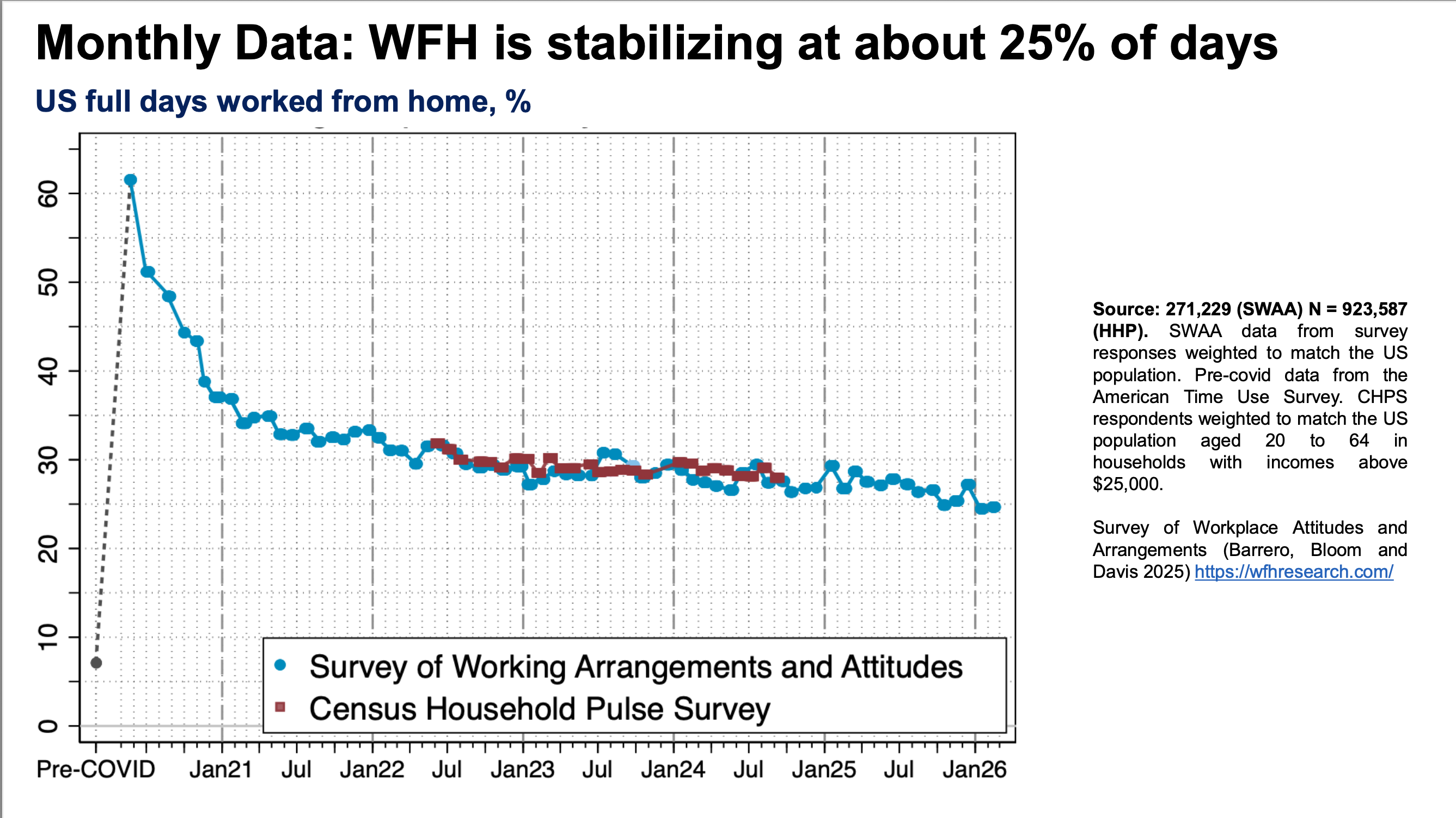
- Work from home has stabilized at 25% of paid days, roughly 3x pre-COVID levels
- Monthly in-person events boost productivity by 7.8% and cut quits by a third
- 75% of CEOs and CFOs now use AI, but its net impact on office demand is unclear
- The smartest workplace strategy right now: plan for the steady state, invest in gatherings, build in flexibility
On March 31, 2026, we hosted 30 workplace leaders for an exclusive lunch in San Francisco with Stanford economist Nick Bloom, the leading researcher on remote and hybrid work. His keynote, “Where Are We on the Office?”, covered three years of post-pandemic data on where work from home has landed, what the evidence says about bringing people together, and how AI is changing the calculus on office space. Here’s what he shared.
Work from home has stabilized, and it’s staying put
The debate about whether remote work is growing or shrinking misses the point. It’s doing neither. Bloom’s data from the Survey of Workplace Attitudes and Arrangements (SWAA), covering over 900,000 respondents, shows that work from home has settled at roughly 25% of full paid days in the US. That’s about 3x pre-COVID levels, but the trend line has been flat since mid-2023.
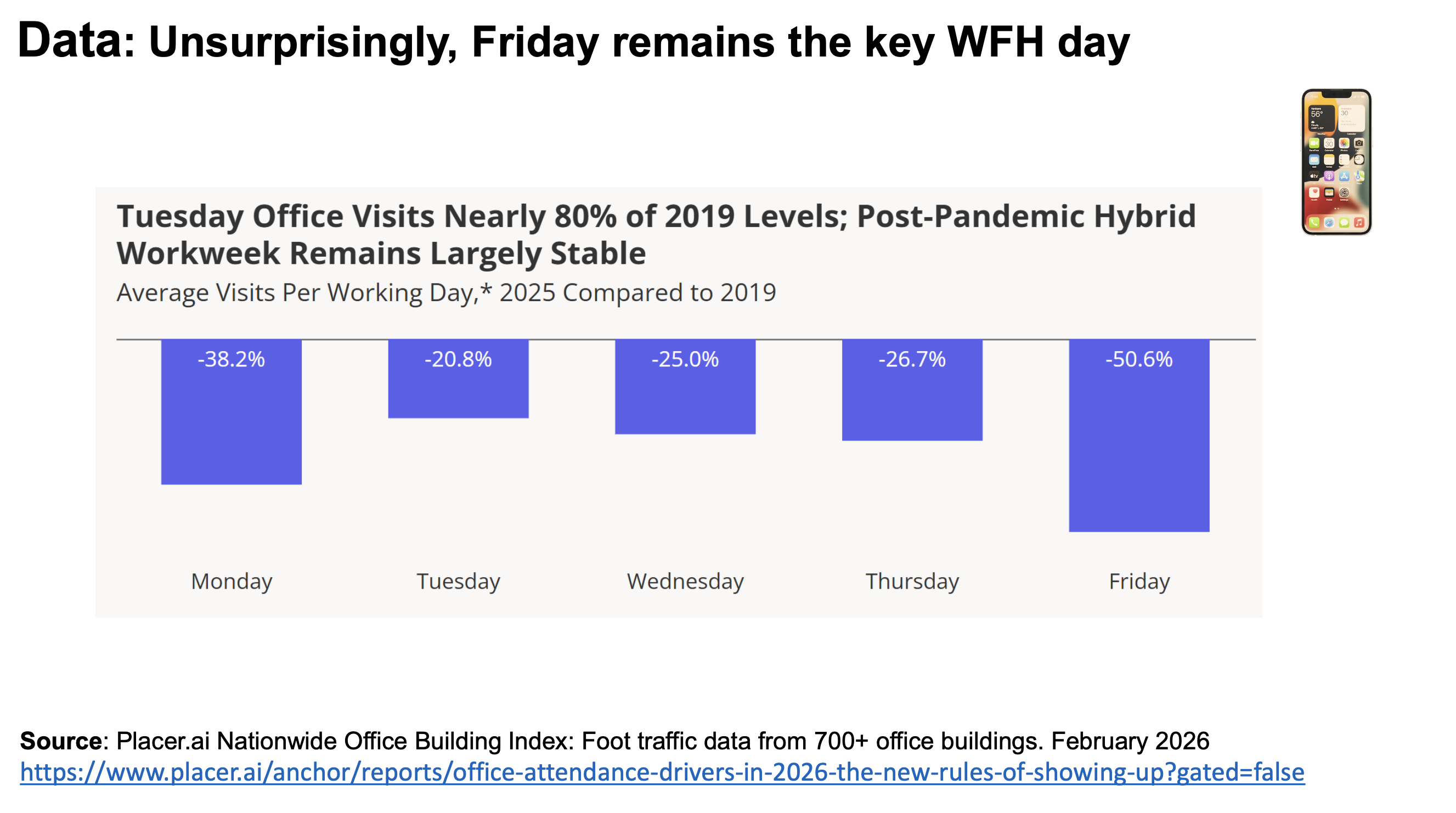
Office swipe data tells the same story from a different angle. Kastle’s Back to Work Barometer, tracking 2,600+ buildings, shows office occupancy sitting about 35% below February 2020 levels. After rising steadily through 2022, the recovery has plateaued. Placer.ai’s foot traffic data from 700+ office buildings confirms it: visits per working day are down roughly 30% from Q1 2019, and the line is flat.
Friday remains the dominant work-from-home day by a wide margin. If you’re planning in-office programming or team collaboration time, the data says don’t bother scheduling it for a Friday.
The practical implication is straightforward: this is the new baseline. If you’re still treating your hybrid work policy as a temporary arrangement or waiting for attendance to “bounce back,” the data says it won’t. Planning around 60-70% peak occupancy on your busiest days is a more useful starting point than hoping for 100%.
Your hybrid benchmarks depend on who you are
National averages are useful for headlines, but they’re misleading for individual companies. Bloom’s data shows significant variation by industry and firm age.
Tech and finance have the highest work-from-home rates. Industries with more in-person requirements, like healthcare and manufacturing, cluster at the low end. This isn’t surprising, but the spread is wider than most leaders assume.
More interesting: younger firms allow significantly more remote work than older ones. Bloom’s analysis of 76,000+ SWAA respondents shows a clear gradient, with companies founded more recently offering substantially more flexibility. If you’re a 15-year-old company benchmarking against a startup, or vice versa, you’re comparing apples to something that isn’t an apple.
FlexIndex’s May 2025 report adds another layer: most large companies have their white-collar workers on some form of hybrid arrangement. The full-time, five-day return to office mandate gets the headlines, but it remains the minority approach among major employers.

Bloom’s data is the latest, but it builds on a broader picture. See 28 data points driving workplace decisions this year.
See the stats
In-person gatherings deliver measurable ROI
This was the most actionable section of Bloom’s keynote, and the one that generated the most conversation during lunch.
Bloom presented results from a controlled experiment with remote-first employees. The setup: one group received monthly in-person events, and a control group didn’t. The results were unambiguous.
Monthly in-person gatherings raised productivity by 7.8% and reduced employee turnover by a third. The mechanisms were specific: better manager feedback, stronger company culture, and improved team communication. The firm running the experiment estimated a 6:1 ratio of benefits to cost.
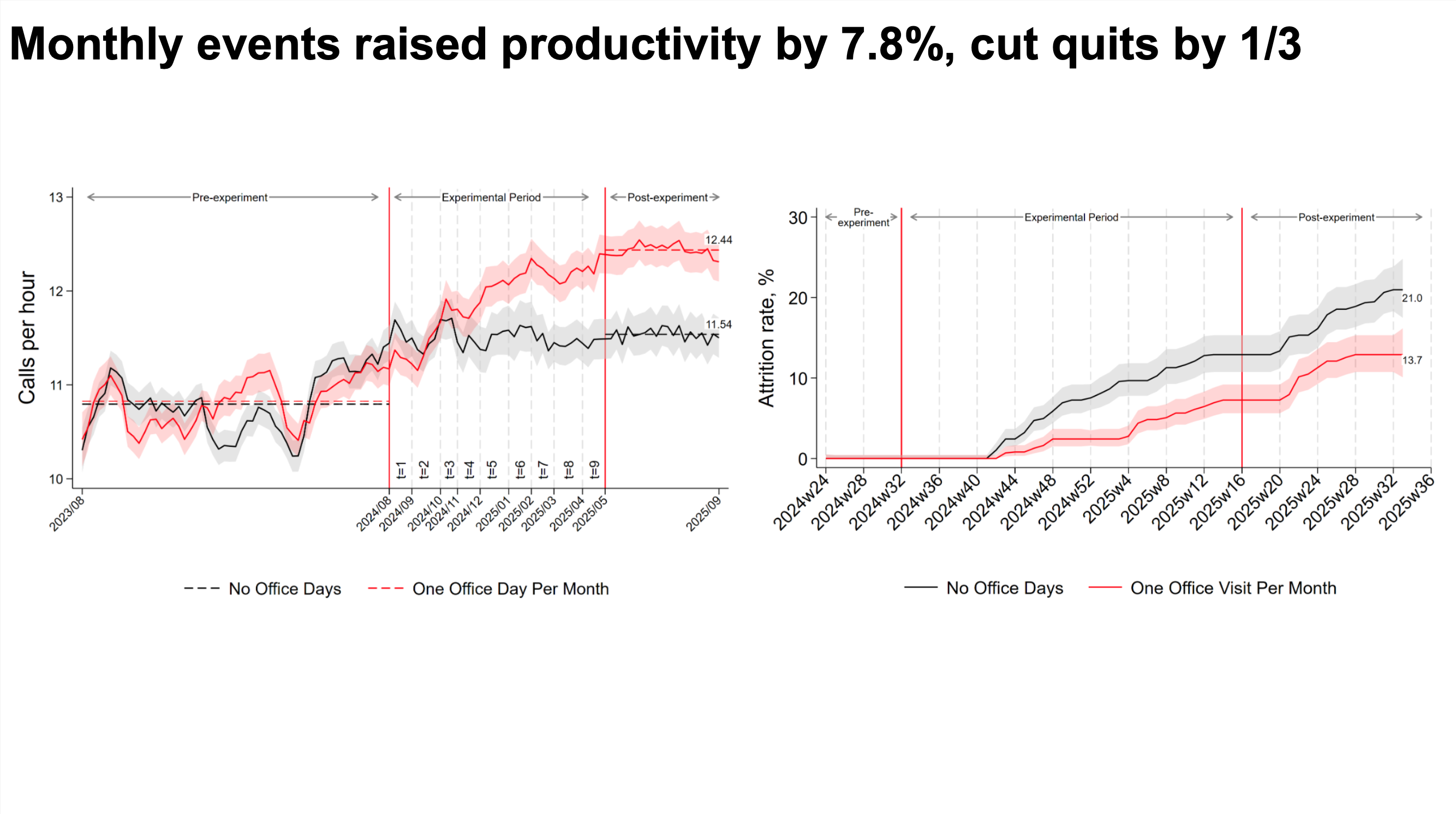
A few things stand out about this data. First, it’s experimental evidence, not a correlation study. The causal link between in-person events and productivity gains is direct. Second, the ROI math is compelling for any finance team that asks “why are we spending money flying people in?” A 6:1 return answers that question.
For workplace leaders managing distributed or hybrid teams, this is a strong case for structured, recurring gatherings. The key word is recurring: monthly events, not an annual offsite. And the data suggests the value comes from the interaction itself (feedback, culture, communication), not from the location or the venue. This aligns with what we see at Gable, where 72% of bookings are for team gatherings, not individual focus work.
AI is the biggest unknown for office demand
Bloom’s third section shifted from what we know to what we don’t. AI adoption is rising faster than most comparable technologies: roughly 30% of the US general population now uses generative AI, according to SWAA data analyzed in Bloom and Makridis (2026).
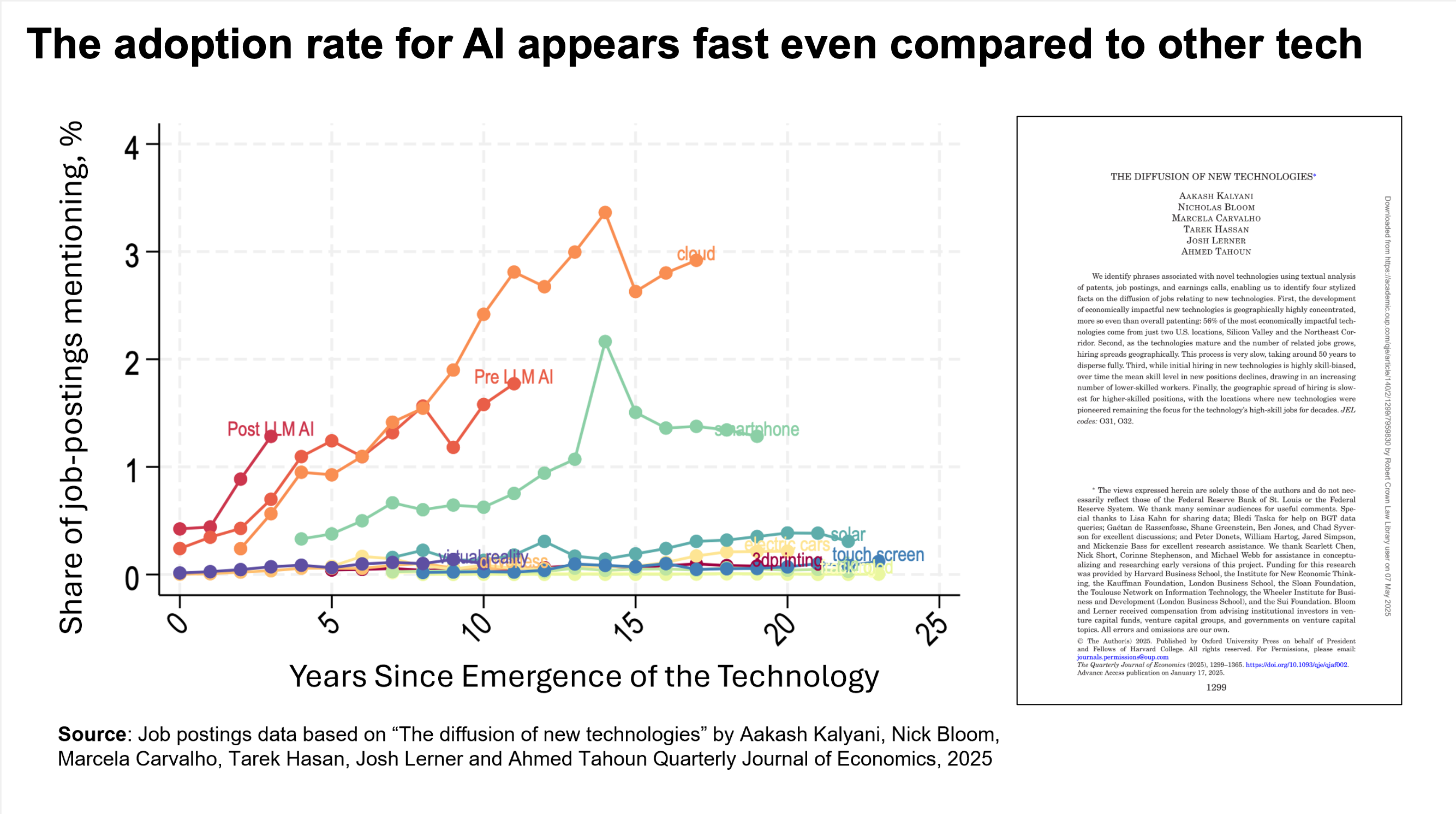
At the leadership level, adoption is even higher. A survey of 6,000 CFOs and CEOs across the US, UK, Germany, and Australia found that 75% are personally using AI, averaging about 1.5 hours per week.
Here’s the tension: firms report minimal productivity impact from AI so far, but they expect significant gains over the next three years. That gap between current reality and expected impact creates real uncertainty for space planning.
Bloom framed it as three linked questions:
- Hiring: AI is having a mild negative impact on headcount plans. Fewer new hires could mean less office demand.
- In-person presence: But does AI-driven work require more or less face-to-face collaboration? That’s unresolved.
- Uncertainty itself: When you don’t know how AI will reshape your team size and work patterns over the next three years, the rational response is to avoid locking into rigid space commitments.
His conclusion: value flexibility. Shorter leases, more flex space, less long-term commitment, more adaptability in how you use the space you have.
When the future of office demand is uncertain, locking into long-term commitments is risky. Gable gives you access to 20,000+ flex spaces globally, with no upfront commitments.
Learn more
Planning for the steady state
Bloom’s data paints a clear picture for workplace leaders heading into the second half of 2026.
Hybrid work has reached a stable equilibrium. The companies still arguing about whether to mandate five days aren’t fighting a trend; they’re fighting a settled outcome. The more productive question is how to make hybrid work well, and the data offers specific answers: design your in-office days around collaboration (skip Fridays), invest in recurring in-person gatherings (the ROI is real), and track your actual occupancy to right-size your space.
AI adds a layer of genuine uncertainty to real estate planning. The rational response, as Bloom argued, is building in flexibility rather than betting on a single forecast. That means shorter lease terms, flex space as a core part of your portfolio (not an afterthought), and real-time utilization data so you can adjust as conditions change.
What struck us most about this conversation wasn’t any single data point. It was the room’s reaction. Thirty workplace leaders, nodding at the same charts, asking the same questions about how to operationalize the data. The challenge in 2026 isn’t access to workplace research. It’s turning that research into decisions about space, budgets, and how you bring your teams together.
From desk booking and utilization data to on-demand flex spaces, Gable gives workplace leaders the tools to act on the data.
Get a demo