.svg)


.svg)
- 74% of coworking members report higher productivity, and 89% report greater happiness at work
- Enterprise adoption is accelerating: 70% of 2024 coworking agreements involved companies with 1,000+ employees
- A 10-person team in NYC can save $62,900 per year by switching from a traditional lease to dedicated desks in flex space
- Meeting room bookings surged 22% in the Americas, making on-demand overflow capacity a strategic priority
- The global flexible office market is projected to reach $194.75 billion by 2034, signaling that flex space is now a core real estate strategy
The benefits of coworking have shifted dramatically over the past two years. What started as a freelancer-friendly alternative to coffee shops has become a strategic real estate lever for companies with thousands of employees. According to Cushman & Wakefield's 2025 report, 55% of global occupiers now use flexible office solutions, with 17% planning to increase their usage further.
For workplace leaders managing distributed teams, the calculus is straightforward: traditional leases lock you into fixed costs for space that sits empty three days a week. Coworking spaces let you pay for what your people actually use. For individual contributors, these spaces offer something equally valuable: a professional environment that reduces isolation, boosts focus, and provides the flexibility that hybrid work models demand.
Whether you're a workplace strategist building a portfolio or an employee looking for a better place to do deep work, this guide breaks down every meaningful benefit of coworking, backed by current data.
What makes coworking spaces different from traditional offices
Coworking spaces are shared professional environments where employees from different companies work alongside each other. Unlike traditional offices with fixed layouts and multi-year leases, these spaces are designed around flexibility and variety.
The physical difference
Modern coworking spaces include a mix of workspace types within a single location:
- Open desks and hot desking areas for collaborative energy and casual interaction
- Dedicated desks for employees who want a consistent spot without a long-term commitment
- Private offices for teams that need enclosed space
- Meeting rooms and huddle rooms for scheduled collaboration
- Phone booths and focus rooms for heads-down work and private calls
This variety means employees can match their environment to their task, something most traditional offices struggle to offer.
The business model difference
The financial structure is where coworking diverges most sharply from conventional leases. Instead of committing to a 5- or 10-year lease with upfront capital expenditure for buildout, furniture, and technology, companies access coworking through memberships or pay-per-use models. This shifts workspace from a fixed cost to a variable one, giving finance teams the flexibility to scale spending with actual headcount and usage.
For enterprises, this model supports what's known as a "Core Plus Flex" strategy: maintain a headquarters or primary office for baseline needs, then layer on flexible space for overflow, satellite teams, and geographic expansion. Companies adopting hub-and-spoke models are finding this approach particularly effective for balancing cost control with employee access.
Enhanced productivity and focus
The productivity benefits of coworking aren't anecdotal. 74% of coworking members report being more productive, with 69% saying they've acquired new skills and 68% reporting they've upgraded existing skills since joining a coworking space.
Why coworking drives focus
Coworking fosters accountability through what researchers call "body doubling," where working alongside other focused professionals naturally encourages concentration and task completion. Unlike home offices, where household distractions compete for attention, or open-plan corporate offices, where interruptions are constant, coworking spaces offer a middle ground: social energy without the noise.
The team leader perspective
For managers of distributed teams, the productivity case extends beyond individual output. When team members have access to professional workspaces near their homes, they're more likely to maintain consistent work routines. They also gain access to meeting rooms and collaboration spaces for the days when in-person work matters most, without requiring everyone to commute to a central headquarters.
This is especially relevant for companies tracking workplace analytics ROI: flex space usage data can reveal which teams collaborate most effectively in person and which work patterns drive the best outcomes.

Nick Bloom shared data-backed insights on hybrid work with 30 workplace leaders. His findings reinforce why flexible space access is becoming a baseline expectation for distributed teams.
Read the key takeaways
Networking opportunities and community building
82% of coworking members have expanded their professional network since joining a shared workspace, with 64% reporting they've gained new projects from connections made in these environments. For individual professionals, this turns a daily workspace into a source of business development and career growth.
Combating isolation at scale
The community aspect addresses one of hybrid work's most persistent challenges. 83% of individuals working from coworking spaces report feeling less isolated and lonely, and 70% say they feel healthier overall. These aren't soft metrics. Isolation directly correlates with disengagement, and disengaged employees cost organizations in turnover, absenteeism, and reduced output.
For workplace leaders, providing coworking access is a concrete way to support employee wellbeing without mandating a return to a central office. It gives people the social infrastructure of an office environment with the autonomy to choose when and where they use it. Companies focused on talent attraction are increasingly listing flex space access as a core benefit in job postings.
Cost savings and financial flexibility
The financial advantages of coworking go well beyond avoiding a security deposit. A company can save as much as 30% on operational costs by shifting from a traditional lease to flexible space. In high-cost markets, the savings are even more dramatic: businesses in expensive urban areas, particularly in California, can save up to 70% in office lease costs by replacing them with coworking.
What's included in the membership
Traditional offices carry significant overhead: utilities, maintenance, cleaning services, internet infrastructure, furniture, equipment, and reception staff. Coworking memberships bundle all of these into a single, predictable monthly cost. National median pricing in 2025 held steady at $120 per month for virtual offices and $300 per month for dedicated desks, though rates vary significantly by market. Wichita, Kansas, offers the most affordable median at $99 per month, while premium markets like San Francisco and New York command substantially more.
Pricing models for enterprise teams
Enterprise coworking pricing typically falls into three categories:
- Pay-per-use: Teams book individual desks or rooms as needed, paying only for actual usage. Ideal for companies testing flex space or with unpredictable demand.
- Monthly memberships: A set number of seats or credits per month, often with volume discounts. Works well for teams with consistent but not daily space needs.
- Dedicated capacity: Reserved desks or private offices within a coworking facility, combining the consistency of a lease with the amenities and flexibility of shared space.
For finance teams evaluating these options, the key metric is cost per desk compared to your current lease. When you factor in the days your office sits partially empty, the per-occupied-seat cost of a traditional lease often exceeds what you'd pay for on-demand flex space.
Enterprise ROI: why large companies are adopting flex spaces
Coworking is no longer a startup phenomenon. In 2024, 70% of coworking agreements involved companies with more than 1,000 employees. And 42% of corporate occupiers plan to significantly increase their use of flex space in the next three years, according to JLL's corporate real estate analysis.
The math for enterprise teams
Consider a concrete example: a team of 10 in New York City could save up to $62,900 annually by switching from a traditional office lease to a dedicated-desk coworking setup. That calculation accounts for rent, utilities, maintenance, and amenities that are bundled into the coworking membership.
Scale that across multiple markets, and the savings become material to your real estate budget. Companies with employees in 10 or 15 cities can avoid signing leases in each location, instead providing on-demand access to professional workspaces through a single platform. Gable On-Demand, for example, gives teams access to 20,000+ premium workspaces in 900+ cities, with centralized budget controls and spend tracking by department, location, and individual.
The hub-and-spoke advantage
Many enterprises are adopting a hub-and-spoke model where the hub is a headquarters or primary office, and the spokes are coworking locations closer to employees' homes. This approach reduces commute times, supports geographic flexibility, and keeps fixed costs low. For companies navigating office consolidation, flex space fills the gap between closing a satellite office and leaving employees without a workspace.
Scaling without capital exposure
Large enterprises are treating flexible space as a strategic real estate lever that supports fast geographic moves and workforce scaling with limited capital exposure. According to Mordor Intelligence, the North America flexible office market is estimated at $14.90 billion in 2025 and expected to reach $28.94 billion by 2030. That growth is driven primarily by enterprise demand for asset-light expansion.
Access the largest premium network of flex workspaces globally. Track usage, control budgets, and give every employee a professional place to work, no matter where they're located.
Learn more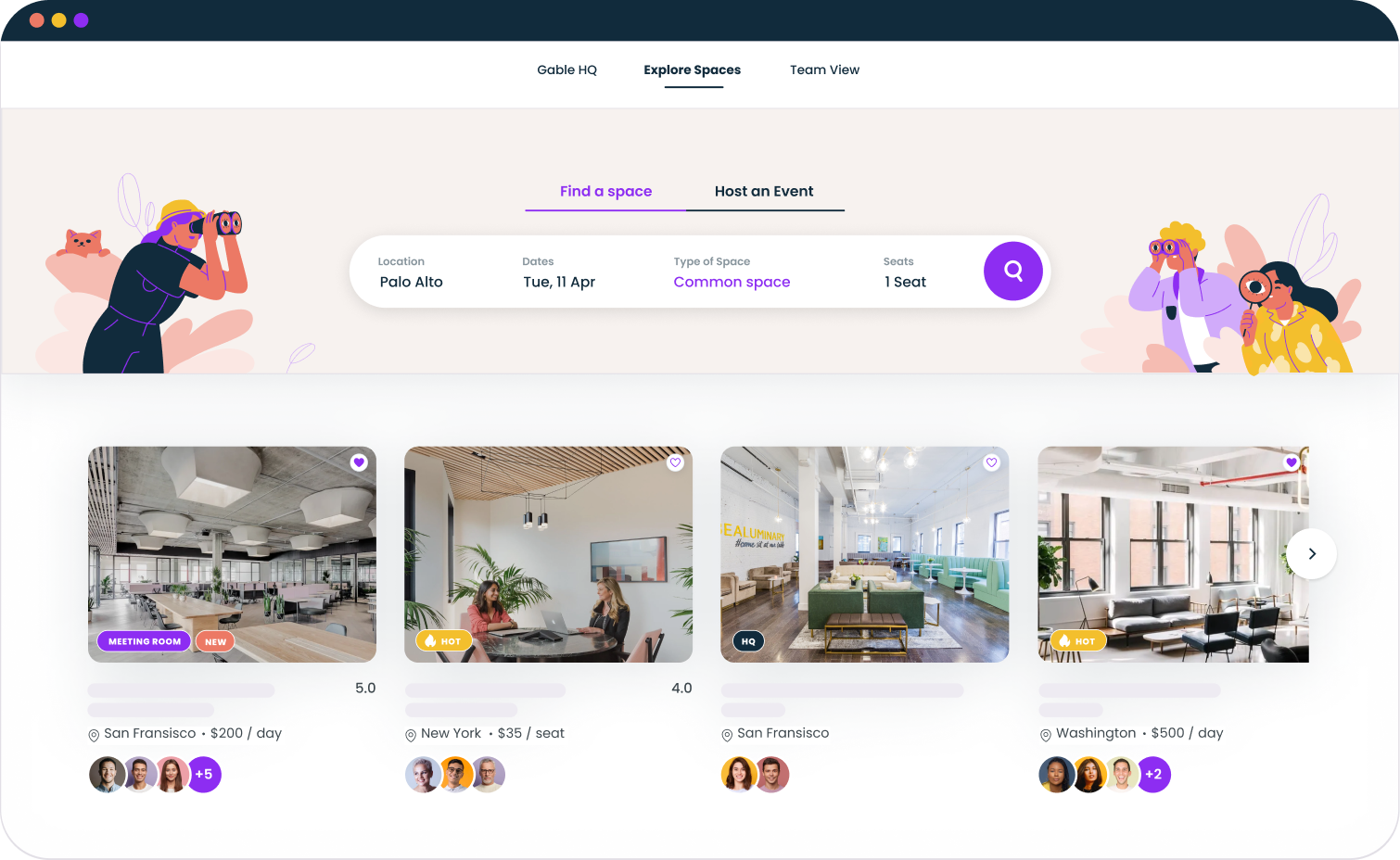
Meeting room capacity: Solving the collaboration bottleneck
One of the most overlooked benefits of coworking is solving the meeting room shortage that plagues hybrid offices. As teams concentrate their in-person days on Tuesdays through Thursdays, demand for meeting rooms spikes dramatically on those peak days while rooms sit empty the rest of the week.
The meeting room crisis in numbers
Meeting room bookings have surged worldwide: up 24.5% in APAC, 22.0% in the Americas, and 17.4% in EMEA. But booking doesn't equal using. Employees treat reservations as insurance policies, booking space "just in case" and failing to cancel when plans change. The booking-to-occupancy ratio has dropped to 0.71, meaning 29% of booked rooms sit empty.
Coworking as overflow capacity
Rather than building out more meeting rooms that will only be used three days a week, companies can use nearby coworking spaces as overflow capacity. When your office conference rooms are fully booked on a Tuesday, teams can reserve meeting space at a flex location within walking distance or a short commute.
This approach pairs well with AI room scheduling tools that can identify booking patterns and recommend when teams should shift to external spaces. The result: better utilization of your owned space and no wasted capital on rooms that peak at 60% occupancy.
Flexibility and work-life balance improvements
For individual employees navigating hybrid schedules, coworking spaces provide a crucial balance between structure and autonomy. The variety of workspace options lets people tailor their environment to their work mode, whether that's a quiet desk for focused writing, a meeting room for a client presentation, or a communal table for casual collaboration.
Geographic flexibility for distributed teams
Many coworking spaces are part of global networks, allowing employees to work from different cities without losing access to professional amenities. This geographic flexibility supports business travel, temporary relocations, and the growing expectation that workplace flexibility is a standard benefit rather than a perk.
For workplace leaders, this flexibility translates directly into talent strategy. When you're not limited to hiring people within commuting distance of a single office, your talent pool expands dramatically. And when existing employees can relocate without losing access to professional workspace, retention improves. Companies that treat flex space as part of their employee experience strategy consistently report stronger engagement scores.
The enterprise angle
For teams managing distributed workforces, the flexibility benefit is operational as well as cultural. Flex space eliminates the need to negotiate short-term subleases when entering a new market, onboarding a new team in a different city, or accommodating a temporary project team. It turns real estate decisions from 12-month commitments into week-by-week choices.
Access to professional amenities and resources
Modern coworking spaces function as comprehensive work environments. They're fully furnished and equipped with high-speed internet, printing and scanning, mail handling, and a range of workspace types. Many include amenities like coffee bars, breakout areas, and wellness spaces.
What matters for enterprise teams
While coffee and comfortable furniture are nice, enterprise buyers care about a different set of amenities:
- Reliable, enterprise-grade WiFi with consistent speeds across locations
- Meeting rooms with video conferencing technology for hybrid meetings
- Reception and mail handling services that replace the need for dedicated admin staff
- Security and access controls that meet corporate compliance requirements
- Consistent quality across locations so an employee in Austin has the same experience as one in Boston
For companies managing multiple office locations, this consistency is critical. On-demand spaces provide standardized work experiences regardless of geography, which matters for both employee satisfaction and operational predictability.
Enterprise use cases: From tech scaleups to established corporations
The benefits of coworking play out differently depending on company size, industry, and growth stage. Here are the patterns driving enterprise adoption.
Tech companies entering new markets
Flexible office space is primarily used to add agility into the real estate portfolio and minimize capital expenditure. Tech companies find the most value in using flex space to accommodate remote workers, test new markets before committing to a lease, and absorb rapid headcount growth. Rather than signing a 5-year lease in a city where you have 8 employees, you provide those employees with coworking access and revisit the lease decision when headcount justifies it.
Suburban expansion for hybrid teams
The suburban flex market is growing fast. New Jersey experienced a 36% year-over-year increase in coworking supply from 2024, reflecting demand from employees who don't want to commute to Manhattan but still need professional workspace. Companies adopting hybrid work schedules are finding that suburban coworking locations reduce commute friction and increase the number of days employees choose to work outside their homes.
Project-based team scaling
IT, financial services, and consulting firms lead coworking adoption due to frequent scaling needs and project-based teams. When a consulting firm wins a 6-month engagement in a new city, coworking provides immediate workspace without the overhead of a temporary lease. When the project ends, so does the space commitment.
Supporting different work styles and team dynamics
Effective work happens in many different ways, and the most successful coworking spaces are designed around that reality.
Some professionals thrive in bustling, energetic environments where they can feed off the productivity of others. Others need quiet, private spaces for deep focus. Flex spaces accommodate both preferences within the same physical location, often on the same floor. This variety addresses a critical limitation of traditional offices, where a single layout forces everyone into the same environment regardless of their task.
For distributed teams that only occasionally work together in person, coworking spaces provide on-demand access to collaborative spaces without the overhead of maintaining an office year-round. Teams can book conference rooms, team workstations, or entire private areas for specific projects, offsites, or collaboration sprints. If you're planning these kinds of gatherings, a corporate event planning checklist can help you coordinate logistics across flex locations.
Enhanced creativity and cross-pollination
Unlike offices with static layouts and homogeneous teams, coworking spaces intentionally create environments that expose professionals to different industries, perspectives, and problem-solving approaches. Working alongside people from different fields, whether that's a design agency, a fintech startup, or a healthcare company, naturally sparks new thinking.
This cross-pollination effect happens organically in well-designed spaces. Open collaboration areas encourage brainstorming and idea sharing, while quiet corners provide space for reflection. Natural light, plants, and thoughtful design create environments that feel more inspiring than standard corporate interiors, a principle that collaboration space design research consistently supports.
Building company culture across distributed teams
Face-to-face interactions are the foundation of workplace culture. For remote-first and hybrid companies, coworking spaces recreate the casual bonding that happens naturally in office environments: grabbing coffee together, chatting between meetings, sharing meals in communal areas.
The shared experience of working in a professional space, even if it's not your company's own office, strengthens team bonds. When distributed team members meet at a coworking space for a collaboration day, they get the benefits of in-person connection without the rigidity of a mandatory return-to-office policy. Companies focused on maintaining culture in distributed teams are finding that regular coworking days strike the right balance between structure and autonomy.
Global accessibility and market reach
One of the most compelling benefits of coworking for enterprise teams is global reach. Instead of establishing offices in new markets, companies can provide employees with immediate access to workspaces in hundreds of cities worldwide.
This global accessibility supports several strategic priorities:
- Business travel: Instead of working from hotel lobbies, professionals access vetted workspaces with stable connectivity and meeting rooms
- Temporary relocations: Employees can work from a different city for weeks or months without disruption
- Market testing: Companies can establish a presence in a new geography without committing to a lease
- Talent acquisition: Hiring isn't limited to cities where you have an office
The North America flexible office market alone is expected to nearly double by 2030, driven largely by enterprise demand for this kind of geographic flexibility.
Managing flexible space at scale
For enterprises, the benefits of coworking are clear. The operational challenge is managing access, spend, and utilization across dozens of locations and hundreds of employees. Fragmented memberships with multiple coworking providers create administrative overhead, inconsistent experiences, and zero visibility into how space is actually being used.
This is where centralized platforms matter. A single system for booking, budget controls, and analytics turns flex space from an unmanaged perk into a data-driven real estate strategy. Key capabilities to look for include:
- Spend tracking by department, location, and individual so finance teams can monitor budgets in real time
- Approval workflows that route booking requests through the right channels
- Integration with existing tools (Slack, Teams, Outlook, HRIS) so employees don't need to learn a new system
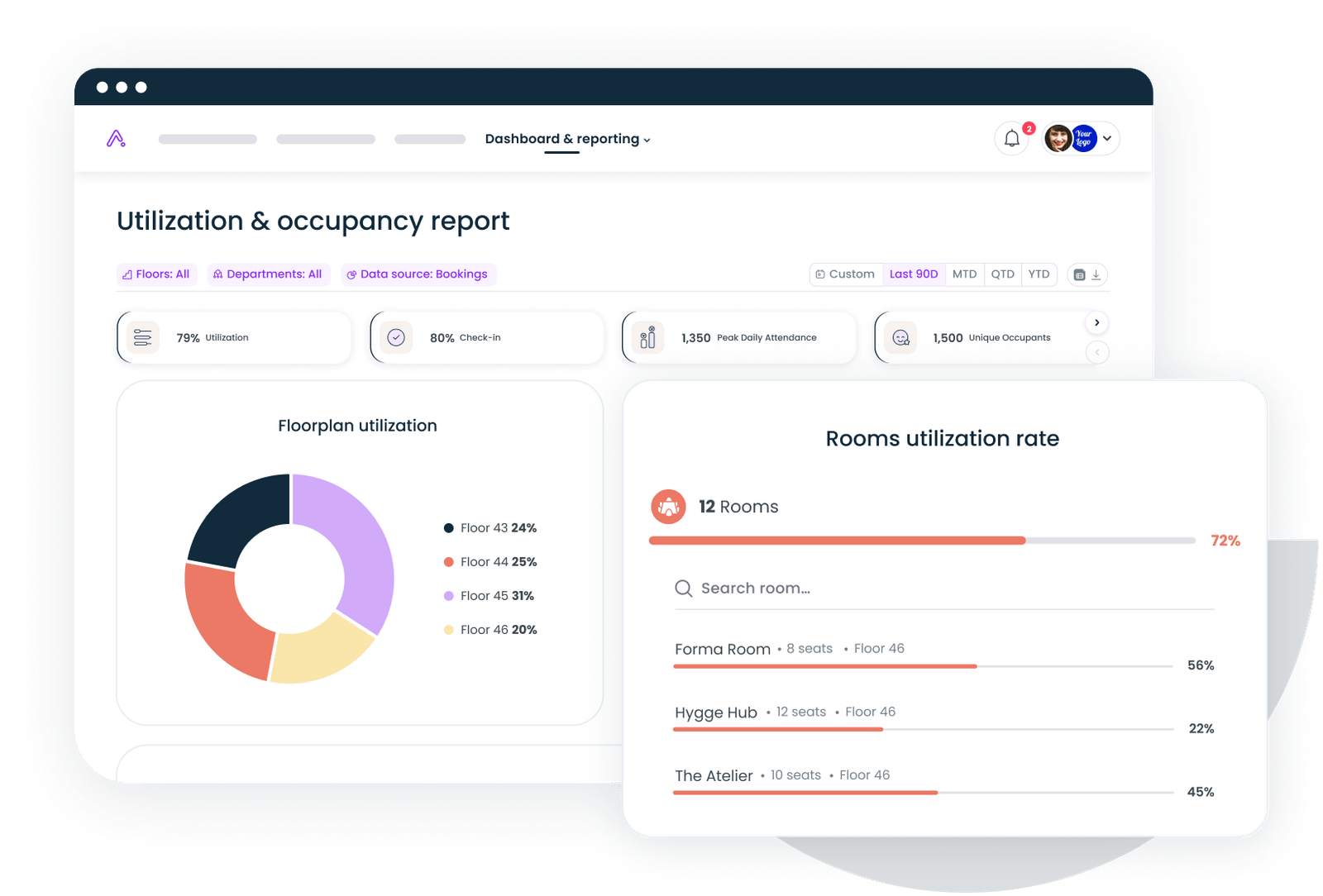
- Utilization analytics that show which locations are used most, which teams collaborate in person, and where you might need more (or less) capacity
For companies building a corporate real estate strategy that blends owned and flex space, this visibility is essential for making informed portfolio decisions.
The bottom line for workplace leaders
The benefits of coworking in 2026 extend far beyond a nice place to sit with your laptop. For individual employees, flex spaces offer productivity, community, and autonomy. For enterprise teams, they provide a financial and operational framework for managing distributed work at scale.
The data tells a consistent story: coworking members are more productive, less isolated, and more satisfied. Companies that integrate flex space into their real estate portfolios save money, attract talent, and gain the agility to scale up or down without the constraints of long-term leases.
The question for most organizations isn't whether flex space belongs in their strategy. It's how to implement it with the right controls, visibility, and employee experience.
Connect your people, spaces, and data with one platform. Get real-time insights on utilization, control budgets by team and location, and give every employee access to professional workspace.
Get a demo