


.svg)


.svg)
- The space planning software market is worth $1.2 billion in 2026 and growing at 7.63% annually, driven by hybrid work and rising real estate costs.
- 89% of workplace leaders now rank office space utilization as the most valuable metric for planning decisions.
- The right office space planning software should include desk booking, interactive floor plans, utilization analytics, and calendar integrations at a minimum.
- Pricing ranges from $3/seat/month for mid-market tools to $50,000+ annually for enterprise IWMS platforms.
- Gable customers have achieved a 32% reduction in unused space and up to 20% lower lease costs by switching to data-driven space planning.
Office space planning software helps organizations design, manage, and optimize how their physical workspaces are used. Instead of relying on static floor plans and gut instinct, these platforms give workplace leaders real-time data on desk utilization, room bookings, and occupancy patterns so they can make smarter decisions about their real estate portfolio. With McKinsey research projecting that demand for office space could be 20% lower by 2030 in major cities, the companies that invest in space planning technology now are the ones that will avoid paying for space nobody uses.
What is office space planning software?
Office space planning software is a category of workplace technology that helps organizations visualize, manage, and optimize their physical office environments. At its core, it replaces spreadsheets, manual headcounts, and static CAD floor plans with dynamic, data-driven tools that reflect how people actually use space.
A modern space planning platform typically includes interactive floor plans where employees can see real-time desk and room availability, a booking engine for reserving desks and meeting rooms, and an analytics dashboard that tracks utilization over time. Some platforms go further by adding visitor management, neighborhood-based seating configurations, and integrations with calendar tools like Google Calendar and Microsoft Outlook.
The shift toward this technology has been rapid. According to a 2025 industry workplace report, 77% of businesses are actively rethinking their approach to office space planning. That number makes sense when you consider the math: the average U.S. office pays roughly $35 per square foot in annual real estate costs. If 30-40% of your desks sit empty on any given day, you're effectively burning money on unused space.
What separates office space planning from simple desk booking is the strategic layer. Good space planning software doesn't just let someone reserve a desk; it tells you which desks are never reserved, which floors are overcrowded on Tuesdays, and whether your 20-person conference room is being used by two-person meetings 80% of the time. That insight is what allows workplace leaders to right-size their footprint, redesign layouts for collaboration, and make confident decisions about lease renewals.
For companies with 200 to 5,000 employees, especially those operating hybrid work models, this category of software has become essential. When only half your workforce is in the office on any given day, you need data, not guesswork, to figure out how much space you actually need.
Why office space planning matters more in 2026
The business case for space planning software has never been stronger, and the data backs it up.
Global office utilization has climbed to 53% in 2026, up from just 38% in 2024, according to CBRE's latest Global Workplace and Occupancy Insights report. That's progress, but it also means nearly half of office space is still sitting underused on any given day. More telling: 81% of corporate real estate teams now say increasing office utilization is their top priority, and 57% expect their portfolio to contract in the next three years.
Translation: companies are paying for space they don't need, they know it, and they're looking for tools to fix it.
The financial pressure is real. Between rising lease rates, energy costs, and maintenance overhead, every unused desk and empty conference room represents a direct hit to the bottom line. For a mid-sized company with 50,000 square feet of office space at $35 per square foot, even a 20% reduction in wasted space saves $350,000 annually. That's not a hypothetical number. Checkr, a Gable customer, reduced their lease costs by 20% after switching from fixed seating to a data-driven hybrid workspace model.
The utilization challenge is compounded by the uneven nature of hybrid attendance. Most companies see peak office days on Tuesday through Thursday, with Monday and Friday running at significantly lower occupancy. Without space planning software that tracks these patterns, workplace teams are flying blind when it comes to deciding how many desks to keep, which floors to consolidate, or whether to sublease unused areas.
And it's not just about cost. Workplace analytics from space planning tools also drive employee experience improvements. When you know that 72% of workspace bookings are for team gatherings (a stat from Gable's own platform data), you can design your office around collaboration zones rather than rows of assigned desks that sit empty three days a week.
The bottom line: office space planning software has shifted from a "nice to have" facilities tool to a strategic lever for real estate optimization, employee experience, and budget control.

Evaluating multiple tools? See how the top platforms compare on features, pricing, and hybrid work support.
Read the comparison
Key features to look for in space planning software
Not all space planning platforms are built the same. Some are glorified desk reservation tools; others offer full-stack workplace management with analytics, integrations, and scenario modeling. Here's a breakdown of the core features that matter, organized by priority.
Must-have features [table]
Nice-to-have features [table]
When evaluating platforms, pay special attention to how the analytics layer works. The difference between good and great space planning software is whether it simply reports what happened (descriptive analytics) or helps you predict what will happen and plan accordingly. Look for tools that can show you trends over time, not just yesterday's occupancy rate.
How much does office space planning software cost?
Pricing for space planning software varies widely depending on company size, feature depth, and whether you're buying a standalone booking tool or a full integrated workplace management system (IWMS). Here's how the market breaks down in 2026.
Market pricing tiers [table]
A few pricing considerations worth flagging:
Per-seat vs. per-user pricing. Some platforms charge per employee in your organization (per-seat), while others charge per active user (per-user). If you have 1,000 employees but only 400 use the office regularly, per-user pricing can save you 60%. Make sure you understand which model a vendor uses before comparing quotes.
Resource-based pricing. A handful of platforms price by the number of desks or rooms managed rather than by headcount. This model can be more cost-effective if you have a high employee-to-desk ratio, which is increasingly common in hot desking setups.
Hidden costs to watch for. Implementation fees, custom integration work, premium support tiers, and per-location charges can add 20-40% to the sticker price. Always ask for a total cost of ownership breakdown during the evaluation process.
Where Gable fits: Gable's office management module starts at $3/seat/month, which places it in the SMB tier from a pricing standpoint, but it includes mid-market features like interactive floor plans, utilization analytics, neighborhood configuration, and calendar integration. It also bundles access to 14,000+ on-demand coworking spaces globally, which is a capability that standalone space planning tools don't offer.
The space planning software market is valued at approximately $1.2 billion in 2026 and projected to reach $2.3 billion by 2035. That growth is being driven by companies realizing that the ROI on even a modestly priced platform far exceeds the cost of the software itself.
See how Gable helps workplace teams manage office space with real-time data, starting at $3/seat/month.
Learn more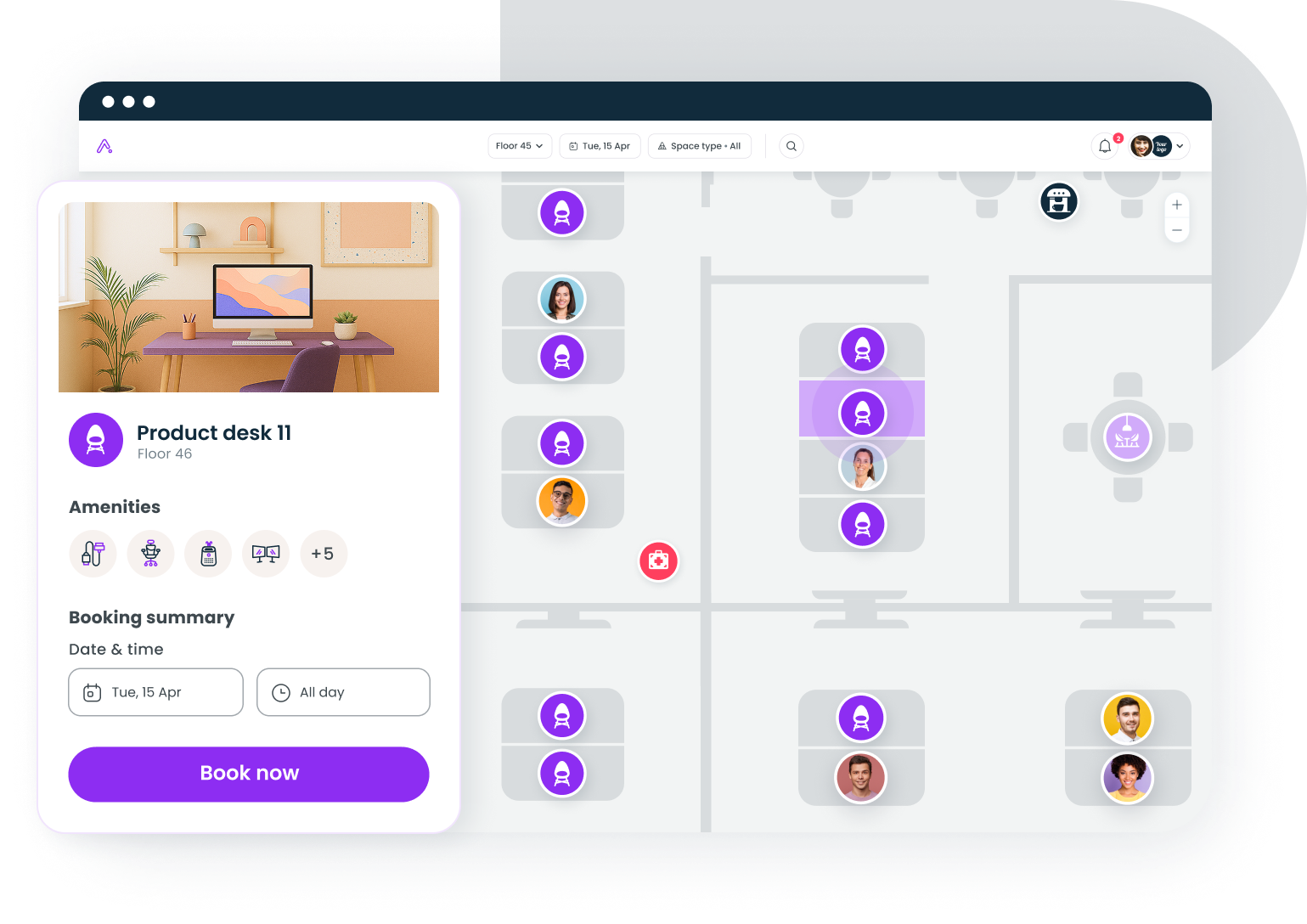
The office space planning software buyer's checklist
Choosing the right platform is less about finding the tool with the longest feature list and more about matching capabilities to your specific workplace challenges. Here's a step-by-step evaluation framework you can use to narrow your shortlist.
Step 1: Define your primary use case
Are you solving for desk booking in a hybrid office? Reducing your real estate footprint? Managing multiple locations? Improving the employee experience? The answer shapes which features are non-negotiable. A company focused on space optimization needs deep analytics; a company focused on employee flexibility might prioritize booking UX and mobile access.
Step 2: Audit your current space data
Before you can plan space better, you need to know how it's being used today. Pull whatever data you have: badge swipe records, Wi-Fi connection logs, manual headcounts, booking system exports. If you don't have any utilization data, that's actually a strong signal that you need a platform with built-in occupancy tracking. Reference our office space planning checklist for a detailed framework on this step.
Step 3: Set your budget and deployment timeline
Based on the pricing tiers above, estimate your annual cost. Factor in implementation time: lightweight SaaS tools can be live in days, while enterprise IWMS platforms can take 3-6 months to fully deploy. If you need quick wins, prioritize platforms that offer fast setup with room to scale.
Step 4: Evaluate integrations
Your space planning tool doesn't exist in isolation. It needs to talk to your calendar system (Google or Outlook), your HR platform (for employee data), your access control system (for badge-based check-in), and potentially your communication tools (Slack, Teams). Integration depth matters; API-only access is fine for engineering-heavy organizations, but most workplace teams need pre-built connectors.
Step 5: Test with a pilot
Never commit to an annual contract without running a pilot. Pick one floor or one office location, deploy the tool for 30-60 days, and measure: How quickly do employees adopt it? Does booking data match actual attendance? Can you generate the utilization reports your leadership team needs? Apartment List, for example, ran a pilot with Gable and saw a 63% increase in workspace bookings and 80% adoption within the first quarter.
Step 6: Measure ROI within the first quarter
Good space planning software should pay for itself within 6-12 months through reduced real estate costs, fewer no-shows, and better space allocation. Track specific metrics: cost per seat, utilization rate by floor, booking-to-attendance ratio, and employee satisfaction scores. If you can't connect the tool to a measurable financial outcome, it's not the right fit.
What makes office space planning software worth the investment?
The ROI conversation is where office space planning software separates itself from other workplace tools. Unlike employee engagement platforms or communication apps, the financial return on space planning is directly measurable in real estate savings.
Consider the math: the average mid-sized company (500-2,000 employees) spends between $5 million and $20 million annually on office space. If space planning software helps you identify and eliminate even 15% of wasted capacity, that's $750,000 to $3 million in annual savings. Compare that to an annual software cost of $18,000-$180,000, and the ROI case essentially writes itself.
But it's not just about cutting costs. The best implementations also improve the employee experience, which has downstream effects on retention and productivity. When employees can easily find and book a desk near their team, reserve a meeting room that's actually the right size, and know before they commute that the office won't be a ghost town, they're more likely to come in. And when they do come in, they have a better experience.
Gable's platform data shows that 72% of workspace bookings are for team gatherings rather than solo work. That insight alone has helped customers shift their office layouts from rows of individual desks to collaborative neighborhoods with shared spaces, reducing their total desk count while increasing the quality of in-office time.
Checkr's experience is a useful benchmark. By analyzing utilization data through Gable, they identified that their fixed-seating model was leaving 30-40% of desks unused daily. They transitioned to an on-demand booking model, reconfigured their floor plan around collaboration zones, and cut their lease costs by 20% while employees reported higher satisfaction with their in-office experience.
For workplace leaders making the case to their CFO, the pitch is straightforward: office space planning software turns your second-largest operating expense (after payroll) from a fixed cost into a variable one that you can optimize continuously. And in a market where CBRE reports that 57% of CRE teams expect portfolio contraction in the next three years, having the data to make those contractions strategic rather than reactive is the difference between cutting costs and cutting value.
Choosing the right office space planning software for your team
Selecting office space planning software isn't a one-size-fits-all decision, and the "best" tool depends entirely on your organization's size, work model, and strategic priorities. But a few principles hold true regardless of your situation.
First, prioritize platforms that combine booking functionality with analytics. Desk booking without utilization data is just a scheduling tool. You need both: the operational layer (employees can reserve space) and the strategic layer (leadership can see how space is actually used). Gable's office management module is a good example of this approach, combining interactive floor plans and meeting room booking with real-time analytics that surface actionable patterns.
Second, think beyond the office walls. If your company supports remote and hybrid employees, a platform that only manages your headquarters doesn't solve the full problem. Tools that integrate on-demand flexible workspace access (like coworking passes for remote employees) alongside internal office management give you a single view of where your people are working, wherever that is.
Third, don't underestimate the value of fast implementation. The longer a platform takes to deploy, the longer you're paying for underutilized space without the data to fix it. Gable customers typically go live within days, not months, which means they start collecting utilization data immediately and can make informed decisions within the first quarter.
The companies that get the most from their space planning investment are the ones that treat their office like a product: iterate on layouts based on usage data, test new configurations, measure the impact, and adjust. The software is the engine that makes that iterative cycle possible.
Get a personalized walkthrough of Gable's office management, on-demand spaces, and analytics features.
Get a demo


