.svg)


.svg)
Most workplace teams are sitting on a goldmine of wasted space, and they don't even know it. According to McKinsey research, office vacancy rates jumped from an average of 8% to 14% between 2019 and 2022, with some cities like San Francisco seeing vacancy rates climb by more than ten percentage points. That translates into billions of dollars in real estate costs spent on unused spaces.
Occupancy planning is how you fix that problem.
It's the practice of strategically managing how people use your physical spaces to reduce unnecessary costs, improve employee satisfaction, and make smarter decisions about your corporate real estate. In the last few years, as hybrid work has reshaped how and when employees come to the office, occupancy planning has become a top priority for workplace leaders trying to balance efficiency with experience.
This guide breaks down everything you need to know about occupancy planning, from the fundamentals to the data-driven approach that actually works.
What is occupancy planning?
Occupancy planning is the strategic process of analyzing, managing, and optimizing how space is used within your workplace. It involves understanding working patterns, measuring workplace occupancy, and making informed decisions about resource allocation to ensure every square foot delivers value.
At its core, an occupancy planner answers three questions:
- How is our space currently being used?
- How much space do we actually need?
- How can we optimize our work environment to support both business goals and employee needs?
Unlike traditional space planning, which focused on assigning one desk per employee, modern occupancy planning accounts for the reality that not everyone comes to the office on the same days. CBRE's 2024 Workplace Insights reportfound that 92% of surveyed companies now use a hybrid work model, with organizations expecting employees to work at the office two to four days per week. This shift means the old approach of counting heads and assigning seats no longer works.
Effective occupancy planning uses technology and data to track how employees actually use meeting rooms, desks, and collaborative spaces. It helps facility managers and workplace teams create environments that support productivity while avoiding the high costs of maintaining wasted space.
Why occupancy planning matters now more than ever
The stakes for getting occupancy right have never been higher. Here's what's driving the urgency:
Real estate costs are under scrutiny
Office space is expensive. When you're paying for square footage that sits empty, you're essentially throwing money away. CBRE found that 43% of organizations globally plan to decrease their portfolio size by more than 30% in the next three years. These companies aren't abandoning the office entirely. They're using occupancy data to rightsize their footprint and cut costs without sacrificing the workplace experience.
The financial impact is significant. Average space allocation per employee has dropped from 292 to 205 rentable square feet, making companies 27% more efficient. But those savings only materialize when you have accurate data about how space is being used.
Employee experience drives retention
The office isn't just a place to work anymore. It's a tool for collaboration, culture building, and employee engagement. When employees commute to an office that feels empty or lacks the available desks and room types they need, the experience suffers.
Gallup's 2024 State of the Global Workplace report found that only 23% of employees worldwide are engaged at work, and low engagement costs the global economy approximately $8.9 trillion. Creating a workplace that supports how people actually want to work, with enough room for collaboration on busy days and quiet focus spaces when needed, directly impacts engagement and retention.
Hybrid work creates new complexity
When 40% of companies use only half or less of their available space, something is clearly broken between policy and reality. The challenge isn't just having a hybrid policy. It's understanding the working patterns that emerge from that policy and designing your space to match.
Occupancy planning gives you the insights to answer questions like: Which days are busiest? Are your meeting rooms actually being used, or just booked? Do you have enough desks on certain days but too many on others? Without data, you're guessing. With it, you can optimize.

Learn how to use data to make smarter decisions about your office space, from tracking the right metrics to building dashboards that drive action.
Read the guide
Key metrics for measuring occupancy
You can't optimize what you don't measure. Here are the most important metrics for accurately tracking how your space performs:
Occupancy rate
The workplace occupancy rate is the total number of people present in a space compared to its maximum capacity. If you have 100 desks and 60 people come in on a given day, your occupancy rate is 60%. This is an essential metric for understanding overall utilization patterns and identifying whether you're over- or under-capacity.
According to CBRE research, office utilization rates in the Americas averaged just 31% in 2023, compared to the 64% pre-pandemic global average. Tracking your occupancy rate over time helps you spot trends and decide whether to consolidate, expand, or reconfigure your space.
Space utilization
While the occupancy rate tells you how many people showed up, space utilization measures how effectively different areas of your building are used. This includes desks, meeting rooms, huddle spaces, and collaborative areas.
For example, you might have high occupancy but low meeting room utilization if everyone is working at desks, but conference rooms sit empty. Or you might discover that certain neighborhoods or floors are consistently packed while others remain unused spaces.
Peak occupancy
Peak occupancy identifies when your space is busiest. For most organizations, this typically falls on Tuesdays, Wednesdays, and Thursdays. Understanding your peak helps you ensure you have enough room for everyone on your busiest days while potentially reducing expenses on days with lower attendance.
Desk sharing ratio
The employee-to-seat ratio has risen sharply since 2021. CBRE reports that 62% of organizations now have a target-sharing ratio of 1.5 or more per desk, with companies seeing a 93% increase in target-sharing ratios above 2:1 compared to the previous year. Tracking your actual vs. target ratio helps you right-size your real estate strategy.
How to build an effective occupancy planning strategy
Occupancy planning isn't a one-time project. It's an ongoing process of measuring, analyzing, and adjusting. Here's how to create a strategy that delivers real results:
Step 1: Gather baseline data
Start by understanding your current state. This means collecting data on how employees use your space today. You can gather this information through badge swipe data, booking systems, sensors, or manual observations.
Look at metrics like daily attendance, which spaces are booked vs. actually used, peak usage times, and how many desks remain consistently empty. The goal is to establish a clear picture before making any changes.
Step 2: Identify gaps and opportunities
With data in hand, analyze where you're wasting resources. Common findings include meeting rooms that are booked but frequently go unused, entire floors that sit empty on certain days, or desks that haven't been occupied in months.
Also look for pain points. Are employees struggling to find meeting rooms on busy days? Are certain departments overcrowded while others have excess space? These insights guide your space optimization efforts.
Step 3: Set clear goals
Define what success looks like for your organization. Goals might include reducing real estate costs by 20%, achieving a 70% target occupancy rate, or improving employee satisfaction with the workplace experience.
Your goals should align with broader business goals and be measurable. Vague objectives like "use space better" don't give you anything to track.
Step 4: Implement changes and measure results
Based on your analysis, make targeted changes. This might mean converting underused individual workspaces into collaboration areas, implementing desk booking to support desk sharing, adjusting air conditioning schedules based on actual occupancy, or consolidating teams onto fewer floors.
Workplace management platforms like Gable's office management software help you track reservations, collect utilization data, and see who's planning to come in on which days. This real-time visibility makes it easier to measure the impact of changes and adjust your strategy over time.
Gable helps you track desk bookings, room reservations, and utilization data so you can make smarter space decisions.
Explore Gable Offices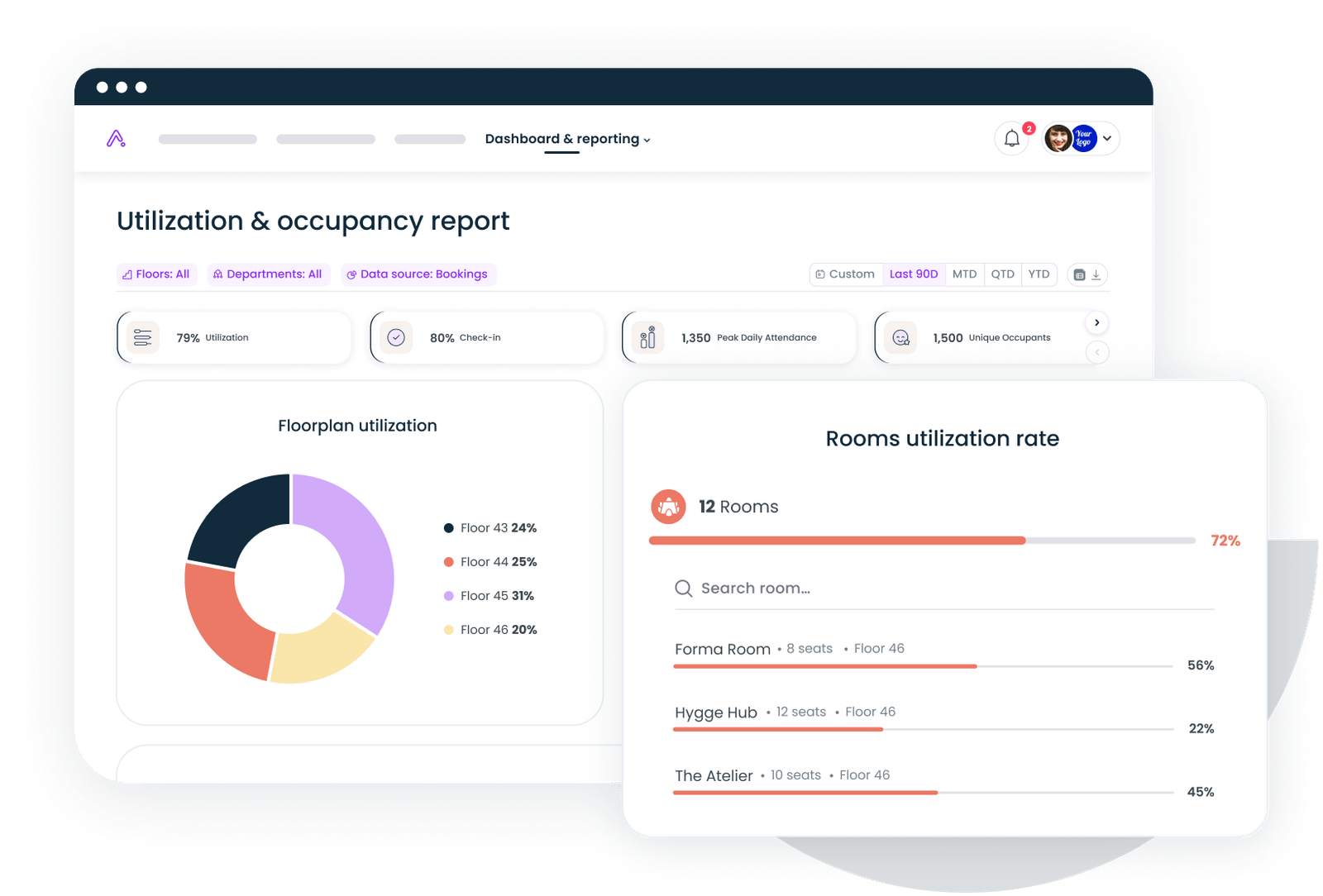
Step 5: Iterate and improve
Occupancy planning is never "done." Employee needs change, business priorities shift, and working patterns continue to evolve. Set up regular reviews of your occupancy data, at least quarterly, to identify new trends and opportunities.
Organizations that treat the office as an evolving product rather than a fixed asset consistently outperform those that don't. This iterative approach is essential for staying ahead of the evolving needs of a hybrid workforce.
Technology's role in occupancy planning
Modern occupancy planning relies heavily on technology to collect and analyze data. Here are the key tools that support effective planning:
Booking and scheduling systems
Desk and room booking platforms track who plans to use which spaces. This data provides a foundation for understanding demand and identifying patterns. When employees can see who else is coming in, it also improves collaboration by helping teams coordinate their office days.
Sensors and badge data
For more granular insights, many organizations use occupancy sensors or access control integrations. These tools provide real-time visibility into actual usage, not just booked reservations. The gap between "booked" and "used" can be significant, and sensors help you understand true utilization.
Analytics dashboards
Raw data only becomes useful when you can visualize and interpret it. Analytics platforms aggregate data from multiple sources and present insights that help you make decisions. Look for tools that show trends over time, compare different locations or floors, and highlight anomalies.
The space utilization guide offers a deeper look at how to calculate and benchmark these critical metrics for your organization.
Common occupancy planning mistakes to avoid
Even well-intentioned occupancy planning efforts can go wrong. Here are mistakes to watch for:
Relying on assumptions instead of data. Many organizations make decisions based on what they think is happening rather than what the data shows. Always validate assumptions with actual usage information.
Optimizing only for efficiency. While reducing costs matters, cutting too deep can damage employee experience. The goal is space optimization that balances cost savings with creating a workplace people actually want to use.
Ignoring peak vs. average usage. Planning for average occupancy means you won't have enough room on your busiest days. Always design for peak capacity, even if average usage is lower.
Treating all spaces the same. Different teams and functions have different needs. A finance team might need more individual workspaces while a creative team needs collaborative areas. Effective space management accounts for these differences.
The future of occupancy planning
Occupancy planning will only become more important as organizations continue to refine their real estate strategy. McKinsey projects that demand for office space could be 13-20% lower by 2030 than it was in 2019, meaning companies will need to be increasingly strategic about the space they do maintain.
The organizations that thrive will be those that view occupancy planning not as a cost-cutting exercise but as a way to create workplaces that genuinely support their people and their business. That means combining data driven decisions with a focus on employee experience, using insights to create spaces that people choose to use rather than are forced to use.
Whether you're managing a single office or a global portfolio, the principles remain the same: measure what matters, analyze the results, and continuously improve. That's how you turn your workspace from a cost center into a competitive advantage.
Gable gives you the data and tools to understand how your space is being used and optimize for what matters most, whether that's reducing costs, improving collaboration, or creating a workplace employees love.
Get a demo