.svg)


.svg)
- The meeting room booking software market is projected to grow from roughly $1 billion in 2026 to $1.8-3.6 billion by 2035 (Market Research Future), driven by hybrid work and rising demand for space optimization.
- CBRE's 2026 global data shows office utilization at 53%, meaning nearly half of booked space still goes unused on any given day.
- 80% of meetings happen in rooms designed for six or fewer people, while boardrooms (17+ seats) see just 12% utilization (Worklytics 2025). Right-sizing your room mix starts with the right booking data.
- We reviewed 10 platforms for 2026, comparing features, pricing, integrations, and analytics. Gable is one of them, and we're transparent about where it fits.
- The comparison table below gives you a quick look at how each tool stacks up before you read the full breakdowns.
Meeting room booking software gives your team a single place to find, reserve, and manage conference rooms across one or more offices. The best tools do more than prevent double bookings: they surface utilization data, connect to your calendar and chat tools, and help facilities teams right-size their real estate. With global office utilization at 53% according to CBRE and no-show rates reaching 40% of booked meetings per Worklytics, the gap between reserved space and actual use represents real money. This guide breaks down 10 platforms, what they do well, where they fall short, and what they cost.
Best meeting room booking software at a glance
Gable
Best for: Hybrid teams needing unified workspace management across owned offices and on-demand spaces
Gable combines meeting room scheduling with desk booking, visitor management, and access to 20,000+ flexible workspaces in 900+ cities. Rather than solving only the conference room problem, Gable gives workplace teams a single platform for every type of space, from the huddle room down the hall to a coworking space across town.
Key features:
- Room and desk booking with interactive floor maps
- Two-way calendar sync with Google Workspace and Microsoft 365
- Automated check-in and no-show management
- AI-powered workplace analytics with utilization dashboards
- Slack, Teams, Outlook, and Google Calendar integrations
- On-demand workspace network for distributed teams
- Visitor management with custom sign-in, badge printing, and host notifications
Pricing: Contact Gable for pricing. No upfront credits or monthly memberships for on-demand spaces; pay only for what your team uses.
Pros:
- Combines room booking, desk booking, visitor management, and flex workspace access in one platform, reducing tool sprawl
- Real-time utilization data helps facilities teams right-size their real estate (Gable customers report a 25% reduction in unused desk space)
- On-demand network means distributed team members can book meeting spaces wherever they're working
Cons:
- Best suited for organizations that want a comprehensive workplace management platform rather than a standalone room booking tool
- The breadth of features means teams who only need basic room scheduling may not use the full platform
Bottom line:If your challenge is managing meeting rooms alongside desks, visitors, and flexible workspaces for a hybrid team, Gable's unified approach eliminates the need for three or four separate tools. If you only need to put a booking screen outside five conference rooms, a simpler option may be a better fit.
Learn more about Gable room booking software >>>
Robin
Best for: Data-driven teams needing detailed analytics on space usage
Robin pairs meeting room scheduling with interactive floor maps and desk booking. Its strength is utilization data: booking patterns, no-show rates, actual occupancy, and peak usage by room, floor, and building.
Key features:
- Interactive floor maps with real-time room status
- Calendar integration with Microsoft Outlook and Google Calendar
- Desk booking and neighborhood management
- Space analytics and utilization reporting
- Mobile app for on-the-go booking
- Room display hardware support with scheduling screens outside conference rooms
Pricing: Starts at $399/month, which includes 25 user licenses. Custom pricing for larger organizations.
Pros:
- Analytics are among the deepest in the category, with granular data on room-level usage patterns
- Floor maps make it easy for employees to find available rooms visually
- Strong Microsoft and Google calendar integration
Cons:
- Per-user pricing can add up quickly for larger organizations
- Analytics dashboards require configuration time to get the most value
- The $399/month starting price puts it above several competitors for smaller teams
Bottom line: Robin is a strong pick for facilities teams who make space decisions based on data. If you're tracking booking patterns across multiple floors or buildings, the analytics depth justifies the premium.
Envoy
Best for: Organizations needing room booking combined with visitor management
Envoy integrates meeting room booking with visitor management, combining front-desk operations and space scheduling in one platform. Visitor arrivals can automatically trigger meeting room preparations, and space utilization data combines with visitor traffic for a more complete picture of how your offices are used.
Key features:
- Room booking with real-time availability displays and color-coded room status indicators
- Integrated visitor management and check-in
- Calendar sync with Google and Microsoft 365
- Space analytics and capacity planning
- Mobile app for booking and check-ins
- Delivery management
Pricing: Workplace Standard starts at $3 per active user per month (billed annually). Rooms add-on starts at approximately $18 per space. The per-space tiered pricing means organizations with many bookable resources (meeting rooms, phone booths, desks) can hit higher tiers quickly.
Pros:
- Visitor management is a core strength, not an afterthought
- The combined visitor + room data gives facilities teams a fuller view of office usage
- Broad integration ecosystem
Cons:
- Room booking is part of a broader workplace platform, so organizations only needing room scheduling may be paying for capabilities they don't use
- Map functionality could be more intuitive
- Per-space pricing tiers can escalate for offices with many bookable rooms
Bottom line: If visitor management is as important to you as room booking, Envoy handles both well. Organizations that already use Envoy for visitor check-in get the most value from adding Rooms to their existing setup.
Joan
Best for: Companies wanting elegant room display hardware with intuitive scheduling
Joan is known for its e-paper room displays: wireless, battery-powered screens that show real-time room availability outside conference rooms. The displays eliminate cable installations and last weeks on a single charge.
Key features:
- E-paper room displays with real-time availability
- Calendar integration with Google and Microsoft 365
- Mobile app and web booking
- Desk booking capabilities
- Visitor management add-on
- Battery-powered, wireless displays (no installation wiring required)
Pricing: Hardware + software model. Display hardware is the primary cost driver. Contact Joan for current pricing on displays and software subscriptions.
Pros:
- Display hardware is genuinely elegant; the e-paper screens look clean and professional
- Wireless, battery-powered installation means no electrician or IT cabling
- Employees can book directly from the display, mobile app, or their calendar
Cons:
- Display hardware adds meaningfully to the total cost, especially across many rooms
- Touchscreen responsiveness can be slow in some conditions (inherent to e-paper technology)
- Analytics capabilities are lighter than dedicated analytics-first platforms like Robin
Bottom line: Joan makes sense when the physical room display experience matters to you. If employees frequently walk up to conference rooms looking for availability, Joan's hardware is among the best in class. If you're primarily managing room booking from calendars and apps, you're paying a premium for hardware you may not need.
Skedda
Best for: Spaces requiring specific booking rules and high customization
Skedda stands out for its rules engine. If you need to limit booking durations, require approvals for certain rooms, set different policies by user group, or enforce complex scheduling logic, Skedda gives you the controls to do it.
Key features:
- Powerful rules engine for booking policies (duration limits, approval workflows, user group restrictions)
- Visual scheduling with floor plans
- Calendar integration with Google and Outlook
- Automated booking confirmations and reminders
- Access control integration
- Multi-location support
Pricing: Starting at $99/month.
Pros:
- Rules engine is one of the most flexible in the category; you can configure nearly any booking policy
- Works well for diverse environments (offices, coworking spaces, universities, shared facilities)
- Solid value at the $99/month starting price
Cons:
- The depth of customization options requires time to configure properly
- The interface isn't as polished as some newer competitors
- Analytics are functional but not as deep as Robin or Gable
Bottom line: Skedda is the right choice when your booking rules are complex. Universities, multi-tenant buildings, and organizations with strict room access policies will appreciate the rules engine. Simpler environments won't need that level of configuration.

Hybrid policies are shifting fast. This guide breaks down what workplace leaders need to know about RTO mandates, employee expectations, and the data behind the decisions.
Read the guide
Archie
Best for: Small-to-mid teams wanting simple, predictable pricing
Archie keeps room and desk booking straightforward. Its per-room pricing model means costs stay predictable regardless of headcount growth, which is a genuine advantage for hybrid offices where employee counts fluctuate but room counts don't.
Key features:
- Room and desk booking with a clean, simple interface
- Per-room pricing model
- Calendar integration with Microsoft and Google
- Visitor management
- Workspace analytics
- Mobile app
- Slack, Teams, Outlook, and Google Calendar integrations
Pricing: Per-room pricing starting at approximately $8/room/month. Costs scale with the number of bookable rooms, not users.
Pros:
- Per-room pricing makes budgeting simple and predictable, especially for growing teams
- Fast implementation; most teams go live in days rather than weeks
- Clean, intuitive interface with low training overhead
Cons:
- May lack some advanced analytics features that larger enterprises need
- Per-room pricing requires careful comparison against per-user alternatives for organizations with many rooms but fewer employees
- Feature depth is lighter than enterprise platforms
Bottom line: Archie is a good starting point for teams that need room booking without the complexity or cost of a full workplace management platform. If your primary goal is getting a booking system up and running quickly with predictable costs, it delivers.
Officely
Best for: Teams using Slack or Microsoft Teams as their daily workspace
Officely lets employees check room availability and book directly inside Slack or Microsoft Teams. No separate app, no context switching. For organizations where Slack or Teams is already the hub of daily work, this approach drives higher adoption because people don't have to learn another tool.
Key features:
- Native Slack and Microsoft Teams integration for booking
- Room and desk booking within chat interfaces
- "Who's in the office" visibility for hybrid coordination
- Calendar sync
- Booking reminders and notifications
- Hybrid scheduling coordination
Pricing: Contact Officely for pricing. Not publicly listed.
Pros:
- Zero friction for teams already in Slack or Teams; booking happens where they already work
- Hybrid coordination features (who's in, when) help teams plan in-person time
- Simple setup
Cons:
- Functionality is tied to Slack or Teams adoption; organizations not heavily using these platforms won't benefit from the integration approach
- Analytics are lighter than standalone room booking platforms
- Less suited for organizations that need room displays or complex booking rules
Bottom line: Officely is the right choice when your team lives in Slack or Teams and adoption of a separate booking tool has been a challenge. The native integration removes the biggest barrier to consistent room booking.
Tactic
Best for: Hybrid teams focused on employee coordination and collaboration
Tactic goes beyond basic room booking to help distributed teams coordinate in-office days and find each other when on site. It answers the question hybrid employees ask most: "Who's going to be in the office when I am?"
Key features:
- Room and desk booking
- Team coordination and visibility (see when teammates plan to be in office)
- Interactive office maps
- Calendar integration
- Analytics on office attendance patterns
- Mobile app
Pricing: Contact Tactic for pricing. Not publicly listed.
Pros:
- Team visibility features are a genuine differentiator for hybrid coordination
- Helps solve the "empty office" problem where people come in but their collaborators don't
- Straightforward interface
Cons:
- Newer entrant compared to established players like Robin or Eptura
- Feature set may be lighter on advanced analytics and room-specific management
- Less well-known, so finding peer reviews and case studies is harder
Bottom line: Tactic fits hybrid teams where the coordination problem (getting the right people in the office on the same days) matters as much as the room booking itself. If your biggest challenge is that people book desks but end up working alone because their team is remote that day, Tactic addresses that directly.
Gable combines meeting room booking with desk reservations, visitor management, and real-time utilization data. One platform, fewer tools to manage, better data for space decisions.
Learn more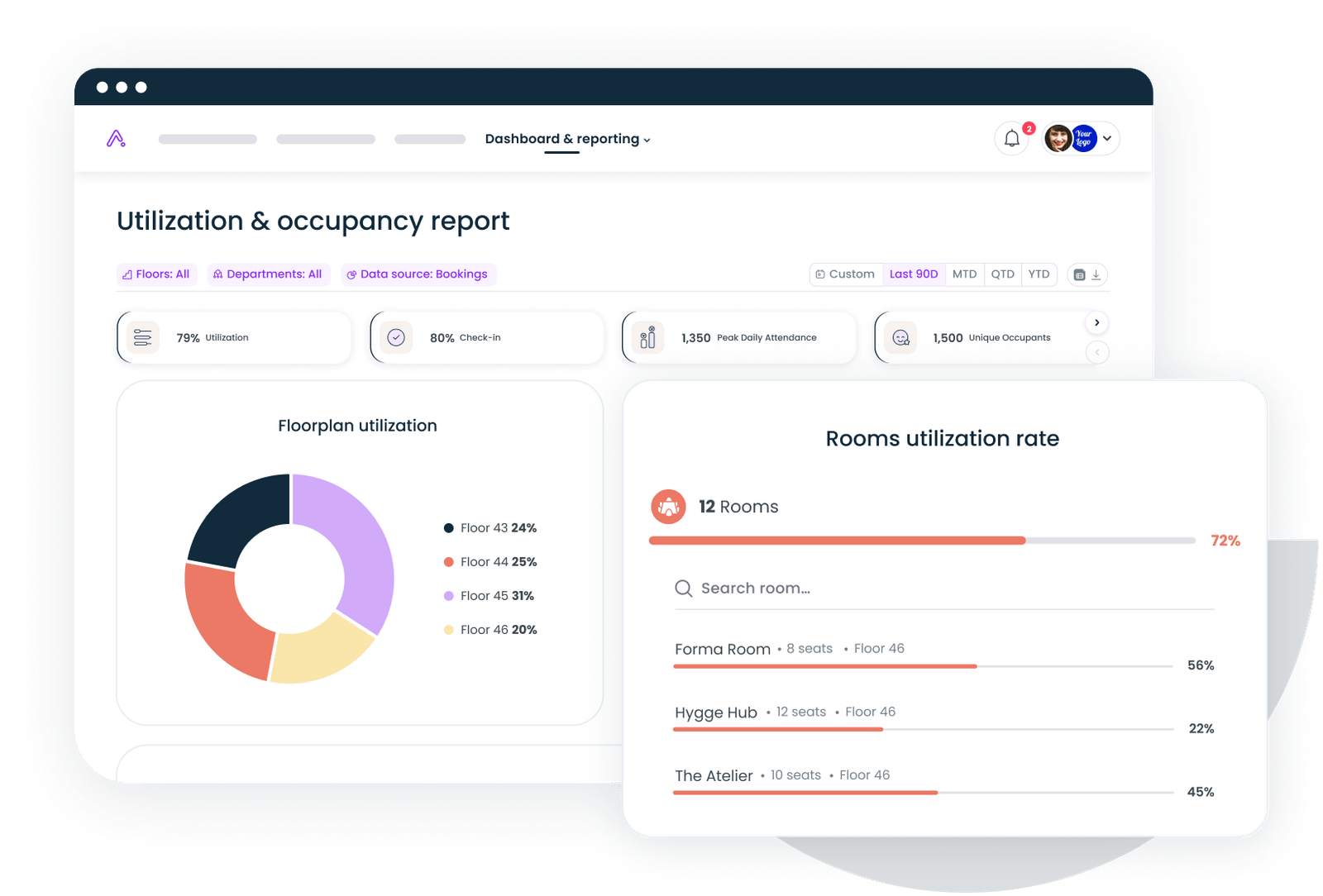
Eptura
Best for: Enterprise organizations needing sensor-based room management with deep Microsoft 365 integration
Eptura (formerly Condeco) brings decades of room scheduling heritage to a modern platform. Its standout capability is sensor-driven space management: badge swipes and occupancy sensors automatically check employees into reserved rooms, release unoccupied bookings, and generate walk-in reservations when people enter unreserved spaces.
Key features:
- AI-powered workspace recommendations with natural language commands
- Automated check-in via badge swipe and sensor data
- Automatic room release for no-shows, with walk-in booking generation
- Full Microsoft 365 integration (Outlook, Teams, mobile app)
- Visitor and services management within room bookings
- Room rescheduling that automatically finds new spaces when meetings change
- Multi-location portfolio management
Pricing: Custom per-user subscription. Tiered plans for SMB, mid-market, and enterprise with optional add-ons. No public pricing; contact Eptura for a quote.
Pros:
- Sensor integration is among the most mature in the market; automated check-in and no-show management reduce manual administration
- Deep Microsoft 365 integration makes it a natural fit for Microsoft-heavy organizations
- AI workspace recommendations go beyond basic search to suggest optimal rooms based on attendees, equipment needs, and past behavior
- Long Condeco heritage means the room scheduling feature set is deeply built out
Cons:
- Enterprise focus means the platform may be more than smaller organizations need
- Custom pricing makes it harder to compare costs upfront
- Sensor hardware adds implementation complexity and cost
Bottom line: Eptura is the enterprise play. If you're managing hundreds of conference rooms across multiple buildings, need sensor-driven accuracy, and your organization runs on Microsoft 365, Eptura's depth is hard to match. Smaller teams will likely find simpler (and more affordable) options elsewhere on this list.
OfficeSpace Software
Best for: Mid-to-large organizations wanting room booking tightly integrated with space planning
OfficeSpace Software wraps room scheduling into a broader workplace management platform that includes desk booking, space planning, and move management. Its room booking searches by capacity, amenities, and attendee location, with live status shown on interactive floor plans.
Key features:
- Room scheduling integrated with Microsoft, Google, Slack, and Zoom
- Search by capacity, amenities, and attendee location
- Live room status on interactive floor plans
- Automatic room creation when people enter (sensor-based)
- No-show auto-release
- Full workplace management platform with desk booking, space planning, and move management
- IWMS-grade features for facilities teams
Pricing: Quote-based with no public pricing. Third-party sources estimate approximately $60/user/year, with annual costs reported in the $22K-$96K range depending on organization size. Implementation typically takes 35-60 days.
Pros:
- Space planning capabilities (stack planning, move management, scenario planning) go well beyond room booking
- Interactive floor plans with live room status are strong
- Good fit for facilities teams who need room scheduling as part of a broader space management strategy
Cons:
- No public pricing makes budgeting and comparison difficult before engaging sales
- Implementation timeline (35-60 days) is longer than lighter tools
- The full platform may be more than teams who only need room booking require
Bottom line: OfficeSpace Software fits organizations where room booking is one piece of a larger space management strategy. If your facilities team also handles move planning, floor plan updates, and portfolio-level space decisions, the integrated approach adds real value. If you just need rooms booked, it's overkill.
How to choose the right meeting room booking software
1. Start with your calendar
Calendar integration is table stakes. Your room booking tool must sync two ways with Google Calendar or Microsoft Outlook so that bookings appear on attendees' calendars automatically and prevent conflicts. Every tool on this list offers calendar integration, but the depth varies. Some offer native two-way sync; others rely on plugins or require manual setup. Test this before you buy.
If your team relies on Slack or Microsoft Teams for daily communication, prioritize platforms that offer native chat integration. Booking a room without leaving your communication tool saves time and drives higher adoption rates.
2. Match analytics to your decisions
Not every team needs the same level of data. Ask what decisions you're trying to make:
- Right-sizing your room mix: You need room-level utilization data. Worklytics foundthat 80% of meetings happen in rooms for six or fewer people, while boardrooms with 17+ seats see just 12% utilization. If your data confirms a similar pattern, you might convert large rooms into smaller huddle spaces.
- Justifying real estate changes: You need occupancy trends over time. Tuesday records the highest global occupancy at 58.6%, while Friday drops to 34.5% (HubStar Hybrid Occupancy Index). That kind of day-by-day data helps you decide whether to shrink your footprint or shift to a hot desking model.
- Reducing wasted space: You need no-show tracking and auto-release. Worklytics reports no-show rates up to 40% of booked meetings. Tools with automated check-in and room release reclaim that space automatically.
3. Assess your booking complexity
A small office with five conference rooms has different needs than a multi-building campus with restricted executive rooms, approval workflows, and recurring standing meetings. Match the tool to your rules:
- Simple: Calendar-based booking with basic floor plans (Archie, Officely, Tactic)
- Moderate: Booking policies, approval workflows, and department-specific rules (Skedda, Robin, Gable)
- Complex: Sensor-driven occupancy, automated check-in, multi-location portfolio management (Eptura, OfficeSpace Software)
4. Factor in hardware
Some organizations want visible displays outside conference rooms. Joan specializes in this with its e-paper displays. Eptura integrates with occupancy sensors. Many other platforms support QR code check-ins or mobile app verification, which handles no-show management without dedicated hardware.
If hardware matters, budget for it separately. Display installations add cost and maintenance, but they solve the "is this room actually free?" problem better than any app can.
5. Plan for scale and pricing models
Pricing models vary significantly across this category, and the right one depends on your growth trajectory:
- Per-user pricing (Robin, Envoy, Eptura): Costs rise with headcount. Predictable per-person, but expensive as you scale.
- Per-room pricing (Archie): Costs stay flat as headcount grows. Better for organizations with more employees than rooms, like desk sharing environments.
- Platform pricing (Gable, OfficeSpace Software): You're buying a broader workplace management platform, not just room booking. The room scheduling cost is bundled with other capabilities.
Run the math for your specific situation. A per-user tool at $3/user/month sounds cheap until you multiply it by 2,000 employees.
Key features to look for in meeting room booking software
Real-time availability and visual floor plans
Live dashboards show employees which rooms are free right now, not 10 minutes ago. The best tools display availability on interactive floor plans, so employees can see room locations, capacity, and equipment at a glance. Mobile apps, web interfaces, and physical displays all serve this function, and the tools that update room status immediately after bookings, modifications, or cancellations create the least friction.
Calendar sync and double-booking prevention
Two-way calendar synchronization is the single most important feature. Bookings made in the room software should appear on attendees' calendars. Calendar events with room resources should automatically block that space in the booking tool. Without this, you'll get the scheduling conflicts the software was supposed to prevent.
Check-in and no-show management
With no-show rates reaching 40% of booked meetings according to Worklytics, automated check-in is critical. QR code check-ins, mobile app verification, sensor-based detection, and timed auto-release all help ensure that reserved rooms don't sit empty. This single feature can meaningfully improve your office occupancy rate.
AI-powered scheduling
AI is now a meaningful differentiator in this category. Features range from smart room recommendations based on meeting size and attendee locations, to natural language booking ("find me a room for six near the marketing team at 2 PM"), to predictive analytics that forecast room demand by day of week. Eptura and Gable lead here, but expect AI capabilities to spread across most platforms through 2026.
Analytics and reporting
Detailed reports on room usage reveal which rooms are popular, which are underutilized, and when peak demand occurs. This data drives decisions about office layout, real estate optimization, and room configuration. The difference between basic analytics (how many bookings per room) and advanced analytics (actual occupancy vs. booked capacity, meeting duration patterns, department-level usage) determines how much value your facilities team gets.
Booking policies and permissions
User-configurable rules control who can book which spaces and when. Options include limiting advance booking windows, setting maximum meeting durations, requiring approval for certain rooms, and restricting access to executive conference rooms. Skedda's rules engine is the most flexible here, but most tools offer basic policy controls.
Benefits of meeting room booking software
Fewer scheduling conflicts, less wasted time
A single source of truth for all room reservations eliminates the email chains, the "is this room taken?" walks, and the meeting-starts-five-minutes-late problem. When booking data syncs with calendars in real time, conflicts get caught at reservation time rather than at meeting time.
Better space utilization and cost savings
Meeting room data reveals patterns that save real money. When you can see that your 20-person boardroom averages three attendees per meeting, you can reconfigure that space. When you know that Tuesday sees 58.6% occupancy while Friday drops to 34.5%, you can adjust cleaning schedules, catering, and HVAC accordingly. Gable customers have seen a 32% reduction in unused space by using analytics to match supply with actual demand.
Higher adoption of hybrid work policies
The tools that make it easy to find a room, book it in three taps, and check in with a QR scan remove friction from the in-office experience. That matters because the biggest threat to any hybrid work model isn't policy resistance; it's that the office experience isn't good enough to justify the commute. Smooth room booking is one part of making the office worth the trip.
Data for real estate decisions
Workplace analytics from room booking tools feed directly into real estate strategy. How many rooms do you actually need? What sizes? On which floors? These questions used to be answered by gut feeling. Now they're answered by six months of booking and occupancy data, which gives CRE teams the evidence to negotiate leases, consolidate floors, or invest in new configurations.
See how Gable brings room scheduling, desk booking, visitor management, and workplace analytics into one platform your team will actually use.
Get a demo