.svg)


.svg)
- Hybrid work now covers 53% of remote-capable US workers, and despite high-profile RTO mandates, telework rates rose to 23.7% in early 2025
- Productivity gains are real but nuanced: hybrid teams get only 31% uninterrupted focus time, compared to 45% for in-office teams
- 62% of organizations cite schedule coordination as their top hybrid challenge, with 40% of meeting rooms sitting unused due to ghost bookings
- Flexibility carries the weight of an 8% pay raise for retention, and 60% of remote workers say they'd quit if it disappeared
- US office vacancy hit 18.8% in Q3 2025, accelerating a split between premium and commodity office space
Hybrid work isn't a perk anymore. It's shifted from a differentiator to a filter: candidates don't choose employers because they offer flexibility; they eliminate employers who don't. For workplace leaders, people teams, and finance professionals, the question has moved past "should we go hybrid?" to "how do we make hybrid work well?"
This article pulls together 40+ of the most current hybrid work statistics from 2025 and 2026, organized by theme and grounded in cited research. Whether you're building a business case for flexible schedules, defending real estate decisions, or trying to get Tuesday attendance above 40%, you'll find data here that moves the conversation forward.
Hybrid work adoption is still climbing
The headline narrative of 2025 and 2026 was supposed to be about the great return to office. The data tells a different story.
The current state of hybrid adoption
Gallup's 2025 data shows that 53% of remote-capable US workers now operate on a hybrid schedule, while 27% work fully remote and 20% work fully on site. That 53% figure has held steady since mid-2023, signaling that hybrid isn't a transitional phase.
Globally, the numbers vary by region but confirm the same trend:
- 74% of US companies have permanently codified a hybrid work policy, according to DropDesk's 2026 analysis
- 22.5% of US employees worked remotely at least partially as of December 2025, per Remotive
- 34.6 million Americans teleworked in August 2025, according to Vena Solutions
- The average number of remote working days per week has risen to 3.2 days, up from 2.5 in 2023
Company size matters
Smaller organizations have leaned harder into flexibility. FlexIndex 2025 data shows 67% of companies with fewer than 500 employees are fully flexible, compared to less than 30% of enterprises above 10,000 employees. Larger companies tend to maintain physical offices for coordination, culture events, and client-facing work, but they're increasingly supplementing those spaces with on-demand options rather than expanding fixed leases.
The mandate paradox: what companies say vs. what data shows
Amazon, JPMorgan, and the US federal government dominated 2025 headlines with aggressive return-to-office mandates. Here's what happened next.
RTO mandates barely moved the needle
According to Stanford's WFH Research, planned RTO mandates across US businesses would only reduce the share of work-from-home days by about 0.5%. Despite every mandate announced in 2024 and 2025, remote work was higher in early 2025 (23.7%) than in October 2022 (17.9%).
Badge-swipe data and cell phone tracking confirm the gap between policy and behavior: employees aren't coming in as often as their employers require. Office attendance remains roughly 30% lower than pre-pandemic levels.
The retention cost of forced returns
The data on what happens when companies force full-time returns is unambiguous:
- 60% of remote workers say they'd quit if work-from-home were eliminated entirely, per Owl Labs' State of Hybrid Work survey
- 65% of Gen Z and Millennial workers would leave if forced back full-time, per DropDesk
Rather than forcing compliance, organizations seeing strong results are designing hybrid models that create genuine reasons to come in, then measuring whether those reasons hold up.

Getting people back to the office matters less than making the office worth coming to. See how hybrid work software supports smarter scheduling and collaboration.
Read the guide
Productivity and performance: the nuanced picture
The early-pandemic productivity narrative was simple: remote workers are more productive. The 2026 reality is more complicated, and more useful.
What the research confirms
Stanford's landmark study of 1,612 Trip.com employees found that hybrid workers (three days in-office, two remote) showed no measurable difference in productivity, performance reviews, or promotion rates compared to full-time office workers. Turnover, however, dropped by 33% in the hybrid group.
Broader surveys consistently find productivity gains:
- 83% of employees report they're more productive in a hybrid model (DropDesk)
- Remote and hybrid workers save an average of 72 minutes per day on commuting, per Vena Solutions
The focus time problem
Here's where it gets complicated. Hubstaff's research found that hybrid teams get only 31% of their working hours as uninterrupted deep focus time, compared to 45% for fully in-office teams and 41% for fully remote teams.
The culprit isn't hybrid work itself. It's the constant context-switching between home and office, combined with poorly coordinated schedules that fragment the week. When everyone's in the office on different days, you get all the commute costs and none of the collaboration benefits.
Manager perception is shifting
Manager confidence in remote productivity has cooled. While 84% of hybrid employees say their productivity has improved, manager agreement has dropped from 79% to 62% over the past year, per DropDesk. That gap between employee self-reporting and manager perception represents a measurement problem, not necessarily a performance problem. Organizations that track outcomes rather than presence tend to see the gap narrow significantly.
The coordination crisis: hybrid's biggest operational challenge
Coordinating hybrid schedules consistently ranks among the operational challenges workplace teams face most often, and it's where small tooling choices have the biggest downstream impact.
Ghost bookings and wasted space
The meeting room problem captures the coordination crisis perfectly. Roughly 40% of booked meeting rooms go unused on any given day, with employees reserving rooms as a precaution and never showing up. Double bookings, abandoned reservations, and mismatched room sizes plague offices that rely on basic calendar tools for space management.
This isn't a minor inconvenience. When a team comes in specifically to collaborate and can't find a room, the entire purpose of their office day evaporates.
What effective coordination looks like
Hybrid organizations with high in-office satisfaction, according to Gallup, tend to share a few characteristics:
- Clear anchor days where teams align on in-office presence (Tuesday, Wednesday, and Thursday remain the most popular)
- Real-time visibility into who's planning to be on site, so employees can coordinate organically
- Automated space release when bookings aren't confirmed, preventing ghost reservations
- Data feedback loops showing attendance versus planned attendance, so policies can adjust
Gable's desk and room booking tools, combined with its AI-powered insights, help organizations connect their calendar, chat, and access control data to identify and close these coordination gaps, replacing guesswork with measurable patterns.
Retention, turnover, and the flexibility premium
The connection between flexible work and employee retention is now one of the most well-documented trends in workforce management.
The numbers on turnover
- Stanford's Trip.com study measured a 33-35% reduction in quit rates among hybrid workers
- Owl Labs found that companies offering hybrid or remote options see approximately 25% lower turnover than those requiring full-time office presence
Flexibility as compensation
Employees don't treat flexibility as a nice-to-have. Owl Labs' data shows workers value it as a compensation equivalent of approximately 8% of salary. In practical terms, workers would accept an 8% pay cut to maintain their current level of location flexibility, and they'd demand at least an 8% raise to give it up.
This framing matters for finance teams building total compensation models. Flexibility functions as a retention tool with a quantifiable dollar value.
Generational splits
The generational data is shifting in interesting ways:
- Gen Z prefers hybrid to fully remote, bucking the assumption that younger workers want to stay home
- Millennials show the strongest preference for fully remote work, driven largely by caregiving responsibilities and commute aversion
Real estate bifurcation: the office market splits in two
Hybrid work hasn't killed the office. It's fundamentally reshaped what "office" means for most organizations.
Vacancy rates tell the story
The US office vacancy rate hit 18.8% in Q3 2025, according to CBRE data cited by Remotive. That represents the first year-over-year decline since Q1 2020, but remains historically high. In major CBD markets like San Francisco, vacancy rates run significantly higher than the national average.
Premium vs. commodity: two different markets
The office market has split into two distinct segments:
- Premium space is recovering. Companies that want physical offices are upgrading to newer buildings with better amenities, natural light, and collaboration-friendly layouts.
- Commodity space faces conversion or demolition. Older buildings with poor layouts, limited amenities, and inefficient systems are struggling to find tenants. Office-to-residential conversion projects are underway in dozens of major US cities as landlords repurpose obsolete stock.
The rise of flexible space
Meanwhile, the coworking and flex space market has continued expanding, with 55% of global occupiers now using flexible office solutions and 17% planning to increase their flex footprint. Hot desking and activity-based working have replaced assigned seating at roughly 38% of large employers, per DropDesk.
For finance and workplace teams, this creates a clear decision framework: invest in fewer, better spaces for anchor-day collaboration, and use on-demand flex space to cover the rest. Global Workplace Analytics estimates that employers save an average of $11,000 per year for each employee who works remotely part-time, primarily through reduced real estate costs.
From interactive floor plans to AI-driven utilization insights, Gable Offices gives you the tools to make every in-office day count.
Learn more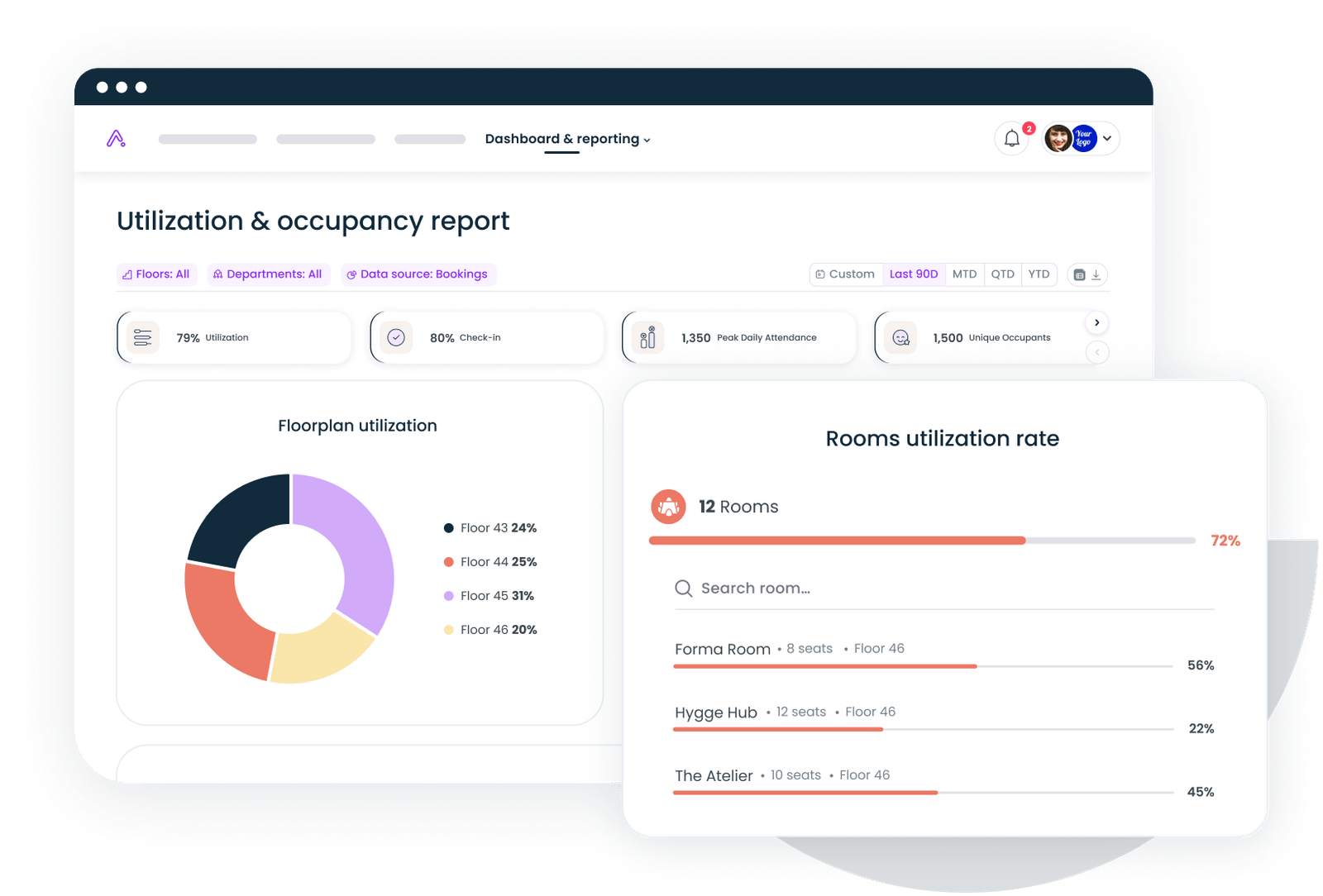
Employee well-being: benefits and trade-offs
The well-being data on hybrid and remote work is overwhelmingly positive, with one important caveat.
The benefits are measurable
- Hybrid workers report higher job satisfaction (78%) compared to fully on-site workers (62%), per Owl Labs
The isolation risk for fully remote workers
The caveat: burnout among fully remote workers rose approximately 18% between 2023 and 2025, driven primarily by isolation and blurred work-life boundaries (SaaS Ultra). Hybrid models appear to offer a protective effect by providing regular in-person social connection without eliminating flexibility.
This is one of the strongest arguments for intentional hybrid design. The goal is to create a rhythm where in-person time serves connection and collaboration while remote time protects focus and autonomy.
Proximity bias and career equity
One of the emerging risks of hybrid work is that it can create a two-tier workforce if organizations aren't deliberate about equity.
The visibility gap
- 37% of remote workers say they feel less visible to senior leadership and worry it affects career progression, a phenomenon researchers call "proximity bias" (DropDesk)
What the research says about actual career impact
Stanford's Trip.com study provides an important counterpoint: hybrid workers in their controlled experiment saw no difference in promotion rates compared to full-time office workers. The key distinction is that Trip.com designed its hybrid model with explicit equity safeguards, including standardized performance reviews and equal access to leadership time.
Organizations that measure collaboration patterns across locations, rather than relying on hallway impressions, are better positioned to identify and correct proximity bias before it affects retention or advancement.
Industry and geographic breakdown
Hybrid work adoption varies significantly by sector and region, which matters for organizations benchmarking against peers.
By industry
According to DropDesk:
- Tech and business services are the most flexible: only 17% of employees are required to be on site full-time
- Finance and professional services have largely standardized on 2-3 days in-office
- Healthcare (46% full-time on site) and education (45%) remain the least flexible, driven by the nature of the work
- 33% of employees globally still work in the office five days a week
By region
Geographic patterns reflect cultural and infrastructure differences:
- North America trends toward more in-office time within hybrid models (averaging 2.5-3 days in-office)
- Western Europe leans more strongly toward hybrid, with the UK, Netherlands, and Nordics leading adoption
- Asia-Pacific shows higher rates of fully remote work, particularly in Australia, India, and Singapore
By company size
FlexJobs' Q1 2026 Remote Work Index found that remote job postings increased 20% in Q1 2026, with senior-level roles seeing the highest growth in remote availability. Smaller companies continue to out-flex larger ones: 67% of companies under 500 employees offer fully remote options.
Scheduling strategy: what the research recommends
New academic research is helping quantify what many workplace teams have intuited: there's a sweet spot between too rigid and too flexible.
The satisfaction-interaction trade-off
A 2026 study published in SAGE journals used mathematical modeling to analyze the relationship between in-office scheduling policies, employee satisfaction, and team interaction. The conclusion: "Modest in-office coordination goals may be sufficient to maintain collaboration, while overly strict rules risk widespread discontent with limited added benefit."
In other words, requiring three fixed days generates significantly more resentment than requiring two, but produces only marginally more in-person interaction.
The most common models in 2026
- 2-3 days in-office per week is the dominant arrangement, per Gallup
- Tuesday, Wednesday, and Thursday remain the most popular anchor days
- "Manager's choice" models (where team leads decide schedules) show the highest satisfaction when combined with clear guidelines
- Fully flexible (any days, any location) correlates with the highest employee preference but the lowest in-person collaboration frequency
The implication for workplace teams is clear: set a light structure, invest in coordination tools that make it easy for teams to align organically, and measure outcomes rather than compliance.
Technology and AI in hybrid work
The technology layer supporting hybrid work has matured significantly, with AI adoption accelerating in 2025 and 2026.
AI-powered meetings and async tools
- 85% of hybrid meetings in 2026 use AI for transcription and summarization (DropDesk)
- Asynchronous video tools like Loom have seen 400% growth since 2022
- 72% of companies plan to increase investment in virtual collaboration tools, per Vena Solutions
Infrastructure and training investments
Beyond collaboration software, organizations are investing in:
- IT infrastructure for secure virtual connectivity (70% of companies, per Vena Solutions)
- Manager training for remote and hybrid workforce management (64% of companies)
- Workplace analytics platforms that combine HR, access control, and WiFi data to measure utilization patterns
Successful hybrid organizations treat their workplace technology stack as an integrated system, connecting scheduling, space management, and analytics rather than running them as separate tools.
What these hybrid work statistics mean for 2026 and beyond
The data paints a consistent picture. Hybrid work has stabilized as the dominant model for knowledge workers, and the organizations getting the most out of it are the ones treating execution as seriously as they treated adoption.
Three themes stand out:
- The coordination problem is solvable. Ghost bookings, empty meeting rooms, and misaligned schedules aren't inevitable. They're symptoms of insufficient tooling and unclear norms.
- Measurement beats mandates. Companies that track utilization, collaboration patterns, and employee satisfaction make better real estate and policy decisions than those relying on executive instinct or blanket rules.
- Flexibility has a quantifiable ROI. Between the 8% compensation equivalent, 25-35% turnover reduction, and $11,000 per-employee real estate savings, the financial case for hybrid work is stronger than ever.
The question for workplace, people, and finance teams isn't whether to support hybrid. It's whether you have the data, tools, and coordination infrastructure to make it work at the level your organization needs.
Gable's all-in-one workplace platform helps hybrid teams coordinate schedules, book spaces, and turn utilization data into smarter decisions.
Get a demo