


.svg)


.svg)
- WeWork's post-bankruptcy recovery is underway, but the coworking market has diversified far beyond a single provider
- The global coworking market is projected to reach $41.12B by 2031, with 41% of corporations now using flexible workspaces
- Alternatives span three categories: physical coworking providers, on-demand booking platforms, and workplace management software
- Choosing the right alternative depends on your company size, budget, geographic spread, and whether you need data integration
- Enterprise buyers should prioritize budget controls, multi-provider access, and usage analytics over brand loyalty to any single operator
The search for WeWork alternatives has shifted dramatically. What started as a hunt for "another coworking space" has become a strategic decision about how companies manage their entire flexible workspace portfolio. With the coworking market projected to grow from $15.81B in 2025 to $41.12B by 2031, the options available today look nothing like they did even two years ago.
This guide breaks down the leading WeWork alternatives across every category, compares pricing and features, and helps you match the right solution to your company's specific needs.
One note before you compare coworking space alternatives: providers now compete on network reach, pricing transparency, and usage data as much as on the spaces themselves. Several options in this guide don't require a membership at all, which matters most for teams booking space across multiple cities, where per-visit costs and consolidated reporting beat a stack of separate contracts.
Where WeWork stands in 2026
WeWork's Chapter 11 bankruptcy filing in November 2023 reshaped the coworking landscape. After shedding unprofitable leases and restructuring its debt, the company has entered a cautious growth phase. Its first new NYC location at 250 Broadway opened in late 2025, a 60,000-square-foot space across five floors that's notably smaller than the company's pre-bankruptcy expansions.
The early signs of recovery are modest but real. Access membership bookings increased 10% from January to April 2025, and foot traffic rose 6% during the same period. WeWork is also leaning into premium amenities like wellness rooms and upgraded furnishings to differentiate from the growing field of competitors.
Still, the company's reduced footprint and conservative strategy mean it no longer dominates the flexible workspace conversation. For enterprises evaluating their hybrid workplace strategy, the question isn't whether to consider alternatives; it's which category of alternative fits best.
Three categories of WeWork alternatives
One of the biggest mistakes companies make when searching for WeWork alternatives is treating all options as interchangeable. The market has split into three distinct categories, each solving a different problem.
Physical coworking providers
These are the direct competitors: companies that own or lease space and offer memberships, dedicated desks, and private offices. Regus/IWG, Industrious, Spaces, and Convene all fall here. You're buying access to a specific operator's locations.
On-demand booking platforms
Platforms like Gable On-Demand, LiquidSpace, and Coworker.com aggregate thousands of workspaces into a single booking experience. Instead of committing to one provider's network, your team can access multiple operators through a unified platform with budget controls and usage tracking.
Workplace management software
Tools like Gable Offices, Robin, and DeskFlex help companies manage their own office spaces alongside flex access. This category is growing fast as enterprises realize they need to coordinate multiple office locations and coworking memberships from a single dashboard.
The right choice depends on whether you need physical space, platform access, software management, or some combination of all three.
Top physical coworking alternatives to WeWork
Here's how the leading WeWork competitors compare at a glance. The table covers every provider in this guide: global chains like IWG, premium operators like Industrious and Convene, and on-demand platforms that skip memberships entirely. Weigh the pricing model as heavily as the price itself; a $200 monthly hot desk only beats pay-per-use access if your team shows up several days a week. Shortlist two or three options here, then read on for what sets each one apart.
Location counts and pricing move fast among WeWork competitors. IWG alone plans roughly 1,500 new centers over the next 18 months, and Industrious grew its footprint 58% in 2025. Treat these figures as directional benchmarks and confirm current numbers with each provider before you sign anything.
IWG/Regus
IWG remains the largest flexible workspace operator globally, with over 3,500 locations across 120+ countries. The company opened 338 new centers in early 2025 and has plans for approximately 1,500 additional locations within 18 months, driven by a capital-light franchise model.
Best for: Companies needing global coverage with predictable, no-frills workspace access.
Pricing: Varies by location, but IWG tends to offer more transparent pricing than WeWork. Hot desks in major U.S. metros typically start around $200-$300/month.
Key differentiator: Sheer scale. If your team is spread across dozens of countries, IWG's network is hard to match.
Industrious
Industrious has positioned itself as the premium alternative, and CBRE's $400M acquisition in January 2025 cemented its place in the enterprise market. The company grew by 13% in top U.S. markets through Q3 2024, and its management-agreement model (where building owners retain ownership while Industrious operates the space) reduces the financial risk that sank WeWork.
Best for: Companies that want a hospitality-grade experience with enterprise-level service.
Pricing: Industrious undercuts WeWork in nearly every major city, though exact pricing varies by location and commitment length.
Key differentiator: The CBRE partnership gives Industrious access to commercial real estate data and relationships that no other coworking operator can match.
Spaces (by IWG)
Spaces is IWG's direct answer to WeWork's design-forward, community-oriented model. The locations tend to be more modern and collaborative than traditional Regus offices, with open floor plans, event programming, and a younger aesthetic.
Best for: Teams that want the WeWork vibe without the WeWork brand risk.
Pricing: Generally falls between Regus (budget) and Industrious (premium), making it a solid mid-market option.
Key differentiator: Backed by IWG's infrastructure and global reach, but with a more curated, creative-class feel.
Convene
Convene focuses on premium meeting and event spaces alongside flexible workspace. Its locations are concentrated in major U.S. cities, and the company has carved out a niche in hospitality-driven workplace experiences.
Best for: Companies that host frequent client meetings, offsites, or corporate events and want a polished, hotel-quality environment.
Pricing: Premium tier. Expect to pay more than Regus or Industrious, but the meeting and event infrastructure is included.
Key differentiator: If your primary need is impressive meeting spaces rather than daily desk access, Convene is purpose-built for that use case.

Enterprise teams managing coworking across multiple providers need more than a membership card. Learn how corporate coworking software consolidates access, budgets, and reporting.
Read the guide
Pricing comparison: What WeWork alternatives cost in 2026
Vague pricing language doesn't help anyone make a decision. Here's what the U.S. market looks like based on current industry benchmarks.
| Workspace type | Average U.S. price | Range |
|---|---|---|
| Hot desk (day pass) | $25-$50/day | Varies by city |
| Hot desk (monthly) | $215/month | $150-$350 |
| Dedicated desk | $325/month | $200-$600 |
| Private office (1-2 person) | $500-$800/month | $350-$1,500 |
| Private office (team, 5-10) | $2,000-$5,000/month | Location-dependent |
A few things to note about these numbers:
- Location matters more than brand. A hot desk in Manhattan costs 2-3x what it costs in Austin, regardless of the operator.
- Industrious tends to undercut WeWork in head-to-head city comparisons, while Regus offers the widest range of price points.
- On-demand platforms often provide better per-visit economics for teams that don't need daily access, since you pay only for what you use rather than committing to a monthly membership.
For a deeper analysis of how flex space costs compare to traditional leases, see this cost comparison breakdown.
How to choose a WeWork alternative: A selection framework
The right alternative depends on your company's size, work model, and what problem you're solving. Here's a framework for matching your needs to the right category.
For startups and freelancers
Priority: Affordability, single-location access, community.
If you need one or two desks in one city, a direct membership with a local coworking space or a budget operator like Regus makes sense. The overhead of a platform or management software isn't justified at this scale.
Best options: Local independent coworking spaces, Regus, Coworker.com for discovery.
For distributed enterprises
Priority: Network depth, predictable costs, data integration.
When your team spans multiple cities or countries, managing individual memberships with different providers becomes an administrative burden. You need a platform that aggregates access, tracks spending by department and location, and integrates with your HR systems.
Best options: Gable On-Demand (20,000+ spaces globally with unified budget controls and permissions), IWG for single-network global coverage.
For hybrid-first companies with their own offices
Priority: Office management plus flex access for remote days or satellite employees.
If you have headquarters or regional offices but also need flex space for employees who don't live near an office, you need both office management software and on-demand coworking access.
Best options: Gable (combines office desk booking with on-demand flex access), Robin + a coworking membership (separate tools for each need).
For premium and hospitality-focused needs
Priority: Client-facing spaces, event hosting, high-end amenities.
If your primary use case is impressing clients or hosting team gatherings, prioritize operators that invest in hospitality-grade design and service.
Best options: Convene, Industrious, Spaces.
Access 20,000+ premium workspaces in 900+ cities with unified budget controls, permissions, and usage insights. Pay only for what your team uses.
Learn more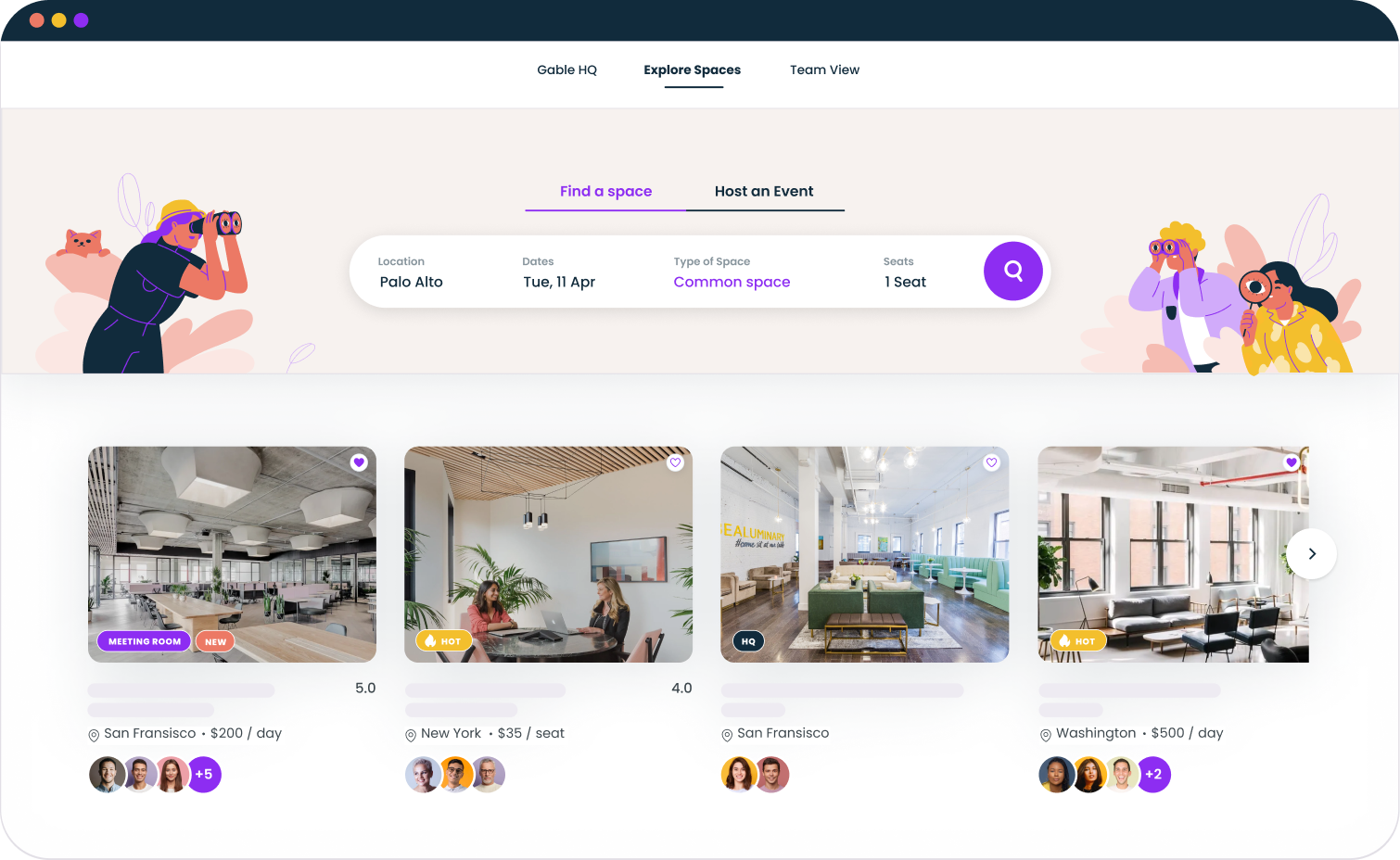
Workspace management software as a WeWork alternative
Here's a trend that most "WeWork alternatives" articles miss: for many enterprises, the real alternative isn't another coworking brand. It's software that lets you manage your own offices and flex space access from a single platform.
According to CommercialSearch, 41% of corporations now use coworking spaces, and enterprise memberships grew by 27% in 2024 alone. At that scale, the challenge isn't finding a coworking space; it's managing access, controlling costs, and understanding utilization across your entire real estate portfolio.
Workplace management software solves this by providing:
- Desk and room booking for your own offices
- On-demand coworking access through aggregated networks
- Budget controls and approval workflows by department, location, or individual
- Usage analytics that show which spaces are being used, by whom, and whether the spend is justified
- Integration with HRIS, calendar, and communication tools so workspace management fits into existing workflows
This category is particularly relevant for companies that have moved past the "do we need coworking?" question and are now asking "how do we manage coworking at scale?" For a broader look at the software landscape, see this workplace management software comparison.
Coworking trends reshaping the market in 2026
The coworking market isn't standing still. Several trends are changing what "WeWork alternative" means in practice.
The rise of the third workplace
The defining trend of 2026 is the "third workplace," a flex space that's neither home nor HQ but a local option within a short commute. According to Allwork.Space, suburban coworking spaces have seen 25% year-over-year growth in occupancy, outperforming downtown business districts. Roughly 65% of new coworking memberships in 2025-2026 were purchased for locations within a 15-minute commute of the worker's home.
For companies designing commuter benefits, this shift means coworking stipends may deliver more value than transit subsidies for some employees.
Hospitality as the differentiator
Coworking is converging with the hospitality industry. Across the industry, operators are designing spaces to look and feel like hotels, with bespoke amenities, curated food and beverage programs, and concierge-level service. The operators winning in 2026 are either big and efficient (IWG) or niche and personal. The middle ground is getting squeezed.
Industry-specific coworking
Operators are building spaces tailored to specific industries: bio-labs for life sciences, recording studios for creative media, and tech-optimized spaces with advanced AV setups. This specialization segment has matured into a $1.43B global market, and it acts as a defensive measure against commoditization in dense urban markets.
Employer-funded memberships dominate
The freelancer-funded coworking model is fading. Today, 45% of coworking memberships are paid for or subsidized by an employer. In a 2024 WeWork survey, 59% of companies planning to increase workspace in the next two years said they're choosing flexible space over traditional offices. This shift puts procurement, finance, and workplace teams in the driver's seat when selecting providers.
Enterprise coworking: Why access alone isn't enough
For companies with 100+ employees spread across multiple locations, the challenge with traditional coworking providers is operational, not spatial. You can sign up for Regus in London, Industrious in New York, and a local operator in Austin. But then you're managing three contracts, three billing systems, and zero consolidated data.
This is where platform-based alternatives create the most value. Gable On-Demand, for example, connects teams to 20,000+ global workspaces through a single platform with unified budget controls, permissions, and workplace analytics. Instead of juggling provider relationships, workplace teams set spending limits by department, approve bookings through existing channels like Slack or Teams, and track utilization across every location from one dashboard.
The result is that enterprises get the flexibility of coworking with the governance and visibility they need to manage real estate costs effectively.
What to evaluate before leaving WeWork
If you're currently on a WeWork membership and considering alternatives, here's a practical checklist:
- Audit your current usage. How many of your memberships are actively used? WeWork's own data showed significant underutilization before bankruptcy. Don't replicate that pattern with a new provider.
- Map your team's locations. Plot where your employees live and work. A provider with 3,000 locations doesn't help if none are near your people.
- Calculate your true cost per desk. Include membership fees, day passes, meeting room add-ons, and administrative time. Compare that to alternatives on an apples-to-apples basis.
- Assess your data needs. Do you need utilization reports for real estate planning? Budget tracking by department? Integration with your HRIS? If yes, a platform or software solution will serve you better than a direct coworking membership.
- Test before committing. Most alternatives offer trial periods or pay-per-use models. Run a 30-day pilot with your highest-volume team before signing an annual contract.
The bottom line on WeWork alternatives in 2026
The coworking market has matured past the point where any single provider can claim to be the default choice. WeWork's bankruptcy and recovery, Industrious's CBRE acquisition, IWG's franchise expansion, and the rise of workplace management platforms have created a market with genuine options for every company size and work model.
For startups, a direct membership with a local operator or budget provider still makes sense. For enterprises managing distributed teams, the value has shifted from "which coworking brand" to "which platform gives us access, control, and data across all providers." And for hybrid companies with their own offices, the answer increasingly involves software that manages both owned space and flex access in one place.
The companies that get the most from their flexible workspace spend in 2026 won't be the ones loyal to a single coworking brand. They'll be the ones that treat workspace as a managed portfolio, with the tools and data to optimize it continuously.
From office desk booking to on-demand coworking access across 20,000+ spaces, Gable gives workplace teams the control and visibility they need.
Get a demo


