.svg)


.svg)
TL;DR
- The workspace management software market hit $2.64 billion in 2025 and is projected to reach $10.30 billion by 2035, driven by hybrid work and AI adoption (Precedence Research)
- Global office utilization climbed to 53% in 2025 (up from 38% in 2024), and 81% of CRE teams now prioritize increasing it further (CBRE, 2026)
- 53% of remote-capable workers operate in hybrid arrangements, making desk booking, room scheduling, and utilization analytics non-negotiable features (Gallup, 2025)
- We evaluated eight platforms across core functionality, integrations, analytics depth, scalability, and pricing to help you pick the right fit
- Gable stands out as the only platform combining office management, on-demand coworking access (20,000+ spaces), visitor management, and event coordination in a single dashboard
Workplace management software helps organizations coordinate desk bookings, room reservations, visitor check-ins, and space utilization tracking from a single platform. With office utilization surging 15 percentage points in a single year and hybrid work now the dominant model for knowledge workers, choosing the right platform directly impacts your real estate costs, employee experience, and operational efficiency. This guide compares the top platforms for 2026, explains our evaluation methodology, and gives you a buyer's checklist you can use today.
What is workplace management software?
Workplace management software is a category of digital platforms that centralize how organizations manage their physical spaces and the people using them. At its core, these tools handle desk booking, meeting room scheduling, visitor management, and space utilization analytics in one system.
The category has evolved significantly since the pandemic. What started as simple room reservation tools has grown into comprehensive platforms that integrate with your calendar, HR systems, access control, and communication tools. Modern workplace technology stacks connect booking data with occupancy sensors, badge swipes, and Wi-Fi signals to give facilities teams a real-time picture of how space is actually being used.
This evolution reflects a fundamental shift in how organizations think about their offices. According to JLL's 2025 Global Occupancy Planning Benchmark Report, 73% of CRE leaders now rank portfolio optimization as their top objective, overtaking cost reduction for the first time. That means the software you choose isn't just an IT decision; it's a real estate strategy decision.
The distinction between workplace management software and broader integrated workplace management systems (IWMS) matters here. IWMS platforms tend to focus on the building itself: lease management, capital projects, energy systems. Workplace management software focuses on the people: where they sit, when they come in, who they're meeting with, and how the space supports their work. Some platforms bridge both categories, but most buyers in the 200-5,000 employee range need the people-focused tools first.
For organizations running hybrid work models, workplace management software solves a specific coordination problem. When only a portion of your workforce is in the office on any given day, you need visibility into who's coming in, which desks and rooms are available, and how utilization patterns shift across the week. Without this data, you're either paying for space nobody uses or running short on peak days.
Why workplace management software matters in 2026
The business case for workplace management software has never been stronger, and the data from 2025-2026 makes that clear across four dimensions.
The market is growing fast. The workspace management software market was valued at $2.64 billion in 2025 and is projected to reach $10.30 billion by 2035, growing at a 14.6% CAGR. Cloud-based solutions already account for 58% of the market, and the space/desk management segment captures the largest share at 29%. This isn't a niche category anymore. It's becoming core infrastructure for how companies operate their offices.
Office utilization is climbing, but the gap persists. CBRE's 2026 Global Workplace and Occupancy Insights report found that global office utilization reached 53% in 2025, up from 38% in 2024 and 35% in 2023. That's significant progress, but 87% of organizations still set explicit utilization targets averaging 76-85%, meaning there's a 20+ percentage point gap between actual and desired usage. Closing that gap requires data, and data requires software.
Hybrid work is the default, not the exception. Gallup's latest workforce panel data shows 53% of remote-capable U.S. employees now work hybrid, 27% work fully remote, and just 20% are entirely on-site. Perhaps more telling: 60% of fully remote employees say they would actively job-search if their employer eliminated flexibility entirely. For organizations with hybrid work policies, workplace management software isn't optional. It's how you make the office worth the commute.
The cost of getting it wrong keeps rising. McKinsey's analysis projects office demand could be 13-20% lower by 2030 compared to 2019 levels. Companies with effective space management are reducing real estate costs by 15-30% through hot-desking, space consolidation, and data-driven portfolio decisions. Meanwhile, Gallup's 2025 State of the Global Workplace report found global employee engagement sitting at just 21%, costing an estimated $438 billion in lost productivity worldwide. The workplace itself is a lever for engagement, and the software managing it determines whether that lever works.
Our evaluation methodology
Transparency matters when recommending software, especially when we're one of the platforms in the comparison. Here's exactly how we assessed each tool.
How we selected platforms. We focused on tools that specifically address physical workplace management for hybrid teams: desk booking, room scheduling, visitor management, and utilization analytics. We excluded pure workforce management tools (scheduling, time tracking, payroll), pure IWMS platforms focused on building operations, and project/task management software. We also prioritized platforms with sufficient market presence and user reviews to evaluate meaningfully.
Scoring criteria. We evaluated each platform across six weighted dimensions:
- Core functionality (30%): Desk booking, room scheduling, visitor management, floor plans, no-show handling
- Integrations (20%): Calendar, communication, HR, and access control system compatibility
- Analytics and reporting (20%): Utilization dashboards, trend analysis, exportable data, real-time vs. historical
- Scalability (15%): Multi-location support, enterprise readiness, policy flexibility
- User experience (10%): Mobile app quality, onboarding ease, adoption friction
- Pricing transparency (5%): Published pricing, free trials, clear tier structure
G2 and user sentiment data. Where available, we incorporated G2 review data including overall ratings, review volume, and top user feedback themes. G2 uses verified reviews from authenticated users, making it one of the more reliable third-party sources for software evaluation. We note where G2 data was limited or unavailable for specific platforms.
A note on objectivity. Gable is one of the platforms reviewed here. We've been transparent about our scoring methodology and criteria weights so you can apply the same framework to any tool on your shortlist, including options we haven't covered.

New to workplace management? Our complete guide covers what it is, why it matters, and how to build a strategy that works for hybrid teams.
Read the guide
The best workplace management software compared [table]
1. Gable (best for hybrid teams managing multiple workspace types)
Gable is the only platform in this comparison that combines office management, flexible workspace access, visitor management, and event coordination in a single dashboard. That breadth matters for distributed organizations that need to manage both their own offices and external coworking spaces.
Core capabilities. Gable's office management tools include desk booking with interactive floor plans, meeting room scheduling with auto-release for no-shows, neighborhood configuration for team-based seating, and real-time utilization analytics. The platform's On-Demand feature provides access to 20,000+ coworking spaces across 600+ cities globally, which is unique in this category. Most workplace management platforms assume you only need to manage space you own or lease. Gable also manages the space you don't.
Visitor management. Gable's visitor management system handles pre-registration, QR code check-in, badge printing, arrival notifications, and compliance documentation. It integrates with the same dashboard used for desk and room booking, so facilities teams get a unified view of everyone in the building.
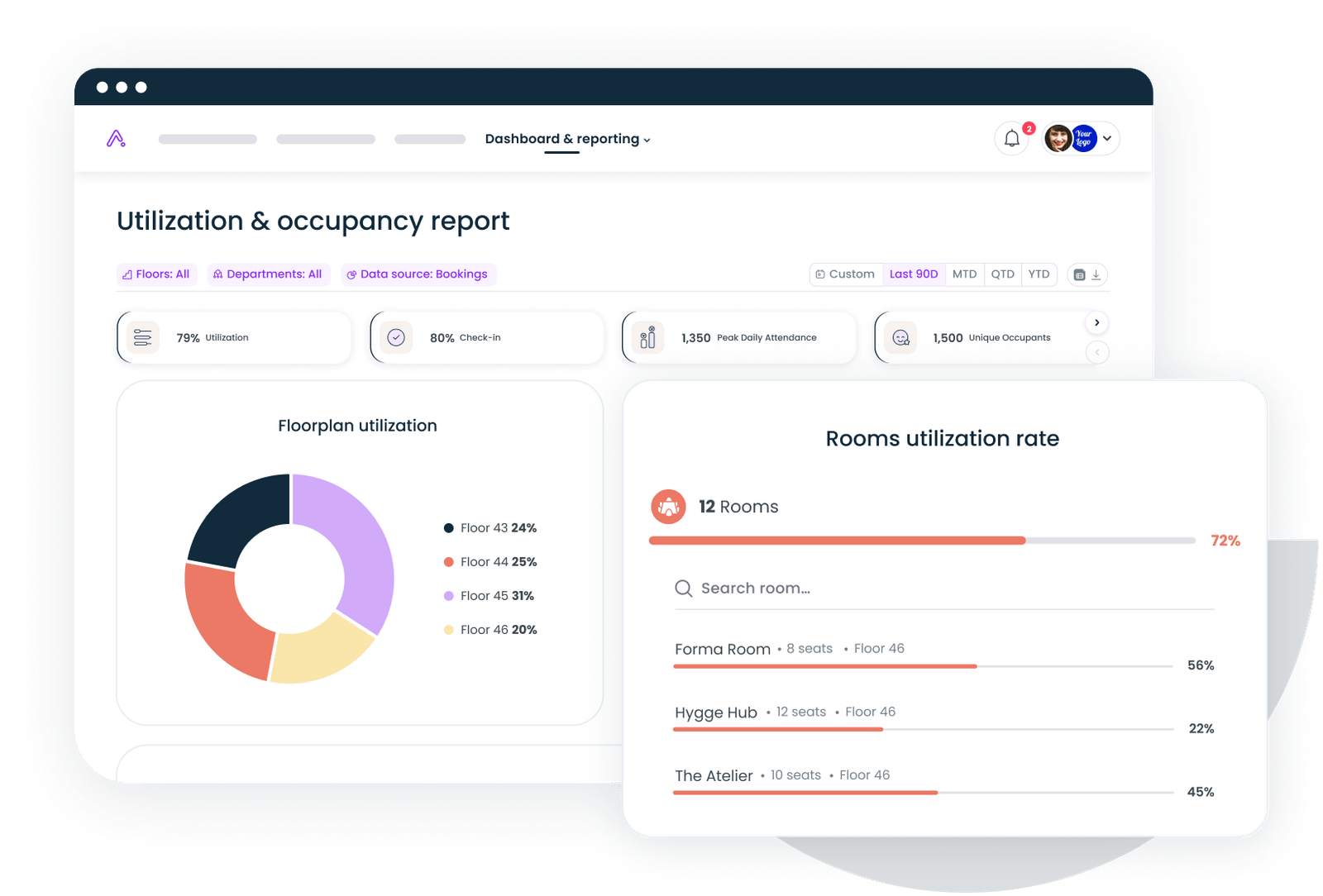
Analytics. Utilization data is available in real time, with historical trend analysis, peak-day identification, and neighborhood-level breakdowns. The platform feeds occupancy data directly into space planning decisions, helping teams identify which areas are overbooked and which sit empty.
Integrations. Microsoft Teams, Slack, Google Workspace, Outlook, Workday, Rippling, BambooHR, Brivo, and Verkada. The calendar integrations are bidirectional, so bookings made in the app appear on employee calendars and vice versa.
G2 user sentiment. Gable has 46 reviews on G2, with top positive themes including Ease of Use (18 mentions), Intuitive design (14), Customer Support (13), Navigation Ease (12), and User Interface (11). Users frequently highlight the platform's flexibility for managing both owned offices and coworking spaces, plus the responsiveness of the support team. Companies like Twilio, Checkr, and Upwork use Gable to manage their workplaces.
Pricing. $3/seat/month for desk booking and room scheduling (annual billing). Visitor management at $150/month per location. Custom enterprise pricing available for organizations needing the full platform.
Best for: Distributed organizations managing multiple workspace types, companies with hybrid policies across locations, and teams that want to reduce fixed real estate costs while maintaining access to flexible space. Gable's internal data shows 72% of bookings are for team gatherings, and customers see an average 32% reduction in unused space.
2. Envoy (best for visitor management and workplace security)
Envoy built its reputation on visitor management and has since expanded into a comprehensive workplace platform. That heritage shows: if your top priority is managing who enters your buildings, Envoy's visitor features remain among the strongest in the market.
Strengths. Envoy's visitor management includes pre-registration, ID scanning, watchlist screening, customizable badges, and an occupancy dashboard that combines visitor and employee data. The platform also offers desk booking, room scheduling, and deliveries management. The lobby experience is polished and professional, which matters for organizations hosting clients and external partners regularly.
Limitations. Envoy's workplace management features (desk booking, room scheduling) came later and aren't as deeply developed as platforms that were built for those use cases from the start. The pricing structure can add up quickly since visitor management, desks, and rooms are often priced as separate modules.
Pricing. $5-$12/user/month depending on modules; visitor management priced separately per location.
Best for: Organizations where visitor management is the primary need, or companies with high-security or compliance requirements that demand robust lobby and access management. Also strong for organizations that host frequent external guests and want a polished, professional check-in experience.
3. Robin (best for employee experience and adoption)
Robin focuses on making the office experience frictionless for employees. The platform emphasizes clean design, intuitive UX, and team coordination features that drive high adoption rates among end users.
Strengths. Robin's desk booking includes real-time office maps, AI-powered desk suggestions, and colleague visibility features that let employees see where their teammates are sitting. The meeting room scheduling is solid, with calendar integration and room display compatibility. The platform's focus on user experience means adoption tends to be higher than tools that feel more like facilities management software.
Limitations. Robin's analytics capabilities aren't as deep as some enterprise-focused competitors. Visitor management is available but isn't the platform's core strength. Organizations with complex, multi-building portfolios may find Robin better suited as a complement to a heavier space planning tool.
Pricing. Starting around $5/user/month.
Best for: Mid-size companies (200-2,000 employees) that prioritize employee experience and want a tool their workforce will actually use without constant nudging. Strong choice for organizations where adoption is the primary concern.
4. OfficeSpace Software (best for space planning and move management)
OfficeSpace Software provides a comprehensive workplace management suite with particular strength in space planning and facility management. The platform serves enterprise organizations that need detailed control over their real estate portfolio and move management capabilities.
Strengths. OfficeSpace stands out in interactive mapping, scenario planning for office redesigns, and move coordination. If your facilities team regularly handles office moves, seating reassignments, or floor plan redesigns, OfficeSpace's visual planning tools deliver depth that most booking-focused competitors don't. The platform also covers desk booking, room scheduling, and visitor management.
Limitations. The depth of OfficeSpace's space planning features comes with a steeper learning curve. Implementation timelines tend to be longer than lighter tools, and the platform is built for organizations with dedicated facilities or workplace operations teams.
Best for: Large enterprises (1,000+ employees) that need detailed space planning, CAD integration, move management, and scenario modeling alongside standard booking capabilities.
5. Condeco (best for enterprise meeting room management)
Condeco focuses on enterprise-grade meeting room booking and workspace management. The platform handles complex scheduling scenarios that simpler tools struggle with: multi-timezone coordination, catering integration, equipment booking, and room configuration management.
Strengths. Advanced room management is where Condeco differentiates. If your organization has complex meeting room requirements (think multi-building campuses with different room types, catering needs, and AV setups), Condeco handles that complexity well. The platform also supports global deployments across multiple time zones with centralized management.
Limitations. Condeco is heavier than most mid-market tools. Implementation timelines tend to run longer, and the platform is designed for organizations with dedicated facilities teams. Desk booking capabilities exist but aren't as refined as the room management features.
Best for: Large multinational organizations with complex meeting room requirements and dedicated facilities management teams.
6. Kadence (best for hybrid team schedule alignment)
Kadence focuses specifically on hybrid work coordination, helping teams align their in-office days around when colleagues will be present. The platform emphasizes the social and collaborative aspects of office attendance.
Strengths. Kadence's team attendance visibility features let employees and managers see who's planning to be in the office on which days, making it easier to coordinate hybrid schedules. The platform includes desk booking, meeting room scheduling, visitor management, event coordination, and utilization analytics. Its scheduling intelligence helps organizations identify the best days for team gatherings.
Limitations. Kadence's feature set is focused on coordination rather than deep space management. Organizations needing advanced floor planning, move management, or complex booking policies may need to supplement Kadence with additional tools.
Best for: Organizations emphasizing team schedule alignment for in-office days, particularly companies where the primary challenge is getting the right people in the office on the same days for meaningful collaboration.
7. Skedda (best for diverse resource types and budget-conscious teams)
Skedda takes a different approach by managing a wide range of bookable resources beyond traditional desks and meeting rooms. The platform handles studios, labs, equipment, parking, and other non-traditional spaces with configurable booking rules.
Strengths. Skedda's flexibility in resource types is its main differentiator. The platform offers visual booking, rules-based access control, payment processing for shared spaces, recurring bookings, and waitlist management. The tiered pricing model starting with a free plan makes it accessible for smaller organizations or teams testing workplace management software for the first time.
Limitations. Skedda is lighter than full workplace management suites. It doesn't offer the depth of analytics, visitor management, or HR integrations that larger platforms provide. Organizations with 500+ employees typically outgrow Skedda's capabilities.
Pricing. Tiered pricing starting with a free plan; paid plans based on booking volume and features.
Best for: Organizations managing diverse resource types (studios, labs, equipment), smaller teams (under 500 employees), and budget-conscious organizations looking for an affordable entry point into workspace management.
8. Tactic (best for mobile-first hybrid scheduling)
Tactic positions itself as a hybrid workplace solution that bridges remote and office work. The platform emphasizes team coordination with a polished mobile experience, helping employees plan their in-office days around when their colleagues will be present.
Strengths. The team coordination views are Tactic's differentiator. Employees can see who's planning to come in on which days, making it easier to align schedules for collaboration. The mobile-first design is polished, and check-in requirements help reduce ghost bookings (reservations that go unused). Desk booking, meeting room scheduling, and basic analytics are all included.
Limitations. Tactic's feature set is narrower than full-suite platforms. Visitor management and external coworking access aren't core capabilities. Analytics are functional but less detailed than what you'd find in enterprise-focused tools.
Best for: Organizations that prioritize hybrid schedule coordination and want a mobile-first experience for employees. Works well for teams where the primary challenge is getting the right people in the office on the same days.
Desk booking, room scheduling, visitor management, and utilization analytics in one platform. See how it works for hybrid teams managing multiple locations.
Learn more
The buyer's checklist: how to evaluate workplace management software
Before you start comparing platforms, use this checklist to define your requirements and score each tool consistently. Assign each item a priority (must-have, nice-to-have, or not needed) and rate each vendor on a 1-5 scale.
1. Core booking functionality
- Desk booking with real-time availability and interactive floor plans
- Meeting room scheduling with calendar sync and auto-release for no-shows
- Hot desking support with neighborhood/zone configuration
- Mobile booking (native app, not just mobile web)
- Recurring booking support for regular in-office days
2. Visitor and access management
- Digital visitor pre-registration and check-in
- Badge printing and ID verification
- Arrival notifications to hosts
- Compliance documentation and audit trails
- Integration with physical access control systems
3. Analytics and utilization data
- Real-time occupancy dashboards
- Historical utilization trends by floor, zone, and time period
- Peak-day identification and forecasting
- Exportable reports for leadership and CRE planning
- Benchmarking against utilization targets
4. Integration depth
- Bidirectional calendar sync (Google Workspace, Microsoft 365)
- Communication platforms (Slack, Microsoft Teams)
- HR/people systems (Workday, BambooHR, Rippling)
- Single sign-on (Okta, Azure AD, Google)
- Access control and security systems
5. Scalability and flexibility
- Multi-location support with centralized management
- Configurable booking policies per location, team, or department
- Support for different workspace types (desks, rooms, parking, lockers)
- Ability to add locations without major reconfiguration
- API access for custom integrations
6. Implementation and support
- Deployment timeline under 4 weeks for core features
- Dedicated onboarding and training resources
- Responsive customer support (chat, email, phone)
- Regular product updates and feature releases
- Change management support for driving employee adoption
7. Cost structure
- Transparent per-seat or per-location pricing
- Free trial or pilot program available
- No hidden fees for integrations, support, or data exports
- Flexible contract terms (monthly vs. annual)
- Clear ROI framework (cost savings from space reduction, productivity gains)
How to use this checklist. Share it with your evaluation committee (facilities, HR, IT, and end users). Have each stakeholder mark their priorities, then score your shortlisted platforms against the same criteria. The platform that scores highest on your must-have items, regardless of nice-to-have features, is usually the right choice.
Implementation best practices for workplace management software
Rolling out workplace management software successfully depends less on the tool you choose and more on how you introduce it. CBRE's 2026 data shows that 70% of organizations report employees are in the office less than leaders expect, and poor software adoption is a contributing factor.
Start with clear success metrics. Define what success looks like before you sign a contract. Common metrics include: target utilization rate (most organizations aim for 76-85% per JLL's 2025 benchmarking), booking adoption rate among employees, reduction in ghost bookings, and space cost savings per quarter.
Pilot before you scale. Start with one floor or one office. Run the pilot for 30-60 days. Measure adoption rates, collect employee feedback, and identify friction points. Fix them before expanding. Organizations that skip the pilot phase typically see lower long-term adoption.
Invest in change management. The best software fails if employees don't use it. Communicate the "why" clearly: this isn't surveillance, it's coordination. Make booking as frictionless as possible (Slack commands, calendar integration, mobile app). Identify power users who can champion adoption within their teams.
Configure thoughtfully. Resist the urge to enforce every policy on day one. Start with core booking functionality, then layer in attendance requirements, neighborhood configurations, and approval workflows as employees get comfortable. An employee experience strategy that accounts for gradual adoption outperforms a rigid rollout every time.
Measure and iterate. Review utilization data monthly. Share insights with leadership and employees. Use the data to adjust office layouts, booking policies, and even real estate decisions. The organizations seeing the biggest ROI from workplace management software are the ones treating their office like a product: measuring, learning, and iterating.
The future of workplace management software
The category is moving fast. Here's where it's heading in 2026 and beyond.
AI-powered space optimization. Machine learning is moving beyond dashboards into proactive recommendations. Expect platforms to suggest which floors to open on which days based on booking patterns, recommend seating arrangements that maximize team proximity, and flag underutilized spaces before quarterly reviews. The workforce management software market (valued at $9.76 billion in 2026) is investing heavily in AI capabilities across the board.
Building system convergence. Workplace management software is beginning to connect with building systems: HVAC, lighting, cleaning, and energy management. When the platform knows only 40% of a floor is booked tomorrow, it can signal the building management system to reduce HVAC output on that floor. This convergence ties workplace management directly to sustainability goals and operational cost savings.
Employee experience integration. The line between workplace management and employee experience platforms is blurring. Booking a desk is just the start. Future platforms will surface information like which colleagues are in the office, what events are happening, where the quiet zones are, and which cafe has the shortest line. The goal is making the office visit feel intentional and productive, not random.
Sensor and IoT integration. Badge swipes tell you who entered the building, but sensors tell you who's actually using the space. Occupancy sensors, under-desk presence detectors, and environmental monitors are feeding real-time data into workplace management platforms, giving facilities teams a live view of their buildings rather than relying on booking data alone.
Choosing the right workplace management software for your team
The workplace management software market has matured significantly. What used to be a nice-to-have for forward-thinking companies is now operational infrastructure for any organization running a hybrid model. With office utilization climbing and 73% of CRE leaders prioritizing portfolio optimization, the software you choose determines whether your office data informs decisions or just collects dust.
For most hybrid organizations in the 200-5,000 employee range, the decision comes down to breadth vs. depth. If visitor management and security are your top priorities, Envoy leads there. If employee experience and adoption matter most, Robin delivers. If you need advanced space planning and move management, OfficeSpace is purpose-built for that. If you need a unified platform that handles desk booking, room scheduling, visitor management, and flexible workspace access in one system, Gable's office management platform covers the full spectrum without requiring multiple vendor relationships.
The buyer's checklist above gives you a structured framework for evaluating any platform. Use it, involve your stakeholders, and pilot before you commit. The right workplace management software doesn't just manage space; it turns your office into a strategic asset.
Book a personalized demo to see how Gable's unified platform handles desk booking, room scheduling, visitor management, and analytics for hybrid teams.
Get a demo