.svg)


.svg)
- Remote work has stabilized at 23.7% of U.S. workdays, and RTO mandates aren't reversing the trend
- AI adoption is reshaping distributed workflows, with 54% of workers already using AI tools on the job
- Sales, marketing, and account management are the fastest-growing remote job categories in 2026
- Remote workers earn 12-35% more than on-site peers, and employees value flexibility as an 8% pay raise
- Cybersecurity risks are climbing, with breach costs averaging $1.07 million higher for remote-related incidents
Remote work trends in 2026 tell a clear story: flexibility is a permanent feature of how companies operate, hire, and compete for talent. Despite high-profile return-to-office mandates from Amazon, JPMorgan, and the federal government, the data shows remote and hybrid work holding steady, or even growing, across the private sector. What's changed is the conversation. Leaders aren't debating whether remote work "works." They're asking how to manage it better, measure it more precisely, and build workplace strategies around real occupancy and engagement data.
This article compiles 40+ data-backed statistics across prevalence, productivity, retention, compensation, AI adoption, cybersecurity, and job market shifts to give workplace leaders a complete picture of where remote work stands right now.
How prevalent is remote work in 2026?
The baseline numbers have held remarkably steady since late 2023, despite executive pressure to bring workers back.
Telework rates remain elevated
According to the Bureau of Labor Statistics, the share of employed persons teleworking on an average day was 23.7% in early 2025, up from 17.9% in October 2022. That's a meaningful increase during a period when most headlines focused on RTO mandates.
Stanford economist Nick Bloom's research, which tracks hybrid work data across industries, estimates that about 27% of paid full-time workdays in the U.S. are now worked from home.
The hybrid model dominates
The distribution of work arrangements in 2026 looks like this:
- 52% of remote-capable workers operate in hybrid arrangements
- 26% work fully remote
- 21% are fully on-site
These numbers from Gallup's ongoing workforce surveys confirm that hybrid has become the default for knowledge workers. The vast majority of companies plan to sustain hybrid models through 2026 and beyond, reinforcing that hybrid has become the default for knowledge work.
Industry breakdown: Who's remote and who isn't
Remote work isn't evenly distributed. Technology leads at 47% fully remote, followed by finance and insurance at 40%. But the growth story in 2026 is happening in unexpected places. According to the FlexJobs Remote Work Index, Q1 2026 saw remote job postings increase 20% overall, with the sharpest gains in:
- Sales and business development: +40% growth in fully remote roles
- Account management: +30%
- Marketing and communications: +30%
- Project management: overtook IT as the #1 remote occupation
The fastest-growing remote fields by specialization are AI, cybersecurity, cloud architecture, and data analytics.

Get the latest research on why hybrid work data matters more than executive instinct when setting workplace policy.
Read the research
RTO Mandates aren't working the way leaders expected
This is one of the most important remote work trends 2026 has surfaced: mandates and reality don't match.
The numbers tell the story
Despite 83% of CEOs anticipating a full return to office by 2027 (per a KPMG survey), badge-swipe data and cell phone tracking show employees aren't coming in as often as their employers demand. Remote work was higher in early 2025 (23.7%) than in October 2022 (17.9%), the period when most major return-to-office mandates were announced.
Federal vs. private sector: A case study in mandates
The federal government's 2025 mandate to end remote work for most employees provides a natural experiment. The percentage of federal workers in hybrid arrangements dropped from 61% to 28% after the mandate took effect. But in the private sector, hybrid and remote arrangements remained stable during the same period.
The takeaway: mandates can force compliance in hierarchical organizations with limited labor market alternatives. In competitive private-sector hiring markets, they tend to backfire. Companies like Amazon have learned this firsthand, facing attrition spikes and talent pipeline challenges after enforcing strict in-office requirements.
What works instead
Organizations seeing the best outcomes are treating workplace strategy like a product, iterating based on data rather than issuing top-down edicts. That means tracking real occupancy patterns, measuring collaboration quality, and adjusting policies based on what the numbers show. Gable's AI-powered workplace intelligence helps leaders do exactly this, turning complex occupancy and engagement data into clear, actionable insights so decisions are grounded in evidence rather than assumptions.
Productivity: what the research actually shows
The productivity debate has matured significantly. The question isn't binary anymore.
Remote work doesn't hurt productivity
The BLS found a positive correlation (0.08%) between telework adoption and total factor productivity growth across industries. That's modest, but it runs counter to the narrative that remote work drags output down.
Stanford's WFH Research confirms that remote workers show no measurable negative impact on career advancement or output quality when compared to in-office peers. The key variable isn't location; it's management quality.
Hybrid outperforms when managed well
McKinsey's research adds important nuance: well-organized hybrid teams are approximately 5% more productive than both fully remote and fully on-site teams. Poorly managed hybrid arrangements, on the other hand, suffer from what researchers call a "coordination tax," where the overhead of syncing schedules and managing inconsistent attendance erodes the flexibility gains.
This is why measuring hybrid work success requires more than headcounts. It requires understanding when teams are together, whether those gatherings produce collaboration, and how space is being used during peak and off-peak days.
Engagement varies by arrangement
Gallup's engagement data breaks down like this:
- 31% of fully remote workers report being engaged at work
- 23% of hybrid workers report engagement
- 19% of fully on-site workers report engagement
Fully remote workers report the highest engagement, but they also face unique challenges around isolation and connection, which we'll cover in the wellness section below.
The wellness paradox: Flexibility helps, but isolation is real
Remote work's mental health benefits are well-documented, but the picture isn't uniformly positive.
The upside
- 79% of remote professionals report lower stress levels compared to when they worked on-site
- 82% say their mental health has improved with flexible work arrangements
- Workers save an average of 40 minutes per day on commuting, time that research links to better sleep, more exercise, and improved family relationships
The downside
- 22% of remote workers report feeling isolated when working from home for extended periods
- 30% of remote workers describe themselves as unengaged, despite higher overall engagement averages
- Loneliness and disconnection are the top reasons remote workers consider returning to an office
This paradox explains why the most effective workplace strategies don't force a single model. They give employees options. Distributed teams that combine remote flexibility with intentional in-person gatherings, whether through company events or coworking days, report better outcomes on both productivity and wellbeing metrics.
Gable Insights gives you real-time data on office utilization, collaboration patterns, and space efficiency across your entire portfolio.
Learn more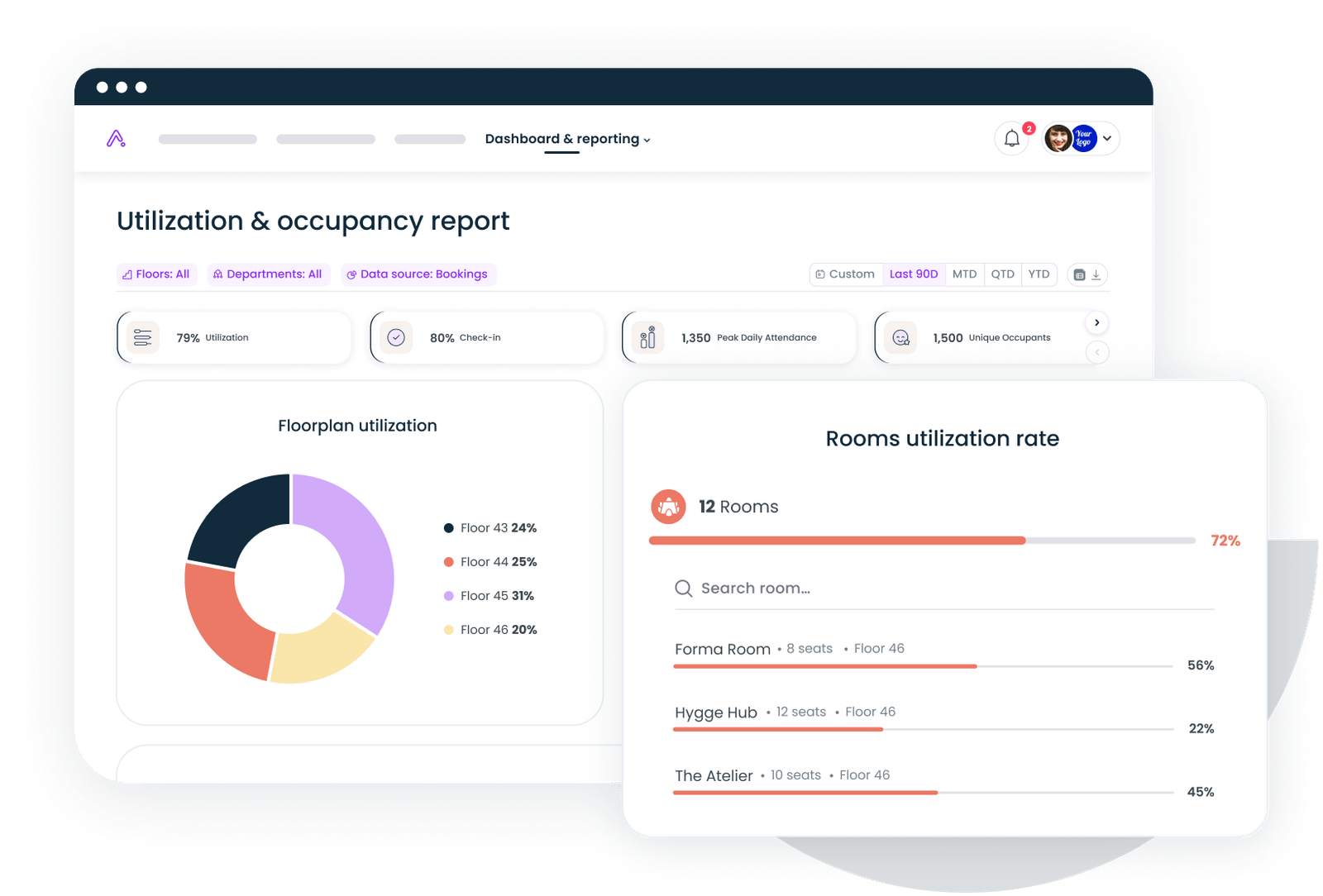
Compensation trends: Remote work carries a wage premium
One of the most striking remote work trends 2026 has reinforced is the compensation gap between remote and on-site workers.
Remote workers earn more
- Remote employees earn 12% more on average than on-site employees
- Before adjusting for occupation, education, and experience, remote workers earn 35.2% higher hourly wages
- The highest-paying remote roles in 2026 include Senior Project Manager ($136K), Data Engineer ($135K), and Cloud Architect ($142K)
Employees value flexibility as compensation
The behavioral economics data is equally telling:
- Employees value the option to work hybrid as equivalent to an 8% pay raise
- 37% of workers would accept a 10% pay cut to maintain remote work
- 66% of workers would accept 95% or more of their current salary for a fully remote role
- Some tech workers report willingness to accept 25% pay cuts for permanent remote arrangements
For talent attraction, these numbers have significant implications. Companies offering flexibility have a measurable recruiting advantage that's worth real dollars in compensation savings.
Retention: flexibility is now a dealbreaker
The retention data makes the business case for flexible work arrangements hard to ignore.
Key retention statistics
- 90% of companies plan to maintain or expand remote work options through 2026
- 76% of employees say they'd quit if forced to return to the office full-time
- 85% of job seekers cite remote or hybrid options as a primary factor in their job search
- Only 30% of employers require five-day in-office attendance
The cost of getting it wrong
Companies that eliminate flexibility face compounding costs: higher turnover, longer time-to-fill for open roles, and increased compensation demands from candidates who expect remote options as standard. A strong employee retention strategy in 2026 treats workplace flexibility as infrastructure, not a perk.
The employer cost savings remain substantial too. Organizations save an estimated $6,000 to $12,000 per remote employee per year through reduced real estate, utilities, and overhead costs.
AI Is reshaping how distributed teams work
AI adoption is one of the defining remote work trends 2026 has accelerated, and its impact on distributed work is particularly significant.
Adoption is widespread
- 54% of workers across all industries have used AI tools at work
- 92% of commercial real estate teams are exploring AI pilots for space planning and portfolio optimization
- AI-powered collaboration tools now handle scheduling, meeting summarization, project tracking, and asynchronous communication at scale
What AI changes for remote teams
AI's biggest impact on remote work isn't replacing jobs. It's reducing the coordination overhead that makes distributed work harder than co-located work. Intelligent assistants handle meeting notes, surface relevant context before calls, and flag scheduling conflicts across time zones.
For workplace leaders, AI adoption means better data on how spaces are used, when teams collaborate most effectively, and where real estate investments are paying off. The shift from gut-feel decisions to data-driven workplace strategy is accelerating because AI makes the analysis faster and more accessible.
The job market is shifting accordingly
The fastest-growing remote specializations, including AI engineering, cybersecurity, and cloud architecture, reflect this trend. Companies need distributed talent that can build and manage the AI infrastructure supporting remote operations.
Cybersecurity: the growing risk of distributed work
As remote work stabilizes, the security challenges are intensifying.
The threat landscape
- Cybersecurity leaders consistently flag distributed work as one of the top vulnerabilities in their current threat models
- 73% of remote employees admit to using personal devices for work
- Only 55% of those personal devices meet corporate security standards
- 42% of phishing attacks targeting remote workers succeed, compared to lower rates in office environments
- When remote work contributes to a data breach, costs average $1.07 million higher than office-based breaches
What this means for workplace strategy
Security can't be an afterthought in distributed work models. Organizations need clear policies on device management, network access, and data handling. Workplace security awareness programs designed for remote and hybrid employees are becoming standard practice at companies that take this risk seriously.
Physical security matters too. For offices that operate with variable daily attendance, visitor management and access control systems provide a baseline of accountability that badge-swipe data alone can't deliver.
Asynchronous work and the four-day week
Two structural shifts are gaining momentum alongside remote work in 2026.
Async-first cultures are growing
Companies with distributed teams across multiple time zones are increasingly adopting asynchronous communication as the default. This means fewer synchronous meetings, more documented decisions, and collaboration tools designed for time-shifted work.
The productivity data supports this approach. Teams that reduce unnecessary meetings and invest in clear written communication report fewer interruptions and higher deep-work output.
Four-day work week pilots are expanding
Early pilot programs for compressed schedules have shown promising results:
- Companies implementing four-day weeks report increased employee satisfaction and reduced burnout
- Productivity in most pilots has remained flat or improved
- Retention rates improve measurably in organizations offering compressed schedules
These models pair naturally with hybrid arrangements. When employees have fewer required office days and more autonomy over their schedules, the combination of flexibility and compressed time creates a compelling value proposition for both recruitment and retention.
What workplace leaders should do with this data
The remote work trends 2026 has produced point toward a few clear priorities for workplace, people, and operations teams.
Right-size your real estate based on actual usage
With 52% of workers in hybrid arrangements, most offices are overbuilt for their actual daily occupancy. Tracking space utilization metrics and adjusting your portfolio accordingly can reduce costs by 25% or more without affecting employee experience.
Invest in coordination, not mandates
The data consistently shows that mandates produce compliance without engagement. Organizations that invest in coordination tools, intentional gathering schedules, and clear hybrid policies see better collaboration outcomes than those relying on attendance requirements.
Treat flexibility as a compensation lever
When employees value hybrid work at 8% of salary, offering flexibility is one of the most cost-effective retention and recruiting tools available. Factor this into total compensation analysis.
Take cybersecurity seriously
With 73% of remote workers using personal devices and breach costs running $1.07 million higher for remote-related incidents, security infrastructure for distributed teams isn't optional. It's a cost-of-doing-business requirement.
Use data to iterate
The best workplace strategies in 2026 aren't static policies. They're living systems that adjust based on occupancy data, employee feedback, and collaboration metrics. Workplace analytics provide the foundation for this kind of continuous improvement.
Connect your offices, flex spaces, and workplace data to make smarter decisions about where and how your teams work.
Get a demo