
.svg)


.svg)
- Remote work means working from any location without a fixed office; it's distinct from WFH, hybrid, telecommuting, and digital nomad arrangements
- Hybrid work has stabilized as the dominant model, with 3-day in-office schedules now the most common policy among Fortune 100 companies
- Stanford research confirms hybrid work has zero negative impact on productivity or career advancement, while cutting resignations by 33%
- Remote and hybrid workers earn 12% higher hourly wages on average than fully in-office peers
- Coworking and flex space adoption is accelerating, with 55% of global occupiers now using flexible office solutions
The question "what is remote work" sounds straightforward, but the answer has gotten more nuanced since the pandemic-era scramble to send everyone home. Six years later, remote work has evolved from crisis response into a structured, data-backed work model that companies like Stripe, Snowflake, and Dropbox have refined into deliberate strategy. According to Gallup's 2025 engagement data, 53% of remote-capable workers now operate in a hybrid arrangement, 27% work fully remote, and only 20% are fully on-site. The landscape has settled, but the terminology hasn't. HR leaders, workplace teams, and employees still conflate remote work, work from home, hybrid, and telecommuting. This guide breaks down each model, compares them side by side, and provides the latest hybrid work statistics you need to build a workplace strategy that fits your organization.
Quick comparison: Remote work models at a glance
Before diving into definitions, here's a reference table that maps the five most common work models against their key characteristics:
| Model | Location flexibility | Office attendance | Primary use | Typical schedule |
|---|---|---|---|---|
| Remote work | Anywhere (geographic freedom) | 0-2 days/week optional | Full-time employment | Async-first culture |
| Work from home (WFH) | Home only | None (home-exclusive) | Part-time or occasional | Home office setup |
| Hybrid work | Home + office | 2-3 days/week required | Balanced collaboration + focus | Fixed or flexible days |
| Telecommuting | Off-site + occasional office | 1-2 days/week check-ins | Transitional to hybrid | Geographic proximity required |
| Digital nomad | Global/traveling | None required | Lifestyle + freelance/contract | Time zone independent |
This table captures the structural differences, but each model carries distinct implications for policy, culture, and cost. Let's unpack them.
What is remote work?
Remote work allows employees to perform their jobs from any location without reporting to a physical office. That could mean a home office, a café, a coworking space, or a different country entirely. The defining characteristic is the decoupling of location from employment itself.
The biggest shift remote work introduced is an output-based relationship between employer and employee. Instead of tracking hours in a chair, managers measure deliverables, KPIs, and outcomes. Companies that operate this way rely heavily on written communication, thorough documentation, and clear performance expectations.
Remote work was accelerated by the COVID-19 pandemic in 2020, but it was made possible by decades of technological progress: cloud computing, video conferencing, project management tools, and always-on messaging platforms. According to Robert Half's Q4 2025 data, 88% of employers now offer some form of hybrid or remote arrangement, and 11% of job postings are fully remote.
Remote-first vs. remote-friendly
Not all remote work policies are created equal. The distinction between remote-first and remote-friendly matters for both employers and job seekers.
Remote-first companies design every process around remote participation. Meetings default to video. Documentation is the primary communication channel. Decisions happen asynchronously. Office space, if it exists, is optional.
Remote-friendly companies allow remote work but default to office-based norms. Meetings happen in conference rooms with a dial-in link added as an afterthought. Promotions and visibility tend to favor those who show up in person.
The difference has real consequences. Remote-friendly organizations often create a two-tier employee experience where in-office workers get more face time with leadership. If you're building a distributed workforce, the remote-first model tends to produce more equitable outcomes.

Our data roundup covers 40+ statistics on hybrid adoption, productivity, and workplace trends shaping 2026.
Read the statistics
Work from home (WFH) vs. remote work
Remote work and work from home are often used interchangeably, but they describe different arrangements.
Remote work is typically a permanent or long-term arrangement where employees have full location flexibility. They might work from home, a coworking space, or another city entirely.
Work from home (WFH) usually refers to a temporary or part-time situation where employees work from their residence instead of commuting to the office. It's often a perk within a broader hybrid policy rather than a standalone model.
Policy implications
For remote workers, HR teams need to build policies around long-term technology provisioning, async collaboration tools, and performance metrics that don't depend on physical presence. For WFH employees, the focus shifts to ensuring smooth transitions between office and home, maintaining team cohesion on in-office days, and coordinating hybrid schedules so people overlap when it counts.
The pandemic-era experience of mandatory WFH, with its school closures, cramped apartments, and improvised desk setups, doesn't represent what either model looks like under normal conditions. Today's remote and WFH arrangements are deliberate, policy-driven, and supported by purpose-built tools.
Can you work remotely but not work from home?
Yes. Remote work doesn't confine employees to their living rooms. Many remote workers split their time across multiple environments: home offices, coworking spaces, libraries, coffee shops, and even different cities or countries.
This flexibility is the point. Remote employees might visit a company office for quarterly planning, book a coworking desk for focused work, or join teammates at a collaboration space for a project sprint. The model accommodates different work styles and energy levels throughout the week.
For HR and workplace teams, this means policies need to account for location variability. Expense guidelines, security protocols, and workplace compliance standards should cover scenarios beyond "home" and "office."
The role of coworking spaces
Many remote workers don't want to work from home every day. Some lack space for a dedicated home office. Others find that a change of environment boosts their focus and motivation. According to Cushman & Wakefield's 2025 global report, 55% of global occupiers now use flexible office solutions, and 17% plan to increase their usage.
Coworking spaces give remote teams access to quiet workspaces, reliable internet, and meeting rooms without a long-term lease commitment. They're also a practical way to bring distributed teammates together for in-person collaboration. Gable's internal data shows that 72% of on-demand bookings are for team gatherings, not solo work.
The challenge for workplace leaders is managing this at scale. Handing out individual coworking memberships can rack up costs quickly, especially in high-density cities, and companies often have no visibility into whether employees are using the perk, how often they're meeting teammates, or whether the spend is driving collaboration. Platforms like Gable connect employees to 20,000+ workspaces worldwide while giving admins control over budgets, permissions, and usage data through unified workplace analytics.
For a deeper look at why companies are shifting to flex space models, see our breakdown of the benefits of coworking spaces.
Remote work vs. digital nomads
Digital nomads represent a small but growing segment of remote workers who combine location independence with travel. They move between cities or countries, working from wherever they have a reliable internet connection.
The lifestyle is gaining institutional support. Over 90 countries now offer digital nomad visas, providing housing infrastructure, tax incentives, and special work permits to attract remote workers. The World Economic Forum projects that remote work jobs will reach 90 million worldwide by 2030, and digital nomads will account for a meaningful share of that growth.
That said, digital nomads remain a niche. Most remote workers prefer a stable home base. For HR teams, the key consideration is whether your policies can accommodate employees who work across time zones and jurisdictions. Tax compliance, benefits administration, and data security all get more complex when an employee's "office" changes every few weeks.
Remote work vs. telecommuting
Telecommuting, sometimes called teleworking, is one of the oldest terms for working outside a traditional office. Coined in the 1970s, it originally described employees who worked from home but still commuted to a central office periodically.
In practice, telecommuting looks a lot like what we now call hybrid work: employees split their time between a remote location and the office. The difference is mostly generational. "Telecommuting" carries connotations of an older, more rigid arrangement, while "hybrid work" implies a designed, flexible system.
For workplace leaders building hybrid work policies, the terminology matters less than the structure. What days are employees expected in-office? How are schedules coordinated? What tools support both synchronous and asynchronous collaboration?
From desk booking and room scheduling to on-demand coworking access, Gable gives workplace teams complete visibility and control.
Learn more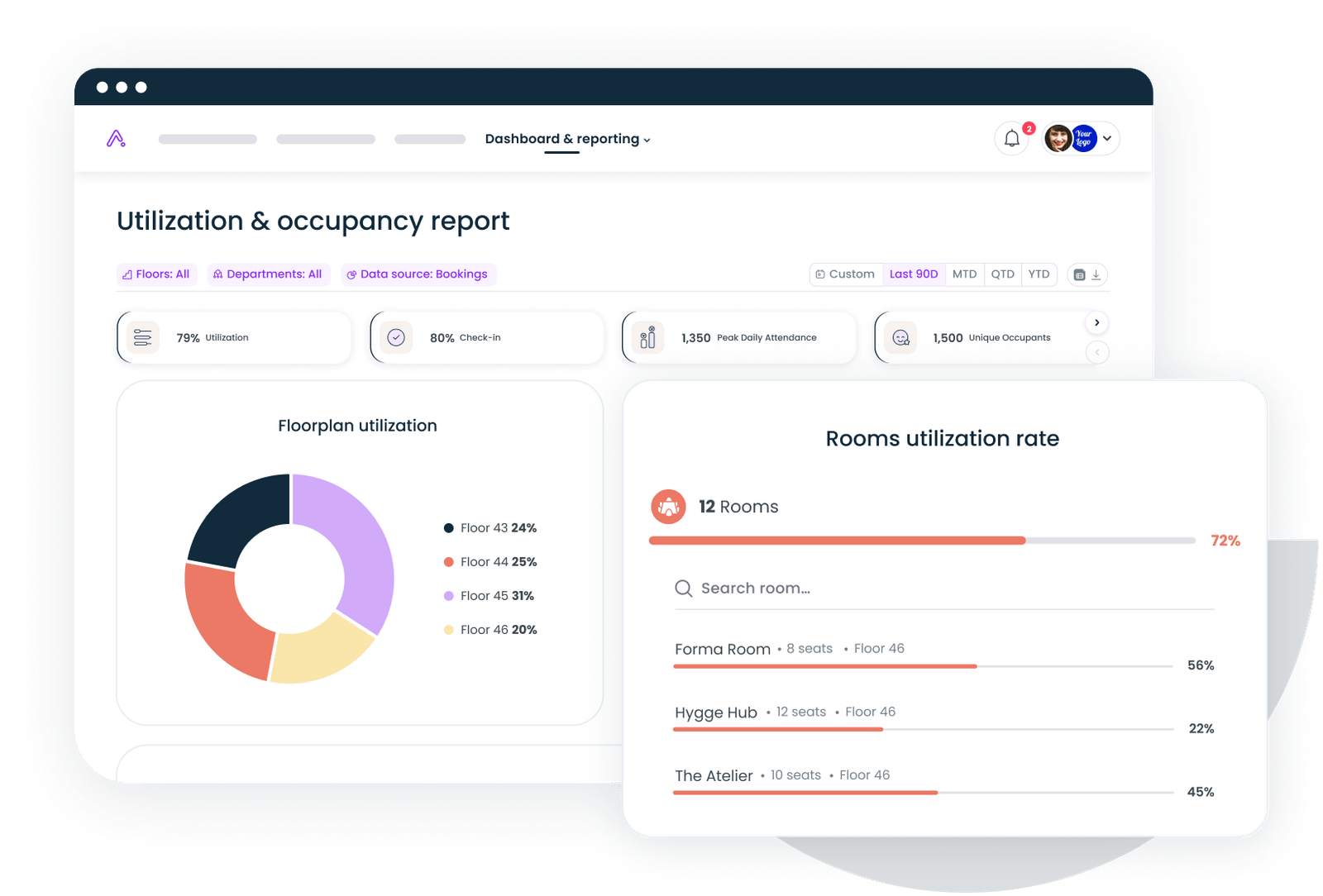
The hybrid work reality in 2026
Hybrid work has become the default operating model for most knowledge-work organizations.
What the data shows
FlexIndex's 2025 data reveals that 35% of Fortune 100 companies now require a 3-day hybrid schedule, making it the single most common policy. Among structured hybrid companies, 66% mandate three days per week in-office, with the national average sitting at 2.82 required days.
Meanwhile, Stanford researcher Nick Bloom's study, published in Nature in June 2024, found that hybrid work (two days WFH per week) had zero negative effect on productivity, performance reviews, or promotion rates. Resignations dropped 33% among employees who shifted to hybrid schedules. For a detailed breakdown of Bloom's findings and their implications, see our recap of what Stanford's Nick Bloom told workplace leaders.
The gap between policy and practice
There's an important nuance in the data: while required office days rose 12% since Q1 2024, actual attendance increased only 1-3%. Employees aren't fully complying with return-to-office mandates, and many companies are choosing not to enforce them strictly.
This gap creates a planning challenge. If your office is sized for 100% attendance on mandated days but only 60% of employees show up, you're paying for space that sits empty. Workplace analytics can help close this gap by showing actual occupancy patterns rather than policy assumptions.
The pros and cons of remote work for companies
Benefits for employers
- Reduced real estate costs: Companies that adopt hybrid or remote models can cut office space requirements significantly. With fewer employees on-site daily, organizations can downsize leases, shift to flex space arrangements, or adopt hot-desking to reduce cost per desk.
- Access to a broader talent pool: Removing geographic requirements lets companies hire from anywhere. This is especially valuable for specialized roles where local talent is scarce.
- Higher productivity: The Stanford/Nature study found no productivity loss from hybrid arrangements. Separately, 73% of employees report that hybrid work makes them more productive, largely because they can match their environment to the type of work they're doing.
- Improved retention: Bloom's research showed a 33% drop in resignations when employees moved to hybrid schedules. Flexibility is now a baseline expectation, not a perk.
- Compensation advantages: According to a San Francisco Fed study, remote and hybrid employees earn 12% higher hourly wages on average. Companies offering flexibility can attract higher-caliber candidates who factor work arrangement into total compensation.
- Diversity and inclusion: Location-independent hiring expands the candidate pool across geographies, backgrounds, and circumstances. Remote work also removes barriers for employees with disabilities, caregiving responsibilities, or limited access to urban job markets.
Challenges for employers
- Complex policy management: Remote and hybrid arrangements create compliance complexity across jurisdictions, tax codes, and labor laws. HR teams need clear frameworks that account for where employees are located, not where the company is headquartered.
- Unequal employee experience: Remote employees can miss out on informal interactions, mentorship opportunities, and visibility with leadership. Without intentional design, a two-tier culture can emerge where in-office workers have advantages.
- Office layout adjustments: Hybrid models require rethinking physical space. Fixed desks for every employee don't make sense when occupancy fluctuates daily. Companies need flexible layouts with bookable desks, collaboration zones, and focus rooms.
- Lack of visibility and coordination: When employees are spread across locations, it's hard to know who's where and when. This makes scheduling in-person collaboration difficult and can lead to underutilized office space.
- Communication friction: Distributed teams face challenges with asynchronous communication, time zone gaps, and the loss of spontaneous hallway conversations. Clear communication protocols and the right tools are essential.
The pros and cons of remote work for employees
Benefits for employees
- Location and schedule flexibility: Employees gain control over when and where they work, which correlates with higher satisfaction and engagement.
- Better work-life integration: Remote work allows employees to manage caregiving, health appointments, and personal responsibilities without sacrificing job performance.
- Eliminated commute: Cutting the daily commute saves time, reduces stress, and lowers transportation costs. For many employees, this is the single most valued aspect of remote work.
- Greater autonomy: Employees can structure their day around their energy levels and focus patterns, doing deep work when they're sharpest and handling administrative tasks during lower-energy periods.
Challenges for employees
- Burnout risk: Without clear boundaries between work and personal life, remote employees often work longer hours. HR teams should build policies that protect off-hours and encourage breaks.
- Reduced face time: Remote workers miss out on casual interactions with peers and managers. This can affect relationship-building, mentorship, and career development.
- Isolation: 22% of remote workers report feelings of isolation. Regular team gatherings, whether virtual or in-person, help counteract this. Companies using team building activities and periodic offsites see stronger engagement among distributed employees.
How to overcome remote and hybrid work challenges
Recognizing the challenges is the first step. Here's how workplace leaders can address them.
Build a documentation-first culture
In remote and hybrid environments, information can't live in hallway conversations. Key decisions, project updates, and process changes should be documented and accessible to everyone. This keeps remote employees aligned and reduces the "you had to be there" problem that plagues hybrid teams.
Use flex spaces for intentional collaboration
Remote employees don't need a permanent office, but they do need places to meet. Providing access to coworking and flex spaces lets teams come together for workshops, planning sessions, and relationship-building without the overhead of a full-time lease. The key is making these gatherings intentional rather than leaving collaboration to chance.
Give teams visibility into who's where
One of the biggest coordination challenges in hybrid work is knowing when teammates will be in the same location. Tools that show who's planning to be in the office or at a coworking space on a given day make it easier to schedule in-person collaboration and avoid empty-office days.
Design policies based on data, not assumptions
Effective hybrid policies start with understanding how employees actually work, not how leadership assumes they work. Gathering data on space utilization, collaboration patterns, and employee preferences helps HR teams build policies that reflect reality. For companies managing multiple locations, measuring hybrid work success requires combining HR data, access control logs, and booking patterns into a single view.
Invest in equitable experiences
Remote employees should have the same access to career development, company events, and leadership visibility as their in-office counterparts. This means designing hybrid events that include remote participants, creating mentorship programs that work across locations, and evaluating performance based on outcomes rather than presence.
Making remote and hybrid work sustainable
Remote work in 2026 has matured from the improvised 2020 experiment into a data-supported model that, when designed well, benefits both companies and employees. The organizations getting it right have moved past the remote-vs-in-office binary and are building flexible systems that let people work where they're most effective while creating intentional moments for connection.
Whether your team is fully remote, hybrid, or somewhere in between, the foundation is the same: clear policies, reliable data, and tools that make coordination easy. The companies that treat workplace strategy as an ongoing practice, informed by real usage data rather than gut instinct, will retain talent, control costs, and build stronger teams.
From on-demand coworking access to office analytics and event planning, Gable gives you the data and tools to build a workplace strategy that works.
Get a demo