


.svg)


.svg)
- Workplace leaders increasingly own the "S" in ESG reporting
- Physical workspace data (occupancy, utilization, safety) is untapped ESG evidence
- Most teams still use spreadsheets; integrated systems close the gap
- Start with materiality, not frameworks; figure out what matters to your business first
- Hybrid work policies directly support both environmental and social ESG goals
ESG reporting in the workplace isn't just a sustainability team problem anymore. If you manage offices, hybrid policies, or employee experience, you're already sitting on data that investors and regulators want to see. This guide walks through what workplace leaders specifically need to measure, how to collect it, and how to turn operational data into credible ESG disclosures.
Why ESG reporting now falls on workplace leaders
Two years ago, ESG reporting lived in finance or sustainability departments. Today, the "S" pillar (social) has pulled workplace, HR, and real estate teams into the conversation. That's because the social metrics investors care about, things like employee safety, engagement, inclusion, and wellbeing, are generated by the systems workplace leaders already manage.
The scale of ESG disclosure is hard to ignore. 86% of large companies globally now disclose sustainability information, with ESG-mandated assets projected at $35 trillion. Even if your company isn't subject to mandatory reporting yet, your board, your investors, or your largest customers are probably asking for this data.
The regulatory landscape is shifting too. The EU's CSRD initially targeted around 45,000 companies, but scope narrowed by roughly 90% in 2025, raising thresholds to approximately 10,000 companies with over 1,000 employees and €450M in revenue. In the U.S., California's SB 253 and SB 261 create disclosure obligations for large companies operating in the state. Even if you're not directly covered, supply chain pressure means your data will likely be requested by someone who is.
The practical implication: if you run workplace operations, you're now a data supplier for ESG reporting whether you planned for it or not.
The three ESG pillars, through a workplace lens
Before diving into metrics, it helps to understand how each ESG pillar maps to things workplace teams actually control.
Environmental. This is where most people's minds go first: carbon emissions, energy consumption, waste. For workplace leaders, the lever is space efficiency. If you're running offices at 40% occupancy, you're heating, cooling, and lighting 60% of nothing. Optimizing office space utilization directly reduces your environmental footprint per employee. Hybrid and flexible work policies compound the effect; fewer commutes, smaller required footprints, lower Scope 2 emissions.
Social. This is the pillar where workplace teams have the most direct influence. Employee health and safety, engagement, diversity and inclusion, pay equity, professional development, wellbeing programs. These aren't abstract HR concepts. They're measurable through the systems you already use: HRIS platforms, badge data, booking systems, engagement surveys, incident reports.
Governance. Workplace teams touch governance through data privacy practices, compliance management, visitor policies, and security protocols. How you collect and handle employee data, how you enforce safety standards, how transparent your policies are; all of this feeds governance disclosures.
The point isn't that workplace leaders need to own the entire ESG report. It's that you own the inputs for a significant chunk of it.
How to measure workplace ESG: a seven-step framework
Here's where most guides get vague. They'll tell you to "align with a framework" and "collect data." That's not helpful when you're staring at a spreadsheet wondering which numbers actually matter. Let's break it down.
Step 1: Define materiality for your workplace
Materiality means figuring out which ESG topics are most relevant to your specific business. A tech company with 5,000 remote employees has different material issues than a manufacturing firm with on-site workers. Don't try to measure everything. Start by asking: what workplace factors most affect our employees, our environmental footprint, and our risk profile?
Talk to your sustainability team, your CFO, and your HR partners. If they don't have a materiality assessment yet, propose one. The output should be a short list of 8 to 12 topics ranked by importance to stakeholders and business impact.
Step 2: Map data sources to each material topic
For every material topic, identify where the data lives. Here's a practical mapping:
If you're running a hybrid program, workplace analytics platforms can consolidate occupancy, booking, and collaboration data into a single view. That's a significant advantage over manually pulling reports from five different systems.
Step 3: Establish baselines
You can't report progress without a starting point. For each metric, pull at least 12 months of historical data. If you don't have it, that's your first finding: "We lack baseline data for X, and we're establishing collection processes now." Honest disclosure of gaps is better than fabricated precision.
Step 4: Set targets and timelines
Targets should be specific, time-bound, and connected to business outcomes. "Improve employee engagement" isn't a target. "Increase eNPS from 32 to 45 by Q4 2027" is. For environmental metrics, tie targets to your real estate strategy. If you're planning an office consolidation, quantify the expected reduction in energy consumption per employee.
Step 5: Build collection rhythms
ESG reporting isn't a once-a-year scramble. It's a continuous data collection process. Set quarterly collection cadences for most metrics, monthly for safety incidents, and annual for compensation equity analyses. Assign clear ownership for each data stream.
Step 6: Consolidate and validate
This is where most teams hit a wall. Data lives in HR systems, facilities platforms, finance tools, and spreadsheets. Someone needs to pull it together, check for inconsistencies, and format it for disclosure. Nearly half of organizations still rely on spreadsheets for ESG data, which creates error risk and makes year-over-year comparison painful.
Step 7: Report, iterate, repeat
Choose a framework (more on that below), publish your disclosure, and immediately start planning improvements. The first report is always the hardest. Each subsequent year gets easier as collection processes mature.

Hybrid and remote policies don't just improve employee satisfaction; they measurably reduce carbon emissions. Here's the data behind the impact.
Read the guide
Key workplace ESG metrics every leader should track
Not every metric matters equally. Here are the ones that show up most frequently in ESG frameworks and investor questionnaires, organized by pillar.
Social metrics (your biggest area of influence)
Employee health and safety. Track recordable incident rates, lost-time injury frequency, and near-miss reports. This isn't just a compliance checkbox. Workplace injuries cost U.S. employers in medical, legal, and lost productivity costs. If you manage physical offices, you own this data. Make sure it's clean and auditable.
Employee engagement and retention. Engagement surveys, eNPS scores, voluntary turnover rates, and internal mobility metrics. 75% of HR leaders believe ESG initiatives increase employee engagement, but you need the data to prove the connection in your own organization. If you're building an employee experience strategy, these metrics should already be in your dashboard.
Diversity, equity, and inclusion. Representation at each level (especially leadership), pay equity ratios by gender and ethnicity, ERG participation rates, and promotion velocity across demographic groups. These are among the most scrutinized social metrics in ESG disclosures.
Wellbeing programs. Participation rates in mental health resources, EAP utilization, wellness program engagement, and absenteeism trends. Companies with strong health and wellness programs don't just report better ESG scores; they appreciated 235% over six compared to 159% for the S&P 500.
Training and development. Average training hours per employee, percentage of employees with individual development plans, and spend on professional development per capita.
Environmental metrics (where space data matters)
Energy consumption per employee. Total energy use divided by headcount or by occupied square footage. This is where occupancy data becomes critical; if you're measuring energy per leased square foot but only using half the space, your per-employee number looks terrible.
Commute impact. Estimated emissions from employee commuting, adjusted for hybrid schedules. If 40% of your workforce works from home three days a week, that's a measurable reduction you can report.
Waste and resource use. Paper consumption, recycling rates, single-use materials in offices. These are straightforward to track and easy wins for improvement.
Governance metrics
Data privacy practices. How you collect, store, and use employee workplace data. This is increasingly relevant as companies deploy occupancy sensors and badge tracking. Transparent policies matter here.
Policy compliance. Completion rates for required training (anti-harassment, safety, ethics), audit findings, and remediation timelines.
Workplace security. Incident response times, access control compliance, visitor management protocols.
Building a workplace culture that supports ESG goals
Metrics without culture are just numbers on a page. The organizations that score well on ESG social metrics aren't the ones with the best spreadsheets; they're the ones where employees actually feel the investment.
Hybrid work as an ESG enabler. A well-designed hybrid work policy supports multiple ESG goals simultaneously. It reduces commute emissions (environmental), improves work-life balance and accessibility (social), and demonstrates employee-centric governance. Don't underestimate how much your flexibility policies contribute to your ESG story.
Events and collaboration as culture infrastructure. Team offsites, ERG events, and cross-functional gatherings aren't just nice-to-haves. They're measurable touchpoints for belonging and engagement. Track attendance, post-event sentiment, and participation across demographic groups. If certain populations consistently don't attend, that's a signal worth investigating.
Bottom-up input, not top-down mandates. The strongest ESG cultures seek employee input on priorities. Run annual surveys asking employees which ESG topics matter most to them. You'll often find that workplace-specific issues (commute support, office sustainability, mental health resources) rank higher than abstract corporate commitments.
Onboarding as a first impression. New hires form opinions about your company's values in their first two weeks. If your onboarding process communicates ESG commitments clearly and demonstrates them through workplace experience, you've set the tone. If it doesn't, no amount of annual reporting will compensate.
Overcoming common ESG reporting challenges
Let's be honest about what makes this hard.
Data silos are the biggest obstacle. Your HRIS has engagement data. Your facilities platform has occupancy data. Your finance system has energy costs. Your safety team has incident logs. Nobody has all of it in one place. The first step is mapping who owns what and building a cross-functional data-sharing agreement. Gable's platform can help here by consolidating workplace data (occupancy, bookings, space utilization, event attendance) into a single source that feeds into broader ESG reporting workflows.
Framework overload. GRI, SASB, TCFD, ISSB, CSRD. The alphabet soup is real. Here's a practical shortcut: if you're a U.S. company without mandatory obligations, start with SASB (now part of ISSB) because it's industry-specific and investor-focused. If you have EU exposure, align with CSRD's European Sustainability Reporting Standards (ESRS). If you're unsure, GRI is the most widely used globally and provides the broadest coverage.
Greenwashing risk. The fastest way to undermine your ESG credibility is to report aspirational narratives instead of actual data. Investors and regulators are increasingly sophisticated at spotting the difference. Report what you can measure. Acknowledge gaps. Set targets for improvement. Real data, even imperfect data, beats polished storytelling every time.
Resource constraints. Most workplace teams don't have a dedicated ESG analyst. You're adding this to an already full plate. Focus on metrics you can automate or pull from existing systems. Manual data collection for 50 metrics isn't sustainable. Pick the 10 to 15 that matter most (based on your materiality assessment) and do those well.
Gable Insights consolidates occupancy, utilization, and collaboration data into dashboards that workplace leaders actually use, including for ESG reporting.
Learn more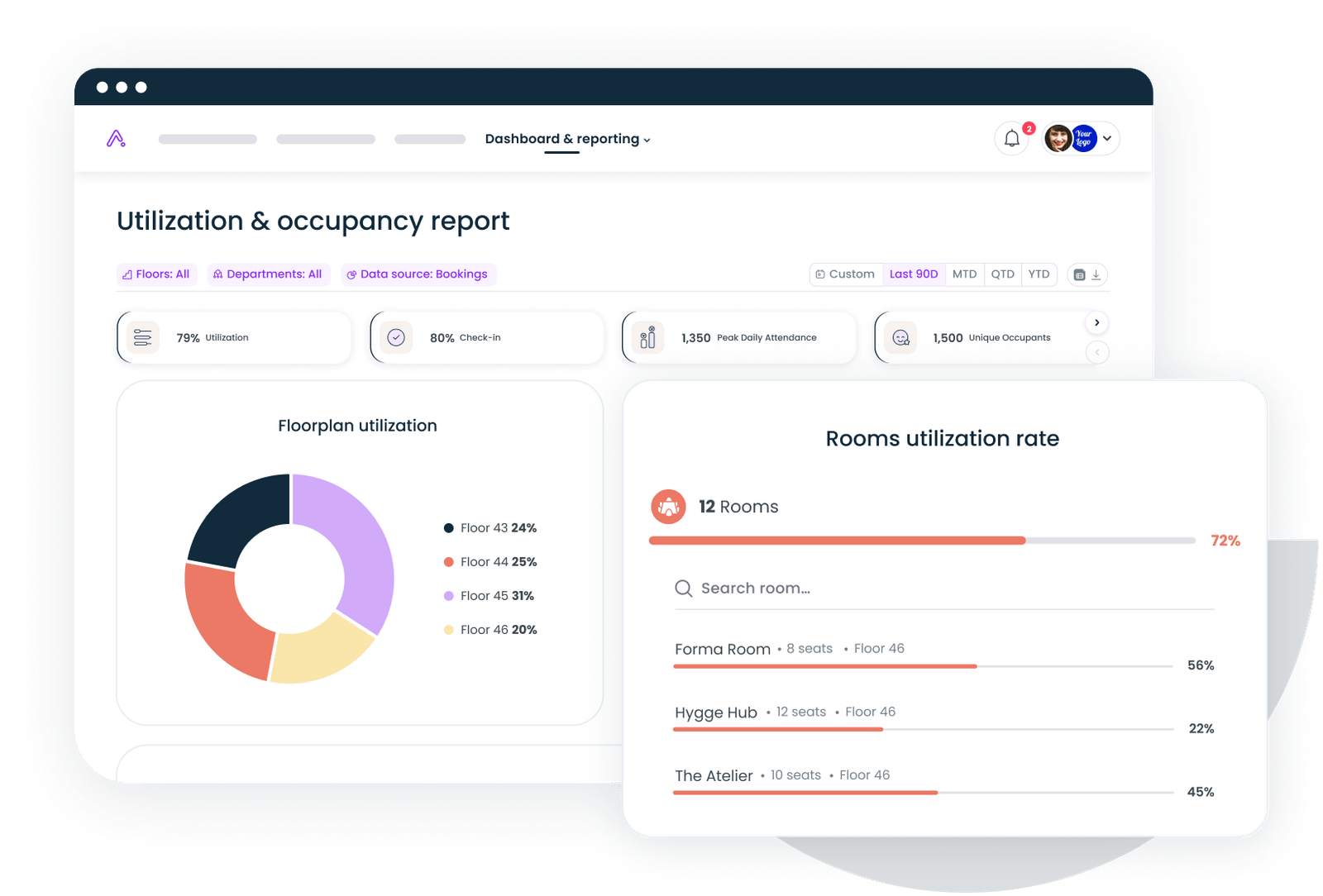
Choosing the right ESG framework for your workplace
Here's a quick comparison of the frameworks most relevant to workplace leaders:
You don't have to pick just one. Many companies use GRI for broad stakeholder communication and SASB/ISSB for investor-specific disclosures. The key is consistency: once you choose a framework, stick with it year over year so stakeholders can track progress.
Your ESG workplace action plan for 2026
If you're starting from scratch, here's a realistic timeline.
Month 1 to 2: Foundation.
- Conduct a materiality assessment with HR, finance, and sustainability partners
- Map existing data sources to material topics
- Identify the three to five biggest data gaps
Month 3 to 4: Baseline.
- Pull 12 months of historical data for priority metrics
- Establish collection processes for missing data streams
- Choose your primary reporting framework
Month 5 to 8: Build.
- Set targets for each priority metric
- Implement quarterly data collection rhythms
- Create a cross-functional ESG data-sharing agreement
- Integrate workplace management data with HR and finance systems
Month 9 to 12: Report.
- Consolidate data into your chosen framework format
- Draft your first workplace ESG disclosure (even if it's internal-only)
- Identify quick wins for the next reporting cycle
- Present findings to leadership with recommendations
The first year is about building infrastructure. Don't aim for a perfect report. Aim for a repeatable process.
Making ESG reporting a workplace advantage, not a burden
ESG reporting can feel like another compliance obligation stacked on top of everything else. But here's the reframe: the data you need for ESG is the same data that makes you better at your job. Occupancy trends that inform your real estate strategy also feed your environmental disclosures. Engagement scores that guide your workplace experience investments also satisfy social pillar requirements. Safety metrics that protect your people also reduce your liability exposure.
The workplace leaders who'll thrive in this environment aren't the ones who treat ESG as a separate workstream. They're the ones who recognize that good workplace management and good ESG reporting are the same thing, measured from different angles.
From occupancy analytics to event management, Gable gives workplace leaders the data infrastructure that ESG reporting demands.
Get a demo


