


.svg)


.svg)
- Most employers monitor workers, but few have a privacy policy that keeps up with the law
- Federal rules are thin; state laws in California, Illinois, and New York carry real teeth
- Excessive monitoring backfires: over half of employees will quit over it
- Privacy-first workplace tech collects space data, not surveillance data
- Transparency isn't just ethical; it's the only approach that scales across jurisdictions
Employee privacy in workplace technology is no longer a niche compliance concern. It's a strategic question that touches retention, legal exposure, culture, and how much your real estate data is actually worth. If you're deploying desk booking, occupancy sensors, badge systems, or AI analytics, you're collecting employee data, and the rules governing that data are changing faster than most workplace teams realize.
Why employee privacy in workplace technology matters
The monitoring industry is booming. 80% of companies now monitor remote or hybrid workers in some form, from email scanning to keystroke logging to badge-in tracking. The monitoring software market is projected to reach $1.47 billion by 2032. That's a lot of data flowing through a lot of systems with very little standardization around who sees what, why, and for how long.
Here's the tension. Workplace leaders genuinely need data. You can't right-size a portfolio, plan team days, or justify a lease renewal without understanding how space gets used. But the tools that generate that data sit on a spectrum. On one end: aggregated occupancy counts that tell you floor three is 40% used on Tuesdays. On the other: software that screenshots an employee's laptop every five minutes. Both technically count as "workplace technology." They are not the same thing, and your employees know the difference.
The regulatory environment is catching up to that distinction. Illinois now bans AI in employment decisions with discriminatory effect as of January 2026. California's CCPA gives employees data access rights. New York requires written notice before electronic monitoring begins. And that's just the U.S. If you operate across borders, GDPR adds another layer entirely.
The cost of getting this wrong isn't hypothetical. It's lawsuits, turnover, and a workforce that doesn't trust you enough to show up when you ask them to.
The legal landscape: Federal gaps and state patchwork
There is no comprehensive federal employee privacy law in the United States. That's the first thing to understand, and it shapes everything else.
The Electronic Communications Privacy Act (ECPA) of 1986 is the closest thing to a federal framework. It permits employer monitoring of electronic communications when there's a legitimate business purpose or when employees consent. It was written before the commercial internet existed. It doesn't address AI, biometrics, location tracking, or any of the tools that define modern workplace technology.
State legislatures have stepped into the gap, unevenly. Here's what matters most for workplace leaders in 2026:
California (CCPA/CPRA): Employees have the right to know what personal data is collected, request deletion, and opt out of certain data sales. This applies to workplace data, not just consumer data. If your desk booking system stores individual usage patterns, California employees can ask to see it.
Illinois (BIPA and AI Act): The Biometric Information Privacy Act requires informed written consent before collecting fingerprints, facial geometry, or other biometric identifiers. The new AI employment law adds restrictions on automated decision-making that could disadvantage protected classes.
New York: Employers must provide written notice to employees before monitoring email, internet usage, or telephone communications on employer-provided devices. Failure to notify is a violation, even if the monitoring itself would otherwise be legal.
Colorado (AI Act): Requires impact assessments for high-risk AI systems used in employment decisions, with transparency obligations to affected employees.
The practical implication: if you operate in multiple states (and most hybrid companies do), your workplace compliance program needs to meet the strictest standard in your footprint. Building to the lowest common denominator is a legal risk. Building to the highest common denominator is a policy decision that also happens to build trust.
For teams managing policies across regions, standardizing global workplace policies is worth the upfront investment. The alternative is a patchwork of local exceptions that no one can keep track of.
What employers can monitor, and where the lines are
Not all monitoring is created equal. Understanding the categories helps you make better decisions about which data you actually need.
Email and internet activity on employer devices: Generally permissible with notice in most jurisdictions. New York and a handful of other states require explicit written disclosure. Best practice: tell people, even where you're not legally required to.
Video surveillance in common areas: Legal in most states for security purposes. Prohibited in restrooms, changing areas, and other spaces with a reasonable expectation of privacy. Audio recording adds complexity; many states require all-party consent.
Badge and access control data: Collecting entry/exit timestamps is standard and generally low-risk from a privacy perspective. The question is what you do with it. Using badge data to understand building occupancy is different from using it to flag individuals who leave early. If you're implementing badge access control systems, define the purpose before you start collecting.
Occupancy sensors: Passive sensors that count bodies without identifying them sit at the privacy-friendly end of the spectrum. Workplace occupancy sensors that aggregate data at the floor or zone level give you the space utilization insights you need without creating individual movement profiles.
Keystroke logging and screenshot capture ("bossware"): Legal in many jurisdictions with notice, but this is where employee trust falls apart. More on that below.
Biometrics (fingerprint, facial recognition): Heavily regulated in Illinois, Texas, Washington, and increasingly other states. Requires explicit consent and clear data retention policies. If you're using biometric check-in at your front desk, make sure your visitor management approach accounts for these requirements.
AI-driven productivity scoring: The newest and least regulated category. Colorado and Illinois have begun restricting it. The EU's AI Act classifies employment-related AI as high-risk. This is the area moving fastest legislatively, and the area where most companies have the least governance.
How excessive monitoring destroys the thing you're trying to build
Here's the paradox that should give every workplace leader pause. The more invasively you monitor, the less you get from your workforce.
54% of employees say they'd over excessive workplace monitoring. That's not a fringe sentiment; it's a majority. And it's not evenly distributed. Younger employees feel it most: 72% of Gen Z workers view employer monitoring of online activity as an invasion of privacy, compared to 65% of workers overall.
55% of employees believe excessive harms workplace culture. That tracks with what most of us have seen firsthand. When people feel watched, they optimize for appearing busy rather than doing meaningful work. They minimize risk-taking. They stop having the candid conversations that lead to better ideas.
The retention math alone should be enough. If you're spending money on employee experience strategy and engagement programs, then deploying surveillance tools that make people want to leave, you're working against yourself.
This doesn't mean you collect no data. It means you collect the right data, for the right reasons, with the right transparency. There's a meaningful difference between "we track which floors are busy so we can plan better" and "we track which employees are at their desks so we can score their productivity." The first builds a better workplace. The second builds resentment.

Not all workplace data collection is the same. This guide breaks down what you should and shouldn't track when employees book desks.
Read the guide
How to build a privacy policy that holds up
A workplace privacy policy isn't a legal formality you draft once and file away. It's a living document that tells employees what data you collect, why, and what you do with it. Done well, it's a trust-building tool. Done poorly (or not at all), it's a liability.
Here's what a defensible, trust-building policy includes in 2026:
Scope and specificity. Name the systems. "We use occupancy sensors on floors 2-5 to measure space utilization" is useful. "We may monitor employee activity" is not. Employees should be able to read your policy and know exactly which tools touch their data.
Purpose limitation. For every data type you collect, state why. Space planning, security, compliance, resource allocation: these are legitimate purposes. "General productivity monitoring" is vague enough to mean anything, which means employees will assume the worst.
Data minimization. Collect only what you need for the stated purpose. If you need to know whether a conference room is occupied, you don't need to know who's in it. If you need to know how many people come to the office on Wednesdays, you don't need individual arrival times. The less personal data you hold, the less risk you carry.
Retention limits. Define how long you keep each data type and when it gets deleted. Occupancy data for space planning might need 12 months of history. Badge logs for security investigations might need 90 days. Keeping everything forever "just in case" is both a privacy risk and a storage cost.
Employee access rights. In California and under GDPR, employees have the legal right to see their data. Even where it's not legally required, offering access is a powerful trust signal. If you're confident your data practices are reasonable, letting employees see what you collect proves it.
Consent mechanisms. Where required by law (biometrics in Illinois, electronic monitoring notice in New York), document consent clearly. Where not legally required, consider opt-in for non-essential data collection anyway. It costs you very little and buys significant goodwill.
Review cadence. Technology changes. Laws change. Your policy should be reviewed at least annually, with input from legal, HR, IT, and ideally employee representatives. When you communicate policy changes, do it proactively, not after someone files a complaint.
Balancing legitimate business needs with privacy protections
Let's be honest about the tension. Workplace leaders need data to do their jobs. You can't optimize a portfolio you can't measure. You can't plan team collaboration days without knowing who's coming in. You can't justify keeping (or closing) an office without utilization numbers.
The question isn't whether to collect workplace data. It's how to collect it in a way that respects privacy, complies with the law, and actually earns employee cooperation.
Privacy by design is the framework that makes this work. Instead of collecting everything and then figuring out privacy controls, you build privacy into the system architecture from the start:
- Aggregate by default. Report on floors, zones, and teams rather than individuals unless there's a specific, documented reason to go more granular.
- Role-based access. Not everyone needs to see everything. Your facilities team needs occupancy trends. Your HRBP might need team-level attendance patterns. Neither needs individual keystroke data.
- Separate identity from behavior. Modern workplace platforms can tell you that 47 people used the fourth floor on Tuesday without telling you which 47 people. That's the level of detail you need for space planning. It's also the level that doesn't create privacy risk.
This is where the choice of workplace technology matters enormously. A platform like Gable is designed to surface space utilization, collaboration patterns, and portfolio insights from aggregated data, giving workplace teams the visibility they need for real estate and experience decisions without building individual surveillance profiles. That architectural choice isn't just a feature; it's a compliance posture.
Cross-functional governance makes the balance sustainable. Privacy decisions shouldn't live solely with IT (who think about systems), legal (who think about risk), or HR (who think about culture). You need all three at the table, plus facilities and ideally employee representation. The companies that handle this well have a standing workplace data governance group that reviews new tools, audits existing data flows, and updates policies before regulators force them to.
Gable's insights platform delivers occupancy, utilization, and collaboration data at the aggregate level, giving you portfolio intelligence without individual surveillance.
Learn more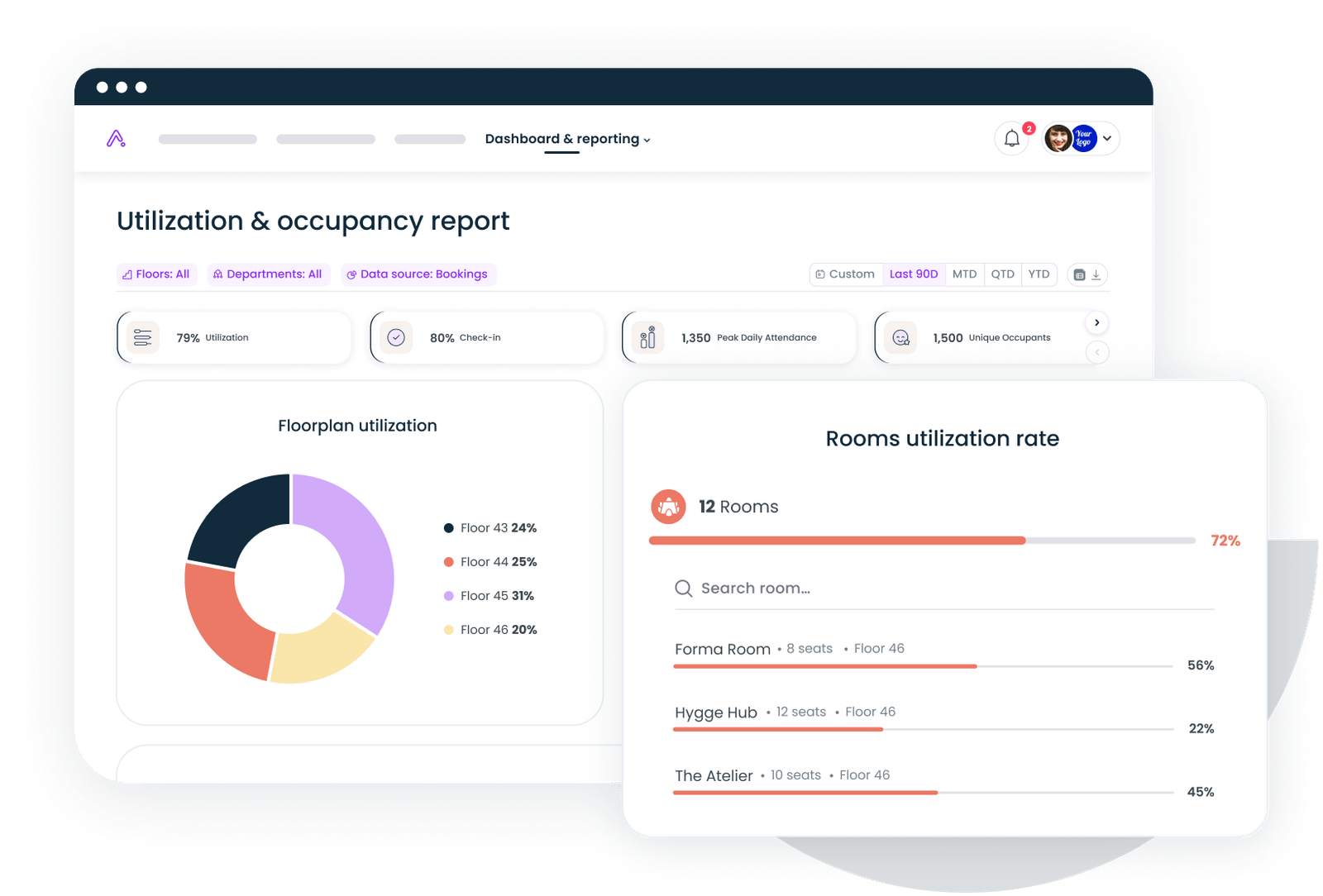
Best practices for privacy-conscious workplace technology
If you're evaluating or implementing workplace technology in 2026, here's a practical checklist that goes beyond "check with legal."
1. Audit your current data flows. Most companies don't have a single system collecting employee data. They have a dozen: badge systems, desk booking, Wi-Fi analytics, calendar integrations, visitor management, HRIS platforms. Map every system that touches employee data, what it collects, where it stores it, who can access it, and how long it's retained. You'll almost certainly find redundancies and gaps.
2. Evaluate vendors on privacy architecture, not just features. When assessing workplace technology, ask vendors: Is data aggregated or individual-level? What's the default retention period? Can we configure role-based access? Is the platform SOC 2 compliant? Where is data stored? These questions matter more than whether the dashboard looks nice.
3. Consolidate where possible. Every additional system that collects employee data is another potential breach point, another privacy policy to maintain, another vendor to audit. A unified platform that handles desk booking, room reservations, visitor management, and space analytics reduces the number of systems holding employee data. Fewer silos means fewer risks.
4. Default to opt-in for non-essential monitoring. If a data collection isn't required for security or legal compliance, make it optional. Let employees choose whether their individual booking patterns are visible to their manager. Let them opt into location sharing rather than requiring it. The employees who opt in give you better data anyway, because they're not gaming the system.
5. Build transparent dashboards. If employees can see what data is collected about them and how it's used, trust goes up and complaints go down. This doesn't mean exposing your entire analytics infrastructure. It means giving individuals a clear view of their own data footprint within your workplace systems.
6. Train managers on appropriate use. The best privacy policy in the world fails if a manager pulls up individual badge data to confront someone about their hours. Define what managers can and can't do with workplace data, and make it part of management training. Your workplace security policies should cover data misuse alongside physical security.
7. Document everything. If a regulator or employee asks how you handle workplace data, "we have good intentions" isn't an answer. Written policies, documented consent, audit logs, and regular compliance reviews are the baseline.
Emerging trends: AI, Biometrics, and what's coming next
The regulatory environment for employee privacy is accelerating, not stabilizing. Here's what workplace leaders should be watching.
AI governance is becoming mandatory. Colorado's AI Act, Illinois's AI employment law, and the EU's AI Act all impose new obligations on employers using AI for workforce decisions. If your workplace analytics platform uses machine learning to predict space demand or recommend scheduling changes, you need to understand whether those models touch individual employee data and whether the outputs could be used in ways that trigger these laws. The workplace AI adoption conversation needs a privacy chapter.
Biometric regulation is expanding. Illinois BIPA has generated over $5 billion in settlements and judgments since its passage. Other states are watching. If you're using facial recognition for office entry, fingerprint scanners for time tracking, or any biometric identifier, expect the compliance requirements to get stricter, not looser.
Generational expectations are shifting the baseline. The Gen Z privacy sensitivity data isn't a blip. It reflects a generation that grew up with data breaches, targeted advertising, and social media surveillance. As they become a larger share of the workforce, their expectations will become the default. Companies that get ahead of this will have a recruiting and retention advantage.
"No Robot Bosses" legislation is gaining traction. Several proposed federal and state bills would restrict automated decision-making in employment contexts, requiring human review of AI-generated recommendations about hiring, scheduling, performance, and termination. Even if these bills don't pass in their current form, they signal where the political wind is blowing.
Privacy-first workplace tech is becoming a category. The market is splitting. On one side: surveillance-heavy tools that track every click and keystroke. On the other: platforms designed to give workplace teams operational intelligence from aggregated, anonymized data. The companies choosing the latter aren't just making an ethical choice; they're making a practical one. Aggregated data is easier to govern, cheaper to store, less risky to hold, and more useful for the space planning and portfolio decisions that actually drive ROI.
The trust equation: Why privacy is a workplace strategy, not just a compliance box
Privacy isn't separate from your workplace strategy. It is your workplace strategy, or at least a foundational piece of it.
Think about what you're actually trying to accomplish. You want people to come into the office on the right days, collaborate effectively, and feel good about the experience. You want accurate data on how space is used so you can make smart real estate decisions. You want to attract and retain talent in a competitive market.
Every one of those goals depends on trust. Employees who trust that their data is handled responsibly are more likely to book desks honestly, show up when they say they will, and give candid feedback about the workplace experience. Employees who suspect they're being surveilled game the system, book desks they don't use, badge in and leave, and tell you everything is fine when it isn't.
The data you get from a trusted system is better data. That's not a soft argument. It's a measurement argument. If 30% of your workforce is gaming their badge-ins because they feel surveilled, your occupancy data is 30% wrong. Your space planning decisions are based on fiction. Your portfolio costs reflect a reality that doesn't exist.
Privacy-conscious workplace technology doesn't give you less data. It gives you more honest data. And honest data is the only kind worth making decisions on.
Where to start if you're behind
If you're reading this and realizing your privacy practices haven't kept pace with your technology stack, you're not alone. Most workplace teams have been focused on getting hybrid logistics right, and privacy governance has been a secondary concern. Here's a pragmatic starting sequence:
Week 1-2: Inventory every system that collects employee data. Include desk booking, badge access, Wi-Fi analytics, visitor management, calendar tools, and any "bossware" deployed during the remote work era.
Week 3-4: Map data flows. For each system, document what's collected, where it's stored, who has access, and how long it's retained. Flag anything that collects individual-level data without a clear, documented business purpose.
Month 2: Draft or update your workplace privacy policy using the framework above. Get legal review, but don't let legal own it alone. HR and facilities need to be co-authors.
Month 3: Communicate the policy to employees. Not buried in an intranet update. Proactively, clearly, with a Q&A session. Explain what you collect, why, and what you don't collect. The "what we don't collect" part matters as much as the rest.
Ongoing: Establish a quarterly review cadence. New tools, new laws, new office locations: any of these can change your privacy posture. Build the review into your existing workplace compliance rhythm rather than treating it as a separate workstream.
Privacy as competitive advantage
The companies that will win the next decade of workplace strategy aren't the ones with the most data. They're the ones with the most trusted data. Trust comes from transparency, and transparency comes from making deliberate choices about what you collect, why, and how you protect it.
Employee privacy in workplace technology isn't a constraint on your workplace program. It's the foundation that makes everything else work: accurate utilization data, genuine employee engagement, defensible compliance posture, and a culture where people actually want to show up.
The regulatory environment will keep tightening. Employee expectations will keep rising. The technology will keep getting more capable. The leaders who treat privacy as a design principle rather than a legal afterthought will find that they're not just avoiding risk; they're building workplaces that work better for everyone.
Gable gives workplace teams the space utilization, collaboration, and portfolio data they need, built on aggregated insights rather than individual surveillance.
Get a demo


