


.svg)


.svg)
- 38% of companies now spend $5M+ annually on privacy, up from 14% in early 2025
- H&M paid €35.2M for tracking employee movements without proper safeguards
- Employee consent in workplace booking systems is legally weaker than most leaders assume
- Data minimization makes insights trustworthy, not less useful
- Average US data breach cost hit $10.22M in 2025, and 2026 isn't trending better
Desk booking data privacy has become the fault line between workplace teams that get adoption and those that watch expensive software collect dust. Spending on privacy jumped from 14% to 38% of companies globally investing $5M or more in the past 12 months, and most of that money is reactive, flowing toward breach response rather than system design. What follows is a breakdown of what your desk booking system should collect, what it shouldn't, and how the regulatory landscape is reshaping that calculus faster than most workplace leaders realize.
Why desk booking data privacy matters
Between 2023 and 2025, EU regulators imposed over €2.1 billion in GDPR fines, and a growing share of those penalties targeted employers who collected employee data without proportionate justification. Twenty-one US states now have active privacy laws on the books, creating a patchwork that makes a single "we comply with CCPA" statement inadequate for any company operating across state lines.
The enforcement trend is accelerating, not plateauing. Regulators in Germany, France, and Ireland have signaled that workplace technology, specifically tools that track when and where employees sit, falls squarely within their scrutiny. With the average US data breach now costing $10.22 million according to IBM's Cost of a Data Breach Report, the financial argument for privacy-first design stops being theoretical.
But the cost that doesn't show up in a breach report is adoption failure. If a 600-person company rolls out desk booking and only 35% of employees use it because they don't trust what's being tracked, the $120K annual software spend generates data so incomplete it's useless for space planning. Privacy negligence and adoption failure feed each other in a loop that's hard to break once it starts.
What data desk booking systems collect
Most workplace leaders underestimate the breadth of what their desk booking platform captures. A typical system, even a basic one, processes personal identifiers like names and email addresses alongside booking timestamps, workspace selections, IP addresses at login, and in some configurations, phone numbers used for check-in confirmations. That's already a meaningful privacy footprint before you add any analytics layer.
Personal identifiers and authentication data
Every booking creates a record tying a specific person to a specific location at a specific time. Names, emails, booking times, workspace selections, and IP addresses form the baseline data set, and when your system integrates with SSO or HRIS platforms, it can pull in department, team membership, manager relationships, and seniority level. For a 1,200-person company with 5 office locations, that's potentially 6,000+ weekly data points linking identity to location.
Location and movement patterns
This is where the risk profile escalates. When an employee books a desk on Floor 2 every Tuesday and a meeting room on Floor 4 every Thursday afternoon, the system builds a predictable movement profile over weeks and months. Aggregated across a team of 15, that data reveals collaboration patterns, preferred neighborhoods within the office, and (perhaps most sensitive) which employees are rarely on site. Facilities teams need some version of this data to make space utilization decisions, but the granularity matters enormously.
Behavioral and engagement data
No-show rates, last-minute cancellations, booking frequency by day of week, average duration of room reservations: this behavioral layer is where analytics platforms extract the most value and create the most privacy exposure simultaneously. A no-show rate of 28% across your Chicago office tells you something useful about policy. A no-show rate tied to a specific employee's name, surfaced in a dashboard visible to their manager, tells that employee their booking tool is a surveillance instrument.
The distinction between booking data (who reserved what, when) and occupancy data (how many people were in a space, anonymized) is one that too many implementations blur. Occupancy data aggregated at the floor or building level serves nearly every legitimate facilities purpose without creating individual tracking profiles.
The regulatory minefield: GDPR, CCPA, and beyond
When a workplace security policy references "GDPR compliance" without specifying which of the regulation's requirements apply to desk booking, it's a signal that nobody has done the legal analysis. The requirements vary significantly depending on jurisdiction, what data you collect, and whether you're relying on consent or legitimate interest as your lawful basis.
GDPR and the consent problem in employment
EU and UK GDPR require employers to have a legal basis for monitoring, notify employees of tracking and its purpose, and conduct Data Protection Impact Assessments before deploying workplace technology that processes personal data. What trips up most companies is the consent question: under GDPR, consent must be "freely given," and in an employment relationship where there's an inherent power imbalance, regulators have been increasingly skeptical that any employee consent is truly voluntary.
A 400-person company in Berlin can't add a checkbox to their booking system login and call it GDPR-compliant. The European Data Protection Board has stated repeatedly that employers should rely on legitimate interest (Article 6(1)(f)) rather than consent for workplace tools, which means you need a documented Legitimate Interest Assessment showing that your data collection is necessary, proportionate, and balanced against employee privacy rights. That assessment needs to be specific: "we collect desk booking timestamps to calculate floor-level occupancy rates for lease renegotiation" passes the test far more easily than "we collect all available employee location data for general analytics."
CCPA, CPRA, and the state-level expansion
California's privacy framework covers employee data as of January 2023 under the CPRA amendments, requiring businesses with $25M+ in revenue (or data on 100,000+ consumers/employees) to provide notice at collection, honor deletion requests, and limit use to disclosed purposes. Colorado's privacy act, amended in 2025, added specific provisions for workplace monitoring disclosure. Connecticut, Virginia, Texas, and Oregon each have their own variations.
For a company with 2,000 employees spread across 8 states, the compliance matrix gets complex fast. An employee in California has deletion rights that an employee in Georgia doesn't (yet), and your booking system needs to handle both consistently or build state-specific data handling rules that add engineering cost and operational overhead.
Cross-border data transfers
If your desk booking provider stores data on US servers but you have employees in the EU, the post-Schrems II landscape means you need Standard Contractual Clauses (SCCs) at minimum, and potentially a Transfer Impact Assessment documenting that US surveillance laws don't undermine GDPR protections. The EU Data Act, which took full effect in September 2025, added requirements around data portability and access that apply to workplace platforms generating user data. Companies that ignored these requirements are now discovering during vendor audits that their data processing agreements are inadequate.
The H&M precedent
H&M's German subsidiary paid €35.2 million in 2020, in a fine issued by the Hamburg Commissioner for Data Protection, because managers collected detailed information about employees' personal circumstances, including health issues and family situations, through informal conversations that were then stored in a database. The fine wasn't for having a system; it was for collecting disproportionate data without justification. When your desk booking system captures more than it needs, you're moving in the same direction, with different data types.

Understanding what to track (and what to skip) starts with knowing which occupancy metrics drive decisions. This guide breaks down the numbers that matter.
Read the occupancy rate guide
Privacy-by-design: building desk booking systems the right way
Starting with a 3,000-person company that books an average of 1,400 desks per day across 6 offices, the data volume is substantial: roughly 7,000 booking records per week, each containing at minimum a name, location, time, and duration. Privacy-by-design means building the rules for handling that volume before the system goes live, not after a regulator asks questions.
Data minimization in practice
The principle sounds straightforward (collect only what you need), but applying it to desk booking requires asking uncomfortable questions about what "need" means. Does your facilities team need individual-level booking data to calculate occupancy rates, or would floor-level aggregated counts serve the same purpose? In most cases, the answer is aggregated data for space planning and individual data only for the booking confirmation itself.
A practical implementation looks like this: the system stores the employee's booking for 30 days (enough for no-show tracking and operational management), then anonymizes the record by stripping the employee identifier and retaining only the timestamp, location, and duration. After 90 days, even the anonymized records roll into monthly summary statistics. That 3,000-person company now retains 12 months of trend data at the floor and building level without maintaining a searchable archive of where every employee sat on March 14th.
Transparency that goes beyond a privacy policy
Burying desk booking data practices in page 47 of your employee handbook doesn't count as transparency, and employees know it. Companies seeing 80%+ booking adoption rates tend to share three things proactively: what data the system collects (specific fields, not vague categories), who can see individual-level data (typically the employee themselves and IT administrators), and how long records are retained before anonymization.
One approach that works: a 30-second explainer during onboarding that says "our booking system knows your name and where you sit today; your manager sees team-level patterns but never your individual schedule; and your booking history is anonymized after 30 days." That level of specificity builds more trust than any privacy policy.
Role-based access controls
RBAC determines who sees what, and the defaults in most booking platforms are too permissive. When a facilities manager can see that a specific employee cancelled 12 bookings last month, that's surveillance data masquerading as space analytics. Platforms like Gable Offices let you configure granular RBAC so that facilities teams see aggregated floor-level trends while individual booking records stay visible only to the employee. The access model should look something like this:
- Employees see their own bookings, upcoming reservations, and floor maps showing available (not occupied-by-whom) desks
- Team leads see aggregated team-level data: how many team members booked on each day, which floors were most used, average booking duration
- Facilities managers see building and floor-level occupancy trends, no-show rates by location (not by person), and peak/off-peak patterns
- HR and compliance access audit logs only when investigating a specific, documented concern, with access logged and time-limited
Data retention schedules
Keeping desk booking records indefinitely is the default in too many systems, and it's a liability that grows every month. For a company generating 7,000 booking records per week, that's 364,000 records per year, each one a potential data subject access request waiting to happen. Under GDPR, every employee has the right to request a copy of all personal data you hold, and "we have 3 years of your desk booking history" is a response that raises more questions than it answers.
Set retention periods that match your business need: 30 days for individual records (operational purposes), 12 months for anonymized aggregates (trend analysis and lease planning), and immediate deletion of any data not required for either purpose. Document these periods in your compliance management framework and enforce them through automated deletion rules, not manual processes.
Pseudonymization and aggregation techniques
Pseudonymization replaces identifying information with artificial identifiers, so booking records show "User_7842" instead of "Jane Smith" while maintaining the ability to re-identify if operationally necessary. Anonymization removes that ability entirely. For space planning analytics, anonymization is almost always sufficient: you don't need to know that Jane books Floor 3 every Wednesday; you need to know that Floor 3 averages 67% occupancy on Wednesdays.
The technical implementation matters here. If your "anonymized" data includes department, team, and booking time alongside the location, and only one person from the Legal team books desks on Fridays, that record is effectively re-identifiable. True anonymization requires stripping enough context that no combination of remaining fields can single out an individual, which typically means aggregating to groups of 10+ before releasing data for analysis.
The hidden cost of privacy negligence
Fines grab headlines, but the $10.22 million average breach cost and the occasional €35 million penalty aren't the expenses that should keep workplace leaders up at night.
Adoption collapse and the data quality spiral
When employees at a 500-person company hear through internal channels that managers can see individual booking patterns, adoption drops. Not dramatically at first; maybe from 72% to 55% over two months as people start booking through informal channels (Slack messages, walking to empty desks) instead of the system. At 55% adoption, your occupancy data understates actual usage by 15-25%, which means your space planning models are built on a foundation that's measurably wrong.
The financial impact compounds. If that company is evaluating whether to renew a $3.2M annual lease on a second office, and the booking data shows only 40% utilization when actual usage is closer to 60%, they might consolidate prematurely and end up scrambling for overflow space within 6 months. The cost of that miscalculation (temporary coworking for displaced teams, productivity loss during the transition, the second lease negotiation) can easily exceed $400K.
Third-party data exposure
Your desk booking vendor is a data processor under GDPR, and their security practices are your liability. Does your Data Processing Agreement specify where data is stored, who has access, what happens during a breach, and how data is handled upon contract termination? For companies managing visitor data alongside employee booking data, the exposure surface doubles because visitor records often include external parties who never agreed to your internal privacy policies.
Regulatory enforcement trajectory
Enforcement isn't slowing down. The EU's €2.1 billion in GDPR fines through 2024 included a growing proportion targeting workplace data practices, and the US is following a similar trajectory with state attorneys general increasingly pursuing privacy enforcement actions. With the EU AI Act reaching full implementation in August 2026, any desk booking system that uses AI for space recommendations or occupancy predictions will face additional transparency requirements around automated decision-making.
Gable Offices gives facilities teams the occupancy insights they need with role-based access controls, aggregated analytics, and data governance designed from day one.
Learn more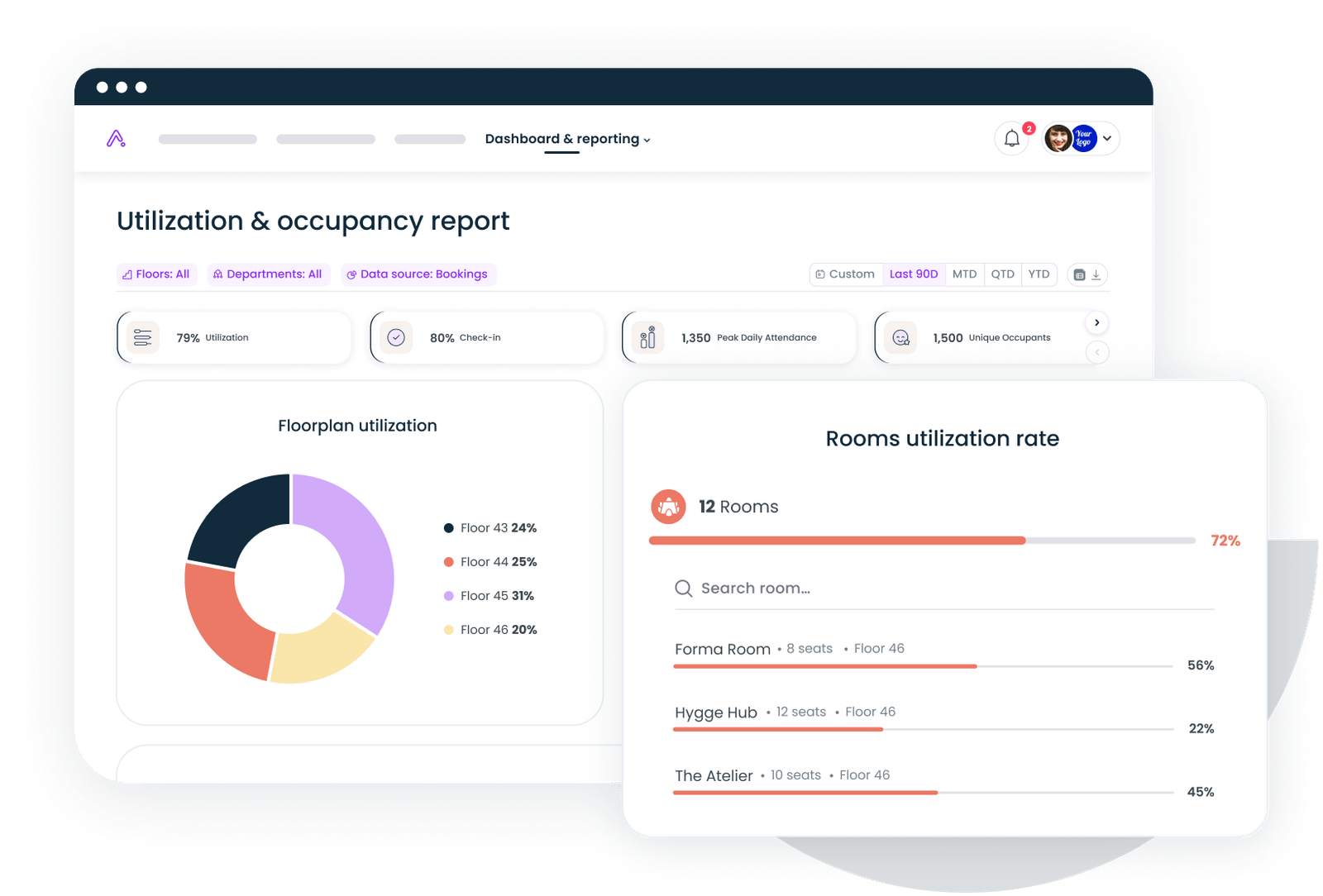
How forward-thinking companies handle desk booking privacy
Organizations getting this right share a pattern: they define what they're collecting and why before selecting a vendor, not after deployment when employees start asking questions.
Starting with documented business purposes
Before evaluating any office management software, write down the specific decisions desk booking data will inform. A 1,500-person company might list three: floor-level occupancy trends for lease negotiation, team co-location frequency for neighborhood planning, and no-show rates by building for policy adjustments. Each purpose gets mapped to the minimum data required to support it, and anything not on the list doesn't get collected.
This isn't a theoretical exercise. When a German regulator asks why your system stores employee check-in timestamps for 18 months, "we thought the data might be useful someday" isn't a defensible answer. "We retain anonymized check-in counts at the building level for 12 months to support our annual lease review" is.
Conducting DPIAs before rollout
A Data Protection Impact Assessment is legally required under GDPR for any processing likely to result in high risk to individuals, and desk booking systems that track employee presence across multiple locations almost certainly qualify. The DPIA should document what data is collected, why each field is necessary, what safeguards (anonymization, access controls, retention limits) are in place, and what residual risks remain.
For a company with 800 employees across 3 EU offices, a thorough DPIA takes 2-4 weeks and involves input from legal, IT, facilities, and HR. That upfront investment is trivial compared to the cost of a regulatory inquiry that finds no DPIA was conducted, which in itself can trigger a fine regardless of whether any data was mishandled.
Vendor evaluation with teeth
ISO 27001 certification and SOC 2 Type II compliance are table stakes, not differentiators. When evaluating desk booking vendors, the questions that matter are granular: does the platform support configurable data retention periods, or is deletion manual? Can RBAC permissions be customized beyond pre-set roles? Where is data stored, and does the vendor support EU data residency? Is there an automated process for handling data subject access requests, or does each one require a support ticket?
Ask for the vendor's own Data Processing Agreement template before signing. If it's generic boilerplate that doesn't reference desk booking data specifically, push back. A vendor that treats privacy as a feature (with configurable controls and documented practices) rather than a compliance checkbox will be the one that doesn't create problems 18 months into your contract.
Communicating with employees as adults
The companies with the highest booking adoption rates (consistently above 75%) treat privacy communication as an ongoing conversation, not a one-time notice. Quarterly updates in all-hands meetings ("here's what we learned from anonymized booking data, and here's how we're using it to improve your office experience") build a feedback loop where employees see the value exchange. Their data, in aggregated and anonymized form, directly improves the spaces they work in.
A 700-person fintech company running this approach reported that after six months of transparent communication about how booking data informed their decision to convert 30% of individual desks to collaboration zones, booking adoption climbed from 61% to 84%. Employees opted in because they could see the connection between the data collected and the improvements made.
Where desk booking data privacy goes from here
The regulatory direction is clear: more laws, higher fines, and increasingly specific requirements for workplace technology. Twenty-one US states now have privacy statutes, and that number will likely exceed 30 by the end of 2027 as legislatures follow California and Colorado's lead. The EU AI Act adds a new layer for any booking system incorporating predictive analytics or AI-driven recommendations, requiring explainability and human oversight for automated decisions that affect employees.
For workplace leaders, the strategic calculus is straightforward even if the implementation isn't. Every piece of individual-level data you collect is a liability with a maintenance cost (storage, access control, deletion, breach notification) and a trust cost (employee skepticism, reduced adoption, lower data quality). The question for every field in your booking system should be: does the aggregate version of this data serve the business purpose as well? In the vast majority of cases, it does, and switching to aggregated-by-default with individual data as a time-limited exception will reduce your compliance burden, improve employee trust, and give you better data because more people will use the system.
Gable's approach to booking data starts with minimization and transparency. See how it works for your team.
Get a demo


