.svg)


.svg)
- A mass notification system is legally required under OSHA's emergency action plan standards
- Multi-channel delivery (SMS, voice, email, Slack) is table stakes; geo-targeting is the differentiator
- Your MNS is only as good as your contact database, and most companies let theirs decay
- Real-time occupancy data from desk booking and badge systems makes alerts dramatically more accurate
- Test quarterly, audit contacts monthly, assign a named owner
A mass notification system is the infrastructure that gets the right warning to the right people when something goes wrong. It's not optional. OSHA standard 1910.165 requires employers to maintain employee alarm systems that provide warning for necessary emergency action, and most modern workplaces can't meet that bar with a fire alarm and a prayer. This guide covers what a mass notification system actually does, when you're legally required to have one, how to evaluate vendors, and how to implement without the project stalling at "we'll get to it next quarter."
What a mass notification system is and how it works
A mass notification system (MNS) simultaneously broadcasts real-time alerts across multiple channels to warn people of threats and direct their response. That's the DHS definition, and it's a good one because it highlights the two things that matter: speed and direction. A fire alarm tells you something is wrong. An MNS tells you what's wrong, where it's happening, and what to do about it.
Modern systems deliver messages through SMS, voice calls, email, desktop pop-ups, digital signage, Slack, Microsoft Teams, and even WhatsApp. The multi-channel approach isn't a nice-to-have. SMS hits a 98% open rate with 90% of messages read within 30 minutes, but that only helps if the person's phone is on. Desktop alerts catch people at their workstations. Voice calls reach field workers. You need all of them working together.
The real power of an MNS shows up when it's connected to other workplace systems. When your notification platform knows who's actually in the building (through badge data, desk bookings, or visitor logs), it can target alerts to the right floors, the right buildings, the right people. Without that integration, you're blasting everyone and hoping for the best.
When you legally need a mass notification system
OSHA doesn't use the phrase "mass notification system" in its regulations. What it does require, under 29 CFR 1910.165, is that every employer with a mandatory emergency action plan maintain an employee alarm system capable of providing warning for necessary emergency action. The alarm must be "distinctive and recognizable" and perceived above ambient noise. For most workplaces with more than a single floor or building, a basic fire alarm doesn't satisfy that standard on its own.
Beyond OSHA, several other frameworks apply. NFPA 72 governs fire and non-fire emergency notification systems, requiring clear audio and visual alerts with automatic fault reporting. California's SB 553 mandates workplace violence prevention plans with notification capabilities. If you operate across states, you're likely subject to a patchwork of requirements that collectively demand something more sophisticated than a PA system.
The triggering events are broader than most people assume. Active threats, yes. But also chemical spills, severe weather, utility failures, cyber incidents affecting physical security, and even pandemic-related building closures. If your workplace emergency plan identifies a scenario, your MNS needs to cover it.
Here's the compliance angle that catches people off guard: documentation. It's not enough to send the alert. You need to prove you sent it, prove it was received, and prove you tested the system regularly. That audit trail is where many organizations fall short, especially when their notification system isn't connected to their access control or workplace security infrastructure.

Your mass notification system is one piece of a broader safety framework. This guide covers the policies and procedures that tie it all together.
Read the guide
Critical features to evaluate in a mass notification system
Not all MNS platforms are built the same. Here's what separates a system that works under pressure from one that looks good in a demo.
Multi-channel delivery. This is baseline. Your system should support SMS, voice, email, desktop alerts, mobile push, and integration with collaboration tools like Slack and Teams. If a vendor only covers two or three channels, keep looking.
Geo-targeting and zone-based alerting. This is where the real differentiation lives. The ability to target alerts by building, floor, or geographic zone means you're not triggering a full evacuation when the issue is contained to one wing. Geo-targeting requires knowing who's where, which means your MNS needs to pull data from access control, desk booking, or visitor management systems.
Two-way communication. Sending an alert is half the job. The other half is confirming people are safe. Look for systems that support reply-based roll calls ("Reply 1 if safe, 2 if you need assistance") and aggregate responses into a real-time dashboard. This is how you account for everyone without manually calling down a roster.
Speed and reliability under load. Ask vendors about throughput: how many messages per minute, what happens during peak load, and what their uptime SLA looks like. An MNS that takes 15 minutes to reach 5,000 people isn't an emergency system; it's an email newsletter.
HRIS and access control integration. Your contact database shouldn't be a standalone spreadsheet. The system should sync with your HRIS for employee data and with badge access control systems for real-time presence. When someone badges into Building C, the system should know they're in Building C.
Compliance reporting and audit trails. Every alert should generate a timestamped log: who was targeted, which channels were used, delivery confirmations, and response data. This is what you hand to auditors, insurers, and (in worst cases) attorneys.
Role-based access and pre-built templates. In an emergency, you don't want the person sending the alert to be composing prose. Pre-built templates for common scenarios (fire, active threat, severe weather, shelter-in-place) with role-based permissions ensure the right people can trigger the right messages without delay.
Mass notification system buyer's checklist
Before you start vendor demos, do the internal work first. Most failed MNS implementations don't fail on technology. They fail on preparation.
1. Assess your workforce composition. How many employees are desk-based vs. field-based vs. remote? A company with 80% office workers has different channel priorities than one with 60% field technicians. Map your workforce to the channels that actually reach them.
2. Inventory your existing systems. What access control, HRIS, collaboration, and office management software do you already run? Your MNS needs to integrate with these, not replace them. The fewer manual data bridges, the fewer points of failure.
3. Define your scenario library. List every emergency scenario your organization could face. For each one, define: who needs to be notified, through which channels, with what message, and what response you expect. This becomes your template library.
4. Audit your contact database. Pull your current employee contact data and check it. How many phone numbers are missing? How many are personal numbers that employees haven't updated? Contact database accuracy is the single biggest predictor of MNS effectiveness, and most organizations are shocked at how bad their data is.
5. Establish ownership. An MNS without a named owner becomes shelfware. Assign someone (typically in security, facilities, or EHS) who owns the system, runs quarterly tests, and audits the contact database monthly.
6. Set your budget against risk. MNS pricing varies widely, from a few thousand dollars annually for basic platforms to six figures for enterprise deployments with dedicated support. Price it against the cost of a failed notification: regulatory fines, liability exposure, and the human cost of delayed warnings.
7. Require a pilot. Don't sign a multi-year contract without running a pilot. Send test alerts to a subset of employees, measure delivery speed and confirmation rates, and stress-test the integration with your existing systems.
Implementation considerations and best practices
The technology is the easy part. Implementation is where organizations stumble.
Contact database management is the hardest ongoing problem. Most deployments fail on what some practitioners call "contact graph management": outdated phone numbers, employees who've changed roles or locations, shift assignments that drift from reality. Mature programs treat the contact database as a monthly audit with a named owner. If you're syncing with your HRIS and your desk booking system, much of this stays current automatically. If you're maintaining a separate spreadsheet, you're already behind.
Integration architecture matters more than features. A feature-rich MNS that doesn't talk to your access control, HR system, or workplace platform is a standalone silo. Prioritize vendors with pre-built integrations or open APIs. The goal is a system that knows, in real time, who's in which building on which floor, without anyone manually updating a roster. This is where connecting your MNS to workplace analytics and occupancy data pays off; you're targeting alerts based on actual presence, not scheduled attendance.
Test like you mean it. Quarterly drills are the minimum. Run them unannounced at least once a year. Measure time-to-delivery, confirmation rates, and how long it takes to account for everyone. After each drill, debrief and fix what broke. The organizations that treat drills as checkbox exercises are the ones that fumble real emergencies.
Train beyond the admin team. Your MNS admin might be out sick on the day it matters. Train at least three people to send alerts, and make sure floor wardens and team leads understand what to expect when an alert goes out. Integrate MNS training into your broader workplace security awareness program.
Plan for multi-site complexity. If you operate across multiple locations, your MNS needs to handle site-specific alerts without cross-contamination. An active threat in your Chicago office shouldn't trigger a shelter-in-place in Austin. Zone-based configuration and site-level admin permissions are essential for managing multiple office locations.
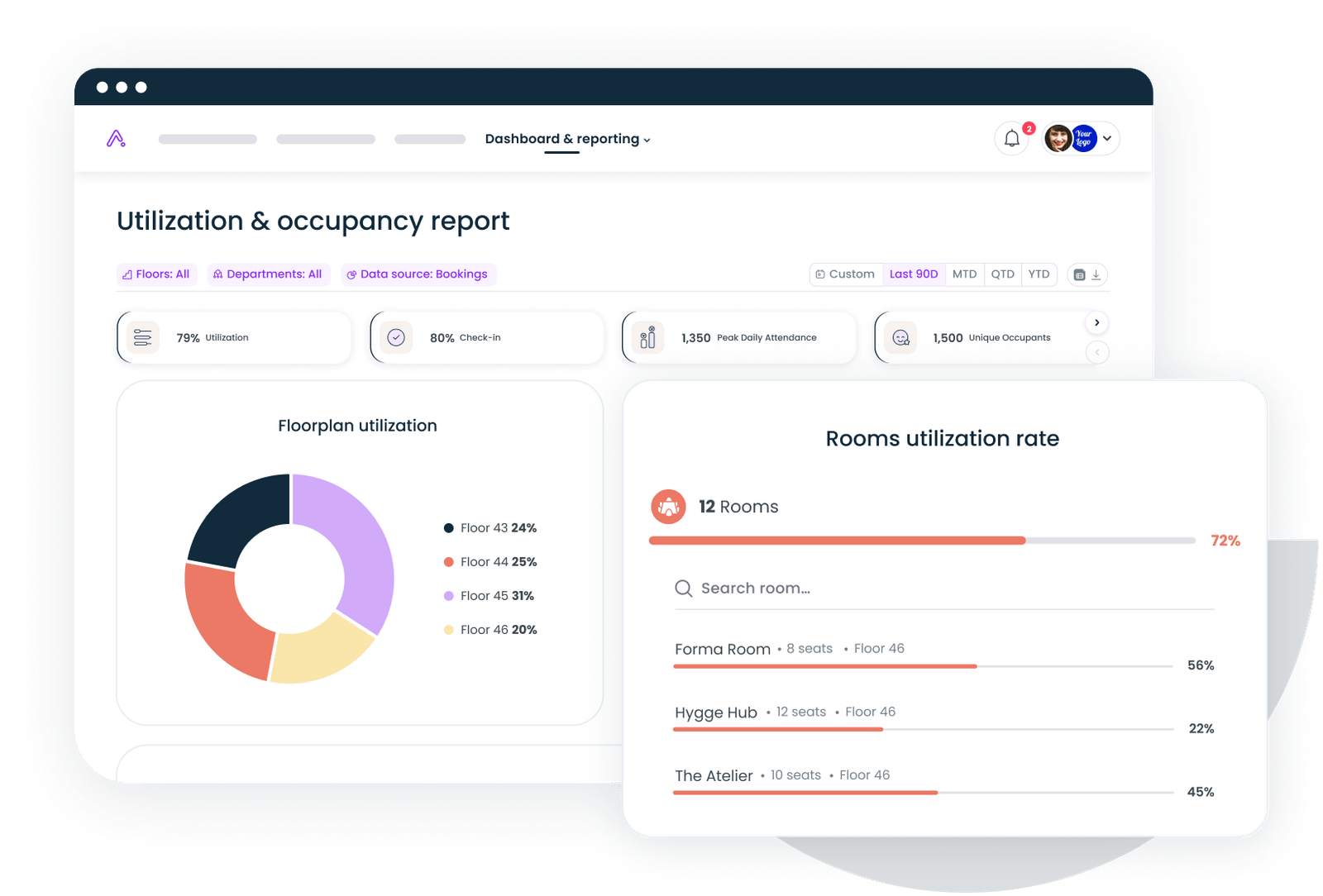
Desk booking, room scheduling, and badge integration give your mass notification system the presence data it needs to target the right people on the right floors.
Learn more
Why occupancy data is the missing layer in most MNS deployments
Here's the gap nobody talks about in vendor demos: your mass notification system can only target alerts accurately if it knows who's actually on-site. And in a hybrid workplace, that's a moving target.
Think about it. On any given Tuesday, maybe 55% of your workforce is in the office. On Friday, it's 30%. The people in the building change day to day. If your MNS is pulling from a static employee directory, it's sending alerts to people sitting at home and missing contractors who badged in that morning.
This is where the connection between your MNS and your workplace management platform becomes critical. When desk bookings, room reservations, badge swipes, and visitor management data feed into your notification system, you get a real-time picture of who's where. Gable Offices provides exactly this layer: unified occupancy data from desk and room bookings, badge integration, and visitor check-ins that can serve as the presence backbone your MNS relies on.
The practical impact is significant. Geo-targeted alerts go to occupied floors only. Roll-call confirmations account for visitors and contractors, not just employees. Post-incident reports show exactly who was in the building and whether they were reached. That's the difference between a compliance checkbox and a system that actually protects people.
How to evaluate MNS vendors without getting lost in feature lists
Vendor evaluation in this space is noisy. Every platform claims to be the fastest, most reliable, most integrated solution on the market. Here's how to cut through it.
Start with your scenario library, not the vendor's feature sheet. Take the three most likely emergency scenarios for your organization and ask each vendor to walk through them live. Not a canned demo; your scenarios, your org structure, your integration requirements. Watch how the platform handles targeting, template selection, delivery, and response tracking.
Ask for real throughput numbers. "Near-instant delivery" is marketing language. Ask: how many messages per second can the platform send? What's the p95 delivery time for 10,000 recipients across SMS and voice simultaneously? Get it in writing.
Test the integration, not just the API documentation. Every vendor has an API. Fewer have production-tested integrations with the specific HRIS, access control, and workplace platforms you run. Ask for reference customers running your same stack.
Check the compliance reporting. Pull a sample audit report from the platform. Does it show per-recipient delivery status, timestamps, channel used, and response received? If the report requires manual assembly, it won't hold up when you need it.
Evaluate the admin experience under stress. Have someone on your team who's never seen the platform try to send a test alert in under 60 seconds. If it takes training to send a basic notification, it's too complex for an emergency. The best systems let you trigger a pre-built alert in two or three clicks.
Your workplace technology RFP process should include MNS-specific evaluation criteria alongside your broader workplace platform requirements.
Making your mass notification system part of a broader safety culture
A mass notification system isn't a standalone purchase. It's one component of a safety infrastructure that includes physical security, access control, emergency planning, and ongoing training. The organizations that get the most value from their MNS are the ones that treat it as integrated infrastructure, not a point solution.
That means your MNS strategy should connect to your office security program, your visitor policies, your emergency action plans, and your workplace technology stack. When these systems share data and workflows, you get faster response times, better accountability, and audit trails that actually hold up.
The biggest risk isn't choosing the wrong vendor. It's buying the right system and letting it atrophy. Contact databases decay. Templates go stale. New buildings get added without updating zone configurations. The organizations that avoid this assign clear ownership, run regular drills, and tie their MNS to live occupancy data so the system stays current without manual intervention.
If you're evaluating a mass notification system for the first time, or replacing one that's underperforming, start with the internal work: scenario library, contact audit, integration inventory, and ownership assignment. The technology decision comes after that foundation is solid.
Book a walkthrough to see how real-time desk booking and badge data can strengthen your emergency notification targeting.
Get a demo