.svg)


.svg)
- Fully remote workers cut carbon footprints by up to 54%, but one day WFH barely moves the needle
- Office buildings waste billions powering empty space; hybrid work only helps if you optimize for it
- Desk sharing is the overlooked environmental multiplier most companies ignore
- Your hybrid policy needs at least two WFH days per week to produce measurable emissions reductions
- You can't claim environmental benefits you aren't tracking
Flexible work environmental impact is more nuanced than most sustainability reports suggest. The headline stat is compelling: remote workers cut emissions by compared to their in-office counterparts. But that number hides a set of trade-offs that most workplace leaders haven't fully reckoned with, from increased home energy use to the stubborn reality that office buildings burn energy whether anyone shows up or not.
The environmental case for flexible work is real, but non-linear
Let's start with what we know. Transportation is the single largest source of greenhouse gas emissions in the United States, and commuting is a significant chunk of that. When people stop driving to an office five days a week, emissions drop. That part is straightforward.
What's less intuitive is the curve. The same Cornell and Microsoft study that produced the 54% headline found that hybrid workers who work from home two to four days per week reduce their carbon footprint by 11% to 29%. Drop to one day? The reduction is just 2%. Barely a rounding error.
That non-linearity matters. A company that lets people work from home on Fridays and calls it a sustainability initiative is, statistically speaking, doing almost nothing for the environment. The benefits only become meaningful at two or more days per week, and they scale from there.
This is the part that gets lost in the ESG slide deck. Flexible work can be genuinely good for the planet, but only if the policy is designed with enough flexibility to actually matter. A well-structured hybrid schedule that gives employees real choice about when and where they work isn't just better for retention. It's the minimum threshold for environmental impact.
The hidden costs nobody wants to talk about
Here's where the conversation gets uncomfortable. Remote work doesn't eliminate energy consumption. It redistributes it.
When employees work from home, they heat, cool, and power their own spaces. They take non-commute trips they wouldn't have made from the office. They tend to live farther from the office (because they can), which means the days they do commute, they drive longer distances. And then there's the digital infrastructure: an hour-long HD video call can emit between 150 and 1,000 grams of CO2, depending on the energy grid powering the data centers.
None of this means flexible work is bad for the environment. It means the math is more complicated than "fewer commutes equals less carbon." And it means companies that want to make honest environmental claims need to account for the full picture, not just the parts that look good in a report.
The biggest hidden cost, though, isn't on the employee side. It's in the buildings.
Empty offices are the real environmental problem
This is the part that should keep workplace leaders up at night. Most office buildings run at roughly the same energy baseline whether they're 20% occupied or 80% occupied. HVAC systems, lighting, elevators, server rooms; they don't scale down just because half the desks are empty.
The numbers are staggering. U.S. offices waste roughly $3.36 annually on electricity for unused space, translating to over 22 million metric tons of CO2 emissions each year. That's not a rounding error. That's a systemic failure.
Hybrid work was supposed to fix this. In theory, fewer people in the office means less energy consumed. In practice, most buildings haven't adapted. They still run full systems across entire floors regardless of actual occupancy. The mismatch between how buildings operate and how people actually use them has quietly become one of the largest sources in commercial real estate.
This is where workplace occupancy tracking becomes an environmental issue, not just an operational one. If you don't know how many people are actually in the building on any given day, you can't right-size energy consumption. You're paying to heat and cool air that nobody breathes.
The fix isn't complicated in concept. It's complicated in execution. You need real-time occupancy data tied to building management systems so that energy use scales with actual presence. You need space utilization metrics that tell you which floors, zones, and rooms are consistently underused. And you need the organizational willingness to consolidate space rather than maintain empty floors "just in case."

Environmental impact starts with understanding how your spaces are actually used. This guide breaks down the metrics that separate real optimization from guesswork.
Read the guide
Desk sharing is the environmental multiplier most companies overlook
Here's a claim I'll stand behind: your desk-sharing ratio matters as much as your work-from-home policy when it comes to environmental impact.
The logic is simple. If your hybrid policy means 60% of desks sit empty on any given day, you have two choices. You can keep paying for (and powering) all that space. Or you can implement desk sharing, consolidate your footprint, and actually capture the environmental benefit that hybrid work promises.
Desk sharing doesn't just reduce real estate costs, though it absolutely does that. It reduces the physical space that needs to be heated, cooled, lit, and maintained. When you move from assigned seating to shared seating, you can close entire floors. You can move to smaller buildings. You can shift from long-term leases to flexible office arrangements that scale with actual demand.
The counterargument is that employees don't like it. Some don't. But the resistance usually comes from poor implementation, not from the concept itself. When desk sharing is supported by reliable booking tools, clear policies, and enough variety in workspace types (focus rooms, collaboration zones, quiet areas), most people adapt quickly. The environmental upside is too significant to let change management anxiety kill the initiative.
Making flexible work genuinely sustainable requires four things
I've talked to enough workplace leaders to know that most want to do the right thing on sustainability. The problem isn't intent. It's that the path from "we have a hybrid policy" to "we've measurably reduced our environmental footprint" isn't obvious. Here's what actually moves the needle.
First, set your hybrid policy at two or more WFH days per week. Anything less produces negligible environmental benefit. If your policy is "come in when you want" with no structure, you'll likely end up with unpredictable occupancy patterns that make space optimization impossible. A clear hybrid work policy with defined in-office days lets you plan energy use, consolidate space, and measure results.
Second, optimize your physical footprint with data. This means tracking occupancy at the floor and zone level, not just counting badge swipes at the front door. It means understanding peak days versus quiet days, and adjusting building operations accordingly. Gable's platform unifies booking data, badge access, and occupancy signals to give workplace teams the visibility they need to right-size space and energy use in real time.
Third, support sustainable commuting on in-office days. The days employees do come in still generate emissions. Transit subsidies, EV charging infrastructure, bike storage, and locating offices near public transit all reduce the per-trip carbon cost. The IEA estimates that even one day of remote work per week globally would save around 1% of oil consumption for road passenger transport; imagine the impact when the remaining commute days are also optimized.
Fourth, track and report honestly. This is where most companies fall short. Don't claim a 54% reduction if your policy only allows one WFH day. Include home energy use in your scope 3 calculations if you're claiming employee-level impact. Use actual occupancy data, not headcount assumptions, to calculate building emissions. Workplace analytics should be the foundation of your environmental reporting, not an afterthought.
From occupancy patterns to space utilization, Gable's analytics platform turns raw workplace data into actionable insights.
Learn more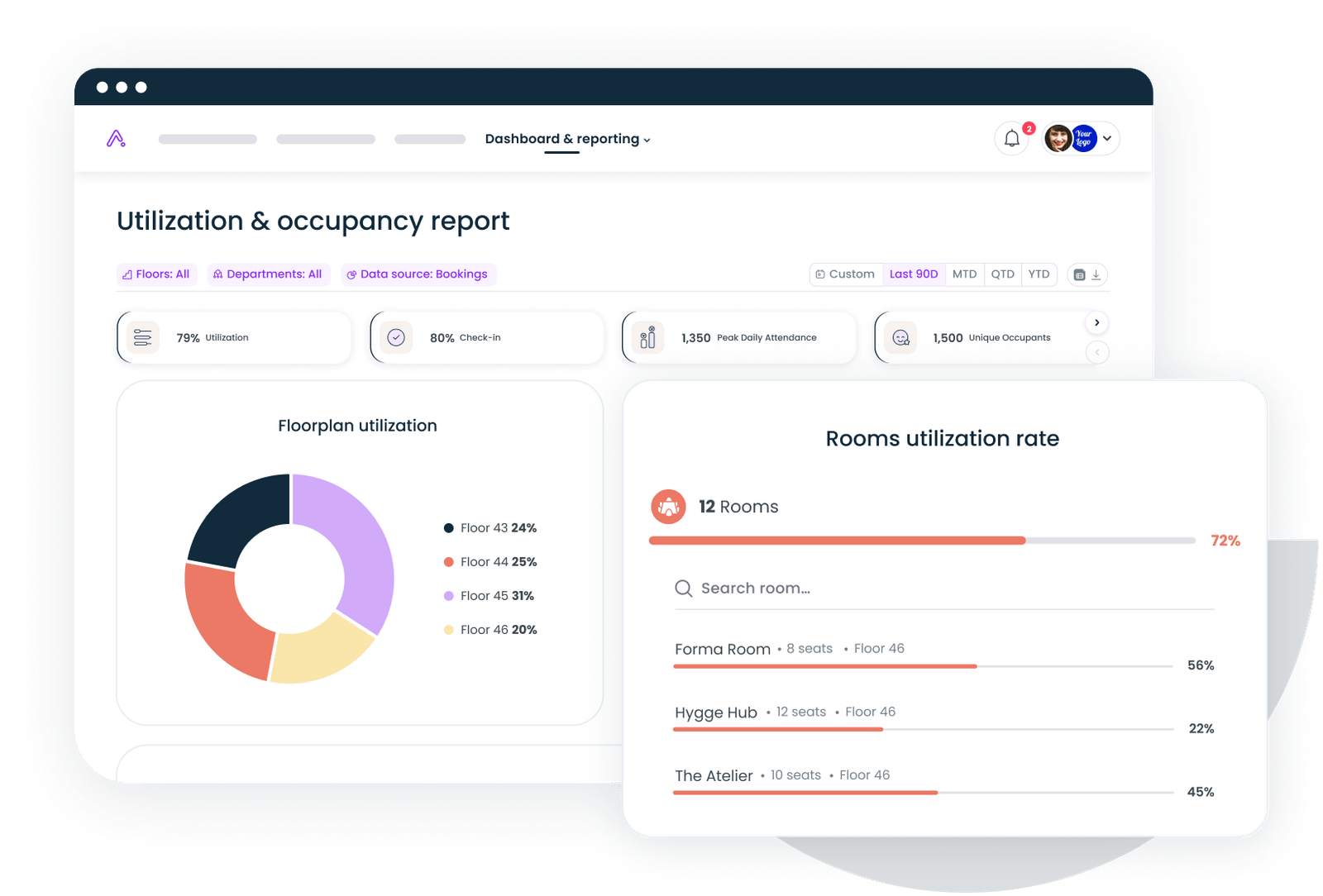
The greenwashing trap (and how to avoid it)
Let's be direct. A lot of corporate sustainability claims around flexible work don't hold up to scrutiny.
Saying "we reduced emissions by going hybrid" without specifying how many days, how you measured it, or whether you adjusted building operations is greenwashing. It might not be intentional, but it's misleading. And as ESG reporting standards tighten globally, vague claims will become liabilities.
The honest version sounds more like this: "We moved to a three-day-in-office model, consolidated from four floors to two, implemented zone-based HVAC scheduling tied to occupancy data, and reduced our building energy consumption by 35%. Home energy offsets partially reduce that gain, and we're working to quantify the net impact."
That's not as catchy. It's a lot more credible.
The companies that will lead on flexible work environmental impact are the ones willing to show their math. That means investing in the data infrastructure to actually measure what's happening, not just in the office, but across the entire distributed work ecosystem.
The distributed work opportunity most companies miss
There's one more angle worth exploring. When employees work from home, they're often working from suburbs or exurbs with limited workspace options. When they need to collaborate in person, they drive to a central HQ that might be 45 minutes away.
But what if they didn't have to? Distributed flex spaces, coworking locations closer to where employees actually live, can dramatically reduce commute distances on collaboration days. IWG research found that local flexible workspaces save an average of 411,000 commuting days per center annually, with projected global savings of 2.56 million metric tons of CO2 by 2029.
This is the hub-and-spoke model applied to sustainability. Instead of one large, energy-intensive headquarters that most people commute long distances to reach, you maintain a smaller central office supplemented by a network of flex spaces closer to where your people live. The environmental math works because you're attacking both sides of the equation: smaller central footprint and shorter commutes.
The bottom line on flexible work and the environment
Flexible work can meaningfully reduce your company's environmental impact. But "can" is doing a lot of heavy lifting in that sentence. The benefit isn't automatic. It requires intentional policy design (two or more WFH days), aggressive space optimization (desk sharing, floor consolidation), real-time occupancy data to align energy use with actual presence, and honest measurement that accounts for trade-offs.
The companies getting this right aren't the ones with the splashiest sustainability pages. They're the ones quietly consolidating floors, tracking utilization by zone, and making data-driven decisions about where and how their people work. The environmental benefit is real. You just have to earn it.
From desk booking to occupancy analytics to on-demand flex spaces, Gable gives workplace teams the tools to right-size their footprint.
Get a demo