.svg)


.svg)
- JPMorgan's 5-day RTO mandate triggered a 2,000-person petition and desk shortages on day one
- Research shows rigid mandates spike turnover 13-14% and hit senior talent hardest
- 91% of financial services firms still offer location flexibility; JPMorgan is the outlier
- Occupancy data, not executive instinct, should drive workplace policy in 2026
- Companies replacing mandates with coordination tools see 30%+ collaboration gains
JPMorgan Chase told 300,000 employees to come back five days a week starting March 2025, making it the largest full-time return-to-office mandate since the pandemic. Ten months in, the results read less like a productivity triumph and more like a case study in what happens when workplace policy ignores workplace data. For any leader weighing their own jp morgan return to office-style mandate, the lesson is clear: rigid policies create problems that flexible, data-informed strategies solve without the attrition bill. Offices matter, but the approach matters more.
JPMorgan's mandate: the timeline nobody expected to accelerate
Jamie Dimon's January 2025 memo didn't arrive in a vacuum. JPMorgan had operated a hybrid policy since 2021, requiring most corporate staff in-office three days per week. The switch to five days eliminated that flexibility for roughly 60% of the workforce who'd been on hybrid schedules, effective March 2025.
Dimon's stated logic: junior employees learn through an "apprenticeship model" that only works in person. He cited mentorship, spontaneous collaboration, and client relationship-building as the pillars of that argument.
By October 2025, Dimon was reinforcing the policy in an internal town hall that leaked almost immediately. His message to dissenters was blunt, punctuated by profanity he later apologized for. The 60-story Manhattan headquarters at 270 Park Avenue, set to open in 2025 as the largest all-electric skyscraper in the country, became both the symbol and the staging ground for JPMorgan's bet that full-time office presence drives better outcomes.
What Dimon didn't share: any occupancy data, utilization benchmarks, or retention modeling to support the decision.
What happened when 300,000 people showed up
The first week of March 2025 exposed a gap between policy ambition and physical readiness that most facilities teams could have predicted with a single floor plan audit.
The problems surfaced immediately:
- Desk shortages: Employees arrived to find no available seats, despite being told to report in person.
- WiFi failures: Networks buckled under full-capacity loads that hadn't been stress-tested.
- Noise complaints: Open floor plans designed for 60% occupancy hit 90%+ on a Monday, making focused work nearly impossible.
- Presenteeism pressure: Sick colleagues, pressured to appear in-person, showed up anyway.
The visual of JPMorgan's "return to greatness" looked more like a cafeteria at an overcrowded airport terminal.
By October, over 2,000 employees had signed a formal petition requesting hybrid flexibility be restored. Conversations about unionization surfaced, with the Communications Workers of America reportedly in early discussions with some JPMorgan staff. Multiple employees told reporters they feared retaliation for speaking out, a dynamic that doesn't typically signal a thriving culture.
The desk shortage paradox
JPMorgan's rollout is particularly instructive. A company with $4.1 trillion in assets and 300,000 employees didn't model whether its offices could physically hold everyone at once. The root cause: the company never collected the data that would have surfaced the problem. Real-time occupancy insights from badge swipes, WiFi connections, and booking systems would have flagged the capacity problem weeks before the mandate went live.
Instead, the policy assumed that telling people to show up was the same thing as being ready for them to show up.

Before setting any RTO policy, you need to understand what your spaces are doing. This guide breaks down the metrics, tools, and frameworks that prevent the kind of capacity disasters JPMorgan experienced.
Read the guide
JPMorgan as outlier, not bellwether
Ninety-one percent of US financial services companies offer some form of work location flexibility, according to the Flex Index. JPMorgan is defying the industry trend rather than leading it.
Citigroup maintained its three-day hybrid policy through 2025. Capital One operates a hybrid model with regional flexibility. Even Goldman Sachs, which pushed hard for five-day returns in 2022, quietly softened enforcement when senior bankers started fielding recruiter calls.
The broader corporate landscape tells the same story. Robert Half data from Q4 2025 shows 24% of new job postings were designated hybrid, up from 9% in early 2023. Amazon delayed its own five-day mandate rollout after infrastructure concerns. Meta increased in-office expectations but stopped short of eliminating remote options entirely.
Where the trend is headed
Global office utilization hit 53% in 2025, up from 38% in 2024, according to CBRE's 2026 Global Workplace and Occupancy Insights report. Utilization is climbing toward a "vibrant day" benchmark of 67% capacity, which leading workplace researchers now consider full occupancy. The gap between "offices are useful" and "offices must be full every day" is where most of the RTO debate lives. JPMorgan's mandate pretends that gap doesn't exist.
HubStar's Hybrid Occupancy Index puts numbers on the pattern: Tuesday recorded the highest global occupancy of any weekday at 58.6% in 2025, while Fridays sat at 34.5%. These aren't anomalies. They're structural features of how knowledge workers use offices in 2026. Mandating Friday presence doesn't make Friday productive; it makes Friday resentful.
The research JPMorgan's leadership hasn't cited
A joint study from Baylor University and the University of Pittsburgh tracked S&P 500 companies that announced RTO mandates and found an average 13-14% increase in abnormal turnover rates post-announcement. The turnover wasn't random. It was concentrated among senior employees and women.
That concentration matters. Research cited by the EO Network found that female employees were roughly three times more likely to leave after a rigid RTO mandate than male peers, driven by childcare logistics, commute burdens, and the signal that leadership didn't value outcomes over presence. Job vacancy durations increased 23%. Hiring rates dropped 17%.
The productivity argument falls apart under scrutiny
Dimon's apprenticeship model theory, that junior employees learn best by being physically proximate to senior colleagues, sounds intuitive. But the Baylor-Pittsburgh research reveals a problem: senior employees are the ones leaving. You can't run an apprenticeship program when the mentors are updating their LinkedIn profiles.
Structured hybrid arrangements of two to three days in-office produce equivalent productivity to full-time office work while improving retention and employee satisfaction, according to longitudinal research across multiple industries. The key word is "structured." Not mandated. Not arbitrary. Structured around collaboration needs, measured by real data.
When the facilities team at a 500-person company sees Floor 3 hitting 12% occupancy every Friday, they don't need a consultant to tell them what to do. They need a booking system that reallocates that space and a coordination tool that helps teams cluster on the days that matter.
Gable's desk booking, interactive floor plans, and real-time coordination tools help workplace teams eliminate the chaos of overcrowded Tuesdays and empty Fridays, without mandates.
Learn more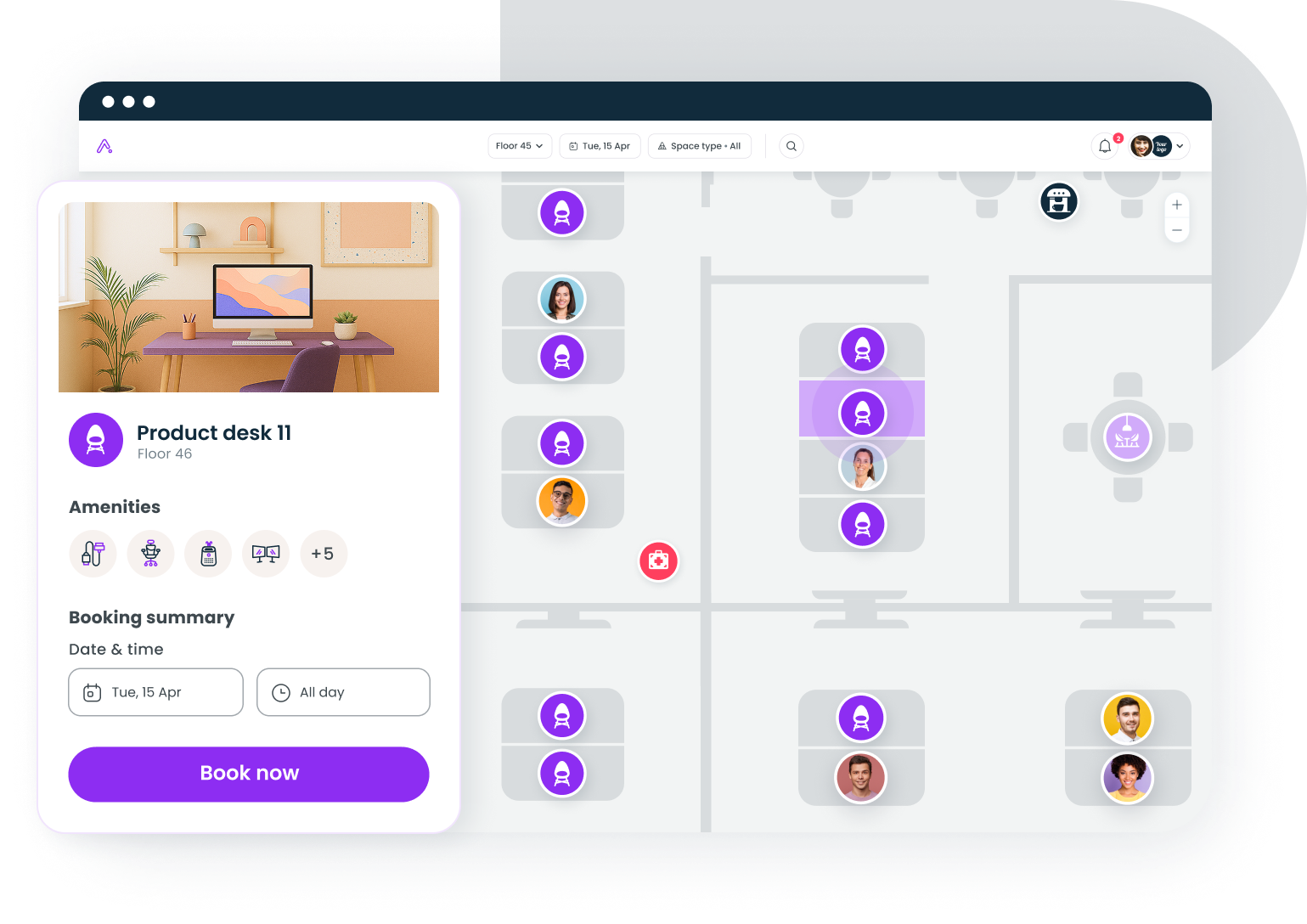
The hidden costs that don't show up in Jamie Dimon's earnings call
JPMorgan posted record profits in 2024. Dimon has pointed to financial performance as validation of in-person work. The logic is appealing and completely unfalsifiable. Record profits preceded the mandate. They don't prove the mandate works.
What's measurable is the cost of replacing the people who leave.
| Cost category | Impact of rigid RTO mandate |
|---|---|
| Turnover increase | 13-14% above baseline (Baylor/Pittsburgh) |
| Senior talent loss | Disproportionate departure of experienced staff |
| Gender equity impact | Female employees ~3x more likely to exit |
| Hiring cycle extension | Job vacancies open 23% longer |
| Hiring rate decline | 17% fewer successful hires |
| Real estate inefficiency | Peak-day overcrowding, off-peak underutilization |
The real estate math deserves its own line. JPMorgan's new 270 Park Avenue headquarters cost approximately $3 billion. Filling it five days a week justifies the investment on paper. But if Tuesday and Wednesday hit 95% capacity while Friday drops to 40%, the building isn't optimized. It's stressed on peaks and wasted on valleys. That pattern is universal, and pretending a mandate eliminates it doesn't change the badge-swipe data.
The talent market has already priced in flexibility
Recruiters at competing banks know exactly which JPMorgan employees are unhappy. Industry benchmarks consistently show most companies reporting office utilization between 41-80%, a range that suggests most organizations have settled into a hybrid rhythm. Companies offering flexibility within that range aren't being generous. They're being competitive.
A senior risk analyst at JPMorgan making $275,000 doesn't need to take a pay cut to get hybrid. She needs to answer one recruiter's InMail. The mandate's true cost isn't the WiFi upgrade or the desk expansion. It's the institutional knowledge that walks out the door with every tenured employee who decides five days in Midtown isn't worth it.
What data-driven leaders do instead
The alternative to JPMorgan's approach isn't "let everyone work from home forever." It's replacing policy instinct with occupancy intelligence, and replacing mandates with coordination.
Measure before you mandate
Most companies that successfully manage hybrid work start with 90 days of baseline occupancy data: badge swipes, WiFi connections, desk bookings, and meeting room utilization. They identify when teams naturally cluster (almost always Tuesday through Thursday), which floors or neighborhoods run hot, and which spaces sit empty enough to sublease or repurpose.
That 90-day window costs nothing except attention. Skipping it, as JPMorgan did, costs a 2,000-signature petition and a PR cycle.
Design for collaboration, not compliance
The difference between "everyone must be here Monday through Friday" and "your team coordinates in-office days around project milestones" is the difference between surveillance and strategy. When employees can see who's planning to be in the office (through a live team view, not a mandate), they self-organize around the days that matter.
The tools that make this work are straightforward:
- Interactive floor plans showing real-time desk availability solve the "paper tent" problem that plagued JPMorgan's rollout.
- QR code and NFC desk booking eliminates the morning scramble for seats.
- Permission-based controls let workplace teams set guardrails (budgets, booking limits, geo-fencing) without removing choice.
Right-size your portfolio with real data
Companies using unified workplace data from HR systems, access control, and WiFi integrated into a single dashboard can identify that Engineering clusters on Mondays and Wednesdays while Sales peaks on Tuesdays and Thursdays. That insight doesn't lead to a mandate. It leads to a smarter floor plan, a neighborhood redesign, or a decision to convert an underused floor into event space.
For distributed teams that don't have a nearby office, platforms like Gable provide access to on-demand flex workspaces in 900+ cities, so collaboration happens without a $3 billion headquarters. The employee in Austin books a coworking space for the day her team is meeting virtually. The regional sales team in London reserves a meeting room for a quarterly planning session. Nobody fills out a petition because nobody was forced into a one-size-fits-all policy.
Track outcomes, not attendance
JPMorgan tracks whether people show up. Data-driven companies track whether showing up produces better work. Those are different questions with different answers.
Workplace intelligence tools that combine booking data, team coordination patterns, and post-visit feedback reveal which in-office days drive collaboration versus which days people sit at a desk and join the same Zoom calls they'd join from home. When the data shows that cross-functional meetings on Wednesdays generate three times more follow-up actions than solo desk days on Mondays, you've got a policy input. Not a guess. A data point.
The real lesson from JPMorgan's mandate
JPMorgan's RTO policy isn't failing because offices are bad. Offices aren't bad. Spontaneous hallway conversations, whiteboard sessions, lunch with a new teammate: these have value that Zoom can't replicate.
The policy is failing because it treats presence as a proxy for productivity, ignores the data on how knowledge workers use physical space, and assumes that a memo from the CEO can override the labor market's preference for flexibility. Every week that JPMorgan holds firm, a competitor with a structured hybrid model hires one of their senior analysts. That's what a 13-14% abnormal turnover rate looks like, one departure at a time.
Companies that will define workplace strategy in 2026 and beyond are investing in better data, more intentional coordination tools, and the willingness to let occupancy patterns shape policy instead of executive preferences. A vibrant office at 67% capacity, where every person chose to be there because they had a reason to be there, will outperform a resentful office at 95% capacity staffed by people counting the days until a recruiter calls.
JPMorgan spent $3 billion on a building. The real question is whether filling the building creates $3 billion in value, or whether a smarter, more flexible approach would have created more.
Gable helps workplace, people, and finance teams coordinate offices, on-demand spaces, and events with the data to prove what's working. No mandates required.
Get a demo