.svg)


.svg)
- Anchor days only work when you design them around purpose, not just presence
- Tuesday and Wednesday dominate for a reason; pick days based on your data, not the herd
- Team-level anchors beat company-wide mandates for most organizations
- Five common anti-patterns kill adoption faster than any policy memo can build it
- Measure attendance, utilization, and sentiment together or you're flying blind
An anchor day is a designated day (or days) when hybrid employees are expected to work from the office together. It's the most common hybrid scheduling pattern in 2026, and most companies still get it wrong. The difference between an anchor day that drives genuine collaboration and one that just fills seats comes down to design: picking the right day, setting the right scope, programming the right activities, and measuring whether any of it's working.
This guide walks through each step.
What is an anchor day?
Let's get the definition out of the way. An anchor day is a recurring, predictable in-office day built into your hybrid work schedule. It's not a return-to-office mandate with a calendar invite stapled on. The distinction matters.
A mandate says "be here three days a week." An anchor day says "be here on Tuesday, because that's when your team collaborates, reviews work, and makes decisions together." One is about compliance. The other is about coordination.
The coordination piece is what makes anchor days valuable. When everyone shows up on the same day, you get the density needed for spontaneous conversations, cross-functional problem-solving, and the kind of mentorship that doesn't happen over Slack. When people trickle in on random days, you get a half-empty office that feels lonelier than working from home.
Placer.ai's 2026 research confirms that Tuesdays and Wednesdays have firmly established themselves as primary anchor days across industries. That's not an accident. It's the result of millions of workers and thousands of companies converging on the same insight: mid-week is when in-person work delivers the most value.
How to pick the right anchor day
Choosing the right day isn't about copying what other companies do. It's about understanding your own work patterns and aligning the anchor day to when collaboration actually happens.
Step 1: Look at your existing attendance data. Before you pick a day, check which days people already come in voluntarily. If your badge data or office attendance tracking shows a natural Tuesday spike, you're not fighting gravity by making Tuesday your anchor. You're formalizing what's already working.
Step 2: Map your meeting patterns. Pull your calendar data for the last 90 days. Which day has the highest concentration of multi-person, in-person meetings? That's your natural collaboration day. Kastle Systems badge data shows Tuesday office occupancy averaging 62% of pre-pandemic levels, Wednesday at 59%, and Thursday at 54%. Monday and Friday lag significantly because employees use those days for deep work, personal errands, or easing into and out of the week.
Step 3: Consider your industry rhythm. Client-facing teams (sales, consulting, account management) often need Mondays for weekly kickoffs and pipeline reviews. Engineering teams tend to prefer mid-week for sprint ceremonies. Creative teams might cluster on Wednesdays for design reviews. There's no universal right answer.
Step 4: Avoid Friday. Just avoid it. Commute friction is highest, attendance is lowest, and you'll spend more energy enforcing the policy than benefiting from it.
Step 5: Start with one day. If you're implementing anchor days for the first time, pick a single day and run it for 8 to 12 weeks before adding a second. This gives you clean data on what's working and what needs adjustment. Our guide on running a workplace pilot covers the mechanics of testing before committing.
Team-level vs. company-level anchor days
This is the decision that trips up most organizations. Do you set one anchor day for the entire company, or let individual teams choose their own?
Company-wide anchor days are simpler to communicate and enforce. Everyone knows Tuesday is office day. Facilities can plan catering, meeting rooms, and desk availability around a single peak. Cross-functional collaboration happens naturally because everyone's in the building.
The downside: company-wide anchors create massive density spikes. If you have 500 employees and 300 desks, a single anchor day means you're either overcrowded or turning people away. That's a fast way to breed resentment.
Team-level anchor days give each team the flexibility to pick the day that fits their workflow. Engineering comes in Wednesday; Sales comes in Tuesday; Marketing comes in Thursday. Density spreads across the week, and each team gets a day optimized for their specific collaboration needs.
The downside: cross-functional work suffers. If the product manager is in on Wednesday but the designer is in on Thursday, they're never in the same room. You lose the serendipitous hallway conversations that anchor days are supposed to create.
The hybrid approach works best for most companies. Set one company-wide anchor day (usually mid-week) for all-hands, cross-functional meetings, and culture-building. Then let teams pick a second anchor day that fits their rhythm. This gives you one high-density day for company cohesion and one team-optimized day for focused collaboration.
Companies like J.M. Smucker have taken a creative approach: instead of weekly anchor days, they designate 22 "anchor weeks" per year when all employees come to the office. The rest of the time, teams coordinate their own schedules. It's an unusual model, but it shows that anchor days don't have to follow a rigid weekly cadence.
For more examples of how real companies structure this, see our roundup of hybrid work model examples.

Anchor days are just one pattern. See how structured hybrid, flex hybrid, and team-choice models stack up in practice.
Read the guide
5 anchor day anti-patterns that kill adoption
Getting the day right is only half the battle. Here's where most companies go wrong, and what to do instead.
The meeting avalanche
The most common failure mode. Everyone's in the office, so every meeting gets scheduled on anchor day. By 10 a.m., people are back-to-back in conference rooms, staring at the same screens they'd stare at from home. The day becomes a marathon of scheduled interactions with zero time for the unstructured collaboration that justified the commute.
Fix it: Cap scheduled meetings at 50% of the anchor day. Block two-hour windows for "open collaboration," meaning no formal meetings, just available time for people to work near each other, grab coffee, whiteboard ideas, or have the conversations that don't fit in a calendar invite.
Overcrowding without space planning
If your anchor day attendance exceeds your desk and meeting room capacity, you've created a worse experience than working from home. People arrive to find no desks, no meeting rooms, and a lunch line that wraps around the kitchen. No-show rates hit 40% for booked meetings, which means rooms are simultaneously "full" on the booking system and physically empty.
Fix it: Use desk booking and office management software to set capacity limits per floor. Show real-time availability so employees can plan their day before commuting. If you're consistently over capacity, that's a signal to either add a second anchor day to split the load or expand your space. Gable's platform handles this by combining desk booking with real-time occupancy data, so you can see the gap between booked and actual usage.
No clear purpose
"Everyone come in on Tuesday" isn't a strategy. It's a calendar entry. If employees don't understand why they're commuting, they'll comply grudgingly or not at all. Coffee-badging (swiping in, grabbing coffee, leaving) is the predictable result.
Fix it: Communicate the specific activities that happen on anchor days. Sprint reviews. Design critiques. Team lunches. Mentorship office hours. New hire onboarding sessions. When people know what's happening and why it matters, the commute feels worth it. Our guide on communicating policy changes covers how to frame this without sounding like a mandate.
Constant schedule changes
Switching your anchor day every few months, or worse, every few weeks, destroys the habit loop that makes anchor days work. People build their childcare, commute, and personal schedules around predictable office days. Change the day, and you're asking them to renegotiate their entire week.
Fix it: Commit to your anchor day for at least a quarter. If the data says it's not working, announce the change with four weeks' notice and explain the reasoning. Consistency is the foundation of trust.
Forced fun
Mandatory happy hours, awkward icebreakers, and "team bonding" activities that feel like summer camp for adults. These don't build culture. They build resentment, especially among introverts and employees with after-work commitments.
Fix it: Make social programming optional and varied. Offer a catered lunch (low-pressure, high-participation). Host a learning session or guest speaker. Set up a casual co-working zone where people can work alongside colleagues without forced interaction. The goal is proximity, not performance.
Making anchor days worth the commute
Here's the uncomfortable truth: CNBC reported on research showing workers who spent 23% to 40% of their week in the office reported the highest happiness levels. That's roughly two days. But those two days need to deliver something employees can't get at home.
Program the day intentionally. Anchor days should be collaboration-heavy by design. Schedule sprint reviews, brainstorms, project kickoffs, and cross-team syncs on anchor days. Push deep focus work, individual tasks, and async communication to remote days. This isn't about micromanaging calendars; it's about creating a rhythm where the office serves a distinct purpose.
Invest in the physical experience. Good coffee, catered lunch, clean desks, reliable AV in meeting rooms. These aren't perks. They're table stakes. If the office experience is worse than working from home (bad WiFi, no available desks, broken monitors), no policy will drive attendance. Check out our guide on collaboration space design for specifics on room types and ratios.
Create rituals, not events. The difference matters. An event is a one-off. A ritual is a recurring practice that people look forward to. A weekly Tuesday lunch where the CEO does a 10-minute update. A Wednesday afternoon "demo hour" where teams show what they shipped. A monthly Friday (yes, Friday) celebration for milestones. Rituals give anchor days a heartbeat.
Don't forget distributed employees. If you have remote team members who can't attend anchor days, you need a parallel strategy. Stream key sessions. Record important discussions. Create async channels for input. Anchor days shouldn't create a two-tier culture where in-office employees get all the face time and remote employees get the leftovers.
Workplace analytics show you the gap between your anchor day policy and what's really happening on the ground.
Learn more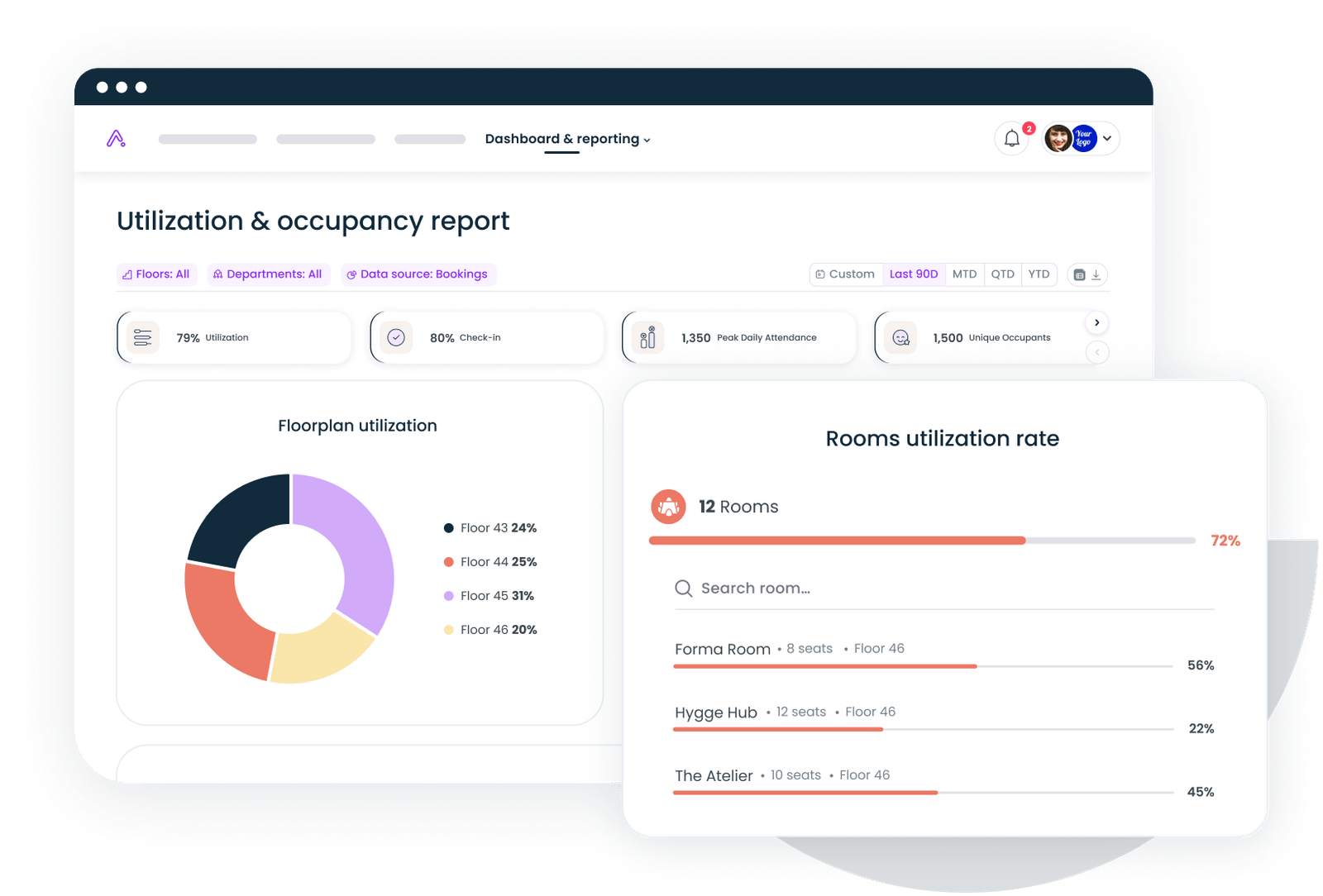
Measuring whether your anchor days are working
You can't improve what you don't measure. But most companies track the wrong things, or nothing at all.
Metric 1: Attendance rate vs. policy. If your policy says "Tuesday is anchor day," what percentage of employees actually show up? Target 80% to 90%. Below 70%, your anchor day has a credibility problem. Below 50%, it's not an anchor day; it's a suggestion.
Metric 2: Desk and room utilization. Attendance tells you who showed up. Utilization tells you whether the space supported them. Track desk occupancy (target: 70% to 85% on anchor days) and meeting room usage. If 80% of meetings happen in rooms for six or fewer, but your floor plan is dominated by 12-person conference rooms, you have a space mismatch, not an attendance problem. Our deep dive on space utilization metrics covers the full framework.
Metric 3: Collaboration density. This is the metric most companies miss. It's not enough that people are in the building. Are they in the building at the same time as the people they need to collaborate with? Track team co-presence: what percentage of a given team is in the office on the same day? If your engineering team's anchor day has 60% attendance but the three people working on the same feature are never there together, the anchor day isn't serving its purpose.
Metric 4: Employee sentiment. Run a short pulse survey (three to five questions) every quarter. Ask: "Does the anchor day help you collaborate with your team?" and "Is the commute worth it on anchor days?" Sentiment data catches problems that utilization data misses, like a team that shows up dutifully but resents every minute.
Metric 5: Cost per occupied seat. Divide your total office cost by the number of occupied seats on anchor days. Compare this to your cost per seat on non-anchor days. If the gap is massive, you're paying for a lot of empty space four days a week. That's a signal to consider right-sizing your office or adding flexible workspace for overflow.
How to implement anchor days without triggering a backlash
Rolling out anchor days poorly looks exactly like a return-to-office mandate with better branding. Here's how to avoid that.
Start with the "why." Before announcing anything, articulate the specific business reason. "We're implementing Tuesday as an anchor day because our sprint reviews, design critiques, and cross-team syncs are more effective in person, and we want to make sure the right people are in the room at the same time." That's a reason. "We believe in the power of in-person collaboration" is a platitude.
Involve employees in the design. Survey teams about which day works best. Ask what activities would make the commute worthwhile. When people have input into the policy, they're more likely to support it. Our guide on getting employee buy-in walks through this process in detail.
Pilot before you mandate. Run the anchor day with two or three teams for six to eight weeks. Measure attendance, utilization, and sentiment. Adjust based on what you learn. Then expand to the full organization with data to back up the decision.
Build in exceptions. Not every role needs an anchor day. Fully remote employees, field sales teams, and employees with accessibility needs should have clear opt-out paths. Rigid policies create more problems than they solve.
Communicate the iteration plan. Tell employees upfront: "We're going to try this for one quarter, measure the results, and adjust. Your feedback will shape what comes next." This frames the anchor day as an experiment, not an edict.
The bottom line on anchor days
Anchor days work when they're designed around collaboration, not compliance. Pick the right day based on your data. Set the right scope (company-wide plus team-level is usually the sweet spot). Program activities that justify the commute. Measure attendance, utilization, and sentiment together. And iterate based on what you learn, not what you assumed.
The companies getting this right aren't the ones with the strictest policies. They're the ones that made the office worth showing up to.
From desk booking to real-time occupancy data to collaboration analytics, get the tools to make your anchor days actually deliver.
Get a demo