.svg)


.svg)
- Right-sizing isn't downsizing; it's matching space supply to actual demand
- Most offices run at roughly 53% utilization while paying for 100% of capacity
- Four paths forward: shrink, consolidate, diversify, or hold and reconfigure
- Occupancy data, not gut instinct, should drive every portfolio decision
- Redirecting savings into experience and flexibility compounds the ROI
Most companies have accepted that hybrid work is permanent. Fewer have figured out what that means for their real estate. Right-sizing office space is the process of aligning your portfolio to how people actually use it, not how they used it in 2019, and not based on a headcount spreadsheet that hasn't been updated since your last funding round. It's the single highest-leverage move a workplace leader can make in 2026, and most organizations are still getting it wrong.
The math is straightforward. Global office utilization hit 53% in 2026, up from 38% two years ago but still well below the capacity companies are paying for. That means roughly half your space sits empty on any given day. Meanwhile, office demand could fall 20-26% by 2030 in major cities as flexible work patterns harden into permanent behavior. The gap between what you're leasing and what you're using is where money goes to die.
This guide walks through the full right-sizing process: diagnosing your current mismatch, choosing the right strategic path, executing the transition, and reinvesting the savings where they'll actually matter.
What right-sizing means in 2026
Let's clear up a common misconception. Right-sizing doesn't mean shrinking. It means matching. Sometimes that means reducing square footage. Sometimes it means adding collaboration space while cutting individual desks. Sometimes it means keeping the same footprint but completely rethinking how it's configured.
The distinction matters because "we need to cut real estate costs" leads to a very different set of decisions than "we need our space to reflect how teams actually work." The first approach optimizes for the CFO's spreadsheet. The second optimizes for the organization. The best right-sizing projects do both.
What's changed in 2026 is that we finally have enough data to do this well. Three years of hybrid work patterns have produced reliable baselines. We know that Tuesday and Wednesday are peak days in most offices. We know that peak occupancy hits 58.6% on Tuesdays while Friday drops to 34.5%. We know that most in-office time is spent in meetings and collaborative work, not heads-down solo tasks.
The old model allocated space based on headcount. One person, one desk, 225 square feet. The new model allocates space based on activity. What are people doing when they come in? How often do they come in? What spaces do they need when they're there? Right-sizing is the bridge between those two models.
And the stakes are real. For a company with 1,000 employees paying $50 per square foot, the difference between a 1:1 desk ratio and a 1:1.5 ratio is roughly $3.75 million per year. That's not a rounding error. That's a product team, a market expansion, or a meaningful improvement to the spaces you keep.
Diagnose your current office mismatch
You can't right-size what you can't measure. The first step is understanding the gap between your current capacity and your actual usage, and that gap is almost certainly larger than you think.
The metrics that matter
Occupancy rate is the percentage of your total capacity that's in use at any given time. If you have 500 desks and 200 are occupied on an average day, your occupancy rate is 40%. This is the headline number, but it's not the whole story. For a deeper breakdown of how to calculate and benchmark this metric, see our guide to office occupancy rate.
Peak occupancy tells you the maximum demand your space needs to handle. If your busiest day hits 75% and your quietest day hits 25%, designing for the average (50%) means you're overcrowded twice a week and half-empty the rest. Designing for the peak means you're overbuilt most of the time. The right answer is somewhere in between, and finding it requires granular data.
Utilization by space type reveals where the real mismatches hide. You might have 80% desk utilization but only 30% meeting room utilization, or vice versa. Most hybrid offices are overbuilt on individual workstations and underbuilt on collaboration spaces. Conference rooms tell a similar story: large rooms sit empty while teams fight over four-person huddle spaces. Understanding space utilization metrics at this level is what separates a right-sizing project that works from one that just makes everything smaller.
Cost per employee is the financial translation of all the above. Take your total real estate spend (rent, utilities, maintenance, furniture, technology) and divide by headcount. Then divide by actual users. The gap between those two numbers is your opportunity cost.
Where the data comes from
Badge swipes give you entry counts but not duration or location within the building. Wi-Fi connections show who's in the building but not what spaces they're using. Booking systems show intent but not actual usage (ghost bookings are a real problem). Sensors show real-time presence but require infrastructure investment.
The best diagnosis combines multiple data sources. Booking data plus badge data plus sensor data creates a picture that no single source can provide on its own. Gable Offices Insights pulls these streams into a single dashboard, showing utilization by floor, space type, and time of day, so you can pinpoint exactly where space is underused and where it's strained.
What the diagnosis typically reveals
In my experience, most organizations discover three things when they actually measure:
First, overall utilization is lower than anyone assumed. Leaders who "feel" like the office is busy are usually experiencing peak-day bias. They're in the office on Tuesday and Wednesday, so they think it's always that full. It isn't.
Second, the space type mix is wrong. Too many desks, not enough meeting rooms, almost no informal collaboration space. The office was designed for a work pattern that no longer exists.
Third, location-level variance is enormous. One office might run at 65% while another runs at 25%. Portfolio-level averages mask building-level problems. If you're managing multiple office locations, this variance is where the biggest opportunities hide.
The four paths forward: Shrink, consolidate, diversify, or hold
Once you've diagnosed the mismatch, you need a strategy. There are four basic moves, and most organizations will use a combination.
Path 1: Shrink in place
Reduce your footprint within your current building. This works when you're in a single location, your lease has a contraction clause (or renewal is approaching), and your utilization data shows consistent underuse across the entire space.
When it makes sense: Utilization consistently below 50%, lease flexibility exists, no significant headcount growth planned.
What it looks like: Surrender one or two floors, renegotiate the lease for reduced square footage, redesign remaining space for higher density and better space-type mix.
Timeline: 6-12 months from decision to completion. Lease negotiation takes 3-6 months; fit-out changes take another 2-4 months.
Risk: If you shrink too aggressively, you'll hit capacity constraints on peak days. Build in a 15-20% buffer above your peak occupancy to absorb growth and seasonal variation.
Path 2: Consolidate across locations
Close underperforming locations and migrate teams to fewer, better-designed hubs. This is the right move for organizations with multiple offices where some locations are clearly underperforming.
When it makes sense: Multi-location portfolio with wide utilization variance, some locations below 30% average occupancy, teams that can reasonably be combined.
What it looks like: Identify the bottom-performing locations, develop migration plans for affected teams, invest in making the remaining locations excellent. For a detailed playbook on this approach, see our guide to office consolidation strategy.
Timeline: 12-18 months. This is the most complex path because it involves people moves, not just space moves.
Risk: Consolidation can feel like a loss to teams in closed locations. Communication matters enormously. You're not just changing real estate; you're changing someone's daily routine.
Path 3: Diversify your portfolio mix
Replace some fixed space with flexible, on-demand space. Instead of maintaining a 50,000-square-foot office for a team that only needs it three days a week, maintain 30,000 square feet of owned space and supplement with flex space for overflow and satellite teams.
When it makes sense: Distributed workforce, variable space demand, teams in secondary markets where a full lease doesn't pencil out. 55% of global occupiers now use flex solutions, and that number is climbing.
What it looks like: Maintain core hubs for daily operations, layer in coworking memberships or on-demand bookings for distributed team members, use flex space for project-based surge capacity. Our comparison of office lease vs. coworking cost breaks down the total cost of ownership for each model.
Timeline: 3-6 months to implement. This is the fastest path because it doesn't require construction or lease renegotiation.
Risk: Quality control. Not all flex spaces are equal, and a bad coworking experience reflects on your company. You need a curated network, not a free-for-all.
Path 4: Hold and reconfigure
Keep the same total footprint but redesign it for higher utilization. This works when your lease is locked, your overall square footage is roughly right, but the space-type mix is wrong.
When it makes sense: Long-term lease with no contraction option, utilization that's moderate (40-60%) but poorly distributed across space types, budget available for renovation.
What it looks like: Convert individual desks to shared workstations, add more meeting rooms and collaboration zones, create neighborhoods for teams, introduce activity-based working zones. The desk-sharing ratio shifts from 1:1 to 1:1.5 or 1:2, freeing up floor area for the spaces people actually need.
Timeline: 6-12 months for design and construction, often phased floor by floor.
Risk: Employee resistance. People are attached to "their" desk. Change management is as important as space planning here.
How to choose
The decision tree is simpler than it looks:
- Is your lease flexible? If yes, shrink or consolidate. If no, hold and reconfigure.
- Do you have multiple locations? If yes, evaluate consolidation. If no, focus on single-site optimization.
- Is your workforce distributed? If yes, diversify with flex space. If no, optimize your core locations.
- Is headcount growing? If yes, build in buffer and favor flexible options. If no, optimize for current state.
Most organizations end up combining two or three paths. Consolidate the weakest locations, shrink the mid-performers, reconfigure the keepers, and layer in flex for distributed teams. The portfolio becomes elastic rather than static.

Right-sizing is one piece of the cost puzzle. This guide covers 12 additional strategies for cutting real estate spend without cutting corners on employee experience.
Read the guide
Execute: lease renegotiation, sublease, and reconfiguration tactics
Strategy without execution is just a slide deck. Here's how to actually make the changes.
Lease renegotiation
Your lease is the single biggest constraint on right-sizing, and it's also the single biggest opportunity. Most commercial leases were signed under assumptions that no longer hold. That gives you leverage.
Contraction clauses let you surrender space at predetermined intervals. If your lease doesn't have one, negotiate it into your next renewal. The cost of a contraction option (typically a modest premium on base rent) is almost always worth the flexibility.
Blend-and-extend deals let you renegotiate terms in exchange for extending the lease term. If you're willing to commit to a longer duration, landlords will often agree to reduced square footage, lower rates, or both. For specific negotiation tactics, our guide to office lease negotiation tips covers 15 approaches that save real money.
Early termination is expensive but sometimes necessary. If your utilization is below 30% and you're paying premium rates, the termination penalty might be cheaper than three more years of underused space. Run the math both ways.
Timing matters. Start negotiations 12-18 months before lease expiration. Landlords are more flexible when they have time to plan for your potential departure. Waiting until the last minute eliminates your leverage.
Sublease strategy
If you can't exit the lease, monetize the unused space. Subleasing isn't ideal (you're still the primary tenant, with all the liability that entails), but it's better than paying full rent on empty floors.
The sublease market in 2026 is competitive. There's a lot of available space. Price aggressively, offer flexible terms, and consider subleasing to companies that complement your culture rather than compete with it. Some organizations have turned subleased floors into a strategic advantage, creating a mini-ecosystem of partner companies in the same building.
Fit-out and reconfiguration
This is where the space-type diagnosis pays off. The goal isn't to make everything smaller. It's to reallocate square footage from what you have too much of (individual desks) to what you don't have enough of (meeting rooms, collaboration zones, focus rooms, social spaces).
Desk-sharing ratios are the foundation. Moving from 1:1 to 1:1.5 frees up 33% of your desk floor area. Moving to 1:2 frees up 50%. That recovered space becomes meeting rooms, phone booths, project rooms, and the informal collision spaces where unplanned collaboration happens.
Neighborhood design assigns teams to zones rather than individual desks. Marketing sits in one neighborhood, engineering in another. Within each neighborhood, desks are shared, but the team's "home base" stays consistent. This preserves team identity while enabling flexibility.
Meeting room right-sizing is its own discipline. Most offices have too many large conference rooms and not enough small ones. The data consistently shows that the majority of meetings involve 2-4 people. Convert your 12-person boardrooms into three 4-person huddle rooms and watch utilization climb.
Phased rollouts reduce risk. Reconfigure one floor, measure the results, adjust, then roll out to the next floor. This approach takes longer but produces better outcomes because you're learning as you go. Running a workplace pilot program before committing to a full buildout can save hundreds of thousands in avoided mistakes.
Reallocate savings: Where the money should go
Right-sizing isn't a cost-cutting exercise. It's a reallocation exercise. The money you save on underused space should go somewhere that generates more value.
The savings are real
Organizations that right-size effectively typically reduce real estate costs by 20-35%. For a company spending $10 million annually on office space, that's $2-3.5 million freed up every year. The question isn't whether to capture those savings. It's where to reinvest them.
Where forward-thinking companies redirect
Better spaces, not just fewer spaces. Take some of the savings and invest in making your remaining offices genuinely great. Better furniture, better technology, better food, better design. If you're asking people to commute, the office needs to be worth the trip.
Workplace technology. Real-time occupancy data, smart booking systems, and analytics platforms aren't luxuries anymore. They're the infrastructure that makes right-sizing sustainable. Without ongoing measurement, you'll drift back to the old mismatch within 18 months.
Flex space budgets. Give distributed team members access to on-demand workspaces near where they live. This is especially valuable for employees who don't live near a hub office but still need professional space for focused work or client meetings.
Team gatherings. The money you save on daily desk space can fund quarterly offsites, team events, and the in-person moments that build culture. These high-impact gatherings often deliver more connection than five days a week of half-empty office attendance.
Employee experience investments. Commuter benefits, wellness programs, professional development. The companies winning the talent war in 2026 are the ones that invest in people, not just real estate.
The key insight is that a dollar spent on an empty desk generates zero return. That same dollar spent on a team offsite, a better meeting room, or a flex space membership generates measurable returns in engagement, retention, and productivity. Hybrid work has zero effect on productivity when implemented well, and right-sizing is what "implemented well" looks like on the real estate side.
Gable Offices Insights gives you real-time utilization data by floor, space type, and time of day, so right-sizing decisions are based on evidence, not assumptions.
Learn more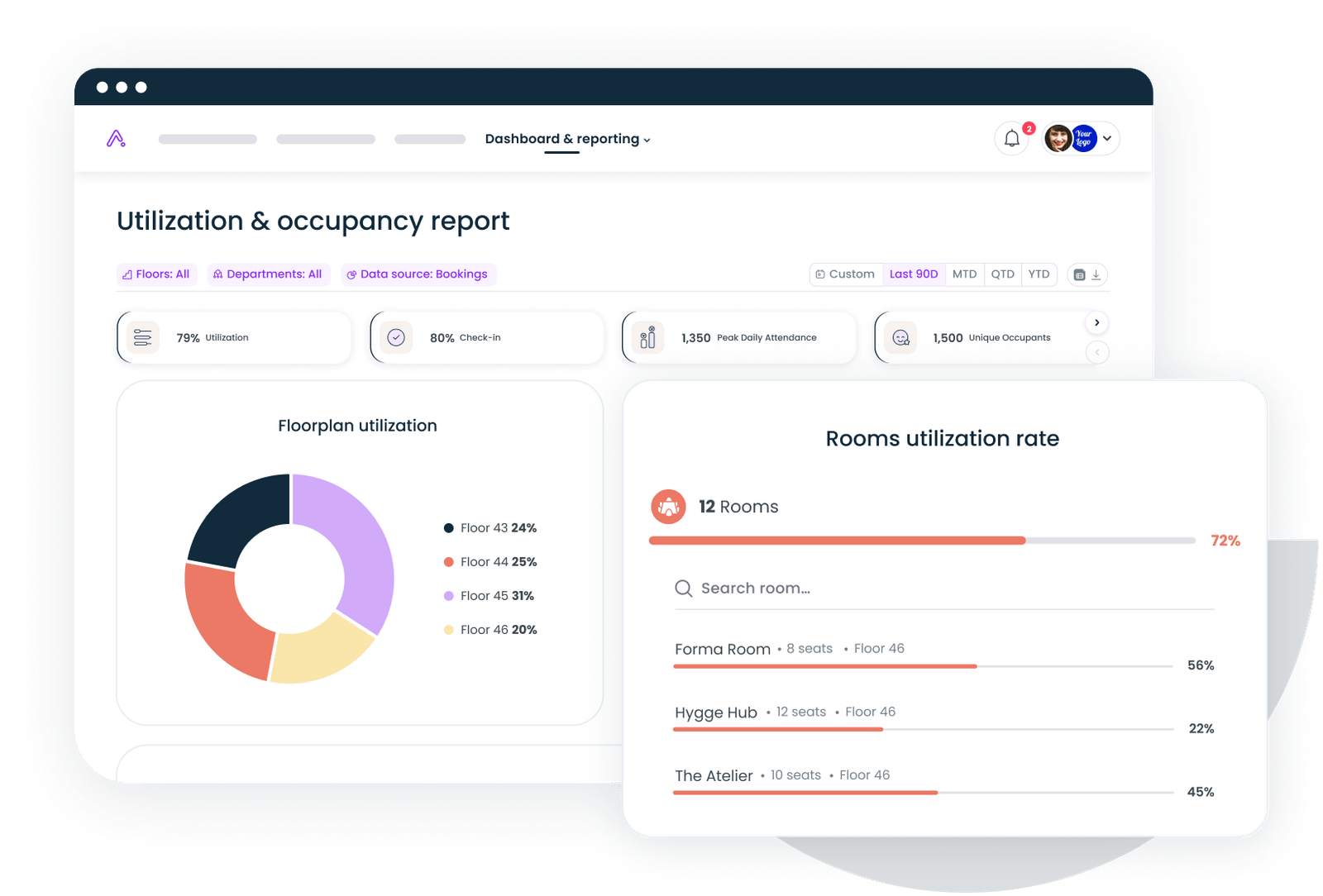
Avoid common right-sizing mistakes
I've seen enough right-sizing projects go sideways to know where the pitfalls are. Here are the ones that come up most often.
Relying on outdated data
Using 2023 occupancy numbers to make 2026 decisions is like using last year's weather to plan this year's harvest. Work patterns have shifted significantly, and they continue to shift. Any data older than six months should be treated as directional, not definitive. Invest in workplace analytics that give you current, continuous data rather than periodic snapshots.
Designing for the average instead of the range
If your average occupancy is 45% but your Tuesday peak is 72%, designing for 45% means chaos two days a week. Right-sizing needs to account for the full range of demand, not just the midpoint. Build for something between your 80th percentile day and your peak, with flex capacity to handle the rest.
Over-optimizing for cost
The cheapest option is rarely the best option. I've seen companies shrink so aggressively that employees can't find a desk on busy days, meeting rooms are perpetually booked, and the office feels cramped and stressful. The backlash erodes whatever goodwill the company had built around flexible work. Leave a buffer. Comfort matters.
Ignoring employee input
Utilization data tells you what's happening. It doesn't tell you why. Maybe that empty floor is empty because the HVAC is broken, not because nobody wants to be there. Maybe meeting rooms are underbooked because the booking system is terrible, not because people don't need them. Talk to employees before making irreversible decisions. Getting employee buy-in for office changes isn't just nice to have; it's what separates successful transitions from costly ones.
Locking into inflexible leases
If the last five years taught us anything, it's that predictions about work patterns have a short shelf life. Whatever right-sizing decisions you make today, build in flexibility for tomorrow. Shorter lease terms, contraction clauses, expansion options, and a flex space layer all create optionality. Optionality has value, even if it costs a bit more upfront.
Poor communication
Announcing that you're "right-sizing the portfolio" without context sounds like layoffs. Be specific about what's changing, why, and what it means for individuals. Share the data that drove the decision. Explain where the savings are going. People can handle change; they can't handle surprises.
Measurement and continuous improvement
Right-sizing isn't a one-time project. It's an ongoing discipline. Work patterns will continue to evolve, headcount will change, and new needs will emerge. The organizations that get the most value from right-sizing are the ones that treat it as a continuous process, not a discrete event.
The metrics to track post-right-sizing
Utilization rate by space type. Target 60-75% for collaboration spaces and 70-85% for individual workstations. Below 60% means you still have excess. Above 85% means you're too tight.
Cost per employee. This should decrease after right-sizing. If it doesn't, something went wrong in execution.
Employee satisfaction scores. Survey employees quarterly on their workspace experience. If satisfaction drops after right-sizing, you've cut too deep or misconfigured the space.
Peak-day capacity. Monitor whether your busiest days are comfortable or chaotic. If people can't find space on Tuesdays, you need to either add capacity or implement better demand management (staggered schedules, booking requirements).
Booking-to-usage ratio. Compare how many spaces are booked versus how many are actually used. A high ghost-booking rate means your booking system needs work, and your utilization data might be overstating actual demand.
Review cadence
Quarterly reviews are the right rhythm for most organizations. Monthly is too frequent (patterns need time to stabilize after changes), and annually is too infrequent (you'll miss emerging trends). Each quarterly review should compare current utilization against your targets, flag any space types that are consistently over or under capacity, and recommend adjustments.
When to right-size again
The triggers for a new right-sizing cycle are predictable: headcount changes of more than 15%, a shift in hybrid policy, a lease event (renewal, expiration, or break clause), or a sustained change in utilization patterns. If any of these happen, go back to the diagnosis step and run the process again.
The goal is a portfolio that breathes with the organization, expanding and contracting as needs change, rather than a fixed asset that you're stuck with regardless of how work evolves.
Making right-sizing stick
Right-sizing office space is one of those rare initiatives where the financial case and the employee experience case point in the same direction. You save money by eliminating space nobody uses. You improve the workplace by reinvesting in spaces people actually need. You gain flexibility by shifting from static leases to elastic portfolios.
The organizations doing this well share a few traits. They measure continuously, not just when a lease is up. They involve employees in the process, not just the finance team. They think in terms of portfolio strategy, not individual buildings. And they treat the savings as an investment fund, not a line item to cut.
The ones doing it poorly are still guessing. They're still using headcount as a proxy for space demand. They're still signing 10-year leases with no flexibility. And they're still paying for offices that are half-empty five days a week.
The data exists to do this right. The tools exist to do this right. The question is whether your organization has the discipline to let the data drive the decisions.
Gable helps workplace teams diagnose utilization gaps, model scenarios, and track outcomes across their entire portfolio. See how it works for organizations like yours.
Get a demo