.svg)


.svg)
- Start negotiations 18 to 24 months before your lease expires
- Calculate total occupancy cost, not just base rent per square foot
- Negotiate flexibility clauses now; rigid long-term leases are liabilities in hybrid work
- Use real occupancy data to right-size your space before you sit down with a landlord
- Every verbal promise is worthless unless it's in the lease documents
Office lease negotiation is the single highest-stakes financial decision most workplace leaders make, and most companies leave money on the table because they focus on the wrong number. Base rent gets all the attention. But operating expenses, inflexible terms, and oversized footprints are where the real waste hides. These 15 office lease negotiation tips will help you approach your next deal (or renewal) with the leverage, data, and strategy to get terms that actually match how your company works in 2026.
Start early: 18 To 24 Months before expiration
The biggest negotiation mistake isn't a bad clause. It's running out of time. JLL recommends beginning discussions 18 to 24 months before your lease expires, and that timeline isn't arbitrary. You need months to assess your space needs, research the market, tour alternatives, and negotiate without desperation.
When you're six months out and your landlord knows you have nowhere else to go, your leverage evaporates. Every concession you might have won, whether it's rent abatement, tenant improvement dollars, or a contraction clause, becomes harder to extract when the clock is against you.
Put a calendar reminder 24 months before every lease expiration. Treat it like a project kickoff, not a last-minute scramble.
Audit your actual space usage before you negotiate anything
Here's where most companies get the sequence wrong. They start by looking at market listings. They should start by looking at their own buildings.
How many desks are occupied on an average Tuesday? What about Friday? Are your conference rooms booked but empty? If you're running a hybrid work schedule, your peak occupancy might be 60% of your total capacity, which means you're potentially paying for 40% of space that sits idle.
Before you walk into a landlord meeting, you need hard numbers: average daily occupancy, peak vs. trough days, department-level usage patterns, and growth projections. This data determines whether you need 20,000 square feet or 12,000. That difference could be hundreds of thousands of dollars per year.
If you don't have occupancy sensors or badge data giving you this picture, you're negotiating blind.
Research market rates and understand what landlords are facing
Knowledge is leverage. Before you make an offer, you need to know what comparable spaces in your market are leasing for, what concessions other tenants are getting, and how desperate (or comfortable) your landlord is.
In 2026, many markets still favor tenants. Older buildings face high vacancies as companies reduce footprints and prioritize newer, amenity-rich buildings. That's leverage you can use, but only if you've done the homework.
Pull recent comparable lease data for your submarket. Talk to tenant rep brokers. Look at the building's vacancy rate. A landlord with 30% vacancy has very different motivations than one with a waitlist. Your CRE strategy should account for these dynamics before you draft a single term sheet.
Build the right negotiation team
You wouldn't go to court without a lawyer. Don't negotiate a multi-year, multi-million-dollar lease without one either.
Your team should include three roles at minimum. First, a tenant representation broker. This is critical: the listing broker works for the landlord, not you. A tenant rep's fiduciary duty is to your interests, and their commission typically comes from the landlord's side anyway, so there's no cost to you. Second, a real estate attorney who specializes in commercial leases. They'll catch the clauses that look standard but aren't, like unlimited operating expense pass-throughs or aggressive personal guarantee language. Third, an internal decision-maker who understands your company's workplace strategy, growth plans, and budget constraints.
Align these three before you tour a single space. Misalignment between your broker's recommendations and your CFO's budget is how deals stall or collapse.
Understand lease types and calculate total occupancy cost
Base rent is the number everyone fixates on. It's also the number that matters least in isolation.
A "net" lease at $30 per square foot might cost you $45 per square foot once you add common area maintenance (CAM) charges, property taxes, insurance, and utilities. A "gross" lease at $42 per square foot might actually be cheaper because those costs are bundled in. The math depends entirely on the lease structure.
Here's a quick breakdown of the main types:
- Gross lease: Landlord covers most operating expenses. More predictable for you.
- Modified gross lease: Some expenses are shared. Read the fine print carefully.
- Triple-net (NNN) lease: You pay base rent plus property taxes, insurance, and maintenance. The cheapest-looking option that often isn't.
The BOMA standard for load factor calculations determines how common areas get allocated to your usable square footage. Ask your broker to walk you through the load factor for any space you're considering. A 15% load factor versus a 20% load factor on a 10,000 square foot space is the difference between paying for 11,500 or 12,000 square feet.
Always model total occupancy cost per person, not just rent per square foot. That's the number that connects your lease to your workplace spend benchmarks.

Lease negotiation is step one. Here's how to keep cutting costs after the ink dries, with strategies that go beyond renegotiation.
Read the guide
Negotiate flexibility into every lease term
Rigid 10-year leases made sense when companies could predict headcount five years out. That world doesn't exist anymore.
In 2026, your lease needs to account for the possibility that you'll grow, shrink, go more hybrid, or restructure entirely. Here are the flexibility mechanisms worth fighting for:
- Shorter initial terms with renewal options. A 3-year lease with two 2-year renewal options gives you 7 years of potential tenure without locking you in for 7 years of obligation.
- Early termination (break) clauses. These let you exit mid-lease, usually with a penalty. The penalty is almost always cheaper than paying for years of space you don't need.
- Expansion rights. If you grow, you want first right to adjacent space at pre-negotiated rates.
- Contraction rights. The inverse: the ability to give back a portion of your space if headcount drops.
- Sublease and assignment rights. If you can't use the space, can you sublease it? Many landlord-friendly leases restrict this heavily. Push back.
Each of these clauses has a cost, either in slightly higher rent or in negotiation capital. Prioritize the ones that match your company's actual risk profile. A fast-growing startup needs expansion rights. A company shifting to flexible office space needs contraction and sublease rights.
Push for rent-free periods and tenant improvement allowances
These are standard concessions, not special favors. Don't let a landlord frame them as generous.
For every year of lease, tenants typically receive at least one month rent-free. A 5-year lease should come with a minimum of 5 months of free rent. In a soft market, you can push for more.
Tenant improvement (TI) allowances are the landlord's contribution to building out your space. These are negotiable and vary widely by market, building class, and lease length. Get quotes for your buildout before you negotiate TI, so you know whether the landlord's offer actually covers your needs or leaves you writing a six-figure check.
Other concessions worth asking for:
- Phased rent escalation. Start at a lower rate that increases gradually, rather than a flat rate from day one.
- Free fixturization period. Time to build out the space before your rent clock starts.
- Moving allowance. Some landlords will contribute to relocation costs.
Stack these concessions. A month of free rent here, a higher TI allowance there, and a fixturization period on top can add up to six figures in savings on a mid-size lease.
Ask for operating expense caps
This is the clause that separates experienced negotiators from first-timers.
In a net or modified gross lease, your share of operating expenses can increase every year. Without a cap, your landlord can pass through unlimited cost increases for property taxes, insurance, maintenance, and management fees. You might sign a lease at $35 per square foot and find yourself paying $42 three years later.
Negotiate a cap on annual operating expense increases, typically 3% to 5% per year. This gives you cost predictability and protects you from surprise assessments. Also ask for the right to audit the landlord's operating expense statements. Errors in CAM reconciliations are more common than you'd think.
Use a letter of intent to frame the deal before the lease
A letter of intent (LOI) is a non-binding document that outlines the key business terms before you get into the weeds of a 60-page lease. Think of it as the handshake before the contract.
Your LOI should cover: base rent, lease term, renewal options, TI allowance, rent-free periods, operating expense structure, and any special clauses (expansion rights, early termination, etc.). Getting alignment on these terms in a simple 2-to-3-page document saves weeks of back-and-forth on the full lease.
One important note: LOIs are typically non-binding, which means either party can walk away. But they set expectations. A landlord who agrees to 5 months of free rent in the LOI will have a hard time pulling that back in the lease without losing credibility.
Negotiate the personal guarantee carefully
If you're a smaller company or a startup, landlords will often require a personal guarantee from a founder or executive. This means if the company defaults, you're personally liable for the remaining lease obligation.
This is one of the most dangerous clauses in any lease. Fight to eliminate it entirely, or at minimum:
- Cap it. Limit the guarantee to 6 to 12 months of rent, not the full lease term.
- Burn it down. Negotiate a "burn-off" where the guarantee decreases over time (e.g., drops by 25% each year of on-time payment).
- Substitute collateral. Offer a larger security deposit or letter of credit instead.
Your attorney should be deeply involved in this clause. It's not boilerplate.
From desk booking to occupancy analytics, Gable gives workplace leaders the data they need to right-size space and cut costs.
Learn more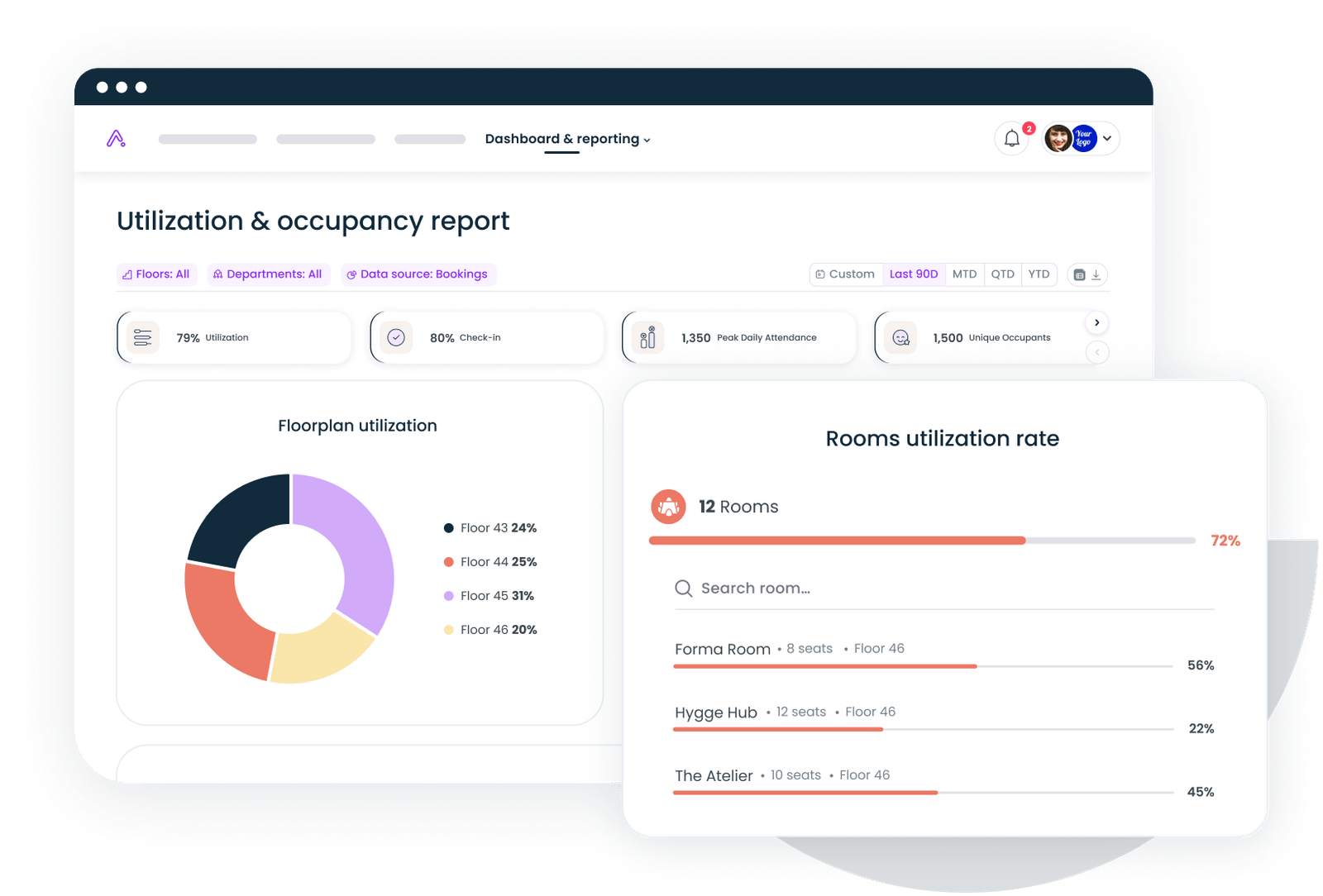
Don't ignore the restoration clause
Buried in most leases is a clause requiring you to return the space to its original condition when you leave. This sounds reasonable until you realize it can mean ripping out every wall, removing every cable, and repainting everything, at your expense.
Restoration costs on a built-out office can run $15 to $30 per square foot. On a 15,000 square foot space, that's $225,000 to $450,000 you didn't budget for.
Negotiate this upfront. Push for a clause that requires you to leave the space in "broom-clean" condition rather than original condition. Or negotiate a cap on restoration costs. At minimum, get clarity on exactly what "restoration" means so there are no surprises at lease end.
Use flexible workspace as strategic use
Here's a tactic most negotiation guides skip: you don't have to commit to a traditional lease at all.
If you're evaluating a hub-and-spoke model or supplementing your HQ with on-demand workspace for distributed teams, you have a credible alternative to signing a long-term lease. And credible alternatives are the foundation of negotiation leverage.
When a landlord knows you can walk away and operate effectively using flexible workspace, the power dynamic shifts. You're not desperate for their space. You're choosing it, and only if the terms make sense.
This doesn't mean threatening to go fully coworking. It means having a real plan B that you've costed out and can articulate. Gable's platform lets you combine traditional office management with on-demand flexible space across thousands of locations, which gives you exactly this kind of optionality when you're sitting across the table from a landlord.
Start by asking for a rent reduction
Negotiation 101: your first offer should never be your best offer. Start by asking for at least 10% off the landlord's asking rent. In a tenant-friendly market, you might get it. In a tighter market, you'll likely land somewhere between 3% and 7%, but you won't know unless you ask.
Pair the rent reduction ask with your concession requests. Landlords often prefer to give concessions (free rent, TI dollars) rather than reduce the face rate, because a lower face rate affects the building's valuation. Understanding this lets you structure your ask in a way that's easier for the landlord to say yes to.
For example: "We'll accept $38 per square foot instead of $35, but we need 6 months of free rent and $50 per square foot in TI." The effective rent might be the same, but the landlord's building valuation stays intact.
Document everything; trust nothing verbal
If it's not in the lease, it doesn't exist. Period.
Landlords and their brokers will make verbal promises during tours and negotiations. "We'll take care of that." "The HVAC will be upgraded before you move in." "Parking won't be an issue." None of these matter unless they're written into the lease document.
Your attorney should review every clause, but pay special attention to:
- Landlord's obligations for maintenance, repairs, and building systems
- Default definitions for both parties (what happens if the landlord fails to maintain the building?)
- Assignment and subletting permissions
- Holdover provisions (what happens if you stay past your lease term?)
- Force majeure clauses (relevant after the past few years of disruption)
Read the lease yourself, too. Don't rely entirely on your attorney's summary. You're the one who has to live with these terms for years.
Use occupancy data to negotiate renewals, not just new leases
Most of these tips apply to new leases, but renewals are where the real money is. You already have a relationship with the landlord. You already have data on how the space performs. Use it.
If your office occupancy rate shows that you're consistently using only 65% of your space, that's your argument for downsizing at renewal. If conference rooms are booked 80% of the time but desks sit empty, that tells you to renegotiate for a different floor plan or a smaller footprint with better meeting space.
This is where workplace analytics become a negotiation tool, not just an operational one. When you can show a landlord actual utilization data, your requests for contraction rights or reduced square footage aren't opinions. They're evidence.
The negotiation doesn't end when you sign
Signing the lease is the midpoint, not the finish line. The real test is whether the terms you negotiated actually match how your company uses the space over the next 3, 5, or 7 years.
Track your space utilization metrics from month one. Monitor operating expense reconciliations annually. Exercise your audit rights if the numbers look off. And start preparing for your next renewal or renegotiation at least 18 months before the current term expires.
The companies that consistently get good lease terms aren't the ones with the best lawyers (though that helps). They're the ones that treat real estate as an ongoing strategic function, not a one-time transaction.
Gable gives workplace leaders occupancy insights, space analytics, and portfolio visibility so you walk into every lease negotiation with evidence, not guesses.
Get a demo