.svg)


.svg)
- Most companies carry 30-50% more real estate than they need
- Global office utilization sits at 54%, but targets average 79%
- Cost per employee ranges from $4,000 to $15,000 depending on model and market
- Benchmarking fails when you rely on employee surveys instead of behavioral data
- The biggest savings come from blending owned, leased, and flex space in a single portfolio view
Your CFO wants to know if you're overspending on real estate. Your CEO wants to know if the office is "working." And you're sitting on a pile of badge data, lease agreements, and booking reports that don't talk to each other. Workplace spend benchmarks give you the external reference points to answer both questions with numbers instead of gut feel. This guide breaks down what companies at your stage and size pay, where the waste hides, and how to build a benchmarking practice that survives more than one quarterly review.
The gap between what companies spend and what they think they spend
For every $100 million a company spends on real estate, roughly $40 million goes to operating costs that rarely show up in the same spreadsheet as the lease. That stat, from Realcomm's analysis of CRE metrics, gets worse when you factor in industry estimates that the average organization holds 30-50% more space than it needs.
A 2,000-person company paying $10,000 per employee in total occupancy costs is writing a $20 million annual check. If 35% of that space sits empty on any given day, you're burning $7 million a year on desks nobody uses, HVAC for floors nobody visits, and cleaning contracts for kitchens nobody touches.
Fewer than 1 in 10 workplace leaders rate their space utilization data as "excellent." The rest are benchmarking against incomplete information, which means they're making portfolio decisions worth millions based on badge swipes that miss half the picture and employee surveys that overstate attendance by 40-60%.
Office space cost benchmarks by employee count and square footage
The range is wide enough to be almost useless without context: $4,000 to $15,000 per employee annually. A SaaS company running a 150-person office in Austin lands closer to $6,500. The same headcount in Midtown Manhattan pushes past $14,000 before you've bought a single monitor arm.
Square footage tells a sharper story. JLL's 2025 occupancy planning benchmarks show organizations compressing from 165 square feet per person toward 132 square feet as a target density. Hybrid models compress further. When only 60% of your workforce shows up on any given day, you can design for 100-120 square feet per assigned seat and still feel spacious.
Here's where the benchmarks break by company size:
| Company size | Typical cost per employee (annual) | Avg. sq. ft. per person | Common model |
|---|---|---|---|
| 50-200 employees | $8,000-$15,000 | 150-200 sq. ft. | Single office, some flex |
| 200-1,000 employees | $6,000-$12,000 | 130-175 sq. ft. | Hub + flex satellite mix |
| 1,000-5,000 employees | $5,000-$10,000 | 120-150 sq. ft. | Multi-office, growing flex |
| 5,000+ employees | $4,000-$9,000 | 100-135 sq. ft. | Portfolio with activity-based design |
Series B companies exhibit the highest software spend per employee at roughly $18,000 per year. Layer workplace technology on top of physical space costs, and a 300-person startup can easily cross $4 million in combined workspace and tooling spend before anyone asks whether the budget is reasonable.
The 3-30-300 rule still holds as a rough compass: for every $3 you spend on utilities, you spend $30 on rent and $300 on people costs. Which means your real estate decisions are compensation decisions in disguise, because the space exists to make those $300-per-square-foot humans more productive.
Meeting rooms and collaboration spaces: the most expensive real estate per square foot
A 12-person conference room in a typical office occupies 250-300 square feet. At $50 per square foot annually, that room costs $12,500-$15,000 per year. If it sits booked but empty 40% of the time (the average no-show rate across enterprise offices), you're paying $5,000-$6,000 a year for a room that functions as a calendar placeholder.
Healthy meeting room utilization lands between 60-75%. Below 60%, you have too many rooms or a booking culture problem. Above 75%, people start complaining they can never find space, which leads to exactly the kind of executive demand that creates more underused rooms.
The day-of-week pattern makes this worse. According to CBRE's 2026 Global Workplace report, Tuesday through Thursday concentrate the overwhelming majority of peak attendance, while Monday attendance hovers near 46% and Friday drops to roughly 35%. So that $15,000 conference room is effectively a three-day-a-week asset, which means your cost per utilized hour is nearly double what it looks like on a spreadsheet.
Space allocation benchmarks for collaboration areas:
| Space type | Sq. ft. per person | Utilization target |
|---|---|---|
| Conference rooms (8-12 person) | 25-30 sq. ft. per seat | 60-75% |
| Huddle rooms (2-4 person) | 30-40 sq. ft. per seat | 65-80% |
| Open collaboration zones | 15-20 sq. ft. per person | Varies by culture |
| Work group areas | 80-100 sq. ft. per person | 50-65% |

Before you benchmark collaboration space, you need to know which occupancy metrics to track and how to measure them across your portfolio.
Read the guide
Occupancy rate benchmarks and what "good" looks like
Global office utilization reached 54% in 2025, up from 49% in 2024, according to CBRE's 2026 Global Workplace report. That sounds like progress until you realize most organizations set internal targets of 79%. The 25-point gap between reality and ambition represents either unrealistic expectations, poor policy design, or spaces that don't match how people work. Usually all three.
The concept of a "vibrant day" is replacing raw utilization as a planning metric. A vibrant day means at least 67% of available capacity is occupied, enough density that the office feels alive, collisions happen naturally, and the commute feels justified. Below 50%, the office feels like a ghost town. People who came in "to collaborate" end up on Zoom calls from an empty floor, which trains them to stay home next time.
52% of organizations still rely on badge data as their primary measurement tool. The problem: badge swipes tell you someone entered the building, not that they stayed for eight hours or used the third-floor collaboration zone. 56% of companies plan to add sensor or WiFi analytics by 2026, which will paint a much more granular picture of how space gets used hour by hour.
Here's a benchmarking framework by work model:
| Work model | Target utilization | Desk ratio (desks:employees) | Avg. daily attendance |
|---|---|---|---|
| Full-time office | 75-90% | 1:1 | 85-95% |
| Hybrid (3 days/week) | 55-70% | 1:1.3-1.5 | 55-65% |
| Hybrid (2 days/week) | 40-55% | 1:1.5-2.0 | 35-50% |
| Flex-first / remote-first | 20-35% | 1:3-5 | 15-30% |
When the facilities team at a 500-person company sees Floor 3 hitting 12% occupancy every Friday, they don't need a consultant. They need to close that floor on Fridays, redirect the cleaning budget, and reallocate those desks to the Tuesday-Thursday crunch.
Flexible and on-demand workspace spend benchmarks
37% of companies globally plan to increase their use of flex and coworking spaces over the next three years. The driver isn't ideology. It's math. A traditional five-year lease locks you into a per-square-foot rate regardless of whether your headcount grows 40% or shrinks 20%. Flex space functions as a 30% buffer against that commitment risk.
The cost comparison depends entirely on usage patterns. A dedicated desk in a premium coworking space in San Francisco runs $600-$900 per month. That same company's leased space, fully loaded with buildout amortization, furniture, IT, and facilities management, might cost $800-$1,200 per seat per month. The lease looks comparable until you account for the seats that sit empty three days a week.
72% of bookings on Gable's platform are for team gatherings, not solo work. That data point reshapes how you should think about flex spend: it's a collaboration infrastructure line item, not a remote work perk. Teams distributed across three cities booking a coworking space in a fourth city for a two-day sprint are spending $2,000-$4,000 on something that would cost $15,000-$25,000 to replicate with a short-term lease, event space rental, and catering coordination.
JLL's 2026 CRE outlook projects that 30% of global office supply will be flex-enabled by 2030. The companies setting benchmarks now will have four years of spend data to optimize against. The ones waiting will be starting from zero.
Real estate cost as a percentage of revenue
The 3-30-300 rule gives you a ratio, but real estate as a percentage of revenue varies so dramatically by industry that a single benchmark is misleading. Law firms routinely spend $40,000-$50,000 per attorney on space. A distributed SaaS company with 500 employees might spend $3,000 per head. Both could be "right" for their business.
What's more useful is the waste ratio. Research suggests the average company can recover $11,000 in savings per employee through real estate optimization. For a 1,000-person company, that's $11 million in potential annual savings sitting in underused floors, overbuilt conference rooms, and leases signed for a headcount projection that never materialized.
Industry-specific ranges worth noting:
| Industry | Real estate cost per employee | % of operating expenses | Key driver |
|---|---|---|---|
| Technology | $5,000-$10,000 | 4-8% | Low density, high amenity |
| Financial services | $8,000-$15,000 | 6-12% | Compliance, downtown locations |
| Legal / professional services | $12,000-$50,000 | 8-15% | Client-facing space, prestige |
| Healthcare (admin) | $6,000-$12,000 | 5-10% | Specialized buildout |
| Manufacturing (HQ/admin) | $4,000-$8,000 | 3-6% | Functional, lower-cost markets |
One number that cuts across industries: hybrid models deliver roughly 15% less space per person and 30% lower operating costs compared to full-time office setups. That 30% isn't all margin; some of it shifts to technology, flex space, and collaboration tools. But the net savings consistently land in the 15-20% range for organizations that right-size deliberately rather than letting attendance drift.
How to benchmark your workplace spend: a five-step framework
Step 1: Audit your portfolio with real numbers
Pull every lease, every flex space contract, every event venue receipt from the last 12 months into a single view. Most workplace teams discover 3-5 cost categories that live in different budgets: facilities pays the lease, IT pays for WiFi, HR pays for coworking passes, and the events team has a separate Amex for offsites. Until those converge, you're benchmarking fragments.
Step 2: Calculate your core metrics
Four numbers matter more than everything else:
- Cost per employee per month: Total occupancy costs (rent + utilities + maintenance + tech + flex) divided by headcount
- Cost per square foot per year: All-in costs divided by total leased square footage
- Peak utilization rate: Highest daily attendance divided by total capacity, measured on your busiest day
- Average utilization rate: Mean daily attendance across all weekdays for the trailing quarter
The gap between peak and average tells you how much "insurance space" you're carrying. If your Tuesday peak is 72% but your weekly average is 48%, you're paying for 24 percentage points of capacity you use one day a week.
Step 3: Segment by location and team
A global average hides everything interesting. Your London office at $18,000 per employee might be lean for the market. Your Austin office at $12,000 per employee might be bloated. Segment by city, by floor, by department. The engineering team that uses 30% of their allocated desks is a different problem than the sales team that's fighting over hoteling space at 95% utilization.
Step 4: Compare against external benchmarks
Use the data in this guide as a starting point. Cross-reference with CBRE, JLL, and IFMA reports for your specific market and industry. The Visual Lease benchmarking framework recommends comparing against at least three peer companies of similar size and industry before drawing conclusions.
Watch for apples-to-oranges comparisons. A company reporting $6,000 per employee might exclude flex spend, event costs, and technology. Another at $9,000 might include everything. The benchmark is only as good as the cost categories you include.
Step 5: Set targets and build a tracking cadence
A quarterly benchmarking review beats an annual audit every time. Set 90-day targets: reduce Floor 3 underutilization from 45% to 55%, bring flex spend per team gathering under $3,000, negotiate a 10% reduction on the Denver lease renewal. Track the specific interventions, not the aggregate number.
Integrating your HR data with office space planning lets you forecast demand based on hiring plans, not historical attendance alone. A company growing from 800 to 1,200 employees needs a very different benchmark target than one holding steady.
Common benchmarking mistakes that inflate your numbers
Trusting employee surveys over behavioral data
Employees say they'll come in 3-4 days per week. Behavioral data shows they attend 1-2 days. That gap means any capacity model built on stated intent will overshoot by 40-60%. Badge data is imperfect. Survey data is worse.
Ignoring day-of-week patterns
Designing for Tuesday's 78% attendance and applying it to Friday's 34% creates massive oversupply four days out of five. Some companies have started closing offices on Fridays entirely, redirecting employees to flex spaces on the days when they do show up. That single policy change can reduce operating costs by 15-20% without cutting a single desk.
Treating all space as equal
A square foot of reception area doesn't generate the same value as a square foot of collaboration space. Benchmark by space type, not total portfolio. Conference rooms, phone booths, focus areas, and social zones each have different utilization patterns, different cost profiles, and different impacts on employee satisfaction.
Running a one-time audit and calling it done
Workplace patterns shift seasonally, quarterly, and in response to policy changes. A company that benchmarked in January 2025 and hasn't looked since is planning against data that may be 40% stale. The CRE strategy that worked for last year's headcount, hybrid policy, and market conditions needs recalibration as those inputs change.
Gable gives you access to 20,000+ premium workspaces in 900+ cities with built-in budget controls, gathering reports, and AI-powered insights to benchmark your on-demand spend.
Learn more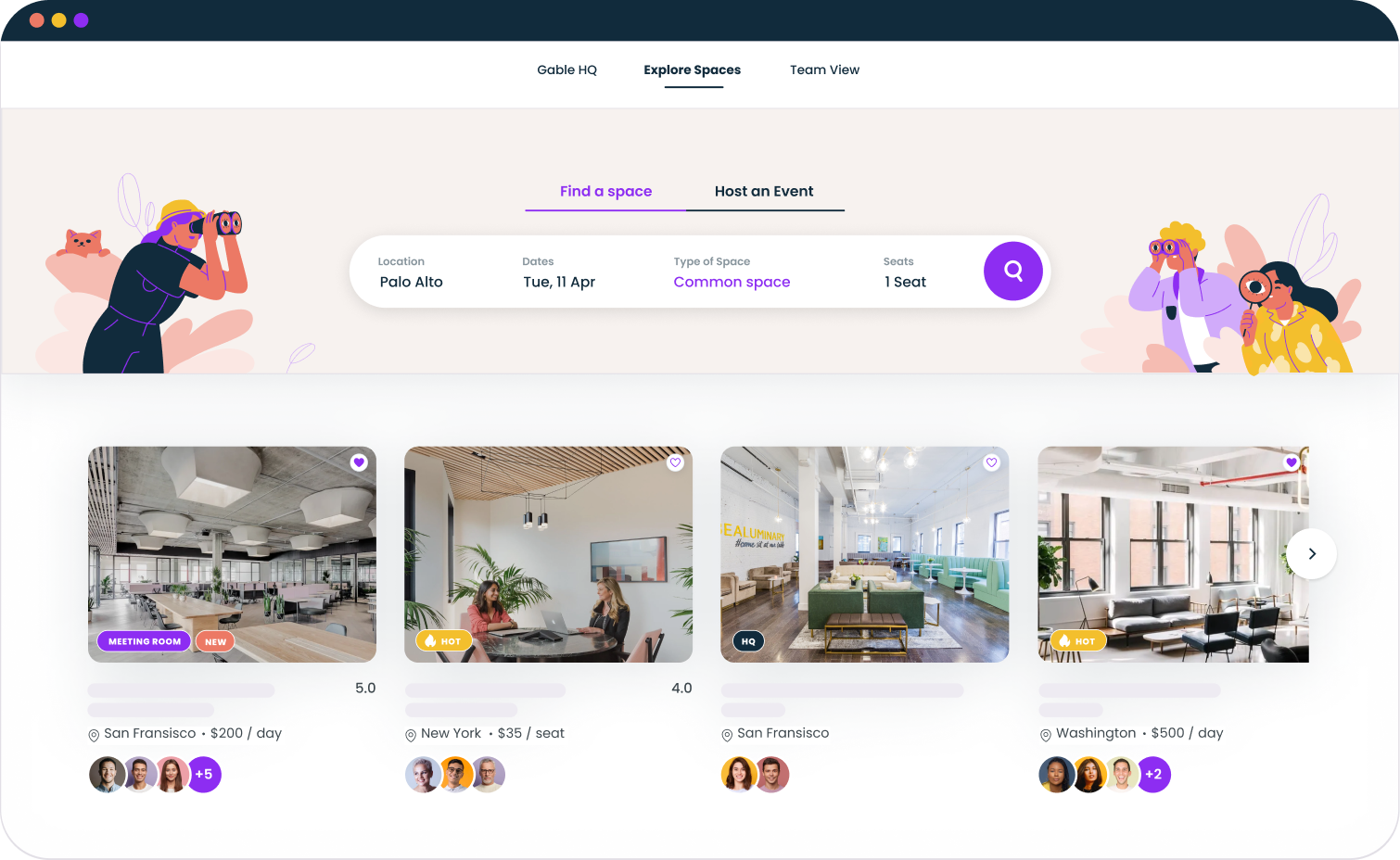
Technology that makes benchmarking possible (and continuous)
52% of organizations measure occupancy through badge systems alone, and 56% plan to layer in sensor or WiFi analytics by 2026. The gap between those two approaches is significant: badges tell you who entered the building, while WiFi and sensors tell you which floors, zones, and rooms people used throughout the day.
The biggest gains come from integrating data streams that usually live in separate systems:
When those streams converge in a single platform, you stop benchmarking once a quarter and start benchmarking continuously. The facilities team sees a floor trending below 40% utilization and can intervene in weeks, not months.
For teams evaluating their options, a comparison of the best workplace management software can help clarify which capabilities matter most for your benchmarking maturity level.
Benchmarking across different workplace strategies
A company mandating four days in the office and a company offering fully flexible attendance need completely different benchmarks. Applying the same utilization target to both is like comparing a restaurant's lunch rush to a food truck's Tuesday afternoon.
Return-to-office mandates
Target: 70-85% utilization. Desk ratio: 1:1 or 1:1.1. Primary risk: overbuilding for compliance attendance that drops 15-20% within six months of the mandate as exceptions accumulate. Benchmark cost per employee: $8,000-$14,000 depending on market.
Structured hybrid (2-3 designated days)
Target: 50-65% utilization. Desk ratio: 1:1.3-1.5. Primary risk: Tuesday-Thursday compression creating a three-day office and a two-day ghost town. Cost per employee: $6,000-$11,000, with potential to drop 20% by closing or subleasing one floor.
Flex-first (no mandated days)
Target: 25-40% utilization in owned space, supplemented by on-demand bookings. Desk ratio: 1:2-5. Primary risk: underinvesting in the spaces people do use, creating a poor experience that reinforces staying home. Cost per employee: $4,000-$8,000 when blending owned and flex, but only if the flex spend is tracked and managed.
Distributed (no central office)
Target: near-zero owned utilization, 100% flex and event-based. Desk ratio: 0:1 (all on-demand). Cost per employee: $2,000-$5,000 in workspace costs, plus $1,000-$3,000 in quarterly gathering budgets. Collaboration frequency and event attendance rates matter more here than utilization percentages.
What to do after you've benchmarked
Numbers on a dashboard don't save money. Actions do. Here are the four highest-ROI moves companies make after their first real benchmarking exercise.
Renegotiate leases with data
Walk into your landlord meeting with utilization data showing 45% average occupancy and you have the leverage to renegotiate square footage, sublease a floor, or restructure the term. Market benchmarks showing comparable space at $42 per square foot when you're paying $55 make the conversation concrete.
Consolidate underperforming locations
A 200-person satellite office at 30% utilization costs the same as one at 70%. If the team can be served by on-demand spaces in the same city at 40% of the cost, the business case writes itself.
Rebalance your portfolio mix
Companies seeing the largest savings are shifting 20-30% of their real estate portfolio from fixed leases to flexible arrangements. They aren't eliminating offices; they're right-sizing them and using flex space to absorb the peaks, the team gatherings, and the seasonal surges.
Invest in the spaces people use
Benchmarking often reveals that social and collaboration spaces run at 80%+ utilization while rows of assigned desks sit at 35%. Reallocating square footage from low-use to high-use space types costs less than adding space and drives measurably higher satisfaction scores.
The benchmark that matters most isn't a cost number
Every metric in this guide (cost per employee, utilization rate, square footage per person) measures the efficiency of your space. None of them measure whether the space is doing its job: bringing people together in ways that produce better work than they'd do apart.
Forward-looking workplace teams are starting to track collaboration density alongside cost density. How many cross-functional interactions happen per office visit? How does project velocity change in weeks with higher co-location? Does team NPS correlate with in-person gathering frequency?
Those metrics are harder to benchmark externally because few companies track them yet. But internally, they're the numbers that tell you whether your $8,000 per employee is an investment or an expense. A floor running at 55% utilization with high collaboration scores is outperforming a floor at 75% utilization where everyone sits in headphones on solo Zoom calls.
The workplace spend benchmarks in this guide give you the external reference points. Your internal data gives you the nuance. The gap between the two is where every dollar of optimization lives.
Gable unifies your office, flex, and event data into a single platform with AI insights that benchmark your spend and surface optimization opportunities you can act on this quarter.
Get a demo