.svg)


.svg)
- Sublease when occupancy data confirms you won't need the space back
- You stay liable for rent even after a subtenant moves in
- Price 20-40% below direct lease rates or your space will sit empty
- For teams under 50, flex space often beats subleasing on total cost
- Measure utilization before you list; gut feelings lead to expensive mistakes
An office sublease is the fastest way to stop paying for space your team doesn't use. If hybrid schedules, headcount changes, or a consolidation have left you with empty floors, subleasing lets you recover a portion of your rent while keeping the master lease intact. This guide walks through the full process: when subleasing makes sense, how to get landlord approval, how to price and market your space, and when a flex-space alternative is the better call.
When an office sublease makes sense (and when it doesn't)
Not every empty floor is a sublease candidate. The decision depends on how confident you are that the space is permanently excess, not just temporarily quiet.
Subleasing works best in a few specific scenarios. Your company shifted to hybrid and occupancy has stayed below 50% for six months or more. You've gone through a reduction in force and don't expect to backfill those roles. You're consolidating locations and one office is redundant before its lease expires. Or you've simply outgrown a space and moved to a larger one, leaving the old lease running.
Hybrid work policies are the most common catalyst. New remote and hybrid schedules have made desk-sharing and reduced footprints the norm, pushing millions of square feet onto the sublease market. If your team genuinely needs fewer desks, subleasing is a rational response.
But there are red flags. If your lease is less than two years from expiration, the marketing and legal costs may not justify the effort; most subtenants want at least 18-24 months of term. If your landlord has strong recapture rights (more on that below), they can simply take the space back and re-lease it themselves, leaving you with nothing. And if your local sublease market is flooded, you may spend months carrying vacancy costs while waiting for a subtenant who never comes.
The worst reason to sublease is a hunch. Before you call a broker, you need hard occupancy data. How many desks are actually used on peak days? What's the no-show rate for booked meeting rooms? If you're guessing, you risk subleasing space you'll need back in 12 months, which is far more expensive than paying for empty desks.
How to measure whether you have excess space
The foundation of any sublease decision is utilization data, not headcount math.
Headcount tells you how many people could be in the office. Utilization tells you how many actually show up. Those are very different numbers. A 200-person team with a three-day hybrid schedule might peak at 120 on Tuesdays and drop to 40 on Fridays. That pattern determines how much space is truly excess.
Start by tracking office occupancy rates over at least 8-12 weeks. You need enough data to capture seasonal variation, project cycles, and the difference between "normal" weeks and outlier weeks. Badge swipe data, desk booking logs, and sensor counts all work. The key is consistency.
Once you have the data, calculate your peak utilization rate. If your peak day uses 60% of capacity, you have roughly 40% excess on your busiest day and far more on quiet days. That 40% is your sublease candidate, minus a buffer for growth and event days.
Gable Offices surfaces these utilization trends automatically, showing you peak and average occupancy by floor, zone, and day of week, so you can quantify exactly how much space to sublease without guessing.
After you've confirmed the numbers, build two scenarios: a conservative one (sublease only the space you're 90% sure you won't need) and an aggressive one (sublease everything beyond peak-day capacity plus a 15% buffer). Present both to leadership. The conservative scenario is almost always the right starting point.

Before you sublease, make sure you're measuring the right metrics. This guide walks through the data-driven approach to aligning your portfolio with actual usage.
Read the guide
Understanding the legal and landlord consent process
You can't sublease without your landlord's written approval. Full stop.
Step 1: Read your lease. Every commercial lease has a sublease clause. Some prohibit subleasing entirely. Most require landlord consent, which the lease may say "shall not be unreasonably withheld," but that language varies. Look specifically for three things: whether subleasing is permitted, what the consent process requires, and whether the landlord has recapture rights.
Recapture rights let the landlord terminate your lease for the subleased portion and re-lease it directly. This is common in Class A buildings. If your landlord exercises recapture, you lose the space and the ability to recover rent through a subtenant. You're off the hook for that portion of rent, which can be a win, but you lose control of the outcome.
Step 2: Notify your landlord in writing. Most leases specify a formal notification process. You'll typically need to provide the proposed subtenant's name, financial statements, intended use, and the sublease terms. Give your landlord 30-60 days to respond, depending on what the lease requires.
Step 3: Understand profit-sharing. Many leases include a clause requiring you to split any sublease profit with the landlord, often 50/50. "Profit" here means the difference between what you pay in rent and what the subtenant pays you, minus your reasonable costs (broker fees, legal fees, tenant improvements). If your sublease rate is below your own rent, which is common, there's no profit to share.
Step 4: Know your liability. This is the part most people underestimate. In a sublease, you remain the tenant on the master lease. If your subtenant stops paying, you still owe your landlord the full rent. You're essentially becoming a landlord yourself, with all the risk that entails. A lease audit before you start this process can surface hidden obligations you might otherwise miss.
One more distinction worth understanding: subleasing is not the same as assigning your lease. In an assignment, the new tenant takes over your entire lease obligation directly with the landlord, and you're released. Assignments are cleaner but harder to negotiate, and most landlords prefer to keep the original tenant on the hook.
Pricing your sublease and selecting the right broker
Sublease space almost always trades at a discount to direct lease rates. The question is how much of a discount you can afford.
Typical sublease discounts run 20-40% below comparable direct lease rates in the same building or submarket. The exact discount depends on your market, the remaining lease term, the condition of the space, and how much sublease inventory is competing with yours. In markets with high vacancy, like San Francisco where office vacancies hit record levels post-pandemic, discounts can be even steeper.
Here's how to set your asking rate:
Research comparable listings. Check CoStar, LoopNet, and your broker's database for sublease listings in your building and submarket. Note the asking rates, but also ask your broker what deals are actually closing at. Asking rates and closing rates can differ by 10-15%.
Factor in your carrying costs. Every month your space sits empty, you're paying full rent plus operating expenses. If your space will take six months to sublease (a reasonable assumption in most markets), that's six months of carrying cost you need to account for. A slightly lower asking rate that fills the space in three months may net you more than a higher rate that takes nine months.
Decide what's included. Furnished sublease space commands a premium because the subtenant avoids capital expenditure on furniture and buildout. If your space is already furnished and in good condition, that's a selling point. If it needs work, you'll need to decide whether to invest in tenant improvements or discount the rate accordingly.
Broker selection matters. Most sublease brokers work on commission, typically 4-6% of the total lease value, split between the listing broker and the tenant's broker. Interview at least three brokers. Ask specifically about their sublease experience (it's different from direct leasing), their marketing plan, and their track record in your submarket. A good broker will give you a realistic timeline and pricing range, not just tell you what you want to hear.
Marketing your space. Professional photography, a virtual tour, and a clear floor plan are table stakes. Your broker should list the space on CoStar, LoopNet, and their internal network. For larger spaces (10,000+ square feet), targeted outreach to companies known to be in the market is more effective than passive listings.
Sublease vs. flexible office space: Which one fits
Subleasing isn't the only way to shed excess space. For some teams, the smarter move is to let the sublease market go and shift to flex space instead.
The comparison comes down to five factors:
Cost. Sublease space is cheaper per square foot, but you're locked into a fixed commitment. Flex space costs more per desk but includes furniture, IT, cleaning, and management. For teams under roughly 50 people, flex space often wins on total cost because you avoid the overhead of managing a dedicated office. Above 50, the per-head economics start favoring a sublease or direct lease.
Flexibility. A sublease typically runs 1-3 years. Flex space can be month-to-month. If your headcount is volatile or you're unsure about long-term space needs, flex gives you an exit ramp that subleasing doesn't.
Speed. Flex space is ready on day one. A sublease can take 3-6 months to negotiate, build out, and occupy. If you need space next month, flex is the only realistic option.
Control. With a sublease, you control the space: layout, branding, access, hours. With flex, you're sharing amenities and following someone else's rules. For teams that need secure space, specialized buildouts, or a branded environment, subleasing wins.
Scalability. Flex space scales up or down with a phone call. A sublease is a fixed footprint. If you're growing 20% year over year, locking into a sublease means you might outgrow it before the term ends.
For a deeper dive into the financial comparison, our cost comparison guide breaks down the total cost of ownership for both models across different team sizes and markets.
The hybrid approach is increasingly common: keep a smaller HQ on a direct lease, sublease the excess, and use on-demand workspace for satellite teams or overflow days. This gives you the cost savings of right-sizing without the rigidity of a single large footprint.
Desk booking, room scheduling, and utilization analytics in one platform. Know exactly which space to keep and which to sublease.
Learn more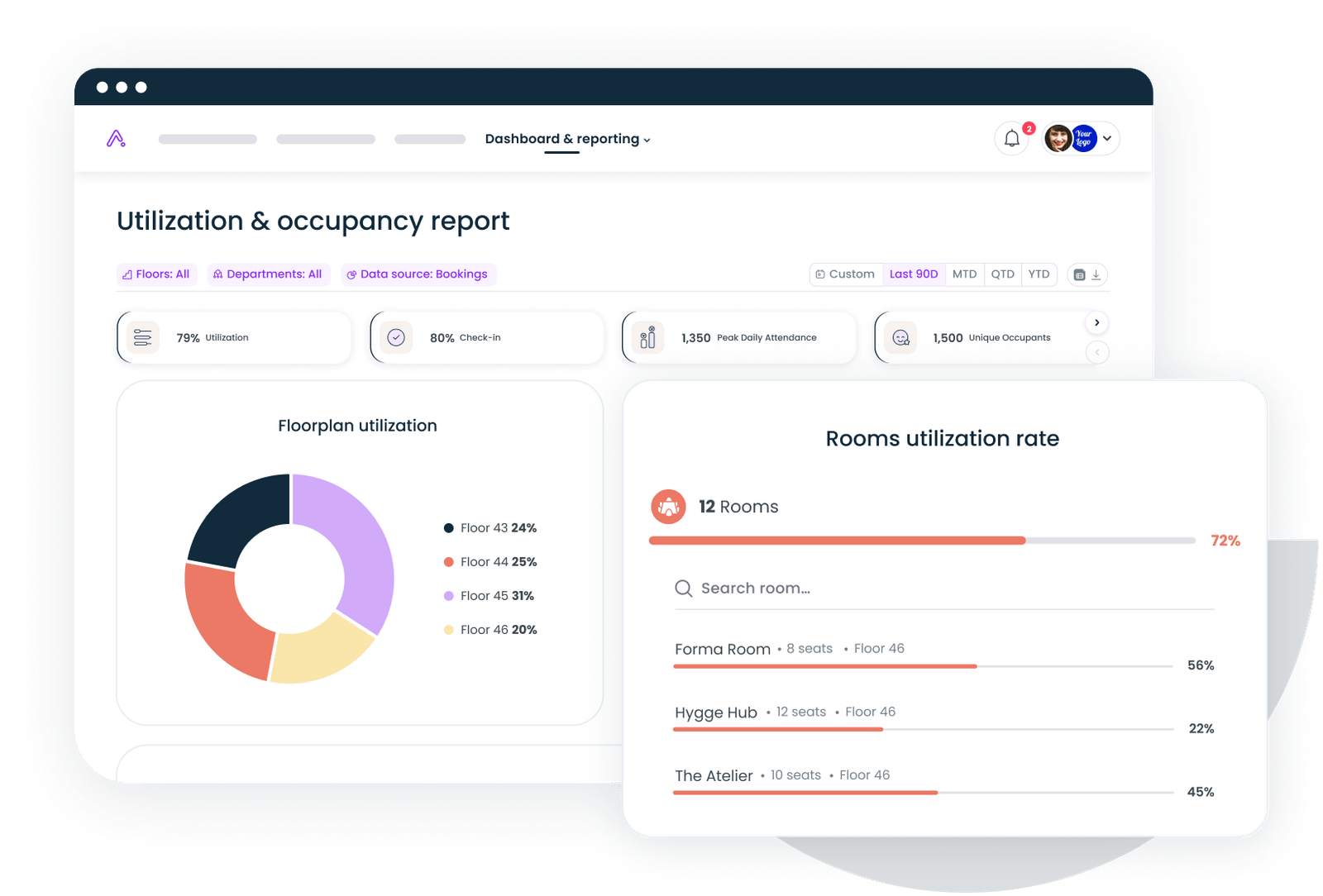
Executing the sublease: Step by step
Once you've decided to sublease, priced the space, and engaged a broker, here's the execution playbook.
1. Prepare the space. Clean it. Stage it if it's furnished. Fix anything that's broken. First impressions matter as much in commercial real estate as they do in residential. Remove any branded signage or confidential materials. The space should feel move-in ready.
2. Vet your subtenants carefully. You're going to be their landlord, and you're still on the hook to yours. Request financial statements, credit reports, and references from previous landlords. Verify their intended use is compatible with your lease (most leases restrict certain uses). And check whether they're a competitor; your lease may prohibit subleasing to competitors, and even if it doesn't, your leadership team probably should.
3. Negotiate the sublease agreement. Your sublease should mirror the key terms of your master lease: permitted use, maintenance obligations, insurance requirements, and default provisions. Your subtenant can't have more rights than you do under the master lease. Hire a real estate attorney; this isn't a document to draft from a template.
4. Get landlord consent in writing. Don't let your subtenant move in until you have a signed consent letter from your landlord. Verbal approval isn't enough. The consent letter should confirm the landlord's approval of the specific subtenant, the sublease terms, and any conditions.
5. Manage the transition. Coordinate move-in logistics: key cards, building access, parking, mail, signage. Introduce your subtenant to building management. Set clear expectations about shared spaces, if any.
6. Monitor ongoing. Collect rent on time. Respond to maintenance requests (or coordinate with building management). Keep your landlord informed of any issues. Remember: if your subtenant defaults, you're the one who gets the call.
Common mistakes to avoid: underpricing because you're desperate to stop the bleeding (run the numbers first), waiting too long to list (the sublease market moves slowly; start 6-9 months before you need the space filled), and skipping tenant vetting because the first applicant seems fine.
Using data to avoid costly sublease mistakes
The most expensive sublease mistakes happen before the listing goes live. They happen when someone decides to sublease based on a gut feeling instead of data.
Here's what to measure before committing:
Average daily occupancy. Not peak, not trough. The average tells you what "normal" looks like. If average occupancy is 45% and peak is 65%, you have a clear picture of excess capacity.
Day-of-week patterns. Most hybrid offices see Tuesday-Thursday peaks and Monday/Friday valleys. If you're subleasing a full floor, make sure you're not giving away space you need on your busiest days. A workplace strategy guide can help you formalize these patterns into policy before making real estate decisions.
Growth projections. Talk to your CFO and hiring managers. If the company plans to grow 30% in the next two years, subleasing half your space today could mean scrambling for space tomorrow. Build growth into your buffer.
Financial impact modeling. Calculate three scenarios: (1) sublease fills in 3 months at your target rate, (2) sublease fills in 6 months at a 10% discount, (3) space sits empty for 12 months. If scenario 3 is survivable, you have room to hold out for a better subtenant. If it's not, price aggressively and move fast.
Market timing. Sublease markets are cyclical. Listing in Q1 when companies are executing new budgets tends to generate more interest than listing in Q4 when budgets are frozen. Your broker should advise on local timing dynamics.
The companies that handle subleasing well are the ones that treat it as a portfolio management decision, not a one-off transaction. They know their numbers, they've modeled the scenarios, and they've aligned the sublease with their broader office consolidation strategy.
Making the right call for your team
Subleasing is a tool, not a strategy. The strategy is right-sizing your real estate to match how your team actually works. Sometimes that means subleasing excess space. Sometimes it means renegotiating your lease, consolidating locations, or shifting to a flex model. Often it means a combination.
The common thread is data. You can't right-size what you can't measure. Whether you end up subleasing a floor, converting it to collaboration space, or keeping it for growth, the decision should start with utilization numbers, not assumptions.
If you're early in this process, start by tracking occupancy for 8-12 weeks. If you already have the data and it's telling you that 40% of your space is empty, it's time to talk to a broker, a real estate attorney, and your leadership team. The longer empty space sits on your books, the more it costs.
Gable gives you the occupancy and utilization data you need before making any sublease, consolidation, or expansion move.
Get a demo