.svg)


.svg)
- A TIA is the landlord's per-square-foot contribution toward your office build-out
- National averages range from $43 to $87 per square foot depending on the source and market
- Longer lease terms and stronger credit directly increase your negotiating leverage
- Tenant-controlled buildouts give you more flexibility; turnkey deals give you less risk
- Every dollar of TIA you leave on the table is a dollar you're paying out of pocket
A tenant improvement allowance (TIA) is the single biggest financial lever most tenants overlook when signing an office lease. It's the dollar amount a landlord contributes toward customizing raw or second-generation space to fit your needs: walls, electrical, HVAC, flooring, the works. Get it right, and you offset a significant chunk of your fit-out costs. Get it wrong, and you're subsidizing improvements that the landlord ultimately owns.
What a tenant improvement allowance actually is
A TIA is a negotiated concession, not a gift. The landlord agrees to fund a specific dollar amount per square foot toward construction and renovation of your leased space. You'll also hear it called a TI allowance, tenant allowance, or leasehold improvement allowance. Different names, same concept.
The landlord's motivation is straightforward: a built-out space with a committed tenant is worth more than an empty shell. Your motivation is equally clear: office fit-outs are expensive, and the TIA is how you shift some of that cost to the building owner.
Here's the part that trips people up. The TIA isn't free money. Landlords amortize it into your base rent over the lease term. A higher TIA usually means higher monthly rent, a longer lease commitment, or both. Understanding that trade-off is the foundation of every negotiation tactic that follows.
If you're weighing whether a traditional lease even makes sense for your situation, the lease vs. coworking comparison breaks down total cost of occupancy across both models.
What tenant improvement allowances typically cover
TIAs fund permanent, physical improvements to the space. Think of it as anything that stays behind when you leave. The distinction between hard costs and soft costs matters because some landlords cap or exclude soft costs entirely.
Hard costs (construction):
- Demising walls, interior partitions, and structural modifications
- HVAC upgrades, ductwork, and ventilation
- Electrical wiring, outlets, and lighting
- Plumbing (kitchens, restrooms, server room cooling)
- Flooring, ceiling tiles, and paint
- Fire suppression and life safety systems
Soft costs (professional services):
- Architectural and engineering fees
- Permitting and inspection costs
- Construction management fees
- Space planning and design
What TIAs typically don't cover:
- Furniture, fixtures, and equipment (FF&E)
- Technology infrastructure (cabling, AV systems, access control)
- Moving costs
- Signage (exterior or interior)
- Specialty items like branded wall treatments
The exclusions matter more than most tenants realize. If you're planning a modern office with collaboration zones and flexible neighborhoods, a big chunk of that investment (furniture systems, AV, technology) falls outside the TIA. Budget accordingly.
How tenant improvement allowances are calculated
There are three common structures. The per-square-foot method dominates, but you'll encounter the others in certain markets and deal types.
1. Per-square-foot allowance (most common)
The landlord offers a flat dollar amount per rentable square foot. Simple math: $50/SF × 10,000 SF = $500,000 TIA. This is the structure you'll see in 80%+ of office leases.
2. Fixed dollar amount
Less common. The landlord offers a lump sum, sometimes expressed as a percentage of first-year rent (typically 25% to 150%). You'll see this in smaller deals or creative lease structures.
3. Percentage of total build-out cost
The landlord agrees to cover a percentage of eligible renovation costs. This shifts more risk to the landlord if costs escalate, which is exactly why most landlords prefer the per-square-foot model instead.
Regardless of structure, the TIA is always negotiable. The number in the landlord's first offer is a starting point, not a ceiling.
Typical TIA ranges by market and lease length
Market matters enormously. TIAs are now 66.7% higher than pre-pandemic levels in major office markets, driven by landlord competition for tenants in a soft leasing environment.
Here's what the current landscape looks like:
The national average is roughly $43/SF, though that figure masks enormous variation. Class A buildings in gateway cities routinely offer three to four times that amount.
Lease length is the other major variable. A five-year lease might get you $30/SF. Commit to ten years, and that number can jump to $50-$80/SF or higher. The landlord is spreading the amortized cost over more months, which makes a larger upfront investment pencil out.
If you're evaluating CRE cost per square foot across markets, layer the TIA on top. A market with high rent but generous TIAs can actually deliver lower total occupancy cost than a cheaper market with stingy allowances.
Cash vs. landlord-managed buildouts
How the TIA gets spent matters almost as much as how much you get. There are two primary models, plus a hybrid that's increasingly common.
Tenant-controlled buildout
You hire the architect, select the contractor, manage the project, and submit receipts to the landlord for reimbursement. This gives you maximum control over design, materials, timeline, and vendor selection.
The catch: you're fronting the cash and getting reimbursed after completion (or at milestones). That creates a cash flow gap. You also bear the risk of cost overruns, permitting delays, and contractor disputes.
Landlord-managed (turnkey) buildout
The landlord handles everything. They hire the architect and contractor, manage construction, and deliver a move-in-ready space. You approve the design, but the landlord controls execution.
The upside is simplicity and cost certainty. The downside is less control, potentially higher costs (landlords often add a 1%-3% management fee), and slower decision-making. If the landlord's contractor is slow or the design process drags, you have limited recourse.
Hybrid model
You manage the buildout, but the landlord retains approval rights over plans, materials, and contractors. The landlord may pay contractors directly rather than reimbursing you. This splits the risk and control more evenly.
Which model to choose:
Pick tenant-controlled if you have an experienced project manager, need specialized build-out (labs, studios, high-density tech floors), or want to control costs tightly. Pick turnkey if you're a smaller tenant without construction expertise, need speed, or want predictable costs. The hybrid works well for mid-size tenants who want design control without the cash flow burden.
For teams planning a move, the office relocation checklist covers the full timeline, including how buildout decisions fit into the broader project plan.

Our guide to office lease negotiation covers 15 tactics that save real money, from TIA to escalation clauses.
Read the guide
How to negotiate a higher tenant improvement allowance
Negotiation is where most tenants leave money on the table. Landlords expect you to push back on the initial TIA offer. If you don't, you're accepting a number designed to leave room for exactly that.
1. Know your market benchmarks before you start
Walk into the negotiation with data. If Class A buildings in your market are offering $70-$90/SF and your landlord opens at $50, you have a factual basis to push higher. Fit-out costs averaged $146/SF nationally in recent years, so a $50 TIA covers barely a third of the total project.
2. Get contractor bids before signing the LOI
Most tenants negotiate the TIA based on rough estimates, then discover the actual build-out costs 30%-50% more. Get two or three contractor bids on your preliminary space plan before you finalize the letter of intent. This gives you a defensible number to present to the landlord.
3. Trade lease terms for higher TIA
Landlords think in total deal economics, not line items. You can often get a higher TIA by offering a longer lease term, accepting modest rent escalations, or waiving a renewal option. The key is understanding which concessions cost you the least over the full lease term.
4. Negotiate soft cost inclusion explicitly
Some landlords exclude architectural fees, permitting, and engineering from the TIA by default. Push to include them. Soft costs typically run 15%-20% of total build-out, so excluding them effectively reduces your TIA by that same percentage.
5. Address cost overruns upfront
Negotiate an overage split (50/50 is common) or a contingency buffer built into the TIA. Construction projects rarely come in exactly on budget. A 5%-10% contingency allocation protects both parties.
6. Watch for hidden fees in turnkey deals
If the landlord manages the buildout, scrutinize the construction management fee, general conditions, and contingency padding. These can add 10%-15% to the project cost, effectively reducing the value of your TIA.
7. Negotiate payment timing
Reimbursement-based TIAs create cash flow pressure. Push for progress draws tied to construction milestones (30% at framing, 30% at rough-in, 40% at completion) rather than a single payment after move-in.
For a deeper dive into lease negotiation beyond TIA, the right-sizing guide covers how to align your space commitment with actual usage patterns.
Making your TIA investment count after move-in
Here's the part that most TIA guides skip entirely. You've negotiated a strong allowance, built out a beautiful space, and moved in. Now what?
The uncomfortable truth is that many companies invest six or seven figures in office fit-outs and then have no idea whether the space is actually being used well. Meeting rooms sit empty. Collaboration zones go underutilized. Desks that cost $150/SF to build out are occupied two days a week.
This is where workplace analytics become essential. If you can't measure how your space is performing, you can't justify the investment you made, and you certainly can't negotiate intelligently for your next lease.
Gable Offices gives workplace teams real-time visibility into desk and room utilization, so you can see exactly which parts of your TIA-funded buildout are delivering value and which need to be reconfigured. That data becomes your strongest asset when it's time to renew or relocate.
The connection between space design and actual usage patterns is something the office space planning guide covers in detail.
Gable Offices tracks desk and room utilization so you can make data-backed decisions about your real estate.
Learn more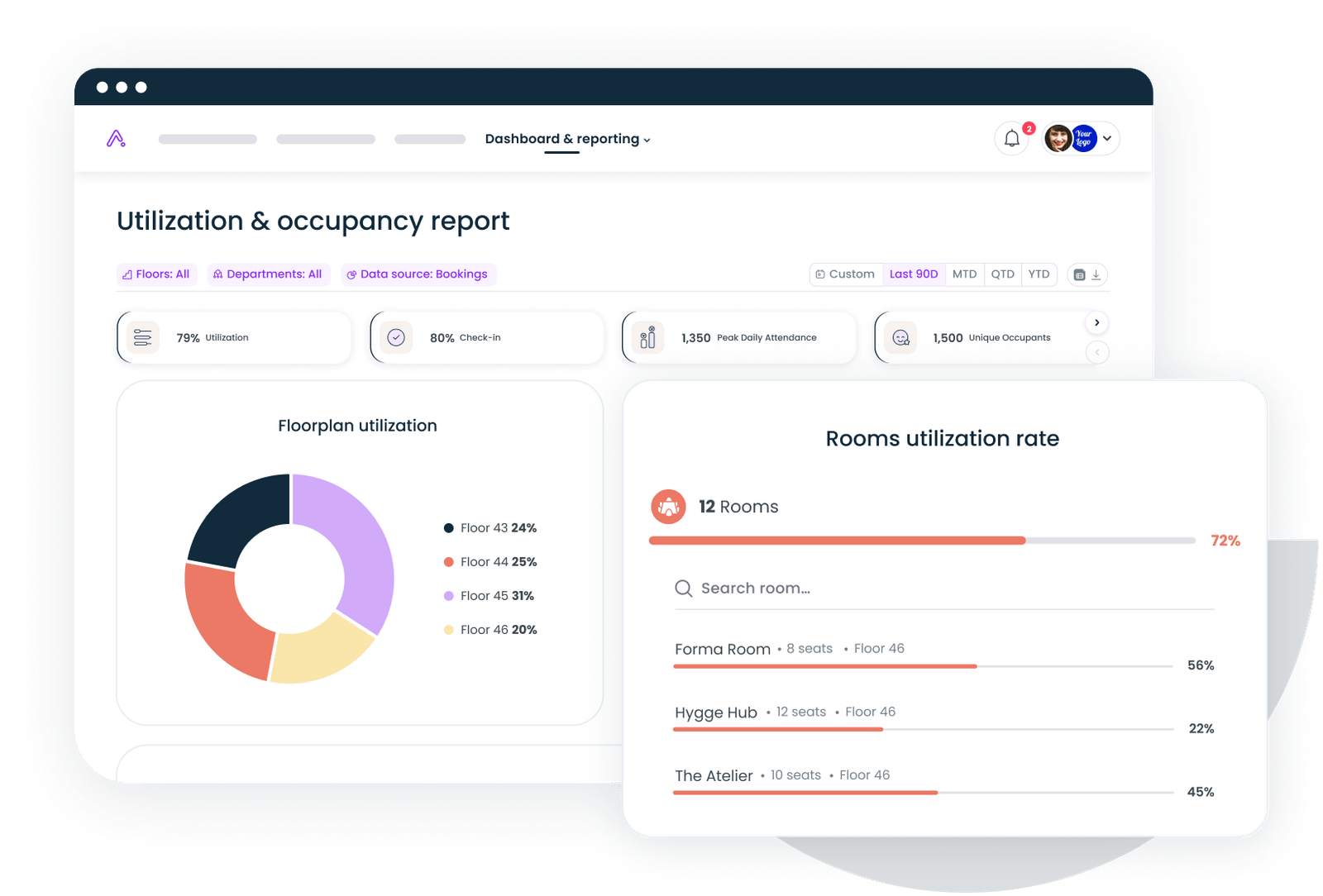
TIA Payment terms and timeline
Understanding when and how TIA funds flow is critical for cash planning. There are three common payment models:
Reimbursement after completion: The tenant funds the entire buildout, then submits documentation (receipts, lien waivers, certificate of occupancy) for reimbursement. This is the most common structure and the worst for tenant cash flow.
Progress draws: Funds are released at predefined construction milestones. This is better for tenants but requires more documentation and landlord oversight at each stage.
Direct payment to contractor: The landlord pays your contractor directly, eliminating the reimbursement lag. This is ideal for tenants but less common because it gives the landlord less control over documentation.
Regardless of structure, expect to provide: detailed construction budgets, contractor agreements, proof of insurance, lien waivers at each draw, and a final accounting with receipts. Landlords are lending you money through the TIA. They want documentation that it was spent on eligible improvements.
Timeline reality check: From lease signing to move-in, expect 4-8 months for a standard office buildout. Permitting alone can take 4-12 weeks depending on the municipality. Factor this into your lease commencement date negotiation; you don't want to start paying rent while construction is still underway.
If you're managing a corporate real estate portfolio across multiple locations, standardizing your TIA documentation process saves significant time and reduces the risk of leaving reimbursement dollars unclaimed.
Why TIA strategy belongs in your workplace playbook
A tenant improvement allowance isn't just a real estate transaction. It's a workplace design decision with years of downstream consequences.
The layout you fund with your TIA determines how teams collaborate, where people focus, and whether employees actually want to come into the office. A poorly designed buildout funded by a generous TIA is worse than a thoughtful design funded by a modest one.
Think about it this way: if you're spending $80/SF on a buildout that creates rows of assigned desks nobody uses three days a week, you've wasted the TIA. If you spend $60/SF on flexible neighborhoods, bookable focus rooms, and well-equipped collaboration spaces, you've created an asset that drives attendance and productivity.
The companies getting this right are the ones connecting their real estate decisions to their workplace strategy. They negotiate the TIA with a space plan already in hand, informed by utilization data from their current space. They know exactly what types of rooms and zones their teams need because they've measured it.
The bottom line on tenant improvement allowances
TIA negotiation is one of those areas where preparation creates outsized returns. The difference between a $40/SF and a $70/SF allowance on a 15,000 SF space is $450,000. That's real money, and it's available to tenants who show up with market data, contractor bids, and a clear space plan.
The landlord wants a signed lease with a creditworthy tenant. You want a space that works for your team without blowing your capital budget. The TIA is where those interests overlap. Negotiate it like the six- or seven-figure decision it is.
Gable helps workplace leaders connect space utilization data to lease negotiations and portfolio strategy.
Get a demo