.svg)


.svg)
- Most collaboration spaces fail because they're designed for aesthetics, not actual work patterns
- You need multiple room types; one-size-fits-all conference rooms don't match how teams collaborate
- Acoustics and focus zones matter as much as open collaboration areas
- Booking and utilization data tell you what's working and what's wasting money
- Design is only half the job; coordination technology makes the spaces functional
Collaboration space design is the practice of creating physical environments that support how teams actually work together, not how architects imagine they might. Most offices get this wrong. They build rows of identical conference rooms, scatter some couches in a corner, and call it a "collaborative workplace." The result: rooms that stay booked but empty, spaces that are too loud for real work, and teams that default to video calls even when they're in the same building.
This guide walks through how to design collaboration spaces that people genuinely use, from first principles through room-by-room specifics to the coordination layer that keeps everything running.
Why most collaboration spaces don't work
The problem isn't that companies don't invest in collaboration spaces. It's that they invest in the wrong ones.
86% of executives cite poor as a factor in organizational failures. That's a staggering number, and it points to something deeper than "we need more meeting rooms." It suggests that the spaces companies build don't match the collaboration patterns teams actually have.
Here's what typically goes wrong. A company leases a floor, fills it with 10-person conference rooms, adds a few phone booths, and assumes the layout will serve every team equally. But engineering needs whiteboard space for four people. Sales needs a room with a big screen for client calls. The executive team books the largest room for a two-person conversation. Meanwhile, 40% of booked meetings are, and the rooms sit empty anyway.
The fix isn't more space. It's better-designed space, matched to real workflows and supported by systems that make coordination easy.
Step 1: Understand how your teams actually collaborate
Before you sketch a single floor plan, you need to know what collaboration looks like at your company. Not in theory. In practice.
Start by auditing your current space. Pull conference room analytics to see which rooms get used, which get booked and abandoned, and which sit empty all week. Talk to team leads about how their groups work together. You'll likely find patterns you didn't expect.
Some common collaboration modes to map:
- Brainstorming sessions (3-6 people, informal, need writable surfaces)
- Tactical standups (4-8 people, short duration, don't need a table)
- Deep project work (2-4 people, extended sessions, need screens and quiet)
- Client or cross-timezone calls (1-3 people in-room, need video conferencing)
- Social connection (variable size, informal, need comfortable seating)
Each of these modes demands a different room configuration. Lumping them all into "conference room" is like designing a kitchen that's also supposed to be a bedroom. Technically possible. Functionally terrible.
If you're working across multiple locations, the audit gets more complex. Managing multiple offices means you'll need to account for different team sizes, cultures, and collaboration habits at each site.
Step 2: Design a mix of space types, not a collection of conference rooms
The single biggest mistake in collaboration space design is building too many rooms of the same size. 80% of meetings happen in, yet most offices over-index on large conference rooms that seat 12 or more. Those big rooms see utilization rates as low as 12%.
Here's a practical breakdown of the space types you need and what each one requires.
Huddle rooms (2-4 people)
These are your workhorses. Small, enclosed, acoustically isolated. They need a display or monitor for screen sharing, a small table or counter, good lighting, and a video camera plus microphone for hybrid participants. Skip the speakerphone from 2015. For a deeper dive on sizing and tech specs, our huddle room guide covers the details.
Medium collaboration rooms (5-8 people)
This is where most cross-functional work happens. Think project kickoffs, design reviews, sprint planning. These rooms need a large display or interactive whiteboard, flexible seating (chairs that move, not bolted-down furniture), good acoustics (sound masking or acoustic panels), and power outlets accessible from every seat.
Large gathering spaces (10-20+ people)
Use these sparingly. All-hands meetings, workshops, and training sessions need them, but they shouldn't dominate your floor plan. Make them flexible: moveable partitions, stackable furniture, multiple display options. If a room this size can't be reconfigured for a 10-person workshop and a 40-person town hall, it's too rigid.
Informal collision spaces
Not every collaboration is scheduled. Some of the best ideas come from unplanned conversations in a café area, a lounge near the stairwell, or a bench by the entrance. Design these intentionally. Place them along natural traffic paths, not tucked in a corner nobody walks past. Comfortable seating, good coffee, and a whiteboard nearby go a long way.
Outdoor or semi-outdoor areas
If your building allows it, outdoor collaboration spaces are underrated. They work well for informal brainstorming and one-on-ones. They don't need much: weather protection, Wi-Fi, power, and seating.
The ratio between these types depends on your audit from Step 1. But as a starting point, most hybrid offices need far more huddle rooms and fewer boardrooms than they currently have.
Step 3: Balance collaboration with focus
This is where many redesigns go sideways. Companies read about "collaborative workplaces," tear down every wall, and create an open floor plan that's great for spontaneous conversation and terrible for everything else.
82% of leaders and 72% struggle with insufficient focus time due to meeting overload. If your collaboration space design doesn't account for focus work, you'll solve one problem and create another.
The fix is what some designers call the "we and me" balance. For every collaborative zone, you need a corresponding quiet zone. Practically, that means:
- Acoustic separation between collaboration areas and focus areas. This isn't optional. Sound travels, and a brainstorming session three rooms away will destroy someone's deep work if the walls are thin.
- Dedicated focus rooms or pods where individuals can work without interruption. These aren't phone booths (too small for extended work). They're small, enclosed rooms with a desk, monitor, and good ventilation. Our guide on focus room strategy covers how to size and position these.
- Clear zoning on the floor plan. Collaboration spaces on one side, focus spaces on the other, with a buffer zone (café, lounge, circulation space) in between.
- Wellness rooms that serve a different purpose entirely: quiet spaces for decompression, nursing, prayer, or medical needs. These aren't focus rooms, and they shouldn't be treated as overflow workspace. Wellness room design has its own set of requirements.
The goal isn't to eliminate noise. It's to make noise predictable. People can tolerate a loud café area because they chose to sit there. They can't tolerate a surprise brainstorming session erupting next to their desk.

If you're rethinking your floor plan for hybrid work, this guide covers layout principles, zoning strategies, and common mistakes to avoid.
Read the guide
Step 4: Build technology into the room, not onto it
A collaboration space without the right technology is just a room with chairs. But "the right technology" doesn't mean cramming every room with the latest gadgets. It means matching the tech to the room's purpose.
30% of meetings now cross, and that number keeps climbing. Every collaboration space needs to work for hybrid participants, not just the people physically in the room.
Here's a room-by-room technology checklist:
Every collaboration room needs:
- Reliable Wi-Fi (not "it works most of the time" Wi-Fi)
- A large display or monitor with wireless screen sharing
- A video camera positioned at eye level, not ceiling-mounted
- A quality microphone that picks up everyone in the room, not just the person closest to it
- At least one power outlet per seat
Brainstorming rooms additionally need:
- A digital whiteboard or large writable surface
- A camera that captures the whiteboard for remote participants
- Informal seating (couches, stools) rather than a formal conference table
Client-facing rooms additionally need:
- Better lighting (ring lights or diffused overhead, not harsh fluorescents)
- A clean, professional background visible on camera
- Acoustic treatment that eliminates echo
Large gathering spaces additionally need:
- Multiple displays or a projector
- A PA system or ceiling speakers
- Flexible AV routing so presenters can switch between sources
The key principle: technology should be invisible when it works and easy to troubleshoot when it doesn't. If someone needs to call IT every time they want to share their screen, the room has failed. For a broader look at conference room technology options, we've covered the landscape separately.
Step 5: Make the spaces bookable, visible, and accountable
Here's the uncomfortable truth about collaboration space design: you can build the perfect rooms and still watch them go unused. Or worse, watch them get booked by one person who wanted a quiet place to eat lunch.
The gap between "designed well" and "used well" is a coordination problem. Teams need to know which spaces are available, who's in the office on a given day, and whether the room they need is actually free or just phantom-booked by someone who forgot to cancel.
This is where most design guides stop, and it's exactly where the real work begins.
Real-time visibility matters. If people can't see room availability at a glance (on their phone, on a screen outside the room, in their calendar), they'll default to booking the same room every time or just not booking at all.
Booking needs to be frictionless. If reserving a huddle room takes more than 30 seconds, people won't do it. They'll just walk in, and the person who actually booked it will show up to a conflict.
No-show policies reduce waste. That 40% no-show rate isn't inevitable. Auto-release policies (if nobody checks in within 10 minutes, the room frees up) recover a huge amount of wasted capacity.
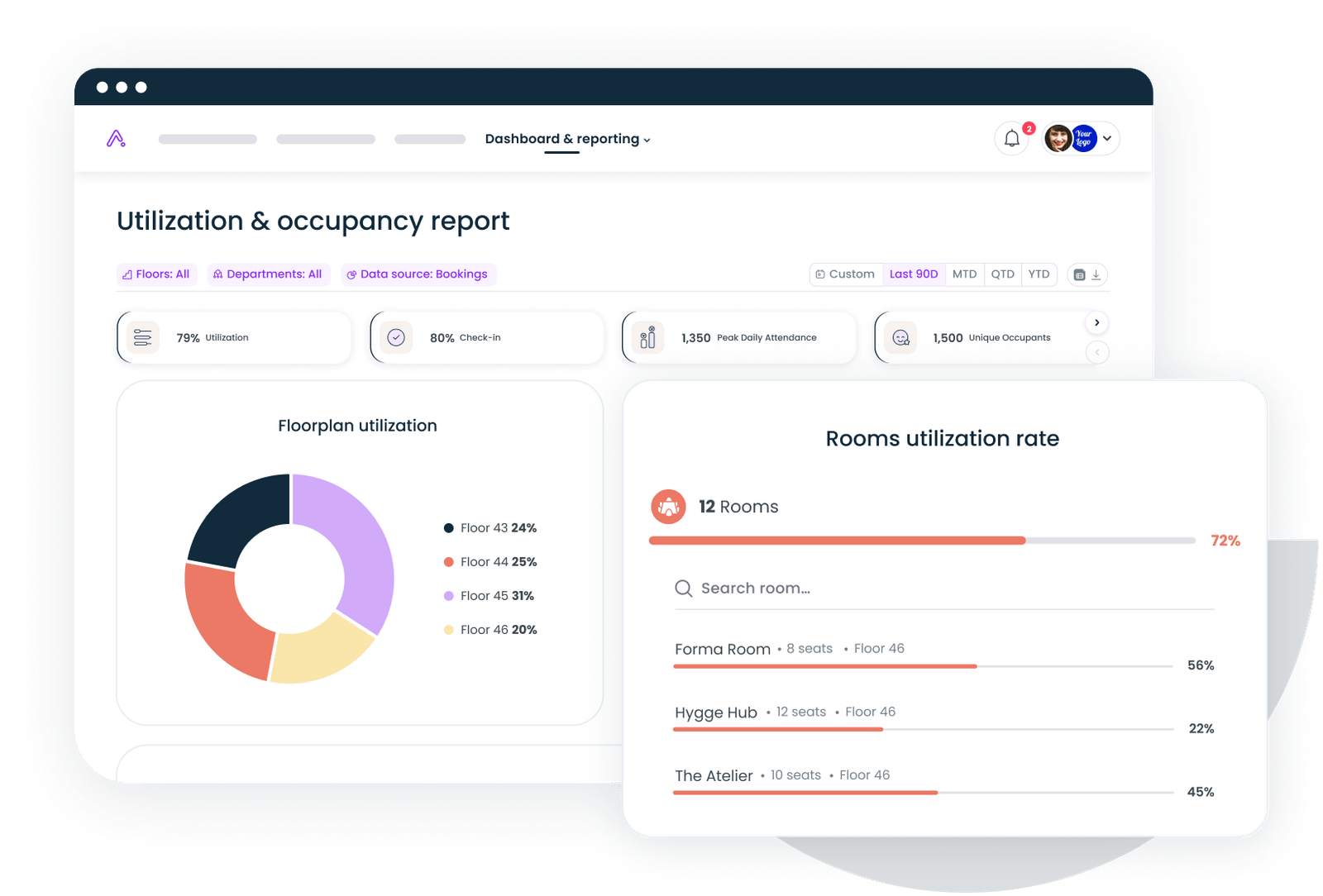
Utilization data closes the feedback loop. You need to know which rooms are actually used, not just booked. Gable Offices handles desk and room booking, visitor management, and utilization analytics in one platform, giving you the data to iterate on your design based on real behavior rather than assumptions.
Without this coordination layer, even beautifully designed spaces become expensive furniture showrooms.
Desk booking, room reservations, visitor management, and utilization data in one platform. Built for hybrid teams that need coordination, not complexity.
Learn more
Step 6: Avoid the five most common design mistakes
I've seen these mistakes repeated across dozens of office redesigns. They're predictable, and they're avoidable.
Mistake 1: All collaboration, no focus
The pendulum swings. Open offices were the trend, then "collaboration hubs" became the trend, and in both cases, focus work got sacrificed. If your redesign doesn't include quiet zones, you'll hear about it within a month. Loudly. From everyone trying to concentrate.
Mistake 2: Ignoring acoustics
Acoustics are the single most underinvested element in office design. A glass-walled huddle room looks great in photos and leaks sound like a sieve. Invest in acoustic panels, sound masking systems, solid-core doors, and proper seals. This isn't glamorous work, but it's the difference between spaces people use and spaces people avoid.
Mistake 3: Same-sized rooms everywhere
We covered this above, but it bears repeating. Your room mix should reflect your meeting mix. If 80% of your meetings are six people or fewer, 80% of your rooms should seat six or fewer. Audit first, build second.
Mistake 4: Designing for peak occupancy
If your office hits 90% capacity three days a year, don't design for 90%. Design for your typical peak (usually Tuesday through Thursday) and use flexible furniture and overflow spaces for the rare days when everyone shows up. Occupancy planning should drive your space allocation, not worst-case scenarios.
Mistake 5: Forgetting accessibility
Collaboration spaces need to work for everyone. That means wheelchair-accessible rooms, hearing loops or captioning for video calls, adjustable-height tables, and clear wayfinding. Accessibility isn't an add-on. It's a design requirement.
Step 7: Implement, measure, and iterate
Collaboration space design isn't a one-time project. It's an ongoing process. Here's a practical implementation checklist:
Before launch:
- Complete your space audit (utilization data, employee surveys, team interviews)
- Define your collaboration scenarios based on actual workflows
- Map your room mix: how many of each type, where on the floor plan
- Specify technology and acoustic requirements per room
- Choose a booking system and establish policies (booking windows, no-show rules, capacity limits)
- Communicate the changes to employees before they walk in on day one
After launch (first 30 days):
- Monitor utilization daily. Which rooms are overbooked? Which are empty?
- Collect informal feedback. Walk the floor. Ask people what's working.
- Adjust booking policies if you see patterns (e.g., one team monopolizing a popular room)
Ongoing (quarterly):
- Review space utilization metrics to identify underperforming rooms
- Reconfigure or repurpose spaces that aren't earning their square footage
- Survey employees on satisfaction with collaboration and focus spaces
- Benchmark your costs against workplace spend data to ensure you're not overpaying for underused space
The companies that get collaboration space design right treat it like a product. They ship a first version, watch how people use it, and iterate. The ones that get it wrong treat it like a construction project: build it, move on, never look back.
The design is only as good as the system behind it
You can nail every design principle in this guide and still end up with underused spaces if teams can't coordinate around them. Collaboration space design solves the physical problem: what rooms exist, how they're configured, what technology they contain. But the operational problem (who's in the office, which rooms are free, whether the space is actually being used) requires a different kind of solution.
The best collaboration spaces aren't just well-designed rooms. They're well-designed rooms that people can find, book, and use without friction, and that generate data you can act on. That feedback loop, from design to usage to redesign, is what separates offices that work from offices that just look good in a real estate brochure.
Book a demo to see how Gable helps hybrid teams coordinate space, track utilization, and make smarter workplace decisions.
Get a demo