.svg)


.svg)
- Breakout spaces are the informal zones that make the hybrid office worth commuting to
- Size for peak occupancy day attendance, not total headcount
- Mix at least three seating types to support different activities and energy levels
- Acoustic management matters more than aesthetics in open breakout areas
- Measure actual usage with booking and sensor data, then redesign based on what you find
Breakout space design is the practice of creating informal, flexible zones within an office where employees can collaborate spontaneously, recharge, or shift between work modes without booking a formal meeting room. In hybrid offices, where the whole point of coming in is connection and collaboration, these spaces do more of the heavy lifting than most workplace leaders realize. Get them wrong and you've built expensive furniture showrooms that nobody sits in. Get them right and they become the reason people actually want to be on-site.
What counts as a breakout space?
A breakout space is any informal area designed for unstructured interaction, quick collaboration, or mental reset. It's not a meeting room. It's not a focus pod. It sits in the gap between those two, serving the messy, spontaneous work that doesn't fit neatly into a calendar invite.
Think lounge clusters near a kitchen. Banquette booths tucked along a corridor. A café-style zone with high tables and power outlets. The common thread is flexibility: people choose how to use the space in the moment, rather than reserving it for a specific purpose.
The distinction matters because hybrid offices need a different mix of space types than traditional ones. When most knowledge workers spend two or three days per week on-site, the office shifts from a place for heads-down task work to a place for the interactions that don't happen well over Zoom. Breakout spaces serve that shift directly. They're where the hallway conversation happens, where two people sketch an idea on a whiteboard after a meeting, where someone takes a mental break that prevents the 3 p.m. burnout spiral.
This is different from a huddle room, which is enclosed and purpose-built for small group discussions. It's also different from a focus room, which prioritizes silence and individual concentration. Breakout spaces are the connective tissue between those dedicated zones.
Why breakout spaces matter more in hybrid offices
The hybrid model changed what the office is for. If people can do deep work from home, the office needs to justify the commute. That justification is almost always social: collaboration, mentorship, culture, the kind of trust-building that happens face to face.
Employees report feeling 6% more productive and 15% more creative when their office includes breakout and social spaces, according to a Fellowes/Forbes workplace study. That's not a massive number on its own, but creativity compounds. The ideas that emerge from informal collisions in a well-designed lounge area don't show up in a spreadsheet until months later.
There's a retention angle too. People stay longer at companies that invest in their physical environment. When the office feels like a place designed for human beings rather than a grid of identical workstations, it signals that leadership cares about the day-to-day experience. That signal matters, especially when competing for talent against companies offering full remote flexibility.
The practical argument is simpler. In a hybrid office, formal meeting rooms are chronically overbooked on anchor days and empty the rest of the week. Breakout spaces absorb the overflow. They handle the two-person check-in that doesn't need a conference room, the post-standup debrief, the lunch that turns into a working session. Without them, people end up hovering awkwardly in hallways or retreating to their desks for conversations that would benefit from a more relaxed setting.
How to size breakout spaces for your headcount and occupancy
The old rule of thumb, one breakout area per 10 to 15 employees, still holds as a starting point. But in a hybrid office, "employees" means something different than it used to.
Don't size for your total headcount. Size for your peak occupancy day. If you have 200 employees but your busiest day (usually Tuesday or Wednesday) brings in 120, you're designing for 120. That means roughly 8 to 12 breakout zones, depending on size and variety.
Here's a practical framework:
Step 1: Identify peak day attendance. Pull badge data or booking records for the last 90 days. Find your highest-traffic day of the week and use the 75th percentile attendance figure, not the average. You want to design for a busy day, not a typical one.
Step 2: Allocate 10 to 15% of usable floor space. Industry benchmarks suggest breakout areas should occupy roughly this range of your total office footprint. For a 15,000-square-foot office, that's 1,500 to 2,250 square feet dedicated to informal zones.
Step 3: Distribute across the floor plate. One large breakout area in a corner doesn't work. People won't walk past three departments to reach it. Scatter smaller zones throughout the office so every team is within a 30-second walk of an informal space.
Step 4: Buffer for growth and anchor day spikes. If you're right-sizing your office, build in 10 to 15% capacity above your current peak. Hybrid attendance patterns shift seasonally and as policies evolve.
Example calculation for a 150-person hybrid company:
- Peak day attendance: 95 people (75th percentile)
- Breakout zones needed: 7 to 10 (at 1 per 10 to 15 on-site employees)
- Square footage: 1,200 to 1,800 sq ft (assuming 12,000 sq ft total office)
- Distribution: 3 zones on each floor, plus 1 near the kitchen/café area
The numbers are guidelines, not gospel. Your actual needs depend on how your teams work, which is why measurement matters (more on that below).

If you're rethinking how much space you actually need, this guide walks through the data-driven approach to aligning your portfolio with real usage patterns.
Read the guide
5 layout patterns and when to use each
Not all breakout spaces serve the same purpose. The best hybrid offices mix multiple patterns so employees can choose the setting that matches their energy and task. Here are five that work, and when each one earns its square footage.
1. Social lounge cluster
Low seating, soft furniture, coffee table. Think living room, not waiting room. This pattern works best near high-traffic areas like kitchens or building entrances where people naturally gather. It supports casual conversation, informal one-on-ones, and the kind of social bonding that builds team cohesion.
Best for: Culture-building, onboarding conversations, decompression between meetings.
Watch out for: Lounge clusters that are too comfortable become nap zones. Keep them visible and near activity to maintain energy.
2. Informal collaboration zone
Standing-height tables, writeable walls or portable whiteboards, stools. This is the "let me show you something" space. It's designed for quick, active collaboration: sketching a workflow, reviewing a design, hashing out a problem that surfaced in a meeting.
Best for: Cross-functional teams, design and product teams, post-meeting follow-ups.
Watch out for: Without acoustic treatment, these zones bleed noise into adjacent areas. Position them away from focus zones and quiet work areas.
3. Banquette seating booths
Semi-enclosed booths with bench seating, typically for two to four people. The high backs provide visual and partial acoustic privacy without the formality of a booked room. These are the workhorses of breakout design because they serve multiple purposes: a quick sync, a private phone call, a solo lunch with a laptop.
Best for: Small group conversations, semi-private calls, focused pair work.
Watch out for: Booths that are too deep or too enclosed become de facto meeting rooms that people camp in all day. Keep them slightly open to signal "temporary use."
4. Wellness and quiet nook
Soft lighting, comfortable seating, biophilic elements like plants and natural materials. This is the mental reset space. It's not for collaboration; it's for the five-minute break that prevents the afternoon crash.
Employees near windows report 84% fewer headaches and less eyestrain, according to research cited from Cornell University. Position quiet nooks near natural light wherever possible.
Best for: Stress recovery, brief solo breaks, neurodivergent employees who need sensory regulation.
Watch out for: If it looks too much like a lounge, people will use it for loud conversations. Clear signage and intentional design (no tables, no power outlets) help set expectations.
5. Work café
Communal tables, café-height seating, integrated power and charging, proximity to a kitchen or coffee station. This is the most versatile pattern. It blends social energy with productivity, functioning as an informal coworking zone where people can work alongside colleagues without the isolation of a desk.
Best for: Companies with strong activity-based working cultures, anchor days when the office is full, new employees finding their footing.
Watch out for: Work cafés need regular cleaning and maintenance. A sticky table with yesterday's coffee rings kills the vibe faster than bad furniture.
Choosing the right mix
Most offices need at least three of these five patterns. The specific mix depends on your culture and work style. A product-heavy company might lean toward collaboration zones and banquettes. A company with a strong wellness focus might invest more in quiet nooks. The point is variety: one type of breakout space doesn't serve all needs, just like one type of meeting room doesn't work for every meeting.
For more on how these patterns fit into a broader floor plan, see our guide on designing collaborative office layouts.
Furniture, acoustics, and tech that actually matter
Breakout spaces fail or succeed on the details. The layout pattern sets the intention; the furniture, acoustics, and technology determine whether people actually use the space.
Furniture: variety over uniformity
The single biggest furniture mistake is buying one type of seating and filling every breakout zone with it. Height variation is essential. Mix lounge chairs (seated height around 16 to 18 inches), café tables (36 inches), and standing-height bars (42 inches). Different heights attract different activities and energy levels.
Modularity matters too. Furniture that's bolted to the floor or too heavy to move defeats the purpose of a flexible space. Look for pieces that one person can rearrange without calling facilities. Lightweight tables on casters, stackable stools, modular sofa sections.
Durability is non-negotiable. Breakout spaces get more wear than meeting rooms because they're used more casually. Upholstery needs to handle spills. Table surfaces need to resist scratches. Budget for commercial-grade materials, not residential.
Acoustics: the most underrated factor
Noise is the number one reason breakout spaces either thrive or get abandoned. A lounge cluster next to an open collaboration zone creates a noise conflict that makes both spaces worse.
Practical acoustic interventions:
- Soft furnishings (rugs, upholstered panels, curtains) absorb sound and reduce echo
- Acoustic screens between zones create psychological and physical sound barriers
- Ceiling baffles in open-plan areas prevent sound from bouncing across the floor plate
- Strategic placement keeps loud zones (collaboration, café) away from quiet zones (nooks, focus areas)
You don't need to hire an acoustician for every breakout area. But you do need to think about sound paths before you place furniture. Walk the floor plan and ask: if four people are laughing at this table, who else hears it?
Technology: subtle, not showy
Breakout spaces aren't AV-heavy environments. The tech requirements are simpler than a conference room but still important:
- Power and USB charging at every seating zone. Recessed outlets in tables or floor boxes work better than visible power strips.
- Strong Wi-Fi coverage. Breakout areas are often in corners or transitional spaces where signal drops. Test coverage before finalizing placement.
- Optional small displays (32 to 43 inches) in collaboration zones for screen sharing. Not every zone needs one, but having a couple available prevents people from huddling around a laptop.
- No booking screens on breakout spaces. The whole point is spontaneous use. Adding a reservation system turns a breakout area into a meeting room with worse furniture.
Natural light and biophilic design
Position breakout spaces near windows whenever possible. Natural light improves mood, reduces fatigue, and makes informal spaces feel inviting rather than like afterthoughts tucked into interior corridors.
Plants, wood surfaces, and natural textures reinforce the "not a workstation" feeling. They also improve air quality and acoustic absorption. Even small touches, like a living wall near a lounge cluster or wooden tabletops in a café zone, shift the atmosphere meaningfully. Our biophilic office design guide covers the science and practical implementation in more detail.
From desk booking to utilization analytics, Gable Offices gives you the data to design spaces people actually use.
Learn more
Common design mistakes that kill breakout space usage
Even well-intentioned breakout spaces fail when these mistakes creep in. Most of them are avoidable with a bit of forethought.
Treating breakout space as leftover space. The area next to the server room that's too small for desks is not a breakout zone. It's a closet with a beanbag. Breakout spaces need intentional placement in high-traffic, visible locations. If people have to go looking for them, they won't use them.
Single seating type everywhere. A room full of identical couches serves one activity. A mix of heights, enclosures, and orientations serves five. Variety is the whole point.
Ignoring acoustics. This bears repeating. A beautiful lounge that echoes every conversation across the floor is a beautiful lounge that nobody uses twice.
Placing breakout zones next to focus areas. The energy that makes a collaboration zone work is the same energy that destroys a quiet zone. Separate them with buffer spaces, corridors, or acoustic barriers.
No employee input. Designing breakout spaces without asking employees what they need is like planning a menu without knowing your guests' dietary restrictions. Run a quick workplace satisfaction survey before committing to a layout. You'll learn things the floor plan can't tell you.
Skipping maintenance. Breakout spaces degrade faster than formal rooms because they're used more casually. Stained cushions, dead plants, and overflowing trash bins signal neglect. Budget for weekly deep cleaning and quarterly furniture checks.
No clear zoning. If a breakout area tries to be everything (quiet nook, collaboration zone, phone booth, lunch spot) it ends up being nothing. Use furniture arrangement, flooring changes, lighting differences, and signage to signal what each zone is for.
Measuring and optimizing breakout space usage with data
Designing a breakout space is a hypothesis. You're guessing that a lounge cluster near the kitchen will get used, that banquette booths on the third floor will attract small groups, that the quiet nook by the window will serve as a reset space. Measurement tells you whether those guesses were right.
What to track
Occupancy sensor data shows how many people are in each zone throughout the day. Sensors don't require booking; they passively count bodies. This is the most reliable signal for breakout spaces because these areas are, by design, unbookable. If you're exploring sensor options, our sensor implementation guide walks through the setup process.
Badge data reveals traffic patterns. Which floors see the most movement? Which zones do people pass through versus linger in? Cross-reference badge swipes with sensor data to understand flow.
Employee feedback fills the gaps that quantitative data misses. A zone might show decent occupancy numbers but still frustrate users because the chairs are uncomfortable or the lighting is harsh. Periodic pulse surveys (quarterly is enough) surface these qualitative issues.
What good looks like
Healthy utilization for breakout spaces typically falls between 40% and 70% during peak hours. Below 40% suggests the space isn't meeting a real need or isn't positioned well. Above 70% consistently means you need more capacity; people are likely avoiding the area during crowded periods.
Compare utilization across zones to identify patterns. If your collaboration zones are at 80% while your quiet nooks sit at 20%, you might need to convert a nook into a collaboration area, or investigate why the nooks aren't working (wrong location, wrong furniture, unclear purpose).
Iterating based on data
The best breakout spaces evolve. Use office management software to consolidate booking data, sensor readings, and feedback into a single view. Then make changes in small increments: swap furniture between zones, adjust lighting, add acoustic panels, relocate a whiteboard. Measure again after 30 days. This iterative approach costs less and works better than a full redesign every two years.
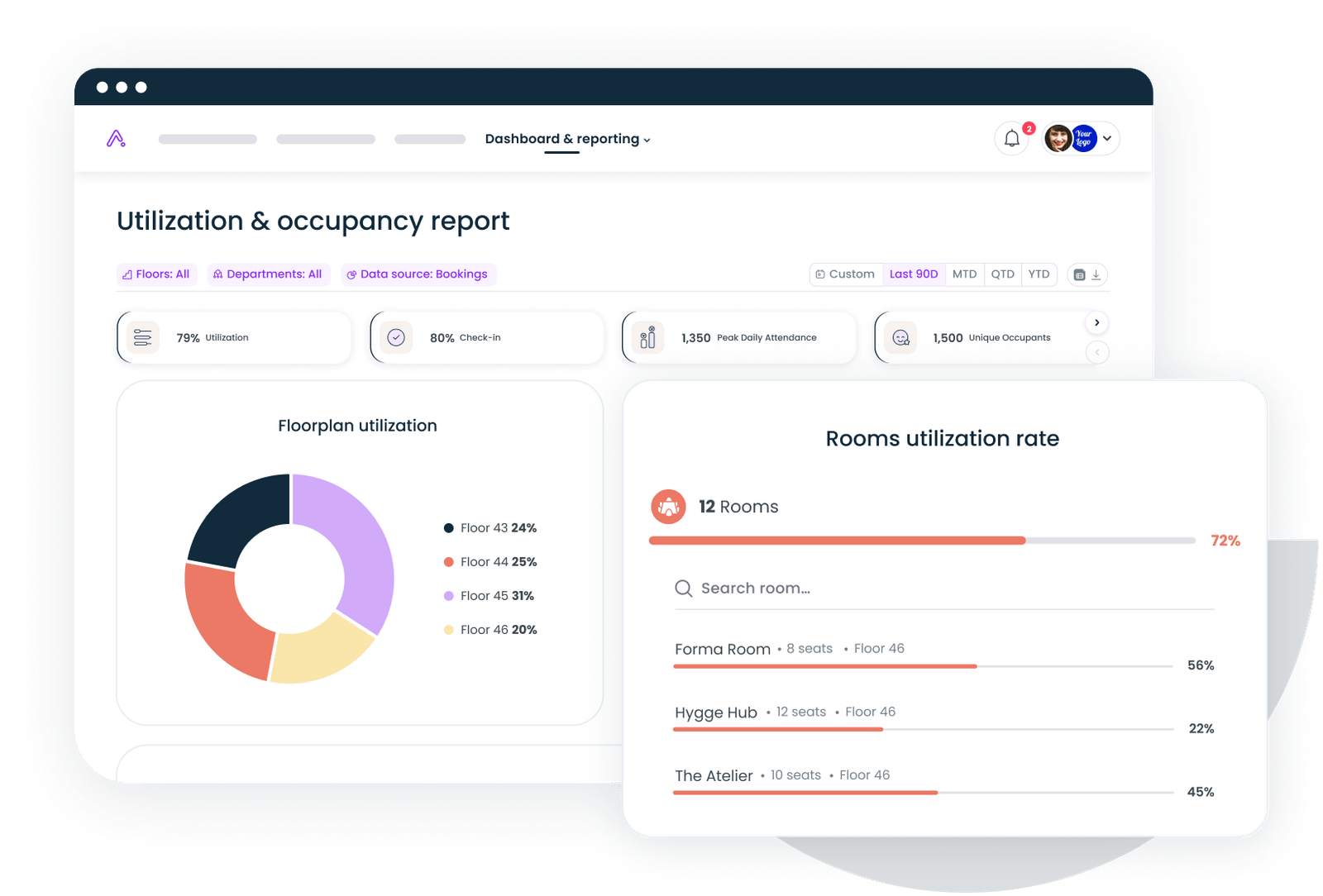
Gable Offices gives you this consolidated view across desk bookings, room reservations, and occupancy data, so you can see which informal zones are earning their square footage and which ones need rethinking.
How breakout spaces fit into a hybrid workplace strategy
Breakout space design doesn't exist in isolation. It's one piece of a broader workplace strategy that includes desk allocation, meeting room ratios, anchor day coordination, and real estate planning.
Coordinate with anchor days
If your company runs anchor days (specific days when teams are expected on-site), breakout capacity needs to match those peaks. A breakout area that works fine on a quiet Thursday might be overwhelmed on a Tuesday when 80% of the company is in. Plan your highest-capacity zones for the floors and neighborhoods where anchor day attendance concentrates.
Balance with other space types
The ratio between desks, meeting rooms, and informal spaces shifts in a hybrid model. Traditional offices allocated roughly 70% to desks, 20% to meeting rooms, and 10% to everything else. Hybrid offices are moving toward something closer to 50% desks, 20% meeting rooms, 15% breakout/informal, and 15% focus/wellness. Your specific ratio depends on your work culture, but the direction is clear: informal space is gaining share.
For a deeper look at how all these space types fit together, our guide on office design trends covers the broader shifts happening in 2026.
Connect to employee experience
Breakout spaces are a tangible expression of your workplace values. They say "we trust you to manage your own time" and "we designed this place for humans, not just headcount." That message matters for retention, engagement, and the daily experience of showing up to work. When employees feel the office was designed with their needs in mind, they're more likely to come in voluntarily rather than grudgingly.
The companies getting this right aren't treating breakout design as a facilities project. They're treating it as a workplace strategy decision, informed by data, aligned with how teams actually work, and iterated over time.
The bottom line on breakout space design
Breakout spaces are where the informal, unstructured, human side of work happens. In a hybrid office, that's not a nice-to-have; it's the core value proposition of the physical workplace. Size them based on peak occupancy, not headcount. Mix multiple layout patterns so different activities have a home. Invest in acoustics as much as aesthetics. And measure what's actually happening so you can improve over time instead of guessing.
The office that earns the commute in 2026 isn't the one with the most desks. It's the one with the most thoughtful spaces between the desks.
Book a demo to see how Gable helps you design, book, and optimize every space in your hybrid office.
Get a demo