.svg)


.svg)
- Biophilic design goes far beyond adding a few potted plants
- Research links nature in the office to 6% higher productivity and 15% more creativity
- You can start for under $500 with plants, natural light, and earth-toned materials
- The 14 Patterns framework gives you a science-backed implementation roadmap
- Measure impact with occupancy and well-being data, then iterate
Biophilic office design is the practice of integrating natural elements, materials, light, and spatial patterns into the workplace to strengthen the human connection to nature. It's not a trend or an aesthetic choice. It's a research-backed strategy that improves employee well-being, reduces absenteeism, and makes offices worth commuting to. If you're rethinking your space in 2026, whether for a return-to-office push or a portfolio right-sizing, biophilic design deserves a serious look.
What biophilic office design means
Biophilia is the idea that humans have an innate need to connect with nature. The biologist E.O. Wilson popularized the concept in 1984, and it's since become one of the most well-supported ideas in environmental psychology. Biophilic office design translates that science into built environments: think natural light, living plants, water features, organic materials, and spatial layouts that mimic natural settings.
This isn't about making your office look like a greenhouse. It's about designing spaces that reduce cognitive fatigue, lower stress hormones, and restore attention. The reason it matters now is straightforward. Hybrid work gave people a taste of working near windows, in gardens, on porches. The office they're being asked to return to needs to compete with that. A fluorescent-lit open plan with gray carpet doesn't cut it anymore.
Companies investing in workplace experience are increasingly treating biophilic elements as core infrastructure, not decoration. When you're trying to justify real estate costs in a hybrid model, every square foot needs to earn its keep. Biophilic design is one of the few interventions with hard data behind it.
The research: Productivity, well-being, and financial impact
Let's start with the numbers that matter to your CFO.
Productivity improves by 6% and creativity by up to 15% in offices with natural elements, according to the Human Spaces Report. That same study found a 15% increase in self-reported well-being. These aren't marginal gains. For a 200-person team, a 6% productivity lift is the equivalent of adding 12 full-time employees without hiring anyone.
The financial case goes beyond productivity. Terrapin Bright Green's research on the economics of biophilia estimates organizations can save roughly $2,000 per employee per year through reduced absenteeism alone. For a 500-person office, that's $1 million annually in avoided sick leave costs.
There's also a real estate angle. Offices with outdoor access and natural features command rent premiums of 5 to 14% in major markets, which means biophilic design isn't just an operating expense; it's an asset value play if you own or sublease space.
A 2024 longitudinal study published in Scientific Reports confirmed the mechanism: nature exposure in open-plan offices directly increases vigor, which mediates improvements in overall well-being. This isn't a placebo effect. It's a measurable physiological response.
For workplace leaders building the business case, these data points connect directly to workplace ROI metrics that finance teams already track: absenteeism rates, retention costs, and productivity per square foot.
The 14 patterns framework: A science-backed implementation roadmap
Terrapin Bright Green's 14 Patterns of Biophilic Design is the closest thing this field has to a standard playbook. Published in 2014 and updated for its 10th anniversary, it organizes biophilic interventions into three categories. Understanding these categories is the difference between "we bought some plants" and a coherent design strategy.
Nature in the Space refers to direct, physical contact with natural elements. This includes:
- Visual connection with nature (plants, green walls, views of trees or water)
- Non-visual connection (sounds of water, birdsong, tactile natural materials)
- Non-rhythmic sensory stimuli (movement of leaves, shifting light patterns)
- Thermal and airflow variability (operable windows, varied microclimates)
- Presence of water (fountains, aquariums, rain gardens)
Natural Analogues are objects, materials, and patterns that evoke nature without being nature itself:
- Biomorphic forms and patterns (curved furniture, organic shapes in architecture)
- Material connection with nature (wood, stone, wool, leather, bamboo)
- Complexity and order (fractal patterns in wall treatments, ceiling designs)
Nature of the Space addresses spatial configurations that trigger innate human responses:
- Prospect (open views, elevated vantage points)
- Refuge (enclosed, protected nooks for focused work)
- Mystery (partially obscured views that invite exploration)
- Risk/peril (safe exposure to height or depth, like a mezzanine overlooking an atrium)
You don't need all 14 patterns. Research from the University of Oregon found that a 12% green coverage ratio is the optimal "dose" for well-being and productivity benefits. That's roughly one-eighth of visible surfaces incorporating greenery. More than that and the returns plateau. Less, and you're not hitting the threshold.
The practical takeaway: pick five or six patterns that fit your space and budget, and implement them well. A few strong interventions beat a dozen half-hearted ones.
Biophilic design elements by office size and budget
Not every office can be the Amazon Spheres. Here's what biophilic design looks like at three different scales.
Large offices ($25,000+ budget)
At this scale, you're making architectural decisions. Living walls in lobbies and common areas. Green roofs or planted terraces. Floor-to-ceiling windows with unobstructed sightlines to outdoor greenery. Water features in atriums. Natural stone and reclaimed wood as primary finish materials.
The key consideration at this level is lifecycle cost. A living wall costs $150 to $300 per square foot to install and $30 to $50 per square foot annually to maintain. Preserved (stabilized) moss walls cost roughly the same to install but almost nothing to maintain. Your choice depends on whether you want the air-quality benefits of living plants or primarily the visual and psychological impact.
These larger investments connect to broader office space planning decisions. If you're redesigning a 50,000-square-foot headquarters, biophilic elements should be in the architectural brief from day one, not bolted on after construction.
Mid-size offices ($5,000 to $25,000 budget)
This is where most companies operate, and it's where biophilic design gets interesting. You're not rebuilding the space; you're transforming it.
Vertical garden panels as room dividers. Clusters of large floor plants to define zones. Natural wood desk surfaces or wood-veneer acoustic panels. Skylights or solar tubes to bring daylight into interior spaces. Nature photography or landscape murals on feature walls. Tabletop water features in meeting rooms.
A 50-person tech company might spend $12,000 to replace fluorescent panels with tunable LED fixtures that mimic daylight cycles, add a vertical garden wall in the main collaboration area, and swap laminate conference tables for reclaimed wood. That's a meaningful transformation for the cost of one month's rent in most markets.
For teams thinking about how biophilic zones interact with collaboration space design, the key insight is placement. Put your highest-impact biophilic elements in the spaces where people gather, not in corridors they walk through once a day.
Small offices or tight budgets (under $5,000)
You can start for a few hundred dollars. Seriously.
- Potted plants: Snake plants, pothos, ZZ plants, and peace lilies thrive in office conditions with minimal care. Budget $5 to $20 per plant; aim for one per 100 square feet.
- Natural light optimization: Reposition desks closer to windows. Remove blinds or heavy curtains. Add mirrors on walls opposite windows to bounce light deeper into the space.
- Earth-toned paint: A single accent wall in sage green, warm clay, or soft blue costs under $100 in materials and takes an afternoon.
- Nature sounds: A small Bluetooth speaker playing ambient forest or water sounds in a focus area costs $30.
- Natural materials: Replace plastic desk organizers with bamboo or wood alternatives. Swap synthetic throw pillows for wool or linen.
These aren't consolation prizes. Remember, the research shows benefits kick in at 12% green coverage. A dozen well-placed plants and a nature-themed accent wall can get you there in a small office.

Biophilic design is one of several movements reshaping how companies think about physical space. See what else is changing.
Read the guide
Low-cost starting points: A 90-day plan
If you're convinced but not sure where to begin, here's a phased approach that keeps costs low and builds momentum.
Weeks 1 to 4: Audit and quick wins
Walk your office with fresh eyes. Where does natural light reach? Where are the dead zones? Which surfaces are visible from the most desks? Start with three to five low-maintenance plants in high-traffic areas. Reposition at least four desks to improve window access. Remove any window obstructions.
Cost: $100 to $300.
Weeks 5 to 8: Sensory layers
Add natural materials where people touch things most: wood or cork desk pads, stone coasters in meeting rooms, linen or wool textiles on lounge furniture. Introduce one nature-themed art piece or mural in a common area. If your office has a sound system, add a nature-sounds playlist for focus zones.
Cost: $200 to $500.
Weeks 9 to 12: Measure and expand
Run a short workplace satisfaction survey asking specifically about the physical environment. Compare absenteeism data from the quarter before and after changes. Use the results to build the case for a larger investment in the next budget cycle.
Cost: $0 (just your time).
This phased approach works especially well if you need to get employee buy-in before committing to bigger changes. People who watch their workspace improve incrementally become advocates for the next round of investment.
Maintenance, compliance, and sustainability
Living systems require ongoing care. Ignoring this is how biophilic design projects fail. A beautiful living wall that turns brown in six months is worse than no wall at all.
Plant maintenance realities:
- Small potted plants need watering once or twice a week and occasional pruning. Budget 15 to 30 minutes per week for a small office.
- Living walls need professional maintenance, typically monthly service contracts running $500 to $2,000 per quarter depending on size.
- Preserved (stabilized) moss and faux greenery need only occasional dusting. They're a legitimate option for spaces where maintenance isn't realistic.
Certification alignment:
Biophilic design elements contribute to both LEED and WELL Building Standard certifications. WELL specifically includes a "Mind" concept that rewards biophilic interventions. If your company tracks ESG reporting metrics, biophilic design improvements are reportable under social and environmental categories.
Energy considerations:
More windows mean more solar heat gain. If you're maximizing natural light (and you should), coordinate with your HVAC team. Green roofs actually help here; they provide insulation that can reduce cooling costs by 25% in summer months. But they add structural load, so get an engineer involved early.
Material sourcing:
Choose FSC-certified wood, recycled stone, and low-VOC finishes. The point of connecting people to nature is undermined if your materials contribute to deforestation. This also matters for sustainable office design goals that many companies now track at the portfolio level.
Desk booking, room scheduling, and utilization data in one platform, so you know which spaces people actually use.
Learn more
Common challenges and how to overcome them
"We don't have the budget."
Start with the 90-day plan above. You don't need $50,000 to begin. You need $300 and a willingness to experiment. Use the productivity and absenteeism data from Terrapin's research to build a business case for the next fiscal year.
"Our lease doesn't allow modifications."
Most biophilic interventions are portable. Potted plants, natural-material furniture, artwork, acoustic panels with organic patterns, tabletop water features: none of these require landlord approval. Even vertical garden panels now come in freestanding, modular formats that don't touch the walls.
"Nobody wants to water the plants."
Self-watering planters exist and work well. So do plant service companies that handle everything for a monthly fee. And preserved moss walls look identical to living ones without any watering at all. The maintenance objection is solvable.
"Leadership thinks it's just decoration."
This is a data problem, not a design problem. Lead with the $2,000-per-employee absenteeism savings. Show the 6% productivity gain. Frame it as a facilities investment with measurable ROI, not an interior design project. Pilot one floor or one zone, measure the results, then expand.
"We're hybrid; the office is half-empty most days."
This is actually an argument for biophilic design, not against it. If you're trying to make the office a destination people choose rather than a mandate they resent, the physical environment matters enormously. Biophilic spaces give people a reason to come in that their home office can't replicate. Use office management software to coordinate team days around your best-designed spaces, so the investment gets used when it matters most.
Integrating biophilic design into your workplace strategy
Biophilic design doesn't exist in a vacuum. It's one layer of a broader workplace strategy that includes space planning, hybrid scheduling, employee experience, and real estate optimization.
Align with your hybrid model. If teams come in Tuesdays and Thursdays, concentrate biophilic investments in the collaboration zones they'll use on those days. Don't spread your budget evenly across space that sits empty three days a week. Gable Offices gives you the utilization data to see exactly which zones get traffic and when, so you can place your living wall where 80 people will see it, not where 8 will.
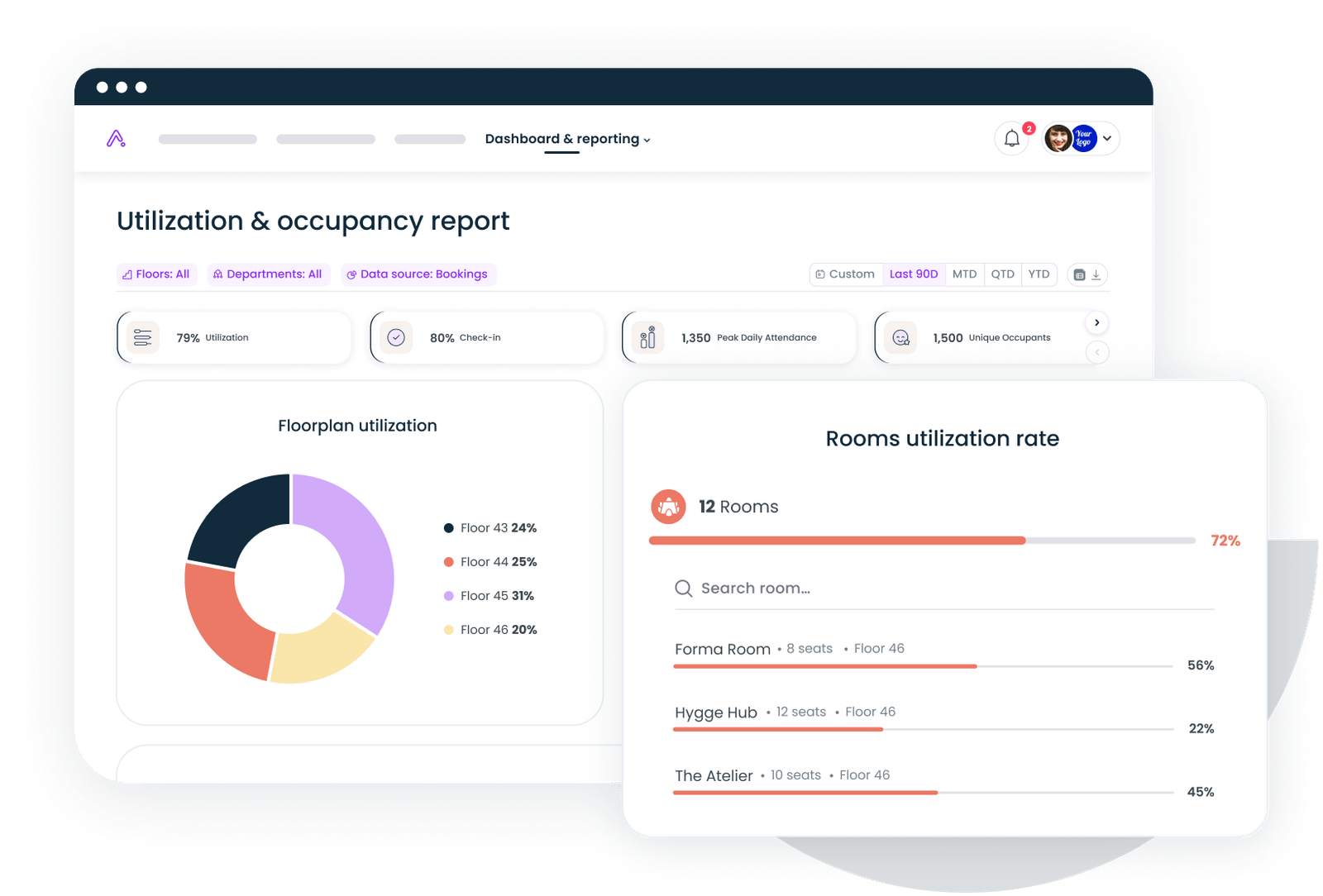
Measure what matters. Track three things before and after biophilic interventions: absenteeism rates, employee satisfaction scores (specifically questions about the physical environment), and space utilization patterns. If your planted collaboration lounge shows 40% higher booking rates than the standard conference room next door, that's your proof of concept for the next investment.
Connect to retention. In a tight labor market, the physical workplace is a talent attraction tool. Candidates notice the difference between a biophilic office and a generic one. It signals that a company cares about employee well-being beyond lip service.
Plan for iteration. Biophilic design isn't a one-time project. It's an ongoing practice. Start small, measure, expand what works, and retire what doesn't. The 14 Patterns framework gives you a menu of options to try over multiple budget cycles.
Making the office worth the commute
The offices that people actually want to work in share a common trait: they offer something you can't get at home. Natural light flooding through a two-story atrium. The sound of water in a quiet focus area. The smell of real wood and living plants. These aren't luxuries. They're the environmental conditions humans evolved to thrive in.
Biophilic office design is one of the few workplace investments with strong evidence across productivity, well-being, retention, and real estate value. The research is clear, the implementation is scalable from $300 to $300,000, and the measurement tools exist to prove ROI. The only real risk is doing nothing and wondering why nobody wants to come in.
From desk booking to space analytics, Gable gives workplace leaders the tools to design offices people actually use.
Get a demo