.svg)


.svg)
- Most office changes fail because leaders skip the "people side" entirely
- Explain the personal impact before you explain the floor plan
- Recruit employee champions early; they're more persuasive than any exec email
- Gather feedback visibly, then act on it just as visibly
- Measure adoption with real data, not gut feeling
Office changes fail when employees feel like something is being done to them rather than with them. Around 70% of change initiatives fail, and the root cause is almost always the same: leadership designed the change in a vacuum, announced it in an all-hands, and expected everyone to fall in line. This guide walks through how to get genuine employee buy-in for office changes, step by step, so your new layout actually gets used.
Why office changes fail (it's rarely the floor plan)
The instinct is to blame the design. Maybe the open layout was too noisy, or the hot desking ratio was off. But the real problem usually starts months earlier, during the planning phase nobody invited employees into.
72% of leaders say they involve employees in change management strategies. Only 42% of employees agree. That's a 30-point perception gap, and it's where resistance is born. People don't resist change because they're stubborn. They resist because they weren't consulted, weren't informed, or weren't given a reason that made sense for their day-to-day work.
This is especially true for office layout changes, which feel deeply personal. You're altering where someone sits, how they collaborate, and whether they have a quiet corner to think. If you skip the human side, even a beautifully designed space will sit half-empty. Understanding the broader principles of workplace change management helps, but the tactics below are specific to physical space changes.
Step 1: Articulate the "why" before the "how"
Before you share a single floor plan rendering, answer one question from the employee's perspective: what's in it for me?
Leaders tend to lead with the business case. "We're consolidating floors to reduce our real estate footprint by 20%." That's a fine reason for the CFO. It means nothing to the engineer who just lost their assigned desk. You need two versions of the "why": the organizational rationale and the personal benefit.
The organizational version might sound like: "We're redesigning the fourth floor to create more collaboration zones because our data shows 70% of in-office time is spent in meetings, but only 30% of our space supports group work." The personal version: "You'll have access to six new team rooms you can book instantly, plus two quiet focus zones that don't exist today."
About 40% of employees feel anxious about organizational changes. Anxiety thrives in ambiguity. The more specific you are about what's changing, what's staying the same, and why it matters to them personally, the less room anxiety has to fill in the blanks with worst-case scenarios.
If you're rethinking your space from scratch, a solid office space planning process will give you the data to build a compelling "why."
Step 2: Build a change team with employee champions
Top-down announcements create compliance. Peer influence creates buy-in. They're not the same thing.
Identify 5 to 10 employees across different teams, levels, and locations who are respected by their peers. These aren't necessarily managers. They're the people others go to when they want the real story. Bring them into the planning process early, share the design options, ask for their input, and give them a role in shaping the outcome.
Here's what champions do that executives can't:
- Translate corporate language into team language. "Activity-based working" means nothing to most people. "You pick where you sit based on what you're doing that day" does.
- Surface objections you'd never hear. The engineering team's concern about monitor setups won't come up in a leadership meeting. A champion from that team will raise it in the first five minutes.
- Model the new behavior. When a well-liked colleague starts booking a collaboration zone for their weekly sync, others follow.
Give your champions real influence, not just a title. If they suggest a change and you implement it, make that visible. Nothing kills a champion program faster than asking for input and ignoring it.
Step 3: Communicate transparently across multiple channels
Roughly 29% of employees report that changes aren't communicated clearly, leading to confusion and disengagement. One all-hands email won't cut it. You need a communication cadence that meets people where they are.
Company-wide: A kickoff announcement that covers the what, why, and timeline. Keep it short. Link to a detailed FAQ for people who want more.
Team-level: Managers should hold 15-minute conversations with their teams within 48 hours of the announcement. Provide managers with talking points, but let them adapt the message. A script feels corporate. Talking points feel human.
One-on-one: For employees who are most affected (losing an assigned desk, moving floors, changing neighborhoods), a direct conversation matters. This is where you address individual concerns that won't surface in a group setting.
Async documentation: Create a living FAQ document that gets updated as questions come in. Share it in Slack, pin it in Teams, link it from your intranet. For distributed teams, recorded walkthroughs of the new layout work better than written descriptions. Our guide on communicating office policy changes covers the messaging framework in more detail.
The key principle: say it seven times, seven ways. People absorb information differently, and they need repetition before a message sticks.

Office layout changes are one piece of a larger change management puzzle. This playbook covers the full framework, from stakeholder alignment to post-launch measurement.
Read the guide
Step 4: Gather feedback early and act on it visibly
Asking for feedback is easy. Acting on it is where most companies fall apart.
Run a short pulse survey before the change goes live. Five questions, max. Focus on what employees value most about their current setup, what frustrates them, and what they'd want in an ideal workspace. This does two things: it gives you data to inform the design, and it signals that employee input matters.
Then, and this is the part people skip, close the loop. Share the survey results. Show what you changed because of the feedback. Be honest about what you couldn't change and why. "We heard that 60% of you want more phone booths. We're adding four to the third floor. We can't add them to the second floor due to HVAC constraints, but we've designated two huddle rooms as quiet call spaces instead."
This kind of transparency builds trust faster than any town hall. It also reduces the "they never listen" narrative that poisons buy-in efforts. If you're designing collaboration spaces as part of the change, employee input on what "collaboration" actually looks like for their team is invaluable.
After launch, keep the feedback channel open. A dedicated Slack channel, a physical suggestion board in the new space, or a monthly check-in survey all work. The format matters less than the consistency.
Step 5: Provide the right infrastructure and training
Here's a pattern I see constantly: a company redesigns the office, introduces hot desking, and then expects everyone to figure out the booking system on their own. Three weeks later, people are hoarding desks with Post-it notes.
Your policy is only as good as the tools supporting it. If you're moving to a flexible layout, employees need a frictionless way to find and book the right space. If you're introducing neighborhoods, they need to understand which zones are for what. If you're adding new meeting room technology, they need a 10-minute walkthrough, not a 40-page PDF.
This is where workplace technology earns its keep. Gable's platform, for example, lets employees see interactive floor plans, book desks or rooms in a couple of clicks, and check real-time availability, which removes the guesswork that breeds frustration during transitions. When the new system is easier than the old one, adoption takes care of itself.
Training doesn't have to be formal. A two-minute Loom video showing how to book a desk. A champion doing a live demo during a team standup. A QR code on each floor linking to a quick-start guide. Lower the barrier to entry as much as possible.
Step 6: Celebrate early wins and address resistance quickly
The first two weeks after a layout change are critical. Momentum builds or dies in that window.
Look for early wins and amplify them. "The product team used the new collaboration zone for their sprint planning and said it was the best session they've had in months." Share that in your company channel. It's social proof, and it's more persuasive than any executive endorsement.
At the same time, watch for resistance signals:
- Passive resistance: People avoiding the new space, working from home more than before, or clustering in the old areas that haven't changed.
- Active resistance: Complaints in public channels, refusal to use the booking system, or vocal criticism in team meetings.
Both are normal. Neither should be ignored. For passive resistance, a one-on-one conversation usually reveals a specific friction point you can fix. For active resistance, listen first. Sometimes the complaint is legitimate and points to a design flaw you missed. Sometimes it's change fatigue, and the person just needs time and a patient ear.
The worst response is to mandate compliance. "Everyone must use the new booking system by Friday" creates resentment, not buy-in. Building a strong employee experience strategy means treating resistance as data, not defiance.
Tracking space utilization and adoption rates helps you prove what's working and fix what isn't. Gable's analytics platform gives you the data in real time.
Learn more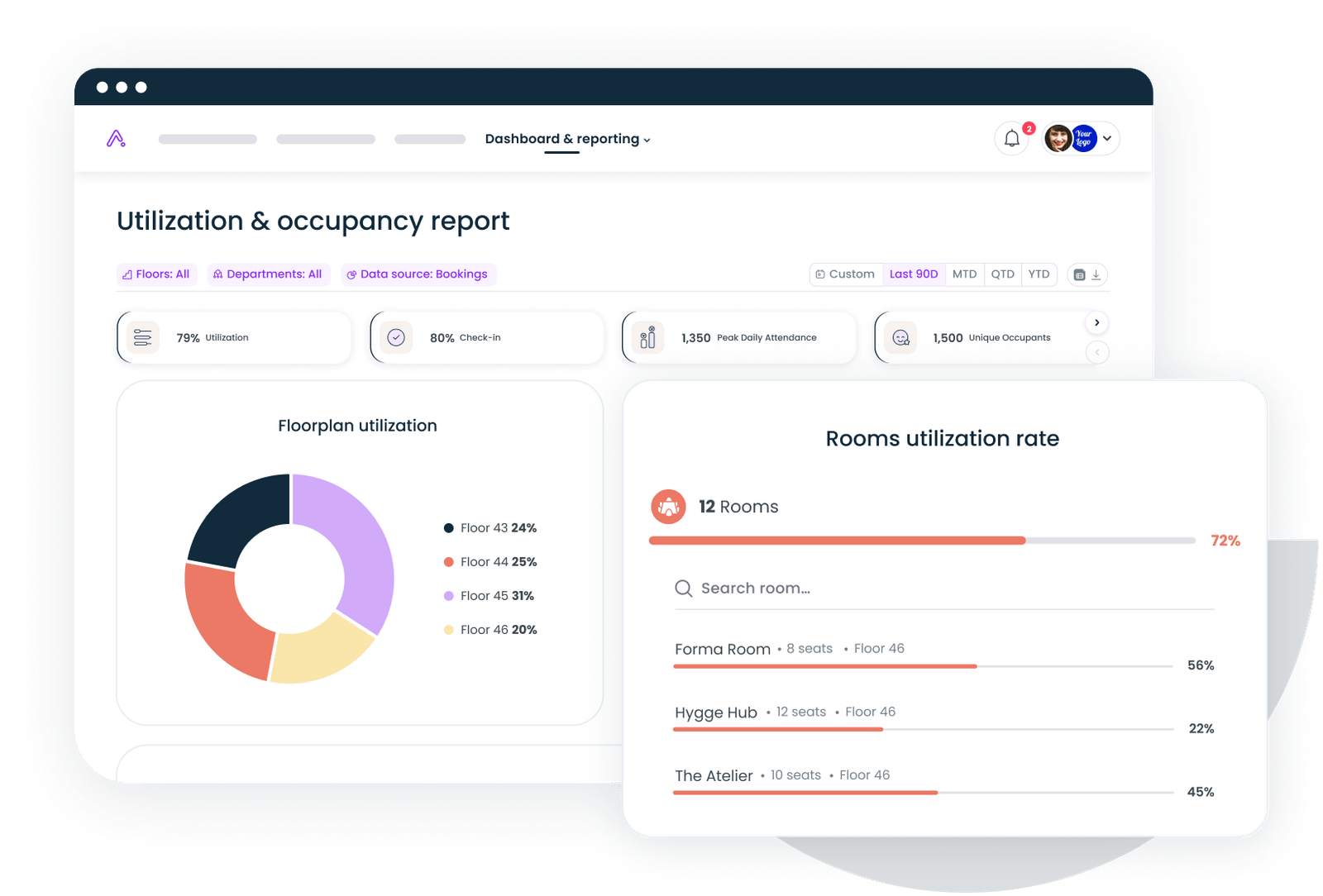
Step 7: Measure buy-in with data, not assumptions
"It feels like people are using the new space" isn't a measurement strategy. You need actual metrics.
Adoption rate: What percentage of employees are using the new booking system, flexible desks, or collaboration zones? Track this weekly for the first two months.
Utilization rate: Are the new spaces being used as intended? If you built six collaboration zones and two are empty every day, that's a signal to investigate. Our guide on space utilization metrics breaks down exactly what to track.
Satisfaction score: Run a follow-up pulse survey at 30 and 90 days. Compare results to your pre-change baseline. Ask specific questions: "How easy is it to find the right space for your work?" beats "How do you feel about the new office?"
Attendance patterns: Are in-office days increasing, decreasing, or holding steady? If you're seeing a dip, it might mean the new layout is pushing people to work from home more, which is the opposite of what most redesigns intend.
Retention and engagement: Longer-term, watch whether the change correlates with shifts in engagement survey scores or attrition. This won't show up in week one, but it matters at the six-month mark.
Organizations with highly engaged employees achieve 30% better outcomes in their change efforts. Measurement isn't just about proving the change worked; it's about maintaining the engagement that made it work.
The change that sticks is the one employees helped build
Getting employee buy-in for office changes isn't a communications exercise. It's a design exercise. You're designing the change process itself, with the same care you'd put into the floor plan.
The companies that get this right share a few traits: they start with "why" before "what," they recruit champions instead of relying on mandates, they treat feedback as a design input rather than a box to check, and they measure outcomes with real data. None of this is complicated. It just requires treating employees as partners in the change rather than recipients of it.
The layout will evolve. Policies will adjust. But if you build the muscle of inclusive, transparent change management now, every future transition gets easier.
From interactive floor plans to real-time utilization data, Gable gives workplace leaders the tools to make office transitions smooth and measurable.
Get a demo