.svg)


.svg)
- Free food and commuter subsidies are the two perks employees consistently rank highest
- Hybrid flexibility itself is a perk, valued at a 7-8% pay raise
- The 2026 meal deduction cliff changes the math on catered lunches
- Most companies overinvest in perks employees don't care about
- You can't optimize perks you don't measure
Most companies offer office perks. Fewer know which ones actually change behavior. The gap between "perks we provide" and "perks that get people to show up" is where most workplace budgets go to waste, and closing it requires data, not guesswork.
Why most office perks strategies miss the mark
Here's the uncomfortable truth: a lot of perk spending is performative. Companies install a kombucha tap, throw a monthly happy hour, and wonder why Tuesday attendance hasn't budged. The problem isn't generosity. It's targeting.
Office attendance rose 5.6% in 2025 but remains roughly 32% below pre-pandemic norms. People aren't avoiding the office because it lacks a ping-pong table. They're avoiding it because the commute is expensive, the day feels unstructured, and nobody they need to collaborate with is there anyway.
The perks that work solve real friction. The ones that don't are just decoration. If you're rethinking your employee experience strategy, start by understanding what friction actually looks like for your people.
Free food and catered meals
Food is the perk that refuses to die, and for good reason. When employees were asked what would make them come into the office more, 44% said office perks like catered lunch. That's the single highest-ranked incentive.
It makes sense. Eating out near the office costs $15-20 a day in most metros. Bringing lunch requires planning. A catered meal removes a daily decision and saves real money. It's not about the food itself; it's about eliminating a reason to stay home.
But there's a catch. Under previous tax rules, employer-provided meals on business premises were 50% deductible. In 2026, that deduction drops to zero. If your company was spending $200K a year on catered lunches, the effective cost just jumped significantly. That doesn't mean you should cut the program. It means you need to be more strategic about when and how you offer it. Tying catered meals to anchor days concentrates the spend on days when it'll have the most impact on collaboration.
Commuter benefits and transportation subsidies
The commute is the single biggest attendance killer. 57% of employees cite commute time as a significant factor preventing more frequent office visits. That's not a preference; it's a dealbreaker.
Commuter benefits directly address this. Transit passes, parking subsidies, bike storage, shuttle services. The specifics depend on your city, but the principle is universal: if you're asking people to spend 45 minutes and $12 getting to the office, offsetting that cost signals you understand the trade-off they're making.
The good news is that commuter benefits remain tax-advantaged in ways that meals no longer are. Pre-tax transit and parking benefits still offer savings for both employer and employee. If you're building a commuter benefits program for hybrid teams, this is one of the highest-ROI line items in your budget.
Flexible scheduling (the perk that isn't really a perk)
Calling flexibility a "perk" feels a bit like calling electricity an amenity. It's table stakes. But the data is worth repeating: employees value hybrid work at the equivalent of a 7-8% pay increase. That same Stanford research found resignations fell by 33% when workers shifted from full-time office to hybrid schedules.
The implication is clear. Flexibility isn't something you offer alongside the snack bar. It's the foundation that makes every other perk viable. Nobody cares about your espresso machine if they're required to be there five days a week against their will.
What matters is how you structure it. Unstructured flexibility often means empty offices on Mondays and Fridays and overcrowded ones on Tuesdays. Setting core hours for hybrid teams gives people autonomy while ensuring enough overlap for the collaboration that justifies the office in the first place.

Anchor days concentrate attendance, collaboration, and perk ROI on the days that matter most. Here's how to set them up without creating a mandate backlash.
Read the guide
Gym memberships and on-site wellness
Wellness perks have staying power because they address something employees genuinely struggle with: integrating fitness into a workday that already feels too long. On-site gyms, subsidized memberships, yoga classes during lunch. These aren't flashy, but they're sticky.
The key is convenience. A gym membership employees have to drive to after work isn't an office perk; it's just a benefit. An on-site fitness space or a lunchtime class removes the friction. People who work out at the office tend to come in more often because the habit becomes tied to the location.
If you don't have space for a full gym, even a wellness room with basic equipment and a meditation corner can shift perception. The signal matters as much as the square footage: this company cares about my well-being beyond my output.
On-site childcare and family-friendly benefits
Childcare is the perk with the highest emotional stakes and the lowest adoption rate. The push for return-to-office policies creates real logistical challenges for working parents. Finding reliable childcare, coordinating drop-offs and pickups, managing the anxiety of being far from a young child during the day. These aren't minor inconveniences. They're the reason some of your best people resist coming in.
On-site or near-site childcare directly addresses this. Parents can check on their kids during breaks. The commute becomes one trip instead of three. The mental load drops.
Yes, it's expensive to implement. But companies that offer it report dramatically higher attendance and retention among parents, a demographic that skews toward your most experienced employees. Even partial solutions help: backup childcare stipends, partnerships with nearby providers, or a dedicated mothers room that signals you've thought about this at all.
Social events and team bonding (done right)
Social events are the perk category with the widest gap between employer enthusiasm and employee interest. Companies love organizing happy hours. Employees are more ambivalent.
The problem isn't socializing. It's forced socializing with no clear purpose. A weekly happy hour where the same eight people show up isn't building culture. It's just a bar tab.
What works better: events tied to something people actually want to do. Lunch-and-learns where someone interesting presents. Recognition events that celebrate real achievements. Team dinners after a big launch. The common thread is intentionality. People will come in for connection that feels genuine, not for a calendar invite that says "Fun Friday!"
If you're planning internal company events, measure attendance and gather feedback. You'll quickly learn which formats your specific culture responds to and which ones you can stop funding.
Desk booking, room scheduling, and utilization data in one platform, so you can schedule perks on the days people actually show up.
Learn more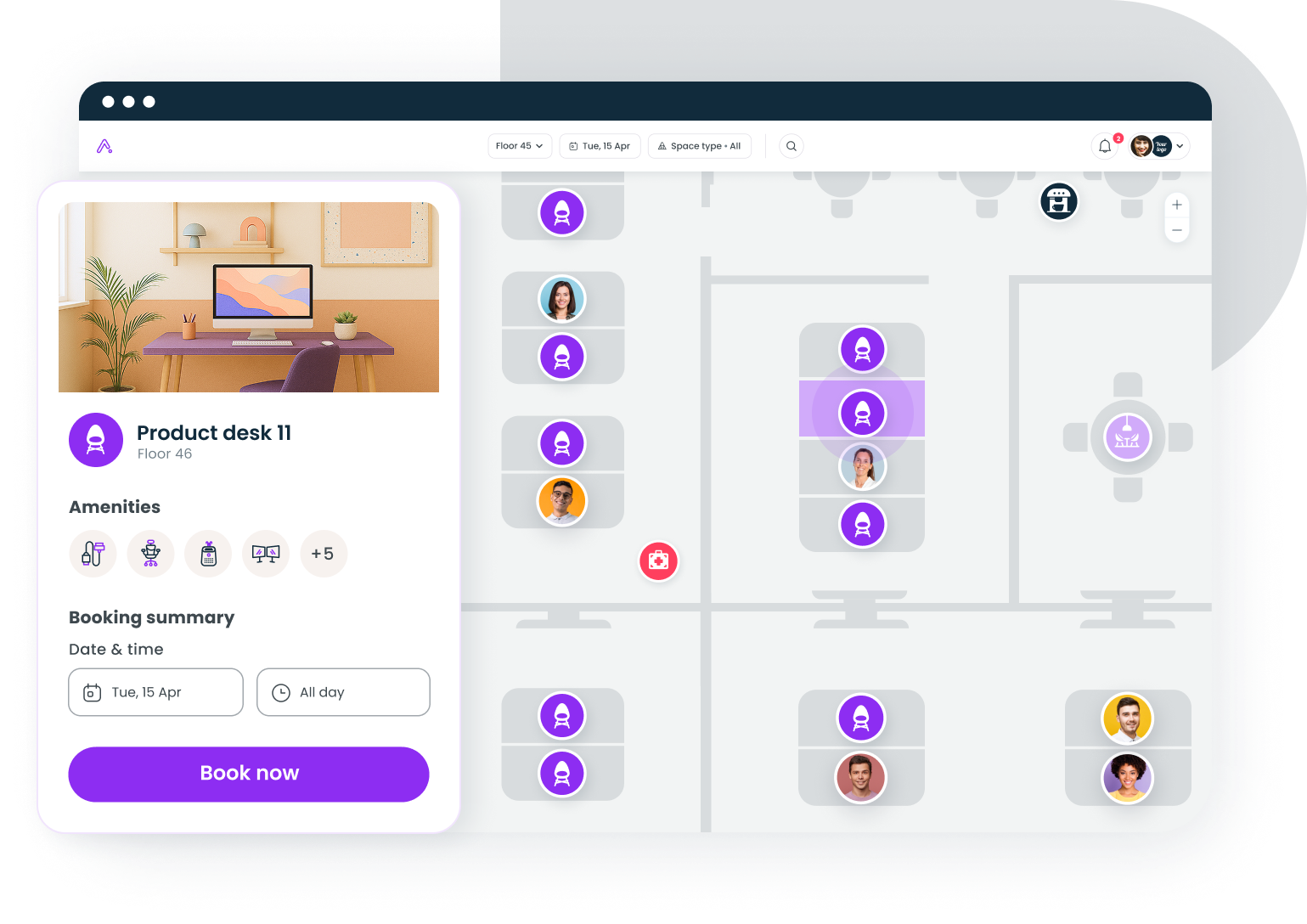
Learning and professional development
8 in 10 employees say learning adds purpose to their work, and 7 in 10 say it strengthens their connection to their organization. That makes professional development one of the most underrated office perks available.
The office-specific angle matters here. In-person workshops, mentoring sessions, and skill-building cohorts give people a reason to come in that goes beyond "because the policy says so." They create moments of genuine value that can't be replicated over Zoom.
Tuition reimbursement and certification programs are valuable too, but they don't drive daily attendance. What does: a regular cadence of in-office learning events that people look forward to. Think monthly masterclasses, cross-functional lunch sessions, or dedicated time for teams to learn together. The perk isn't the budget line; it's the experience of growing alongside colleagues.
Office environment and space design
Sometimes the best perk is a space people actually want to be in. Remote workers have spent years optimizing their home setups. If your office still looks like a 2019 open floor plan with flickering fluorescent lights, you're competing against someone's carefully curated home office and losing.
The shift is toward spaces that feel more like hospitality than corporate. Comfortable seating, natural light, plants, varied zones for different work modes. Companies are investing in breakout space design that gives people options: quiet focus areas, casual collaboration zones, and social spaces that don't feel like a conference room.
This is also where office management software earns its keep. Great spaces only work if people can find and book them. When employees show up and can't get a desk near their team or a room for a spontaneous brainstorm, the environment fails regardless of how nice the furniture is. Booking tools paired with utilization data let you see which spaces people actually use and redesign around real behavior instead of assumptions.
Pet-friendly policies
23 million Americans adopted pets during the early stages of the pandemic. Many of those people now face a daily choice: leave their dog alone for nine hours or work from home. For a meaningful segment of your workforce, a pet-friendly policy tips the scale.
The implementation doesn't have to be complicated. Designated pet-friendly zones, basic ground rules about behavior and allergies, and a sign-up system to manage capacity. Some companies designate specific days as pet-friendly, which creates a natural attendance magnet.
It's not for every office. Allergies, space constraints, and industry norms all factor in. But if your space can accommodate it, this is a low-cost, high-visibility perk that generates genuine enthusiasm.
The perks that don't work (and where companies waste money)
Not every perk earns its budget. Some of the most common investments have surprisingly low impact on attendance.
Bike storage is a good example. It sounds progressive, but the data tells a different story: employers invest in facilities that a small fraction of employees actually use. The same pattern shows up with certain social events. Companies pour money into programming that sounds good in an all-hands but doesn't move the needle on who shows up.
Unlimited PTO is another one that's lost its shine. It sounds generous, but employees often take less time off under unlimited policies than under structured ones. It's become a perk that benefits the company's balance sheet more than the employee's well-being. If you're auditing your perks, check out what workplace experience benchmarks look like for companies your size. You might find you're overspending in categories that don't register with employees.
The fix isn't to cut everything. It's to measure. Survey your people. Track which perks correlate with higher attendance days. Stop funding the ones nobody uses and double down on the ones that work.
How to measure whether your perks are working
This is where most companies fall short. They'll spend six figures on perks and never connect that spending to attendance, retention, or satisfaction data.
Start simple. Track office attendance by day of week and overlay it against your perk schedule. If catered lunch happens on Wednesdays and Wednesday attendance is 40% higher than Thursday, you've got a signal. If your new wellness program launched in March and attendance didn't change, that's a signal too.
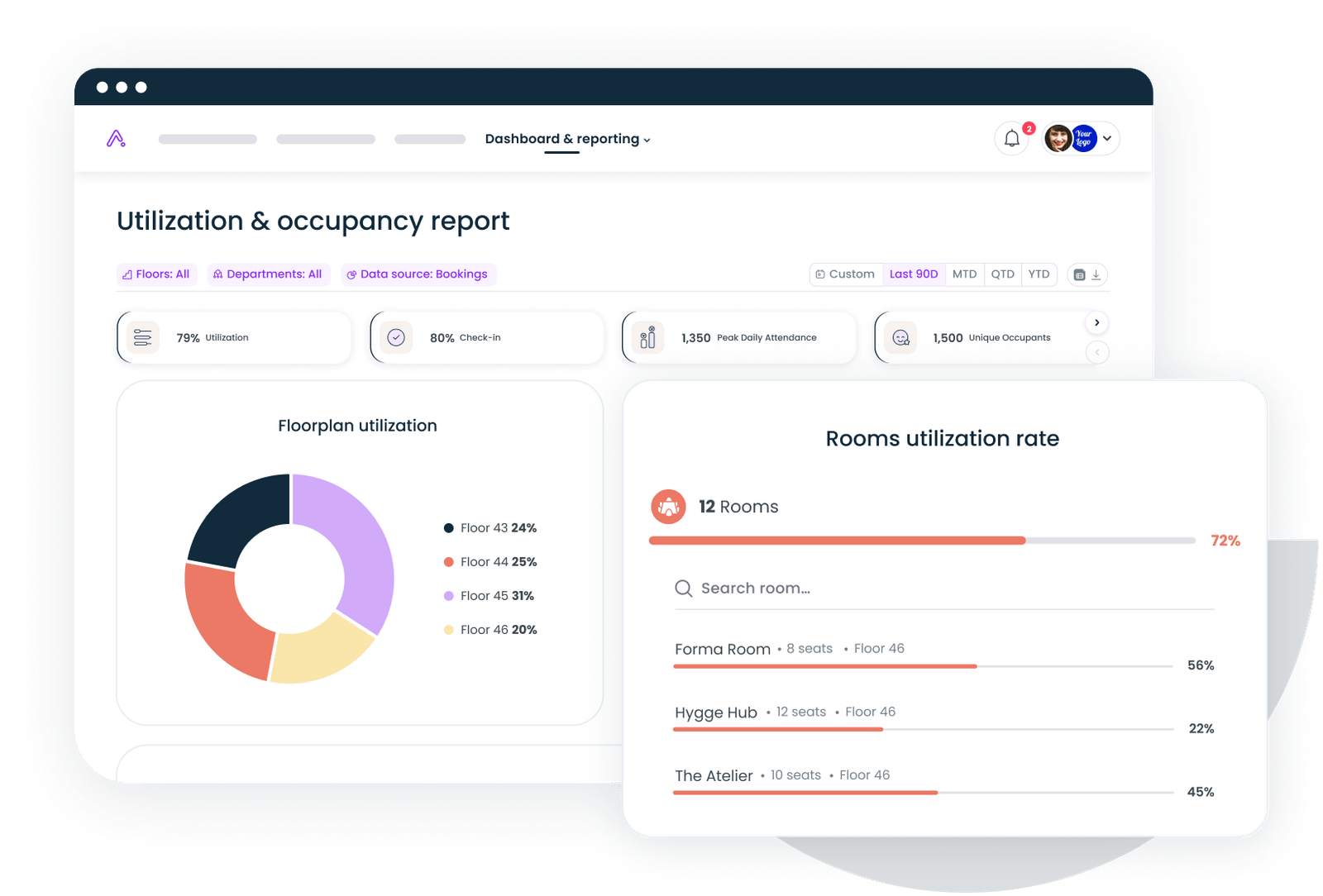
Employee surveys help, but they're lagging indicators. Workplace analytics give you real-time data on which spaces are booked, which days are busiest, and how utilization patterns shift when you introduce or remove a perk. The goal isn't to justify every dollar with a spreadsheet. It's to build a feedback loop so your perks strategy gets smarter over time instead of staying static.
The real perk is a workplace worth commuting to
Office perks aren't a substitute for a workplace strategy. Free lunch doesn't fix a toxic culture. A gym doesn't compensate for a pointless commute to sit on Zoom calls all day. The perks that drive attendance in 2026 share one trait: they reduce real friction or create real value that employees can't get at home.
Food saves money and time. Commuter benefits offset the cost of showing up. Flexibility respects autonomy. Childcare solves logistics. Good space design makes the office worth the trip. Everything else is negotiable.
The companies getting this right aren't the ones with the longest perks list. They're the ones that know which three or four things their specific employees actually care about, and invest accordingly.
From desk booking to utilization analytics, Gable gives you the data to invest in perks that actually drive attendance.
Get a demo