.svg)


.svg)
- Collecting feedback without acting on it is worse than not asking at all
- Categorize every piece of feedback into quick wins, policy debates, or infrastructure changes
- Assign a single owner to every feedback stream with clear response deadlines
- Close the loop publicly: "you said, we did, here's why not"
- Track participation rates over time; they're your best measure of trust
Most organizations collect employee workplace feedback. Very few do anything useful with it. U.S. employee engagement hit just 31% in 2025, down from 36% in 2020, and a big part of the problem is that employees have learned their input doesn't lead to change. This guide walks through six steps to build a feedback loop that actually closes, from making it easy to speak up to proving you listened.
Why most feedback programs fail before they start
The gap isn't in collection. It's in follow-through. Most companies run an annual engagement survey, dump the results into a slide deck, and move on. Employees notice. They stop responding. Then leadership wonders why participation dropped.
The real damage is subtler than low response rates. When people share honest feedback and nothing changes, they don't just disengage from surveys. They disengage from work. They stop raising problems in meetings. They stop suggesting improvements. You lose the informal, hallway-level feedback that's often more valuable than anything a survey captures.
Employees who receive meaningful feedback weekly are far more engaged than those who hear back once a year. But "meaningful" is the operative word. It has to go both directions. If you're asking people to be candid, you owe them a response, even when the answer is "we can't do that right now, and here's why."
Building a real feedback loop requires treating it as an operational process, not an HR initiative. That means channels, categorization, ownership, deadlines, and public accountability. Here's how to set each one up.
Step 1: Make feedback channels easy and always-on
Annual surveys aren't feedback systems. They're snapshots. By the time you analyze the results and present them to leadership, the issues have either resolved themselves or gotten worse. Neither outcome makes the survey useful.
The goal is to create multiple, low-friction channels that capture feedback continuously. Think of it as moving from a once-a-year physical to a fitness tracker that monitors your vitals daily.
What "always-on" looks like in practice:
- Pulse surveys: Two to three questions, weekly or biweekly. Keep them short enough that people can answer between meetings. McKinsey's internal pulse survey has collected over one million responses from 40,000+ employees across 140 offices, with results shared weekly.
- Slack or Teams channels: A dedicated channel where people can drop suggestions, complaints, or observations. Moderated, not ignored.
- One-on-ones: Managers should have a standing question in every 1:1: "What's one thing about your work environment that's getting in your way?" This surfaces issues that people won't put in a survey.
- Anonymous suggestion forms: For sensitive topics (management quality, psychological safety, compensation concerns), anonymity matters. Make the form easy to find, not buried three clicks deep in your intranet.
- Usage data as implicit feedback: This one gets overlooked. If nobody's booking desks on Fridays, that's feedback on your hybrid policy. If small meeting rooms are always full but large conference rooms sit empty, that's feedback on how your teams actually collaborate. Your office occupancy data tells you things people won't say out loud.
The key is matching the channel to the type of feedback you want. Pulse surveys work for sentiment tracking. Slack channels work for real-time operational issues. One-on-ones work for personal and team-level concerns. You need all of them running simultaneously.
If you're building a workplace satisfaction survey for the first time, start with pulse surveys and one structured channel. Add complexity once you've proven you can act on what comes in.
Step 2: Categorize feedback into actionable buckets
Raw feedback is overwhelming. You'll get everything from "the coffee machine is broken" to "our entire hybrid policy needs rethinking" in the same week. Without a system for sorting it, the important stuff gets buried under the urgent stuff, and the urgent stuff gets buried under the volume.
Every piece of feedback should land in one of three buckets:
Bucket 1: Quick wins (1 to 2 weeks)
These are things you can fix without approval chains or budget requests. The coffee machine. The broken monitor in the hot-desking area. The confusing room booking process. Quick wins matter disproportionately because they prove the system works. When someone reports a broken chair and it's replaced by Thursday, they believe the feedback loop is real.
Bucket 2: Policy debates (2 to 6 weeks)
These require stakeholder alignment but not major investment. Examples: adjusting in-office days, changing the guest policy, updating the hybrid work schedule, or revising meeting norms. These take longer because they involve trade-offs and multiple decision-makers. The key is acknowledging the feedback quickly, even if the decision takes weeks.
Bucket 3: Infrastructure and strategic changes (3 to 12 months)
These are the big ones. Office redesigns, new locations, technology overhauls, compensation restructuring. They require budget, planning, and executive buy-in. Most feedback in this bucket won't result in immediate action, and that's fine, as long as you're transparent about it.
Why categorization matters:
Without it, everything feels equally urgent and equally impossible. Your workplace team burns out trying to address strategic issues at quick-win speed, while quick wins sit unresolved because everyone's focused on the big stuff. Categorization sets realistic expectations for both the team handling feedback and the employees who submitted it.
A simple tagging system works. You don't need AI or a fancy platform for this (though both help at scale). A shared spreadsheet with columns for category, owner, status, and target date will get you started.

Feedback only works if employees trust the process. This guide covers how to build that trust when you're making visible changes to the workplace.
Read the guide
Step 3: Triage and assign ownership
Feedback without an owner is feedback that disappears. This is where most loops break. Someone collects the data, someone else presents it, and then it sits in a shared drive because nobody's job is to act on it.
Every feedback stream needs a directly responsible individual (DRI). Not a committee. Not a working group. One person whose name is next to the item and who's accountable for moving it forward.
Build an ownership matrix:
This matrix should be visible to anyone who touches feedback. When a pulse survey response comes in about meeting room availability, it goes to the Workplace lead. When someone flags a management concern, it goes to the HRBP. No ambiguity, no "I thought someone else was handling that."
For cross-functional issues (and many workplace issues are cross-functional), designate one DRI and list the collaborators. The DRI doesn't have to solve it alone, but they're responsible for making sure it doesn't stall.
If you're navigating a larger workplace change management effort, this ownership structure becomes even more critical. Change without clear accountability is just chaos with a project plan.
Step 4: Set response-time SLAs
SLAs aren't just for customer support. When employees submit feedback, they're watching the clock, even if they don't realize it. Two weeks of silence feels like being ignored. A month feels like proof that nobody cares.
Set explicit internal SLAs for each feedback bucket:
Quick wins:
- Acknowledge within 48 hours
- Resolve or provide a timeline within 1 to 2 weeks
Policy debates:
- Acknowledge within 1 week
- Share a decision timeline within 2 weeks
- Communicate the decision within 4 to 6 weeks
Infrastructure/strategic:
- Acknowledge within 1 week
- Share the evaluation process within 2 to 3 weeks
- Provide a quarterly update on status
Notice that every tier starts with acknowledgment. That's the most important part. People can wait for a decision. They can't wait to know whether anyone heard them.
Acknowledgment doesn't mean agreement. It means: "We received your feedback about X. Here's who's looking into it and when you'll hear back." That's it. Three sentences. It takes two minutes to write and it's the difference between a functioning feedback loop and a suggestion box that nobody checks.
Track your SLA performance the same way you'd track any operational metric. If you're consistently missing the two-week window on quick wins, you either need more resources or fewer categories in that bucket.
Step 5: Close the loop publicly
This is the step that separates organizations that collect feedback from organizations that build trust. 67% of employees say transparent communication is crucial for trust, yet most companies collect feedback without ever reporting back on what happened.
Closing the loop means communicating three things:
"You said:"
Summarize the feedback themes. Not individual responses (that breaks anonymity), but patterns. "Multiple team members raised concerns about noise levels in the open floor plan." "Several people asked for more flexibility on in-office days."
"We did:"
Describe the specific actions taken. "We installed sound-dampening panels in zones A and C, and added four new focus rooms on the third floor." "We moved from mandatory Tuesday/Thursday to a team-choice model with a minimum of two days per week."
"Here's why not:"
This is the part almost nobody does, and it's the most important one. For feedback you can't or won't act on, explain why. "We heard requests for a four-day work week. We explored this with leadership and decided it's not feasible right now because of client coverage requirements. We're revisiting in Q3 when we have more data on the pilot program running in our London office."
The "here's why not" builds more trust than the "we did." Anyone can fix a coffee machine. Explaining a difficult trade-off honestly shows respect for the people who raised the issue.
Where to communicate:
- All-hands meetings (quarterly at minimum)
- A dedicated Slack channel or newsletter section
- Team-level summaries from managers
- A living document or dashboard that tracks feedback themes and their status
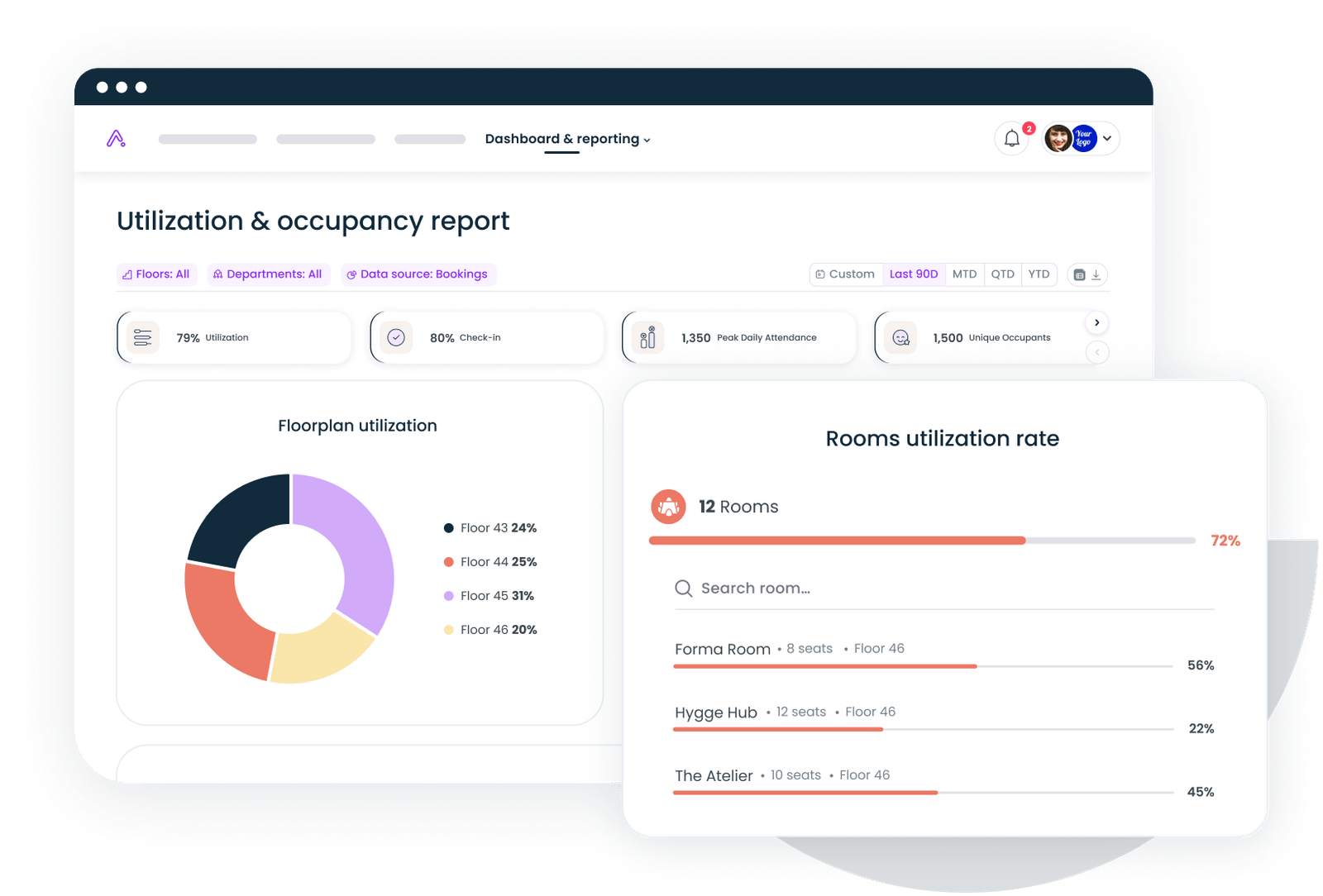
Gable's Insights dashboard can strengthen this step by connecting employee feedback to actual usage data. When you tell people "we adjusted the floor plan based on your input," you can show the before-and-after occupancy patterns that validate the change. Data makes the "we did" credible.
Timing matters. Don't wait six months. Post results within 30 to 45 days of the feedback window. If you're running continuous pulse surveys, share a monthly or biweekly summary. The faster you close the loop, the more people believe the next survey is worth their time.
Gable Insights turns occupancy and booking data into actionable intelligence, so you can back up "you said, we did" with real numbers.
Learn more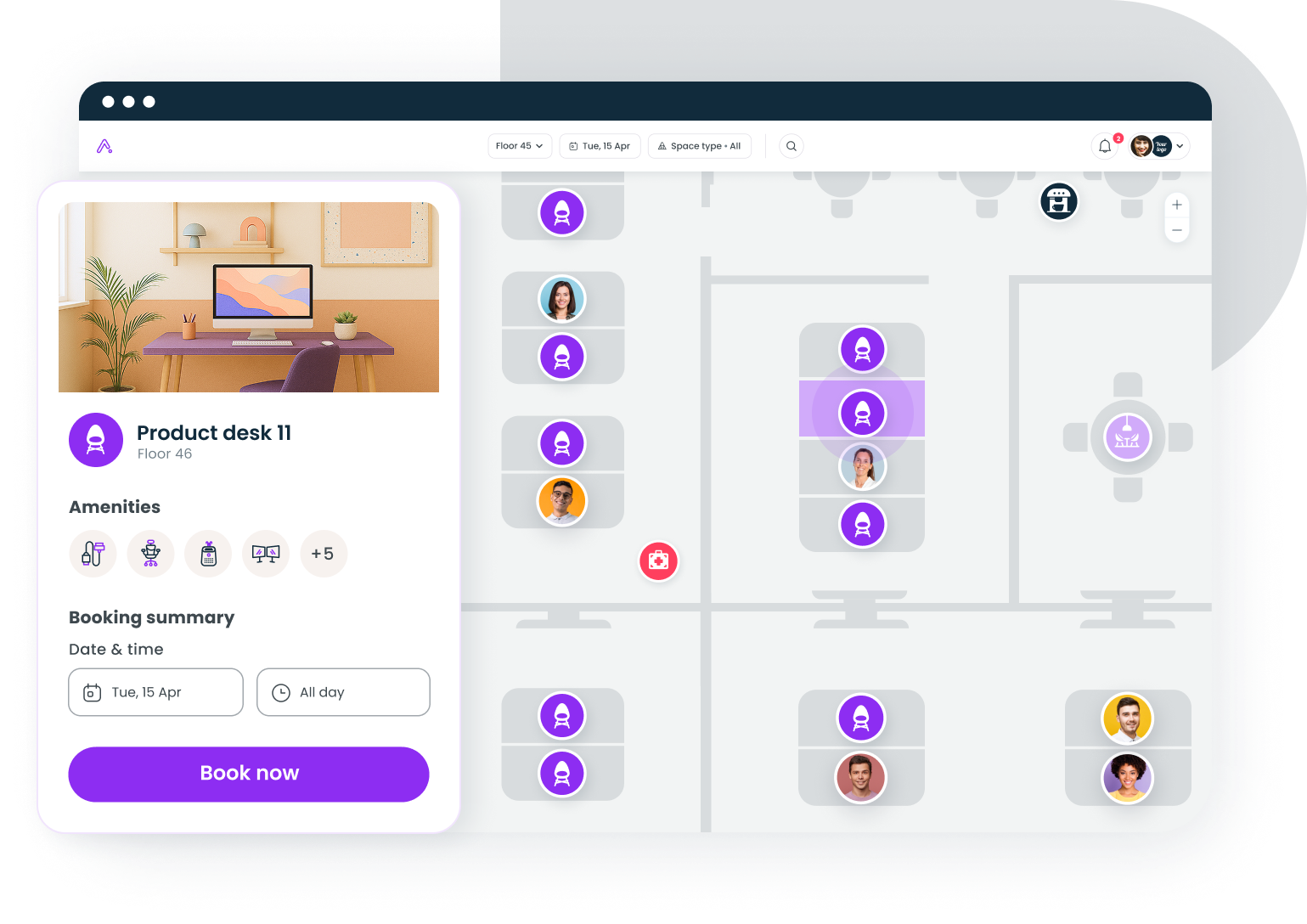
Step 6: Measure trust through response-rate trends
Most organizations measure feedback programs by sentiment scores. Are people happy? Are they engaged? Those matter, but they're lagging indicators. By the time sentiment drops, you've already lost months of trust.
The leading indicator is participation rate. If your feedback loop is working, participation stays steady or climbs. If it's broken, participation drops, because people have learned that responding is a waste of their time.
KPIs to track:
- Participation rate: Target 70%+ for pulse surveys. If you're below 50%, your loop has a credibility problem.
- Participation trend: More important than the absolute number. Is it going up, down, or flat? A declining trend over three consecutive cycles is a red flag.
- Time-to-acknowledgment: Are you hitting your SLA for the initial response?
- Time-to-action: How long between feedback submission and resolution for quick wins?
- Sentiment shift after action: When you close the loop on a specific issue, does sentiment on that topic improve in the next cycle?
- Retention correlation: Organizations with effective listening strategies see 12% lower turnover. Track whether teams with higher feedback participation also have better retention.
What declining participation tells you:
It's not that people don't have opinions. It's that they've decided sharing those opinions isn't worth the effort. That's a trust problem, not an engagement problem. The fix isn't a better survey tool or a more creative question set. The fix is going back to Step 5 and closing loops you left open.
If you're already tracking workplace experience benchmarks, add participation rate to the dashboard. It's one of the few metrics that tells you whether your feedback system is healthy before the engagement scores start to slide.
Common mistakes that break the loop
Even well-intentioned feedback programs fail. Here are the patterns I see most often:
Asking too many questions. A 50-question annual survey feels like homework. People rush through it, give low-quality answers, and resent the time it took. Keep pulse surveys to three questions or fewer. Save the deep dives for quarterly or annual cycles, and keep those under 15 minutes.
Treating all feedback as equal. A request for better snacks and a concern about psychological safety are not the same thing. Without categorization (Step 2), you'll either over-invest in trivial issues or under-invest in critical ones.
Delegating without authority. Assigning a DRI who doesn't have the budget or decision-making power to act is performative. If the facilities lead can't approve a $500 purchase without three levels of sign-off, your quick-win SLA is dead on arrival.
Closing the loop selectively. Only sharing the wins and ignoring the "here's why not" erodes trust faster than saying nothing. People know you received their feedback. Silence on the hard topics is louder than any all-hands presentation.
Forgetting managers. Managers are the most important feedback channel and the most common bottleneck. If they're not trained to ask, listen, and escalate, your formal channels are doing double duty. Invest in building trust at the manager level and the informal feedback flows naturally.
Making it work in a hybrid environment
Hybrid work makes feedback both harder and more important. Harder because you can't read the room when half the room is remote. More important because the workplace decisions you're making (which days, which spaces, which tools) directly affect people's daily lives.
A few hybrid-specific considerations:
Don't let in-office voices dominate. People who are physically present tend to give more feedback, simply because they're closer to the problems. Remote employees may not notice the broken coffee machine, but they have strong opinions about meeting equity, async communication, and whether in-office days feel worth the commute. Make sure your channels reach both populations equally.
Use space data as a feedback signal. Booking patterns, no-show rates, and room utilization tell you what people think about your workplace without requiring them to fill out a form. If you've invested in workplace analytics, you already have a passive feedback stream. Use it.
Test before you scale. When feedback leads to a policy change, run a workplace pilot program before rolling it out company-wide. Pilots generate their own feedback, which feeds back into the loop. It's feedback about your response to feedback, and it's incredibly valuable.
The feedback loop is the strategy
Employee workplace feedback isn't a program you launch and forget. It's an operating system for how your organization listens, decides, and communicates. The six steps (channels, categorization, ownership, SLAs, closing the loop, and measurement) aren't sequential. They're continuous. You're always collecting, always triaging, always closing.
The organizations that get this right don't just have higher engagement scores. They make better workplace decisions because they have a constant stream of signal from the people those decisions affect. They spend less on space that nobody uses. They avoid policy changes that backfire. They retain people who feel heard.
None of this requires perfect execution. It requires consistency. Acknowledge fast. Act when you can. Explain when you can't. Measure whether people still trust you enough to keep talking.
From occupancy insights to space analytics, Gable gives workplace leaders the data to back up every feedback response with evidence.
Get a demo