.svg)


.svg)
- Open offices cost you up to 66% productivity on focus tasks
- 40% of knowledge workers can't find 30 uninterrupted minutes in their day
- Focus rooms are hybrid infrastructure, not a design trend
- Without booking data, even beautiful focus rooms become dead space
- The right ratio, placement, and measurement framework changes everything
Every hybrid office I've walked through in the last two years has the same problem. Rows of beautiful collaboration zones, half-empty on Tuesdays, while people wearing noise-canceling headphones huddle in stairwells and parking garages trying to get work done. The focus room office concept isn't new, but the urgency behind it is. Your people are telling you, loudly, that they need quiet, and most workplace leaders are still designing primarily for togetherness.
Open offices broke the promise they made
Here's the number that should keep every workplace leader up at night: 99% of office workers report that noise impairs their concentration. Not some of them. Not the introverts. Virtually all of them.
The open office was supposed to spark spontaneous collaboration. What it sparked instead was a $15,000 noise-canceling headphone line item in the IT budget and a workforce that started "working from home" to get anything done. Workers lose up to 66% of their productivity from one nearby conversation. One conversation. Not a team standup, not a celebration. One person on a phone call two desks over.
I'm not arguing we should go back to the 1990s cube farm. Collaboration space matters. But we've overcorrected so hard that 40% of knowledge workers can't find a single 30-minute stretch of uninterrupted focus time during their entire workday. That's not a design preference issue. That's a business performance crisis.
The math is brutal. An average worker gets interrupted every 11 minutes and needs 23 minutes to fully refocus. Run those numbers across an eight-hour day. Your team isn't doing deep work at the office. They're recovering from interruptions at the office.
The real business case for a focus room office strategy
Skip the "employee wellness" framing for a moment. I believe in it, but it's not what gets budget approved. Focus rooms are a retention and productivity play, and the data backs both.
Retention math that CFOs understand
77% of employees prefer quiet when focus is needed. That stat alone tells you something about what happens when you don't offer it. People leave. They leave for remote roles, for competitors with better offices, for anywhere they can think. When half your workforce says noise affects their job satisfaction, that's not an amenities problem. That's a turnover risk.
Productivity gains you can measure
Reducing acoustic distractions by even a moderate amount yields 30-50% productivity improvements on focus work. Moderate. Not building a recording studio, not installing $40,000 acoustic panels everywhere. Giving people a room with a door, decent sound insulation, and a way to book it without sending six Slack messages.
The RTO argument nobody's making
Here's where it gets strategic. Increased available focus spaces for video calls, private work, and meetings rank among the top factors encouraging staff to return to the office. Your people aren't resisting the office because they hate their coworkers. They're resisting because the office is louder than their apartment, and they can't get anything done there.
Focus rooms flip that equation. An employee who knows they can book a quiet room for their 2pm deep work block, then grab coffee with their team at 3:30, has a reason to come in. An employee staring at an open floor plan with no escape does not.

The gap between a focus room people use daily and one that collects dust comes down to design, placement, and a booking system that works. Our office space planning guide breaks down the full framework.
Read the planning guide
Designing focus rooms that people book
I've seen too many offices where the "focus rooms" are afterthoughts. A converted storage closet with a folding chair. A glass fishbowl next to the kitchen. A phone booth so small you can't spend more than 12 minutes inside without feeling claustrophobic. These rooms are furniture with good intentions, not spaces built for deep work.
Acoustics come first, everything else comes second
Sound transmission class (STC) ratings matter more than the chair you pick. A focus room with an STC rating below 40 is a room in name only. People can hear conversations through the walls, and they won't come back. Target STC 45-50 for walls, use acoustic ceiling tiles, and add sound masking if the room shares a wall with a collaboration zone.
Glass is tricky. People love the aesthetic. But a fully glass-walled room next to a busy corridor is a visual distraction machine, even if the acoustics are decent. Frosted glass from desk height down, clear above, strikes a practical balance.
Size and configuration for real work
A focus room isn't a phone booth. Phone booths handle five-minute calls. Focus rooms handle two-hour deep work sessions. That means:
- Minimum 60 square feet for single-occupancy rooms
- 80-120 square feet for rooms that accommodate 2-3 people working quietly
- A real desk surface, not a shelf
- Power outlets at desk level, not hidden behind furniture
- Task lighting that doesn't buzz or flicker
- Temperature control, or at minimum, a fan
Location strategy: accessible but protected
Place focus rooms away from kitchens, main corridors, and collaboration zones. But don't bury them in a corner nobody visits. The sweet spot is adjacent to, but acoustically separated from, active areas. People should be able to see focus rooms exist without hearing what's happening inside them.
A baseline ratio of one focus room for every four employees gives you enough capacity for the typical workday demand curve. That number shifts based on your team's work profile. Engineering teams skew higher. Sales teams skew lower. Start at 1:4 and let your booking data tell you where to adjust.
The booking layer most teams forget
This is where beautiful design fails. A focus room without a booking system is a room governed by awkward hallway negotiations and passive-aggressive Post-it notes. People need to see availability before they walk over. They need to reserve from their phone, from Slack, from wherever they're already working.
Interactive floor plans change behavior. When someone opens a map and sees three focus rooms available on Floor 2, they go to Floor 2. When they see all rooms booked until 3pm, they plan around it. Without that visibility, they wander, find every room occupied, and go back to their desk with headphones. That's a design win turned into an experience loss.
The hybrid work equation changes everything about focus rooms
Pre-pandemic offices had a simpler problem. Everyone was there every day, and you could observe patterns with your eyes. Hybrid work made space utilization invisible without data.
When your 400-person company has 180 people in the office on Tuesday and 90 on Thursday, static room allocation doesn't work. Focus rooms need to flex. On high-attendance days, you need more of them. On low-attendance days, some can convert to small meeting spaces. This only works with a booking system that tracks demand patterns over time.
Remote workers who come in specifically for collaboration days still need focus time. Nobody's productive for eight straight hours of meetings. The employee who drove 45 minutes for an "in-office collaboration day" still needs 90 minutes to prep for their afternoon presentation. If there's nowhere quiet to do that, you've reinforced every argument against coming in.
The hybrid offices I've seen work best treat focus rooms as the connective tissue between collaboration events. Team standup at 10. Focus room from 10:30 to noon. Lunch with the team. Focus room from 1 to 2:30. Cross-functional workshop at 3. That rhythm works. But only if focus rooms are bookable, available, and visible.
From design intent to operational reality: why data matters more than aesthetics
A 200-person company I spoke with last year spent $180,000 building six gorgeous focus rooms. Acoustic panels, biophilic design, sit-stand desks, the works. Six months later, two of them averaged less than 90 minutes of use per day. Two others had people camping in them for entire days, blocking everyone else.
The design wasn't the problem. The data was. Nobody could see utilization patterns. Nobody knew which rooms were overbooked versus abandoned. Nobody had connected badge data to booking data to understand whether reservations matched occupancy.
The metrics that matter
Booking rate alone tells you almost nothing. A room booked at 85% that sits empty 40% of those booked hours has a no-show problem, not a demand problem. Track these together:
- Booking rate: percentage of available hours reserved
- Occupancy: badge, WiFi, or sensor data showing real presence
- Dwell time: how long people stay (short sessions suggest the room isn't comfortable enough for deep work)
- No-show rate: gap between bookings and check-ins
- Peak demand windows: when do booking conflicts cluster?
- Cross-team patterns: which departments use focus rooms most, and which are underserved?
When you layer HRIS data on top, the picture sharpens. If your engineering team books focus rooms 3x more than product design, that's either a signal about work patterns or a signal about room location relative to team seating. Both are actionable.
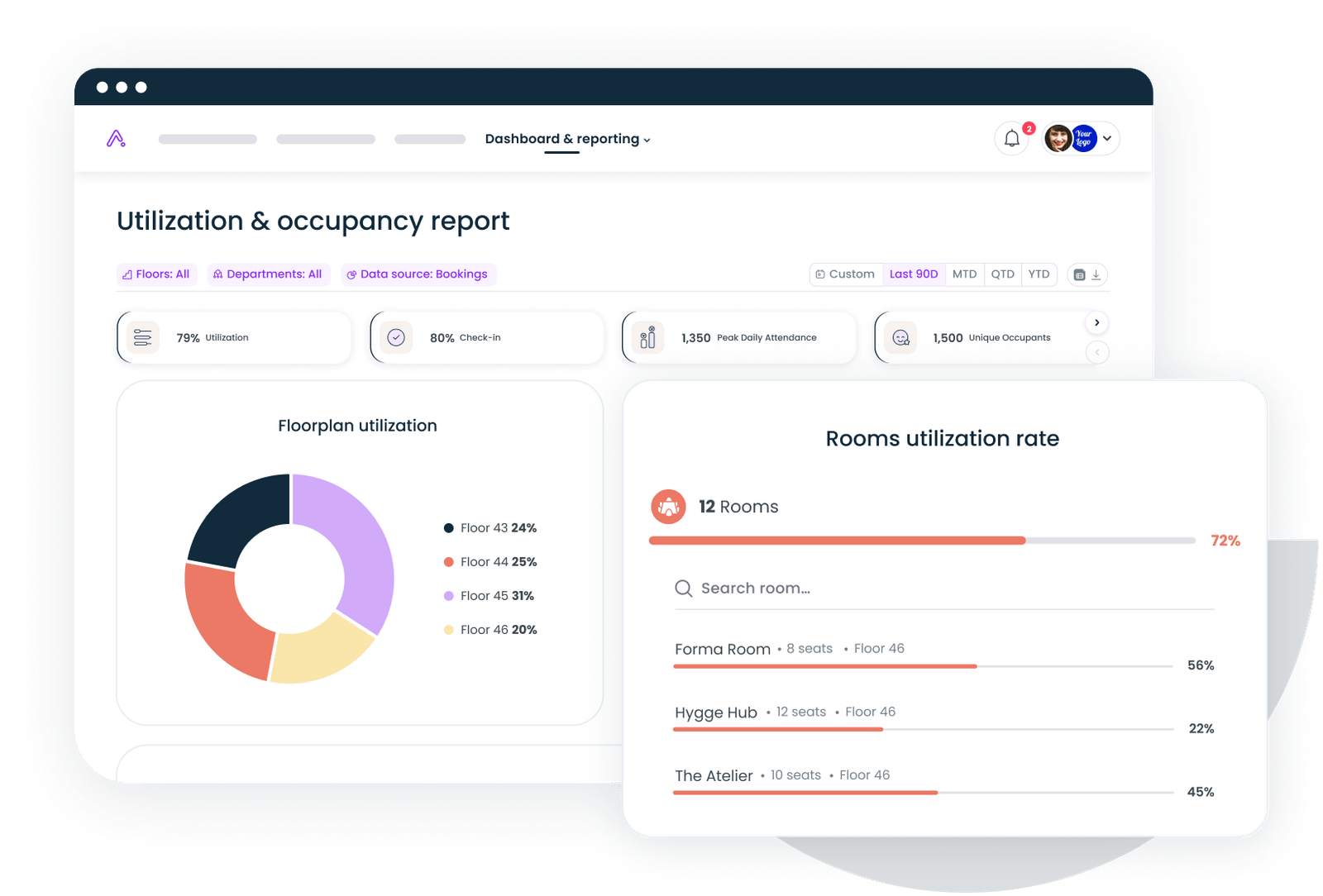
Gable Offices gives workplace teams interactive floor plans, desk and room booking, and utilization insights that connect design decisions to real occupancy data.
Learn more
Turning data into layout decisions
A facilities team at a 500-person company sees Floor 3 hitting 12% focus room occupancy every Friday. They don't need a consultant to tell them what to do. They convert one focus room to a bookable meeting space on Fridays and watch overall utilization climb.
That same team notices that focus rooms near the south stairwell get booked at 2x the rate of rooms near the elevator bank. The elevator bank rooms have better furniture. Doesn't matter. People choose quiet over comfort every time. The team relocates two focus rooms to the quieter wing. Utilization evens out.
These are the kinds of decisions that workspace analytics enable when booking, occupancy, and HR data live in one place. A platform like Gable makes that possible by connecting floor plans, booking flows, and utilization dashboards in a single view. Without that layer, you're guessing. Expensively.
A practical implementation roadmap
Here's how to move from concept to functioning focus rooms.
Phase 1: Assess what you have and what people need (Weeks 1-3)
Survey your employees. Not a 45-question engagement survey. Five questions:
- How many hours per day do you need quiet, uninterrupted work time?
- Where do you currently do your focus work?
- What prevents you from focusing in the office?
- Would bookable quiet rooms change how often you come in?
- What times of day do you most need focused work time?
Simultaneously, audit your existing space. How many rooms could convert to focus rooms with minimal investment? What's the acoustic profile of each floor? Where are the noise hotspots?
Cross-reference with your badge or WiFi data. Which floors have the most people, and which have the most unused rooms? The gap between those two numbers is your opportunity.
Phase 2: Pilot with 3-4 rooms (Weeks 4-8)
Don't build 15 focus rooms on faith. Convert 3-4 existing spaces with basic acoustic treatment, good lighting, and a booking system. Pick rooms on different floors or in different zones so you can compare.
Set clear usage guidelines from day one. Focus rooms are for deep work and private calls. Not standing meetings. Not lunch storage. Not coats. Put the guidelines in the booking confirmation email so nobody misses them.
Make booking frictionless. QR codes on the door. Slack commands. Floor plan visibility. If booking takes more than 15 seconds, adoption drops dramatically.
Phase 3: Measure, adjust, expand (Weeks 9-16)
After a month of pilot data, you'll know:
- Which rooms are oversubscribed (build more like them)
- Which rooms are underused (fix them or repurpose them)
- What times of day demand peaks (adjust availability windows)
- Whether no-shows are a problem (implement auto-release policies)
Employee feedback at this stage is gold. Not satisfaction scores. Specific feedback. "The room on Floor 2 is too warm." "I can hear the elevator through the east wall." "The booking system doesn't show real-time availability." Fix these before you scale.
Phase 4: Scale and integrate (Ongoing)
Expand based on data, not instinct. If your pilot shows 1:4 ratio isn't enough for engineering but is overkill for sales, differentiate by zone. Connect your focus room booking data to your broader workplace experience strategy so you're optimizing the full portfolio, not individual rooms in isolation.
The best workplace teams I know review focus room data monthly alongside collaboration space data, meeting room data, and on-demand workspace data. They're looking at the whole picture: where people work, how they work, and whether the space portfolio matches behavior.
Focus rooms succeed when strategy, design, and operations align
The companies getting this right in 2026 aren't the ones with the prettiest rooms. They're the ones who treat focus rooms as bookable, measurable infrastructure within a broader hybrid work strategy. They design for acoustics first. They make booking effortless. They measure everything. And they adjust quarterly based on what the data tells them.
The alternative is what most offices are doing right now: spending six figures on collaboration spaces, wondering why people won't come in, and blaming remote work for a problem that has a physical, solvable answer. Your people want to come to the office. They want a reason to believe they can get work done when they're there.
Give them the room. Give them the booking system. Give them the data that proves it's working.
Gable connects your people, spaces, and data so workplace leaders can design, book, and optimize focus rooms alongside every other space type, all from one platform.
Get a demo