.svg)


.svg)
- Half of all change initiatives fail; strong change management flips those odds
- Employees resist change they don't understand, not change itself
- Five phases turn messy transitions into manageable projects
- Communication needs to be dialogue, not broadcast
- Measurement doesn't end at launch; it's where real learning starts
Workplace change management is the discipline of guiding people through organizational transitions, whether that's a return-to-office shift, an office consolidation, a new technology rollout, or a complete redesign of how your company works. Most guides treat it as a leadership philosophy. This one treats it as a project with phases, milestones, and measurable outcomes. If you're leading a workplace transition in 2026, here's how to do it without losing trust, productivity, or your best people.
What workplace change management actually is (and why most of it fails)
Let's start with the uncomfortable number. About 50% of change initiatives, and only 34% are a clear success. The same research shows that organizations with strong change management meet their objectives 88% of the time, compared to 13% for those without it.
That gap isn't about strategy. It's about people. Organizational change is the "what": new office layout, new hybrid policy, new tech stack. Change management is the "how": getting actual humans to understand, accept, and adopt the new way of working. Most companies spend 90% of their energy on the structural change and 10% on the human side. That ratio should be reversed.
The workplace changes hitting teams in 2026 are particularly tricky. Return-to-office mandates, office consolidation strategies, hybrid policy overhauls, AI tool adoption. Each one touches how people spend their days. That makes the stakes personal, which makes the resistance real.
Why employees resist change (and what to do about it)
Resistance isn't irrational. It's a signal that something in your process is broken.
There's a massive perception gap between leaders and employees. 74% of leaders believe they in shaping change strategies, but only 42% of employees agree. That 32-point gap is where resistance lives. People don't push back on change they helped shape. They push back on change that feels done to them.
The root causes are predictable: fear of incompetence in the new system, loss of status or routine, and simple lack of information. When people don't know why something is changing, they fill the void with worst-case scenarios.
Here's what actually works. Communication style matters more than communication volume. Dialogue-based communication during change produces dramatically different emotional responses: only 5% of employees express anger, 35% express hope, and 59% express pride. Compare that to top-down "tell" strategies, where only 20% of the workforce even understands the change they're facing.
The practical takeaway: stop announcing changes and start discussing them. Town halls with Q&A, skip-level conversations, department-specific workshops. These aren't nice-to-haves. They're the mechanism that converts resistance into buy-in. If you're navigating a policy shift specifically, our guide on communicating office policy changes breaks down the messaging framework in detail.
The five phases of successful workplace change
Every change framework out there (Kotter, Lewin, Prosci, ADKAR) boils down to the same basic structure. Here's a synthesized version that's practical enough to actually use.
Phase 1: Assessment and preparation
Before you communicate anything, get clear on three things: what's changing, who it affects, and what success looks like.
Map your stakeholders. Not just executives; include team leads, office managers, IT, facilities, and a representative sample of the people who'll live with this change daily. Identify who has influence (formal and informal) and who has the most to lose. Those are your priority conversations.
Build a baseline. If you're changing your hybrid work schedule, measure current attendance patterns, collaboration frequency, and employee sentiment before you touch anything. You can't prove a change worked if you don't know where you started.
Define success metrics upfront. Not vague ones like "improved culture." Specific ones: 70% desk utilization within 90 days, employee sentiment score above X, training completion rate of 95%. Write them down. Share them.
Phase 2: Communication and buy-in
This is where most organizations either succeed or plant the seeds of failure.
Lead with the "why." Not the business case (though that matters), but the human case. "We're consolidating offices" is a fact. "We're consolidating offices so we can invest in better spaces where teams actually want to work" is a reason. People need reasons.
Segment your messaging. The CEO's all-hands email is necessary but insufficient. Department heads need talking points tailored to their teams. Managers need answers to the questions they'll get in one-on-ones. New hires need different context than ten-year veterans.
Create feedback loops immediately. Not after launch. Now. Anonymous surveys, Slack channels, office hours with leadership. The goal isn't to make everyone happy; it's to surface concerns early enough to address them.
Phase 3: Implementation and training
Roll out in phases when possible. A pilot group of 50 people will surface problems that a planning committee of 5 never imagined. Let the pilot group become advocates; peer credibility beats executive credibility every time.
Invest in training that respects people's time. If you're rolling out new workplace technology, don't send a 45-minute video and call it done. Short, role-specific sessions with hands-on practice. Follow-up resources people can reference later. A help channel that actually gets monitored.
Protect workloads during transition. Change takes cognitive energy. If you're asking people to learn a new system, attend training sessions, and adapt to a new office layout, something else needs to come off their plate temporarily. Ignoring this is how you get change fatigue.
Phase 4: Monitoring and adjustment
This is the phase most organizations skip, and it's the one that determines whether your change sticks.
Track leading indicators weekly: training completion rates, booking adoption, sentiment pulse surveys, support ticket volume. These tell you what's happening now. Lagging indicators like productivity, retention, and engagement scores tell you what happened; they're important but slow.
Look for patterns by team, location, and role. A change that's working beautifully for your engineering team might be failing completely for your sales team. Aggregate data hides these differences. If you're tracking occupancy and utilization metrics, segment the data by department to spot adoption gaps early.
Course-correct publicly. When you adjust the plan based on feedback, say so. "We heard that the new booking process was adding friction, so we've simplified it" builds more trust than any launch email ever could.
Phase 5: Reinforcement and sustainability
Change doesn't end at go-live. It ends when the new way of working is just "the way we work."
Celebrate milestones, but make them specific. Not "great job, everyone" but "the London office hit 80% adoption in three weeks, here's what they did differently." Specificity makes success replicable.
Keep communication going for months after launch. The most common mistake is going silent after week two. That silence tells employees the change wasn't important enough to follow through on.
Build the new behaviors into existing systems: onboarding, performance reviews, team rituals. If your new hybrid policy isn't reflected in how you onboard new hires, it's already eroding.

Messaging is the make-or-break moment in any workplace transition. This guide covers the frameworks that keep employees informed and engaged.
Read the guide
How to communicate change effectively: Five strategies that work
Communication during change isn't a single announcement. It's an ongoing campaign.
1. Tell the "why" before the "what." People process change emotionally before they process it logically. If the first thing they hear is the structural change ("we're closing two offices"), they'll react to the loss. If the first thing they hear is the reason ("we're investing in spaces that better support how teams actually collaborate"), they have context for what follows.
2. Use every channel you have. Email for the official record. Town halls for Q&A. Slack for ongoing discussion. Manager one-on-ones for personal concerns. Posters in the office for visibility. Repetition isn't redundant; it's necessary. People need to hear a message seven to ten times before it sinks in.
3. Equip your managers. Managers are the real change agents, not executives. Give them FAQ documents, talking points, and permission to say "I don't know yet, but I'll find out." A manager who's blindsided by their team's questions becomes a source of anxiety instead of stability.
4. Listen more than you broadcast. Over 63% of U.S. employees experienced at least one workplace change in the past year, yet more than a third say those changes weren't worth the organizational effort. That disconnect often comes from leaders who communicated at employees instead of with them.
5. Don't go silent after launch. Post-launch communication should increase, not decrease. Share adoption data. Acknowledge what's working and what isn't. Keep the feedback channels open. Silence after a big change feels like abandonment.
Managing change fatigue without slowing down
Change fatigue is real, measurable, and increasingly common. 71% of employees feel overwhelmed by the amount of change at work, and 48% of change-fatigued employees report increased stress levels.
The root cause isn't always too much change. It's too little support. 83% of employees experiencing change say their employers don't provide enough tools or resources to help them adapt. That's not a change problem; it's a support problem.
Here's how to prevent it:
Sequence your changes. If you're rolling out a new office layout, a new booking system, and a new hybrid policy, don't launch all three in the same month. Stagger them. Give people time to absorb one change before introducing the next.
Build in buffer time. During major transitions, reduce meeting loads, extend deadlines where possible, and explicitly acknowledge that productivity may dip temporarily. Pretending everything should continue at full speed during a major change is how you burn people out.
Offer choice where you can. Autonomy is a powerful antidote to change anxiety. If employees can choose their desk, pick their in-office days, or select from multiple training formats, the change feels less like something happening to them and more like something they're participating in. This is where flexible workspace options, including on-demand spaces for teams that need a change of environment, can ease the friction of major transitions.
Watch for early warning signs. A spike in sick days, a drop in voluntary meeting attendance, increased support tickets, declining sentiment scores. These are signals, not noise. Teams using integrated workplace platforms can track adoption across desks, rooms, and flexible spaces in a single dashboard, catching department-level fatigue signals within days instead of waiting for quarterly survey results. Gable's cross-product analytics make this kind of real-time monitoring possible across offices, on-demand spaces, and events.
Invest in peer support. Change champions (volunteers from each team who get early access and training) are more effective than any top-down communication. People trust their peers more than their executives. Give champions real authority to surface concerns and suggest adjustments.
Track adoption, engagement, and space utilization across your entire workplace portfolio in one platform.
Learn more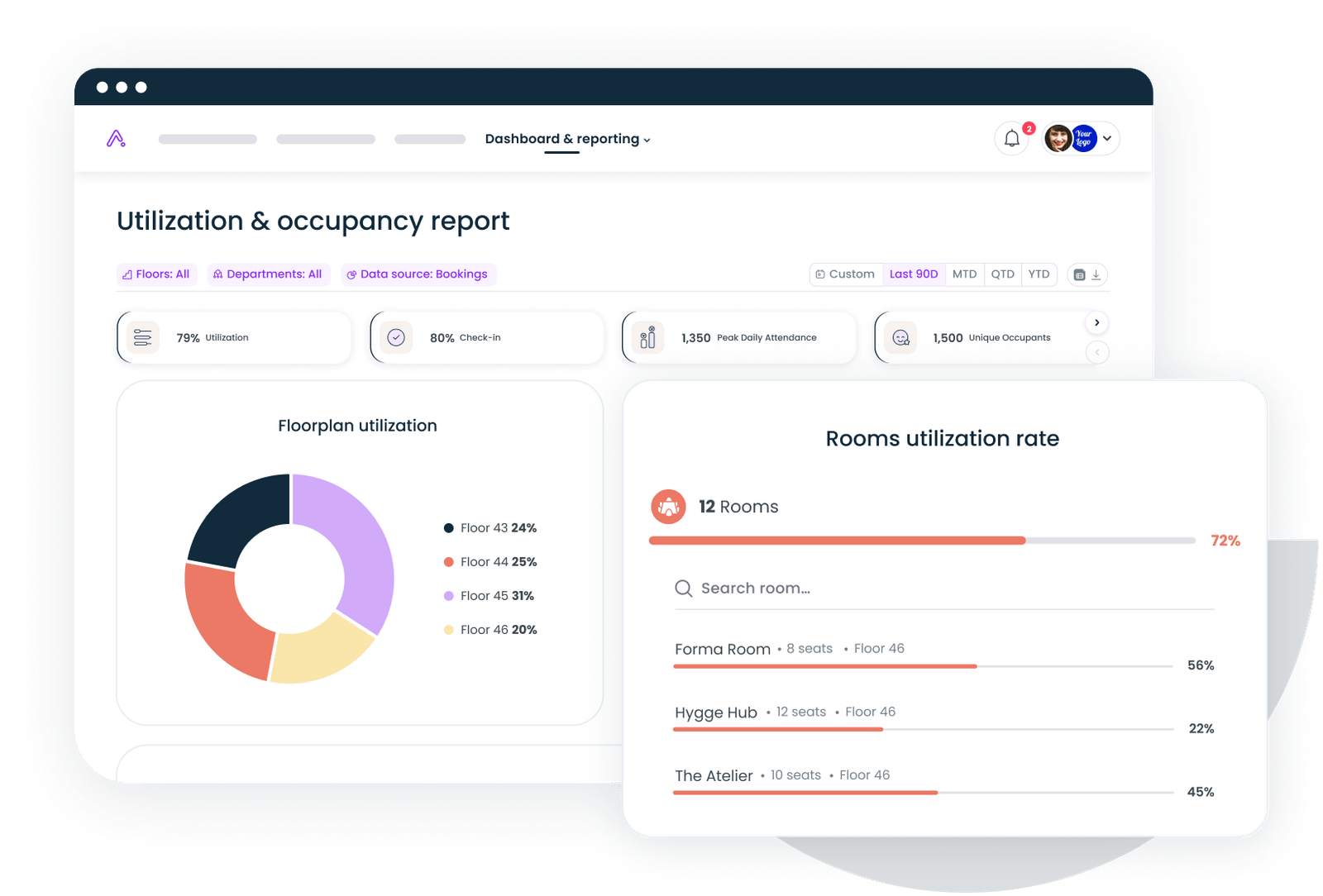
Measuring change success beyond go-live
If you can't measure it, you can't manage it. And if you stop measuring after launch, you're flying blind during the most critical period.
Leading indicators (track weekly)
These tell you whether adoption is happening:
Training completion rate. What percentage of affected employees have completed required training? Below 80% by week two is a red flag.
Adoption rate. Are people actually using the new system, space, or process? Desk booking rates, meeting room utilization, tool login frequency.
Sentiment pulse. Short, frequent surveys (3-5 questions) that track how people feel about the change. Look for trends, not individual scores.
Support ticket volume. A spike is normal at launch. A sustained spike means something's broken.
Lagging indicators (track monthly and quarterly)
These tell you whether the change is delivering results:
Productivity metrics. Output per team, project completion rates, revenue per employee. Compare to your pre-change baseline.
Retention. Are you losing people? More importantly, are you losing the people you can't afford to lose? Track voluntary turnover by department.
Engagement scores. Your quarterly or annual engagement survey should reflect the impact of major changes. If engagement drops, dig into the "why."
Business outcomes. Cost savings from consolidation, collaboration improvements from redesign, whatever the change was supposed to deliver.
The key is connecting these metrics to the specific change, not just tracking them in isolation. If you're measuring workplace ROI metrics already, layer your change-specific KPIs on top of that existing framework.
What to do with the data
Data without action is just reporting. Build a rhythm: weekly check-ins with your change team to review leading indicators, monthly reviews with leadership to assess lagging indicators, and quarterly retrospectives to decide whether to adjust, accelerate, or sunset specific initiatives.
Share the data broadly. Transparency about how a change is performing builds trust, even when the numbers aren't perfect. "Here's what we're seeing, here's what we're adjusting" is a far more powerful message than silence.
Common mistakes that derail workplace change
I've seen the same patterns sink change initiatives across dozens of organizations. Here are the ones that come up most often.
Treating change as a one-time event. Launch day is the beginning, not the end. The organizations that sustain change are the ones that keep communicating, measuring, and adjusting for months afterward.
Underestimating the middle managers. Executives set direction. Middle managers make it real. If your managers don't understand the change, can't answer their team's questions, or quietly disagree with the direction, your initiative is dead on arrival.
Ignoring the distributed workforce. If your change affects hybrid or remote employees, you need a distributed team management strategy that accounts for people who aren't in the room. Communication, training, and support all need to work asynchronously.
Skipping the baseline. You can't prove improvement without a starting point. Measure before you change.
Changing too many things at once. Every simultaneous change compounds the cognitive load on employees. Prioritize ruthlessly. If everything is urgent, nothing is.
Making change stick in 2026
The workplace changes happening right now are bigger and more frequent than anything we've seen in a decade. Return-to-office transitions, AI adoption, space redesigns, policy overhauls. Each one demands its own change management approach, but the fundamentals are the same: understand your people, communicate with honesty, measure relentlessly, and adjust based on what you learn.
The organizations that get this right won't just survive the current wave of change. They'll build the muscle to handle whatever comes next. And the ones that treat change management as a checkbox exercise will keep wondering why their initiatives fail at the same rate they always have.
Change management isn't a department or a framework. It's a capability. Build it once, and it compounds.
From office analytics to flexible space management, get the visibility you need to lead change with confidence.
Get a demo