.svg)


.svg)
- Digital workplace transformation is about people and processes, not just new software
- The market is projected to hit $166B by 2030, so this isn't optional anymore
- 95% of AI pilots fail because of adoption problems, not technology problems
- Measure outcomes (productivity, cost savings, retention), not tool deployments
- Integration beats best-of-breed; disconnected tools create more problems than they solve
Digital workplace transformation is the deliberate redesign of how employees work, collaborate, and access information, using technology as the enabler rather than the end goal. Most companies have bought the tools. Fewer have changed the work. This guide covers what digital workplace transformation actually requires in 2026: the strategic framework, a phased implementation roadmap, the metrics that matter, and the mistakes that sink most initiatives before they deliver results.
What digital workplace transformation actually means
Let's clear up a common conflation. Digital transformation is the broad, enterprise-wide shift in how a company creates value for customers. Digital workplace transformation is narrower and more specific: it's about the internal employee experience, the systems people use to do their work, and the physical and digital spaces where that work happens.
The distinction matters because it changes who owns the initiative. Digital transformation is typically a CEO or CIO mandate. Digital workplace transformation sits at the intersection of facilities, HR, IT, and real estate. It's the workplace leader's problem to solve, and it requires fluency in all four domains.
In practice, digital workplace transformation covers three pillars: technology (the platforms and integrations employees interact with daily), processes (how work flows between people and systems), and space (where work physically happens and how that space is managed). If you're only addressing one pillar, you're doing a technology upgrade, not a transformation.
The digital workplace market hit $48.8B in 2024 and is projected to reach $166.27B by 2030, growing at a 22.8% CAGR. That growth reflects a real shift in how companies allocate budget. Workplace technology is no longer a line item buried in facilities; it's a strategic investment with board-level visibility.
For a deeper look at how workplace strategy connects to these investments, our workplace strategy guide breaks down the policy spectrum and metrics to track.
Why digital workplace transformation matters now
Three forces are converging to make this urgent rather than aspirational.
The talent equation has shifted. Employees expect smooth digital experiences at work because they have them everywhere else. When your internal tools feel like they were designed in 2012, people notice. They don't always quit over it, but it erodes engagement in ways that show up in productivity data and exit interviews. Companies investing in employee experience strategy are seeing measurable returns in retention and performance.
Hybrid work broke the old operating model. When everyone was in the office five days a week, you could get away with clunky systems because proximity papered over the gaps. People walked to someone's desk instead of searching a knowledge base. They booked conference rooms by sticking their head in the door. Hybrid work removed those workarounds, and the cracks became canyons. Understanding hybrid work technology is now table stakes for any workplace leader.
The cost of inaction is compounding. Employees spend up to 20% searching for information across disconnected systems. That's one full day per person, per week, lost to friction. Multiply that across a 500-person company and you're looking at 500 person-days of wasted effort every single week. The math gets uncomfortable fast.
The business case isn't theoretical anymore. It's sitting in your utilization data, your engagement surveys, and your real estate invoices.
The five pillars of digital workplace transformation
Frameworks are only useful if they help you make decisions. This one is designed to give you a diagnostic: where are you strong, and where are the gaps?
1. Integration
The single biggest predictor of transformation success isn't which tools you pick. It's whether those tools talk to each other. When desk booking lives in one system, room scheduling in another, visitor management in a third, and occupancy data in a spreadsheet, nobody has a complete picture. Leaders make decisions in a vacuum. Employees toggle between six apps to do something that should take thirty seconds.
Integration means a unified data layer across your workplace systems. Not necessarily one tool for everything, but a connected ecosystem where information flows without manual intervention.
2. AI and automation
46% of organizations expect to in HR functions in 2026. But here's the uncomfortable truth: 95% of generative AI pilots, and the reason is almost never the technology itself. It's adoption. People don't use the tools because the tools weren't designed around how people actually work.
The lesson is clear. Don't start with "we need AI." Start with "where are people wasting time on repetitive tasks?" Then evaluate whether automation or AI can eliminate that friction. Our guide on workplace AI adoption covers how to move from pilot to production without the 95% failure rate.
3. Employee experience design
Digital employee experience (DEX) is becoming a measurable metric, not just a vague aspiration. It encompasses every digital touchpoint an employee has: from onboarding workflows to desk booking to expense reporting to the intranet search that never returns useful results.
The companies getting this right treat DEX the same way product teams treat customer experience. They map journeys, identify friction points, measure satisfaction, and iterate. The ones getting it wrong buy a new tool every quarter and wonder why nobody uses any of them. For a comprehensive breakdown, see our digital employee experience guide.
4. Hybrid work enablement
Flexibility isn't a perk anymore. It's infrastructure. Digital workplace transformation in a hybrid context means ensuring that the experience of booking a desk, finding a teammate, joining a meeting, or accessing a flex space is equally smooth whether someone is in headquarters, a satellite office, or a coworking space across the country.
This pillar is where physical space strategy and digital strategy collide. You can't optimize one without the other. If your workplace analytics show that Tuesday and Wednesday are at 80% capacity while Friday is at 15%, that's not just a scheduling problem. It's a signal that your digital tools, space design, and policies are misaligned.
5. Data and analytics
You can't manage what you don't measure, but you can definitely drown in metrics that don't matter. The fifth pillar is about building a measurement practice that connects workplace data to business outcomes, not just tracking how many desks were booked last week.
This means linking occupancy data to real estate decisions, connecting collaboration patterns to team performance, and using predictive analytics to anticipate space demand rather than reacting to it after the fact.

From policy design to metrics that matter, this guide gives you the frameworks to build a workplace strategy that actually holds up.
Read the guide
A step-by-step implementation roadmap for digital workplace transformation
Theory is nice. Here's how to actually do it.
Phase 1: Assess and audit (weeks 1 to 6)
Start by understanding where you are. This isn't a technology audit; it's a workplace audit. Map every system employees interact with. Document the workarounds people have built (they always exist). Survey employees about their biggest friction points. Pull utilization data for every space you're paying for.
The goal of this phase is a maturity benchmark: a clear-eyed view of your current state across all five pillars. Most teams discover that they're further behind on integration and measurement than they thought, and further ahead on individual tool adoption than they expected.
Key activities:
- Inventory all workplace technology (including shadow IT and spreadsheet-based systems)
- Conduct employee experience surveys focused on digital friction
- Analyze space utilization across all locations
- Map data flows between systems (or lack thereof)
- Identify the top 10 pain points by frequency and severity
Phase 2: Strategy and vision (weeks 4 to 10)
Notice the overlap with Phase 1. You don't need to finish the audit before you start shaping the strategy. In fact, waiting creates unnecessary delay.
This phase is about aligning stakeholders on what transformation means for your specific organization. "We want a better digital workplace" isn't a strategy. "We want to reduce time-to-information by 40%, cut underutilized space by 25%, and improve DEX scores by 15 points within 18 months" is a strategy.
Define personas for your different employee populations. A field sales rep, a software engineer, and an executive assistant have fundamentally different digital workplace needs. A one-size-fits-all approach will satisfy none of them.
Build your business case for workplace technology during this phase. CFOs don't fund visions; they fund projected returns with clear timelines.
Phase 3: Tool selection and integration (weeks 8 to 16)
This is where most companies go wrong. They start here, skipping Phases 1 and 2, and end up with a collection of best-in-breed point solutions that don't integrate and create more complexity than they eliminate.
The selection criteria should be weighted heavily toward integration capability, not feature lists. A platform that does 80% of what you need with smooth data flow across functions will outperform five tools that each do 100% of one thing but can't share data.
By 2030, 81% of enterprises expect to bundle workplace, network, and field services into a single operating model. The trend is unmistakable: consolidation wins. This is where a platform like Gable fits, unifying space management, flex workspace access, event coordination, and workplace analytics into a single system so that the data from each function informs decisions across all of them.
Evaluate vendors on:
- API ecosystem and native integrations with your existing HR, IT, and facilities stack
- Data model flexibility (can it accommodate your specific space types and policies?)
- Change management support (not just implementation support)
- Analytics depth (dashboards are table stakes; predictive capabilities are the differentiator)
Phase 4: Change management and adoption (weeks 12 to 30)
This is the phase that separates transformation from installation. Remember: 95% of AI pilots fail because of adoption, not technology. The same principle applies to every workplace tool.
Change management isn't a training session. It's a sustained campaign that includes executive sponsorship (visible, not just verbal), peer champions in every department, feedback loops that actually influence product decisions, and communication that explains the "why" before the "how."
Practical tactics that work:
- Launch with a pilot group that includes skeptics, not just enthusiasts
- Measure adoption weekly, not quarterly
- Create a visible feedback channel and respond to every submission within 48 hours
- Celebrate early wins publicly; address early failures privately and quickly
- Tie adoption metrics to manager performance conversations
Phase 5: Measurement and continuous improvement (ongoing from week 16)
Transformation doesn't have a finish line. Phase 5 starts while Phase 4 is still running and continues indefinitely.
Establish a cadence: weekly adoption metrics, monthly experience surveys, quarterly business impact reviews. The quarterly review is where you connect workplace data to outcomes that the C-suite cares about: cost per seat, revenue per employee, retention rates, collaboration frequency.
Build a feedback loop between measurement and action. If the data shows that a particular tool has low adoption in engineering but high adoption in marketing, don't assume engineering is resistant to change. Investigate whether the tool actually fits their workflow. Often it doesn't, and the fix is configuration, not communication.
Common challenges and how to overcome them
Every transformation hits walls. Here are the four most common ones and what actually works to get past them.
Employee resistance
Resistance is usually rational. People resist change when they don't understand why it's happening, when previous changes made their lives harder, or when they weren't consulted. The fix isn't more enthusiasm from leadership. It's more listening.
Run pre-launch focus groups. Ask people what's broken in their current workflow. Then show them, specifically, how the new approach addresses those exact problems. Generic "this will make us more efficient" messaging lands with a thud. "You told us you spend 30 minutes a day searching for meeting rooms; here's how that goes to zero" lands differently.
Tool sprawl and integration complexity
The average enterprise uses over 300 SaaS applications. Most workplace teams manage 8 to 15 tools directly. When those tools don't share data, you get conflicting reports, manual reconciliation, and decisions based on incomplete information.
The solution is ruthless consolidation. Audit every tool against three criteria: Is it integrated with our core systems? Is adoption above 60%? Does it provide data we actually use for decisions? If the answer to any of those is no, it's a candidate for replacement or retirement.
Measuring ROI
"How do we prove this is working?" is the question that kills more transformation initiatives than budget cuts. The problem is usually that teams measure deployment (we rolled out the tool) rather than outcomes (the tool changed behavior that improved results).
Structure your measurement around four categories: productivity gains (time saved, process acceleration), cost reduction (space optimization, tool consolidation), engagement improvement (DEX scores, satisfaction surveys), and risk mitigation (compliance, security, governance). Our workplace ROI metrics guide breaks down the five metrics every leader should track.
Budget constraints
Transformation doesn't require a massive upfront investment. In fact, the phased approach described above is designed to generate quick wins that fund subsequent phases. Start with the highest-friction, lowest-cost improvements. Use the savings and productivity gains from Phase 1 to justify the investment in Phase 2.
Frame the conversation with finance around total cost of ownership, not tool cost. The cheapest desk booking software isn't cheap if it doesn't integrate with your access control system and you need a full-time person to reconcile the data manually.
From desk booking and flex space access to event management and real-time analytics, Gable brings your workplace data into one platform.
Learn more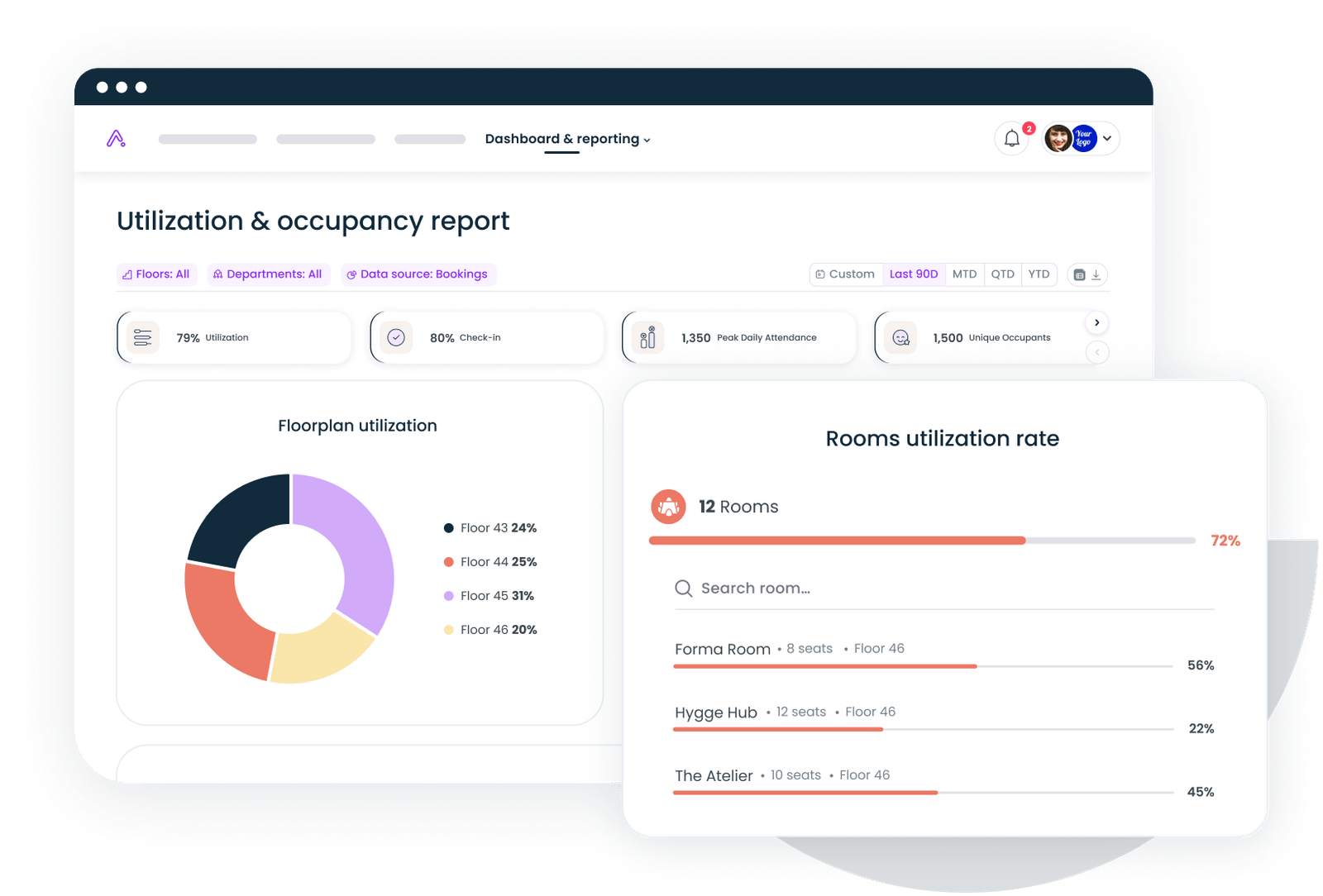
Key metrics and kpis for digital workplace transformation
Metrics should answer questions, not just fill dashboards. Here's a framework organized by the questions your stakeholders are actually asking.
What the CEO asks: "Is this making us more competitive?"
- Revenue per employee (trending over transformation timeline)
- Employee retention rate (especially among high performers)
- Time-to-productivity for new hires
- Innovation metrics (new ideas submitted, experiments launched)
What the CFO asks: "Is this saving us money?"
- Cost per seat (total workplace cost divided by headcount)
- Space utilization rate (occupied seats vs. available seats)
- Tool consolidation savings (reduction in SaaS spend)
- Real estate optimization (square footage reduced or repurposed)
Understanding your cost per desk is foundational here. You can't optimize what you haven't quantified.
What the CHRO asks: "Are people happier and more productive?"
- Digital Employee Experience (DEX) score
- Employee Net Promoter Score (eNPS)
- Time spent on administrative tasks (should decrease)
- Collaboration frequency (cross-functional meeting and gathering data)
What the CIO asks: "is this secure and scalable?"
- System uptime and reliability
- Integration health (API call success rates, data sync latency)
- Security incident frequency
- Adoption rate by tool and department
What the Workplace leader asks: "Is this actually working?"
All of the above, synthesized into a narrative that connects workplace decisions to business outcomes. This is the hardest part, and it's where most workplace teams need to level up. The data exists. The storytelling often doesn't.
Digital workplace transformation trends shaping 2026
Three trends are worth paying attention to. The rest is noise.
Agentic AI replaces chatbots
The first wave of workplace AI was chatbots that answered FAQ-style questions. The second wave, arriving now, is agentic AI: systems that can orchestrate multi-step workflows across applications. Think "reschedule my team's offsite, book a space for 12 in Austin, send calendar invites, and order catering" as a single request.
This is a meaningful shift because it moves AI from a novelty to a productivity multiplier. But it only works if your underlying systems are integrated. An AI agent can't book a room in one system and check availability in another if those systems don't share data. Integration, again, is the prerequisite.
Predictive workplace intelligence
Reactive analytics tell you what happened. Predictive analytics tell you what's about to happen. In 2026, leading workplace teams are using predictive workplace analytics to forecast space demand weeks in advance, identify teams that are drifting toward disengagement based on collaboration patterns, and flag real estate decisions before lease renewals force them.
The shift from "here's your occupancy report from last month" to "here's what occupancy will look like next quarter based on hiring plans, seasonal patterns, and team schedules" is the difference between managing a workplace and leading one.
Outcome-focused measurement
The industry is finally moving past vanity metrics. "We have 10,000 active users" means nothing if those users are logging in to check one thing and then switching to email for everything else. The trend is toward measuring outcomes: Did the tool reduce meeting time? Did the space redesign increase cross-functional collaboration? Did the flex space program improve satisfaction scores for remote employees?
This shift requires better data infrastructure, which circles back to the integration pillar. You can't measure outcomes across systems that don't share data.
Making digital workplace transformation stick
The hardest part of transformation isn't the launch. It's the 18 months after the launch, when the initial excitement fades and the real work of changing habits begins.
Three practices separate the companies that sustain transformation from the ones that revert to old patterns:
Governance that's lightweight but real. Someone needs to own the digital workplace as a product, not a project. That means a dedicated owner (or small team) with authority to make decisions about tools, integrations, and policies. Without governance, tool sprawl returns within a year.
Continuous feedback loops. The best workplace teams run quarterly "friction audits" where they systematically identify the top pain points in the employee experience and prioritize fixes. This keeps the transformation responsive to actual needs rather than locked into a plan that was written 18 months ago.
Executive sponsorship that doesn't expire. Transformation initiatives often lose executive attention after the first board presentation. The workplace leader's job is to keep the narrative alive by connecting workplace data to business outcomes in every leadership meeting. Not as a pitch, but as a standing agenda item.
Digital workplace transformation isn't a technology project with a completion date. It's an operating discipline. The companies that treat it that way, investing in integration, measuring outcomes, and iterating continuously, will build workplaces that attract talent, reduce costs, and adapt to whatever comes next. The ones that treat it as a one-time initiative will be back at square one in two years, buying the next generation of tools to fix the same problems.
From space management to analytics to flex workspace access, get a walkthrough of how Gable fits into your workplace strategy.
Get a demo