.svg)


.svg)
- Organizations lose $8.9 trillion annually to low employee engagement (Gallup, 2025), and poor digital tools are a major driver
- Employees at low-DEX-maturity companies waste 128 minutes per week on tech problems, compared to just 30 minutes at high-maturity organizations (Ivanti, 2025)
- Only 38% of employees are satisfied with their workplace technology, yet 95% of leaders say seamless digital employee experience is critical for competitiveness
- Companies with strong employee experience achieve 2.4x higher revenue growth (Kincentric, 2025)
- 52% of employees now use AI at work daily or weekly, making AI integration central to any digital workplace experience strategy
Digital employee experience (DEX) is the quality of every digital interaction employees have with workplace technology throughout their time at an organization. It covers everything from logging into your laptop in the morning to booking a meeting room, collaborating on a shared doc, and submitting a PTO request. In a world where the majority of knowledge workers now operate in hybrid environments, getting DEX right is no longer an IT nice-to-have. It's a business imperative that directly affects productivity, retention, and your bottom line.
What is digital employee experience?
Digital employee experience refers to how employees perceive and interact with all the technology they use to do their jobs. This includes hardware (laptops, phones, monitors), software (collaboration platforms, HR tools, project management apps), and the support systems that keep everything running smoothly.
Think of it as the technology counterpart to the broader workplace experience. While overall employee experience spans physical spaces, culture, and management, DEX zeroes in on the digital side. And that digital side keeps growing. For many hybrid and remote workers, digital tools are the primary way they experience their organization day to day.
The concept has expanded significantly in recent years. When most work happened in offices, technology was one piece of a larger puzzle. Now that hybrid work is the default for a majority of knowledge workers, digital tools have become the connective tissue between people, spaces, and work itself. A clunky VPN, a booking system that crashes, or an HR portal that requires five clicks to submit a simple request can define how an employee feels about their entire organization.
Gartner now positions DEX as a mainstream digital workplace discipline heading into 2026, a shift from treating it as an emerging or optional category just two years ago. This signals that organizations can no longer afford to treat digital experience as a secondary concern.
Key components of a strong digital employee experience
Building a positive digital workplace experience requires attention to five interconnected pillars. Weakness in any one area creates friction that ripples across the entire experience.
User interface and experience design
The tools employees use every day need to feel intuitive. Clean interfaces, logical navigation, and minimal training requirements aren't luxuries. They're the baseline expectation for a workforce that uses polished consumer apps outside of work. When your booking platform looks like it was built in 2005, employees notice, and their frustration compounds over time.
Technology performance and reliability
Speed and uptime form the foundation of every digital interaction. According to Ivanti's 2025 DEX Report, employees are interrupted by tech problems an average of 3.6 times per month, with each interruption eating at least 15 minutes of productive time. Add another 2.7 monthly interruptions from mandatory security updates, and you're looking at 1.6 hours of lost productivity per employee per month. For a company of 2,000 employees, that adds up to nearly $4 million in annual losses.
Integration and interoperability
The average knowledge worker toggles between multiple applications throughout the day. When those tools don't talk to each other, employees end up manually transferring information between systems, learning different interfaces, and dealing with inconsistent data. Research shows that 74% of IT professionals confirm clear technology overlaps and redundancies exist across their organizations, yet 63% don't prioritize tool consolidation. The result is a fragmented digital environment that frustrates everyone.
Leaders who manage teams using more than 10 apps report 44% poor team alignment, compared to just 29% among those using fewer than five apps. Fewer, better-integrated tools consistently outperform a sprawling tech stack.
Personalization and role-based access
Not every employee needs the same digital experience. A facilities manager, a software engineer, and a sales rep have fundamentally different workflows. The best digital workplaces offer customizable dashboards, role-specific tool access, and personalized content recommendations that adapt to individual work patterns. This kind of personalization reduces noise and helps people find what they need faster.
Training and IT support
Even the best technology falls flat if people don't know how to use it well. Direct access to responsive support, self-service troubleshooting resources, and proactive training programs all contribute to a positive DEX. Interestingly, Ivanti's research found that 49% of employees now prefer to fix IT issues themselves rather than contact the help desk, up four points year over year. But only 13% say it's actually easy to do so. Closing that gap between preference and capability is a major opportunity.
Why digital employee experience matters for your business
The business case for investing in DEX has never been clearer. Organizations that treat it as a strategic priority see measurable returns across productivity, retention, and revenue.
Productivity gains are substantial
The productivity gap between high-DEX and low-DEX organizations is staggering. Employees at companies with mature digital experience programs lose just 30 minutes per week to tech-related friction. Their counterparts at low-maturity organizations lose 128 minutes, more than four times as much. Scale that across hundreds or thousands of employees, and you're looking at massive differences in output.
Globally, low employee engagement costs an estimated $8.9 trillion per year in lost productivity, according to Gallup's State of the Global Workplace report. While engagement is shaped by many factors, digital friction is one of the most fixable. You may not be able to change the economy or your industry, but you can give your people better tools.
Retention and talent attraction
Nearly two in three office workers say negative experiences with workplace technology affect their mood at work, according to Ivanti's research. When frustration becomes a daily occurrence, talented people start looking elsewhere.
The flip side is equally powerful. Companies that score highest on employee experience achieve 2.4x higher revenue growth and 3.5x higher employee retention than low-EX companies, according to a 2025 Kincentric study spanning 12 countries. A strong employee experience strategy that includes digital tools isn't just about keeping people happy. It's a competitive advantage that shows up in financial results.
IT cost reduction
Organizations with mature DEX programs see 64% reductions in service desk ticket volumes, according to Forrester research. When tools work well, employees submit fewer support requests, IT teams spend less time firefighting, and everyone can focus on higher-value work. That's a cycle worth investing in.

If poor technology is slowing your teams down, the numbers might surprise you. This guide breaks down 30+ productivity data points every workplace leader should know.
Read the data
Common digital employee experience challenges
Understanding the obstacles is the first step toward fixing them. Here are the most frequent pain points organizations face.
Technology fragmentation and digital friction
This is the number one DEX challenge across industries. When employees bounce between disconnected tools, context switching drains cognitive energy and slows work. Only 38% of employees report being satisfied with their work-related technology, and 36% of organizations still don't have a clear strategy for improving digital employee experience.
The consequences are real: 27% of office workers regularly use unauthorized tools because their company's approved options don't meet their needs. This shadow IT creates security vulnerabilities while signaling that the official tech stack isn't cutting it.
Poor system integration
When tools don't connect, people become the integration layer. They copy data from one system to another, maintain parallel spreadsheets, and develop workarounds that waste time and introduce errors. Deloitte research found that 70% of workers routinely enter the same information into multiple systems. That's not a minor inconvenience; it's a systemic productivity drain.
Inadequate mobile and remote support
Desktop-first applications create barriers for distributed teams and frontline workers. If booking a desk, checking a schedule, or approving a request requires a laptop, you're adding friction to everyday tasks that should take seconds. Mobile optimization isn't optional anymore, especially when employee productivity data shows that seamless access directly correlates with output.
Change management and adoption resistance
Rolling out new tools is only half the battle. Getting people to actually use them (and use them well) requires thoughtful change management. Forced migrations, inadequate training, and top-down mandates without clear rationale lead to low adoption rates and frustrated employees. McKinsey's research shows that 70% of employee sentiment is shaped by their immediate manager, which means manager buy-in is essential for any digital transformation initiative.
AI adoption growing pains
AI is the newest frontier for DEX challenges. While 52% of employees now use AI at work daily or weekly (up 7 points from 2024), organizations are struggling to manage the transition. Four in five leaders worry that AI requires too much training, 79% feel it's too impersonal, and 78% fear employee over-dependence. Meanwhile, employees are increasingly sourcing their own AI tools when their companies don't provide secure alternatives, creating a new dimension of shadow IT.
How to measure digital employee experience
You can't improve what you don't measure. Yet many organizations still rely on gut feeling or annual surveys to gauge their digital experience. Here's a more structured approach.
Quantitative metrics
Track the hard numbers that reveal how well your digital environment is performing:
- Tool adoption rates: What percentage of employees actively use each approved tool?
- Time-to-completion: How long do common tasks take (submitting requests, booking rooms, finding information)?
- Support ticket volume and resolution time: Trending down is good. If tickets are rising, your tools need attention.
- System uptime and performance scores: Even brief outages or slowdowns compound across a large workforce.
- Digital friction score: Measure the gap between expected and actual task completion times.
Qualitative feedback
Numbers tell part of the story. Employee sentiment fills in the rest:
- Regular pulse surveys focused specifically on technology satisfaction
- Experience Level Agreements (XLAs): A newer framework that defines success based on how technology actually improves (or hinders) employee experience, rather than traditional IT SLAs focused on uptime alone
- Open feedback channels where employees can flag frustrations in real time
Connecting DEX to business outcomes
The most sophisticated organizations tie their digital experience metrics directly to business results: employee engagement scores, retention rates, customer satisfaction, and revenue. This connection makes the business case for continued investment and helps prioritize improvements that move the needle.
For a deeper dive into measurement frameworks, explore how leading organizations are using workplace analytics to drive data-backed decisions about their digital and physical environments.
Digital employee experience tools: a comparison by category [table]
One of the most practical steps you can take to improve DEX is auditing your current tool stack and identifying where consolidation or upgrades would have the biggest impact. Here's how the major categories of DEX-related tools compare.
If you're evaluating specific platforms, our roundup of the best employee experience software breaks down the leading options by category.
The trend for 2026 is clear: consolidation beats accumulation. Rather than adding another point solution for every new need, leading organizations are investing in platforms that combine multiple capabilities into a single experience layer. An estimated 60% of organizations are expected to adopt unified Employee Experience Platforms by the end of 2026.
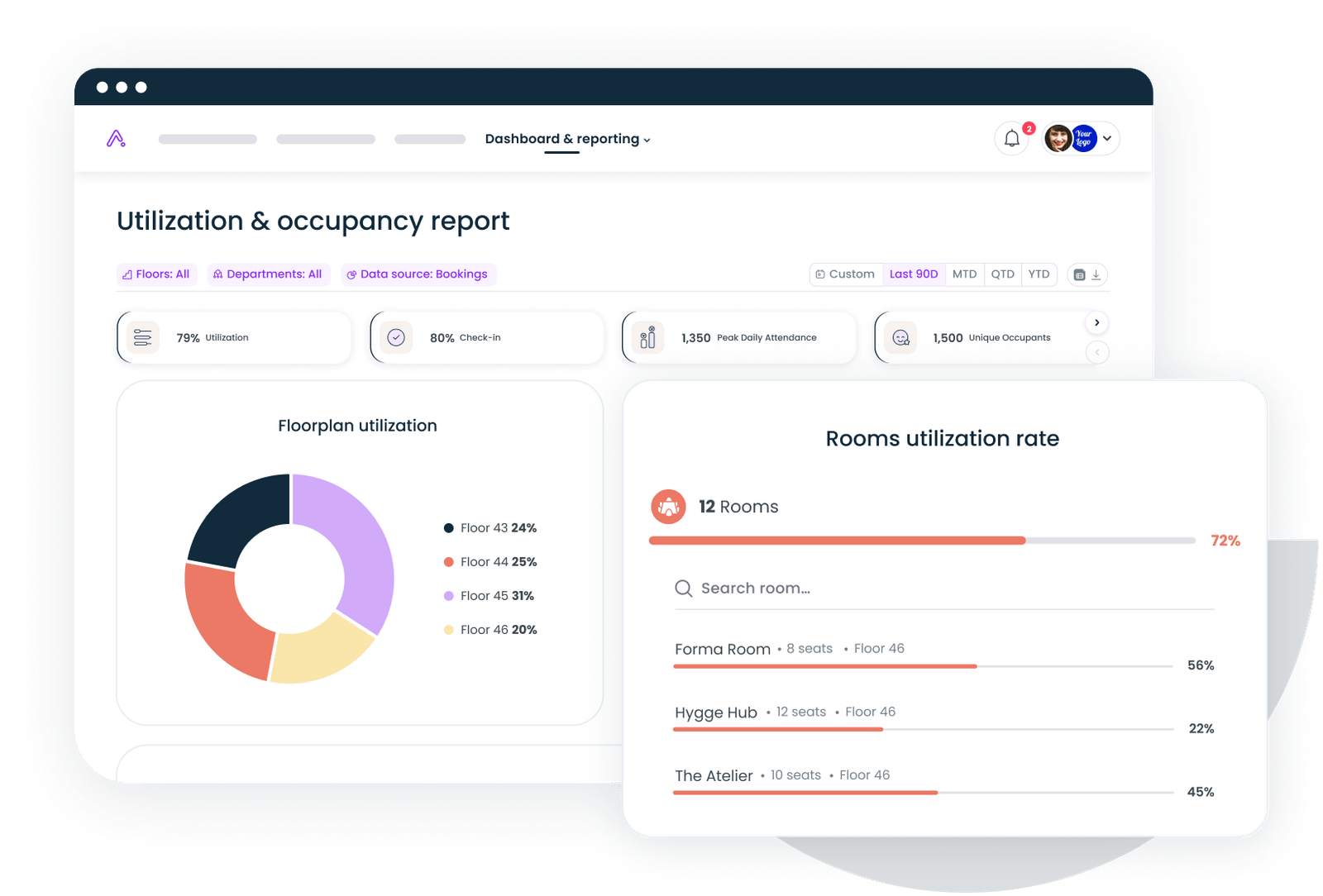
For workplace management specifically, platforms like Gable bring desk booking, room scheduling, visitor management, and space analytics into one integrated system. This reduces the number of tools employees need to learn, eliminates data silos, and gives workplace leaders real-time utilization data to optimize their spaces. Gable customers have seen a 32% reduction in unused space by using analytics to match supply with actual demand.
One platform for desk booking, room scheduling, visitor management, and analytics. Less tool switching, more productive teams.
Learn more
Strategies for improving digital employee experience
Whether you're starting from scratch or optimizing an existing program, these strategies will help you build a digital workplace experience that employees actually appreciate.
Start with a comprehensive assessment
Before changing anything, understand where you stand. Combine employee surveys (focused on technology satisfaction and pain points), usage analytics (which tools are actually being adopted), and workflow mapping (where are the bottlenecks). This baseline ensures you're solving real problems, not just guessing.
Prioritize integration over tool accumulation
The instinct to add new tools for every problem often makes DEX worse, not better. Instead, focus on connecting existing systems through APIs and integrations. A connected ecosystem with fewer tools reduces cognitive load, improves data consistency, and enables the automation that employees increasingly expect. Smart spaces and IoT integrations are a good example of how connected systems create seamless experiences.
Design for the employee, not the admin
Adopt user-centered design principles. This means prioritizing how employees actually work over how the IT team prefers to configure things. Test with real users from different departments and roles. Measure success by task completion speed and satisfaction, not just feature availability.
Invest in manager enablement
Since 70% of employee sentiment is shaped by direct managers, equipping them with the right tools and training is one of the highest-leverage investments you can make. When managers model effective use of digital tools and advocate for their teams' technology needs, adoption and satisfaction both improve.
Measure, iterate, repeat
Treat your digital employee experience like a product. Set specific goals (reduce average ticket resolution time by 40%, achieve 80% adoption of your booking platform), measure progress continuously, and iterate based on what you learn. The organizations that get DEX right aren't the ones that launch a perfect system. They're the ones that keep improving.
The role of AI in digital employee experience
AI has moved from experimental novelty to everyday infrastructure. In 2026, it's reshaping how employees interact with workplace technology at every level.
The numbers tell the story: 52% of employees now use AI at work daily or weekly, a 7-point jump from the previous year, per Ivanti's 2025 research. And the vast majority of organizations now use at least one AI technology, with knowledge workers increasingly integrating AI tools into their daily workflows.
Here's where AI is making the biggest difference for DEX:
Intelligent automation. Repetitive tasks like IT ticket routing, meeting scheduling, and data entry are being handled by AI systems that learn and improve over time. This frees employees to focus on creative and strategic work rather than digital busywork.
Personalized experiences. AI can tailor the digital workplace to each employee's role, preferences, and work patterns. From surfacing relevant documents before a meeting to recommending optimal desk locations based on who you're collaborating with that day, personalization reduces friction and saves time.
Proactive IT support. Instead of waiting for something to break, AI-powered monitoring can detect performance issues before they affect employees, automatically apply fixes, and route complex problems to the right specialist. This shift from reactive to proactive support is one of the most impactful DEX improvements available today.
Smart workspace management. Platforms like Gable use data to help teams find the right spaces for the right moments. When 72% of bookings are for team gatherings rather than individual work, intelligent scheduling tools that understand collaboration patterns become essential for improving workplace experience.
What's shaping digital employee experience in 2026
The DEX landscape is evolving rapidly. Here are the trends with the most momentum heading into the second half of 2026.
Unified experience platforms are replacing point solutions. The era of buying a separate tool for every workflow is ending. Organizations are consolidating around platforms that combine communication, knowledge management, learning, and workflow automation into a single intelligent hub. This isn't just a technology preference; it's a direct response to the digital friction caused by tool sprawl.
Experience Level Agreements (XLAs) are gaining traction. Traditional IT SLAs measure uptime and response time. XLAs flip the script by measuring how technology actually affects employee productivity and satisfaction. This reframing puts employees at the center of digital workplace strategy, which is exactly where they should be.
The physical-digital workplace convergence continues. As hybrid work matures, the line between physical and digital workplace experience is blurring. Booking a desk, checking into an office, finding a colleague, and accessing meeting room technology should all feel like one seamless experience. This convergence is where hybrid work models and the tools that support them play a critical role.
DEX is becoming a C-suite priority. Gartner's classification of DEX as a mainstream discipline signals broader organizational recognition. When poor digital tools cost millions in lost productivity and contribute to employee turnover, digital experience earns a permanent seat at the strategy table.
Building a digital employee experience that works
Digital employee experience isn't a one-time project. It's an ongoing commitment to removing friction, enabling great work, and treating your technology environment with the same intentionality you bring to your physical workspace and company culture.
The organizations winning at DEX in 2026 share a few common traits: they measure relentlessly, they consolidate ruthlessly, they listen to employees genuinely, and they treat digital experience as everyone's responsibility rather than just IT's.
Start with the basics. Audit your current tech stack. Talk to employees about their biggest digital frustrations. Pick the highest-impact improvements and execute them well. Then measure what changed, learn from it, and do it again.
Gable's office management platform is one piece of this puzzle, bringing desk booking, room scheduling, visitor management, and workplace analytics into a single system that reduces tool sprawl and gives you the data to make smarter decisions about your spaces and your people.
See how Gable brings desk booking, room scheduling, visitor management, and workplace analytics into one platform your teams will actually use.
Get a demo