



.svg)


.svg)
Productivity is a measure of business performance that shows how efficiently employees produce outputs with given inputs. But here's the challenge: traditional productivity measurements were designed for factory floors, not knowledge workers who split their time between home offices, headquarters, and flexible workspaces.
According to Gallup's 2024 State of the Global Workplace report, only 21% of employees worldwide are engaged at work, resulting in $438 billion in lost productivity for the global economy. The good news? Organizations that improve how they measure and track productivity see 23% higher profitability and 17% greater company performance.
This guide walks you through how to measure the productivity of employees using methods that work for modern, distributed teams. You'll learn how to calculate productivity levels, which key performance indicators matter most, and how to use data to make informed decisions about workforce productivity.
What is workplace productivity and why does it matter?
Workplace productivity calculates how efficiently your workforce converts inputs like time spent, resources, and effort into valuable outputs like completed projects, revenue, and customer satisfaction. The best way to calculate productivity is to divide total output by total input, though the specific formula varies by industry and goals.
Basic Productivity Formula:
Productivity = Total Output ÷ Total Input
For a sales team, this might mean measuring the number of deals closed per quarter divided by the hours worked. For a customer service representative, it could be customer satisfaction scores relative to the number of tickets resolved. For a marketing team, you might track leads generated against campaign investment.
Measuring productivity provides insight into the efficiency of business processes and reveals areas for improvement. When done well, employee productivity measurements can improve company management and allow the organization to strengthen its workforce through targeted interventions rather than guesswork.
Research from Gallup shows that engaged employees produce better business outcomes than disengaged employees, including 21% higher profitability and a 41% reduction in absenteeism. These productivity metrics connect individual tasks to company goals, making measurement essential for any organization serious about performance.
Types of productivity metrics you should track
Productivity metrics can be quantitative or qualitative, helping assess whether efforts align with company goals. A holistic view requires tracking both types, as focusing solely on quantity can lead to shortcuts and lower-quality outputs. Here are the categories that workplace leaders should monitor:
Output-based metrics include units produced, sales figures, project completion rates, and deals closed. These work well for roles with tangible deliverables. A sales team's average revenue per representative or a content team's number of tasks completed per week fall into this category. These metrics provide clear benchmarks for measuring productivity based on established standards.
Efficiency metrics compare resources against actual goods or services produced to gauge efficiency. Revenue or profit per full-time equivalent, and Human Capital ROI, help identify opportunities to improve how employees allocate their time and resources. Organizations typically measure efficiency by comparing individual employees' output against hours worked, though modern approaches factor in quality alongside quantity.
Quality indicators measure work caliber through error rates, revision frequency, and customer satisfaction scores. Without quality metrics, your productivity measurements might incentivize speed over substance, ultimately hurting company performance.
Time-based metrics track progress by measuring the time taken to complete tasks and the focus hours. Workforce productivity suites visualize focus time versus distractions and workload balance, revealing how much time employees spend on deep work versus context switching. Deloitte research found that employees lose 32 days per year just toggling between workplace applications to find necessary information.
Employee engagement metrics link directly to sustained productivity and can be assessed through regular surveys. Gathering feedback from various stakeholders provides multifaceted insights into worker productivity. The planned-to-done ratio measures how much work is assigned to an employee and how much of it gets done, revealing patterns that pure output numbers might miss.
How to calculate productivity: a step-by-step guide
Calculating productivity levels accurately requires a systematic approach that considers both quantity and quality of output. Here's how to build a measurement framework that delivers valuable insights for your organization:
Step 1: Define role-specific metrics
Defining role-specific productivity metrics involves setting clear, measurable goals that align with broader business objectives. What success looks like for a customer service representative differs dramatically from that of a software engineer or marketing team member. Start by identifying the primary outputs each role produces and the inputs required to generate them.
For sales roles, track deals closed, pipeline value, and conversion rates. For project-based work, measure project completion rates against deadlines. For customer-facing roles, combine resolution time with customer satisfaction scores. The goal is to establish clear benchmarks that serve as a standard for measuring performance.
Step 2: Establish baseline measurements
Before implementing changes, document current productivity levels. Benchmarks are essential for measuring productivity as they provide a standard against which to measure. Collect data over several weeks to account for natural variation in workload and performance.
This baseline also helps you identify opportunities to enhance productivity. If you don't know where you're starting, you can't measure improvement.
Step 3: Implement tracking systems
Utilizing technology to automate data collection and analysis can significantly enhance the efficiency and accuracy of productivity measurement. Modern productivity software captures work patterns passively, reducing the burden on individual employees while providing managers with real-time data.
Workplace analytics tools integrate with existing systems to track time spent on different activities, collaboration patterns, and space utilization. This data helps identify productive habits and patterns while revealing sources of productivity loss.
Step 4: Calculate and analyze
Apply your productivity formula consistently across measurement periods. Labor productivity is typically measured by dividing an output index by an hours-worked index. Compare results against your benchmarks and industry standards.
Measuring productivity by profit means that if revenue increases while inputs stay constant, the employees become more productive. However, don't rely on a single metric. Cross-reference output metrics with quality indicators and engagement data to get the complete picture.
Step 5: Review and adjust regularly
Regularly reviewing and adjusting Key Performance Indicators is essential to stay aligned with changing business objectives. What matters today might not matter next quarter. Build review cycles into your measurement process, gathering employee feedback alongside quantitative data.
Regular check-ins and performance reviews help ensure employees are on track to meet their objectives and provide feedback that fosters a transparent workplace.

Want to optimize how your hybrid teams work and collaborate? Our complete guide covers 10 data-backed strategies for making flexibility work.
Read the guide
Key performance indicators for different teams
Different roles require different KPIs to accurately measure employee productivity. Here's how to approach measurement for common business functions:
Sales teams benefit from tracking average revenue per representative, conversion rates, pipeline velocity, and customer acquisition cost. Multifactor productivity measures combine these outputs against time invested and resources consumed. A strong sales productivity metric connects individual tasks to overall revenue goals.
Customer service teams should monitor first-contact resolution rates, average handle time, customer satisfaction scores, and ticket volume. Quality and accuracy are critical components of employee productivity in these roles, as faster resolution means nothing if customers leave dissatisfied.
Marketing teams can track leads generated, campaign ROI, content engagement, and qualified lead conversion. These metrics connect creative output to business processes and bottom-line impact.
Remote employees require additional consideration. Self-rated productivity invites employees to assess their own performance, which research shows provides useful insights when combined with manager evaluations. 360-degree feedback gathers input from managers, peers, subordinates, and clients, providing a well-rounded view of an employee's impact on collaboration.
OKRs (Objectives and Key Results) align individual efforts with broader company strategy through measurable results. This framework helps employees work with a clear purpose while giving managers visibility into progress.
Modern approaches to measuring productivity
Traditional productivity metrics often overlook the experiential impact of new working norms, which can affect workers' well-being and overall workplace satisfaction. The concept of Productivity+ explores the relationship between workplace productivity and employee experience, focusing on business outcomes alongside well-being initiatives.
Passive data can be leveraged to gain insights into how employees allocate their time and identify productive habits. This includes analyzing collaboration patterns, focus time versus meetings, and workspace usage. Unlike traditional self-reported surveys, passive data collection provides continuous insights without disrupting work.
When assessing workers' ability to balance their time effectively, focus on dimensions that significantly influence productivity:
Focus and deep work time. Research shows that productivity increases by 6% when people work from home, due to fewer distractions. Track how much uninterrupted time employees get for concentrated work.
Collaboration patterns. Knowledge workers spend 288% more time in meetings than before the pandemic, according to Deloitte. While collaboration drives innovation, excessive meetings hurt overall productivity. Monitor meeting load and its impact on output.
Context switching costs. It takes a worker 23 minutes on average to regain focus after a distraction, and organizations that experience frequent context switching lose 40% of productivity. Workplace technology can help reduce unnecessary interruptions.
Well-being indicators. Happy people are 12% more productive on tasks at hand. Employee engagement scores directly correlate with sustained productivity.
Modern productivity measurement approaches emphasize aligning employee activities with the organization's broader objectives while also considering the employee experience.
Productivity measurement challenges and how to overcome them
Measuring productivity can be challenging due to the varying nature of work across different industries. Industries focused on manual work can measure productivity by output quantity, while knowledge-based industries must also consider quality. Here are common obstacles and solutions:
Challenge: Varying work outputs across roles
Some roles produce easily quantifiable outputs, while others contribute value that's harder to measure. A balanced scorecard approach incorporates financial, customer, internal process, and learning perspectives to capture value beyond simple output counts.
Performance management systems integrate goal tracking with self-assessments and manager reviews, providing multiple data points for evaluation. Time utilization analytics measure focus time versus time lost to work about work.
Challenge: Limited visibility in hybrid environments
Managers cannot physically observe all activities of remote and hybrid employees. The solution isn't surveillance but rather outcome-based measurement. Focus on results rather than activity, tracking completion rates, quality metrics, and business impact.
Space utilization data reveals when and how employees use office space, helping you understand collaboration patterns without micromanaging individual employees.
Challenge: Balancing quality and quantity
The balance between quality and quantity is essential in measuring productivity, as focusing solely on quantity can lead to shortcuts. Build quality indicators into every productivity measurement. For example, pair the number of tasks completed with error rates or revision frequency.
Employee utilization measures the percentage of time employees spend on billable work, but high utilization with low-quality output still represents poor productivity.
Challenge: Getting accurate data without intrusion
Employee feedback is essential for tailoring productivity measurement approaches to each organization's unique needs and goals. Combine automated tracking with periodic surveys that ask employees about obstacles, suggestions, and well-being. This dual approach provides both objective data and subjective insights.
Measuring productivity should involve assessing qualitative aspects such as employee engagement, job satisfaction, and workplace culture alongside quantitative outputs.
Get real-time visibility into how your teams use office space. Gable's workplace analytics help you track utilization, optimize space, and make data-driven decisions about your real estate.
Learn more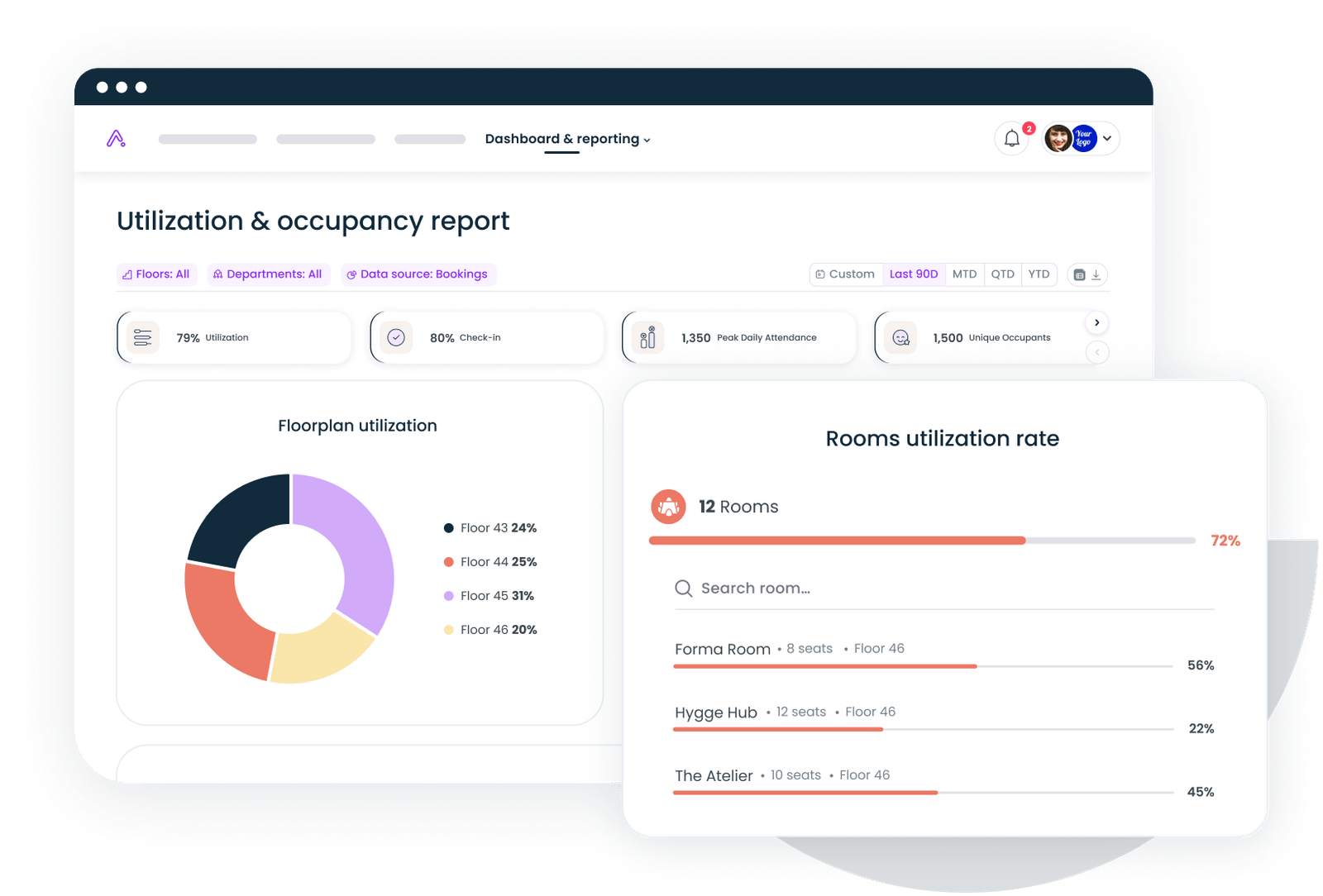
Practical tips to enhance productivity across your organization
Organizations must identify the sources of productivity loss to effectively address and improve productivity. Here are proven strategies that connect directly to better productivity measurements:
Set clear, achievable goals. Setting clear, achievable goals is essential for guiding employee efforts and measuring productivity. Use the SMART framework to ensure goals are specific, measurable, achievable, relevant, and time-bound. When employees understand what success looks like, they can prioritize effectively.
Establish regular check-ins. Regular check-ins help ensure employees stay on track and identify obstacles early. Weekly one-on-ones provide opportunities to discuss progress, remove blockers, and adjust priorities. These conversations also create the feedback loop that drives continuous improvement.
Review workflows with your team. Regularly reviewing workflows with your team can help identify bottlenecks and improve productivity. Involve employees in process improvement, as they often spot inefficiencies that managers miss. This collaborative approach increases buy-in while generating better solutions.
Encourage breaks and a sustainable pace. Encouraging employees to take regular breaks can significantly boost productivity by preventing burnout and maintaining high concentration levels. The Eat the Frog method suggests tackling the most challenging task first thing in the morning, preserving mental energy for the rest of the day.
Eliminate unnecessary steps. Creating a priority list is a simple yet effective way to enhance productivity. Help employees focus on high-impact work by removing administrative burden and unnecessary meetings. Every hour saved on busy work is an hour available for meaningful output.
Invest in the right tools. Provide productivity software that reduces friction rather than adding it. Office management solutions that integrate desk booking, room scheduling, and analytics help hybrid teams coordinate effectively while generating valuable utilization data.
Use data to drive decisions. Organizations should adopt a comprehensive, integrated approach to measuring productivity that draws on data from across departments and teams. Connect productivity metrics to business outcomesso that investments in improvement can be prioritized by impact.
How to use productivity data to improve company performance
Collecting data only creates value when it drives action. Here's how to translate productivity measurements into organizational improvements:
Identify top performers and learn from them. Analyze what high-productivity employees do differently. Do they use specific tools? Follow particular routines? Have better workspace setups? Document these patterns and share them across teams.
Address productivity barriers systematically. When data reveals consistent obstacles, treat them as organizational problems rather than individual performance issues. If multiple employees report meeting overload affecting their focus hours, implement meeting-free days or stricter scheduling guidelines.
Connect productivity to real estate decisions. Workplace analytics reveal how and when employees use physical space. This data informs decisions about office footprint, neighborhood configurations, and resource allocation. Organizations that use utilization data for planning report average reductions of 20-40% in underused office space.
Build feedback into your culture. Providing feedback to employees creates a transparent workplace environment and helps improve productivity. Regular performance conversations normalize productivity discussions and make continuous improvement part of daily work.
Track progress over time. Measure changes in productivity metrics quarter over quarter. Celebrate improvements and investigate declines. This longitudinal view reveals whether interventions actually work and where to focus next.
See how Gable helps workplace leaders track utilization, optimize space, and improve team productivity with real-time analytics.
Get a demo


