.svg)


.svg)
- Every workplace transformation needs five sequential phases, not shortcuts
- Start with data, not assumptions about how people actually use space
- A 90-day pilot is non-negotiable before full rollout
- Assign clear owners across Workplace, HR, IT, Finance, Real Estate, and Legal
- Measure on a six-month cadence; transformation is permanent, not a project
A workplace transformation roadmap is a phased plan for redesigning how and where your company works, covering real estate, occupancy models, technology, and employee experience. Every roadmap needs five phases: Assess, Design, Pilot, Scale, and Measure. Skip one, and you'll join the majority of transformations that fail to deliver value. Barely half of transformations go according to plan, and only 57% deliver returns worth the investment. This guide walks you through each phase, in order, with the dependencies and decision gates that keep the whole thing from falling apart.
Why most workplace transformations stall (and what a roadmap prevents)
Here's the scenario. You're the Director of Workplace for a 5,000-person company. Leadership mandated return-to-office three days a week. Utilization is sitting at 45%. Real estate costs climbed 12% last year. Employees are frustrated, and your CEO wants a plan in 90 days.
Without a roadmap, what happens next is predictable. Someone picks a desk booking tool. Someone else redesigns the floor plan. HR drafts a new attendance policy. Finance asks for cost projections nobody can produce. None of these efforts connect to each other, and six months later you're back where you started, just with a new software contract.
A roadmap prevents that fragmentation. It sequences decisions so each phase builds on the one before it. You don't design a target state without baseline data. You don't roll out company-wide without a pilot. You don't declare victory without measurement. The phases aren't suggestions. They're dependencies.
McKinsey's State of Organizations research frames transformation as a permanent condition, not a one-time project. That's the mindset shift this roadmap requires. You're not building toward a finish line. You're building a system that adapts.
Phase 1: Assess your current state (months 1-3)
You can't design a future workplace without understanding the one you have. Phase 1 is about collecting four categories of baseline data: portfolio, occupancy, sentiment, and financials.
Portfolio audit. List every location, its square footage, lease terms, and expiration dates. If you're post-merger, this step alone can take weeks because nobody has a single source of truth. Include flex space agreements, coworking memberships, and any informal arrangements teams have made on their own. Our guide on right-sizing office space walks through the methodology for matching portfolio to actual demand.
Occupancy and utilization. Pull badge data, WiFi connection logs, or sensor data for the last 6-12 months. You're looking for peak utilization by day of week, by floor, and by team. Most companies discover that Tuesday through Thursday runs at 50-60% while Monday and Friday hover around 20-30%. If you don't have sensor infrastructure yet, smart office sensors covers what's worth buying and what isn't.
Employee sentiment. Run a short survey (10 questions max) asking where people prefer to work, what brings them to the office, and what drives them away. Pair this with qualitative interviews of 15-20 managers across functions. The survey tells you what; the interviews tell you why. For survey design that actually gets honest responses, see our workplace satisfaction survey guide.
Financial baseline. Calculate your fully loaded cost per seat at each location. Include rent, utilities, maintenance, technology, food and beverage, and flex space spend. This number becomes the benchmark everything else gets measured against. If you haven't done this before, cost per desk breaks down the calculation step by step.
Stakeholder readiness. Before you move to Phase 2, assess whether HR, IT, Finance, Real Estate, and Legal are aligned on the need for change. Not on the solution; just on the problem. If your CHRO doesn't agree there's a problem, your roadmap will stall at Phase 2. Over half of CHROs admit they don't know how to prepare for transformation at this scale.
Phase 1 exit gate: You have a data pack with portfolio inventory, utilization trends, sentiment themes, and cost-per-seat by location. Every stakeholder has reviewed it. You're ready to design.
Phase 2: Design your target state (months 3-5)
Phase 2 is where you make decisions. Not all of them, but the structural ones that everything else depends on.
Define your workplace model. Are you hybrid with anchor days? Flex-first with no assigned desks? Activity-based with zones for focus, collaboration, and socializing? Pick one model and commit. Trying to accommodate every preference produces a workplace that works for nobody. If you're weighing options, the hybrid workplace strategy guide lays out the tradeoffs.
Right-size the footprint. Using your Phase 1 data, calculate how many seats you actually need at peak occupancy plus a 15-20% buffer. If your current portfolio is 40% larger than that number, you've found your savings target. This is where you decide which locations to keep, consolidate, sublease, or replace with flex space.
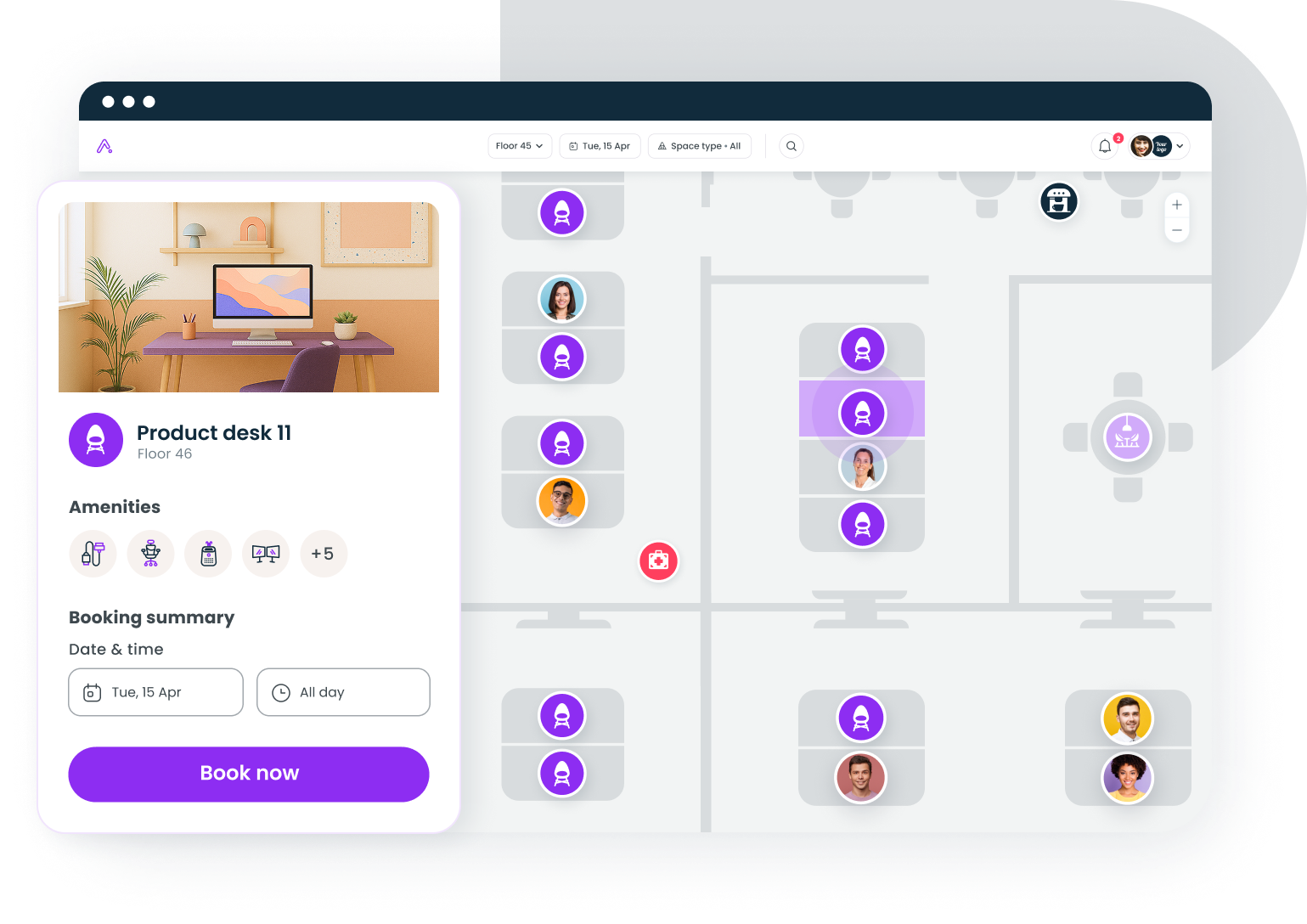
Select your technology stack. You need four capabilities: desk and room booking, visitor management, occupancy analytics, and integrations with your calendar and HRIS. The biggest mistake here is buying four separate tools that don't talk to each other. An integrated platform like Gable covers all four, which matters because fragmented data makes Phase 5 (measurement) nearly impossible.
Draft policies. Write the attendance expectations, booking rules, and equity guardrails. Be specific. "We expect three days in office" is a policy. "Come in when it makes sense" is a suggestion. Policies need to answer: Which days? Who decides? What happens if someone doesn't comply? What accommodations exist?
Build the communication plan. Don't wait until rollout to think about messaging. Draft communications for three audiences: executives (why this matters strategically), managers (what changes for their teams), and individual contributors (what changes for their daily experience). Our guide on communicating office policy changes covers the sequencing and tone that avoids backlash.
Phase 2 exit gate: You have a one-page target state document signed off by your executive sponsor. It specifies the workplace model, footprint target, tech stack, policies, and timeline. You're ready to pilot.

Six real workplace transformations, from post-merger consolidation to flex-first redesigns, with the decisions that made them work.
Read the guide
Phase 3: Run a 90-day pilot (months 5-8)
The pilot is the most important phase in your roadmap. It's also the one most companies skip. 23% of transformations fail during planning, but the number jumps to 55% during implementation. A pilot catches implementation problems before they become company-wide disasters.
Select one location and one team. Pick a site with 100-500 people that's representative of your broader organization. Don't pick your most enthusiastic office or your most resistant one. Pick the one that looks like your average. If you're running a workplace pilot program for the first time, that guide covers selection criteria in detail.
Deploy the new model in parallel. Keep existing systems running alongside the new ones. Employees should be able to book desks, find colleagues, and access flex space through the new tools while the old process remains available as a fallback. This reduces anxiety and gives you a clean comparison.
Define success criteria before you start. Write these down and share them with stakeholders:
- Booking adoption: 70%+ of eligible employees using the new system by week 8
- Utilization on core days: 65%+ of available desks occupied
- Employee satisfaction: Neutral or positive shift in pulse survey scores
- Cost per seat: Trending toward target (you won't hit it in 90 days, but the trajectory should be visible)
Measure weekly. Adjust biweekly. Run a 15-minute standup every Monday to review adoption numbers. Every two weeks, make one policy or configuration adjustment based on what you're seeing. Maybe the booking window is too short. Maybe one floor is overcrowded while another is empty. Small adjustments during the pilot prevent big problems during rollout.
Have a rollback plan. If adoption is below 40% at week 6, or if employee satisfaction drops significantly, you need a documented process for reverting to the previous state. Failure isn't defeat; it's data. But you need to know in advance what failure looks like and what you'll do about it.
Phase 3 exit gate: You've met at least three of four success criteria. You have a lessons-learned document. Your executive sponsor has approved the move to Phase 4.
Phase 4: Scale across the organization (months 8-12)
Scaling is not "do the pilot again, but bigger." It's a different challenge with different risks. The pilot proved the model works. Scaling proves it works at complexity.
Stagger by location, not all at once. Roll out to two or three sites per month. Start with locations that are most similar to your pilot site, then move to the ones with unique constraints (different time zones, different lease structures, different team compositions). Each wave should take 3-4 weeks from kickoff to steady state.
Train managers first. Managers are the transmission mechanism for change. If they don't understand the new model, their teams won't adopt it. Run 60-minute briefings for every people manager covering three things: what's changing, why it's changing, and how to handle the most common employee questions. The workplace change management playbook has a manager briefing template you can adapt.
Coordinate vendors tightly. If you're using multiple systems (HRIS, access control, booking platform, analytics), every integration needs to be live and tested before each wave goes live. One broken integration, say, badge data not syncing with booking data, will undermine trust in the entire system. Build a two-week buffer before each wave for integration testing.
Monitor resistance patterns. Some resistance is normal. About 20% of employees will be slow adopters regardless of how good the rollout is. That's fine. What you're watching for is organized resistance: entire teams refusing to book, managers telling their reports to ignore the new policy, or senior leaders visibly not participating. Escalate these patterns to HR and your executive sponsor within one week of detection.
Run a weekly steering committee. Every Monday during rollout, convene Workplace, HR, IT, Finance, and Real Estate leads for 30 minutes. Review adoption by wave, surface blockers, and make decisions. This meeting is the single most important ritual during Phase 4. Cancel it, and coordination falls apart within two weeks.
Phase 4 exit gate: All locations are live. Adoption is above 60% company-wide. No critical integration issues remain open. You're ready to measure.
Gable's analytics platform surfaces utilization, cost per seat, and adoption trends across every location, so your steering committee has real numbers, not guesses.
Learn more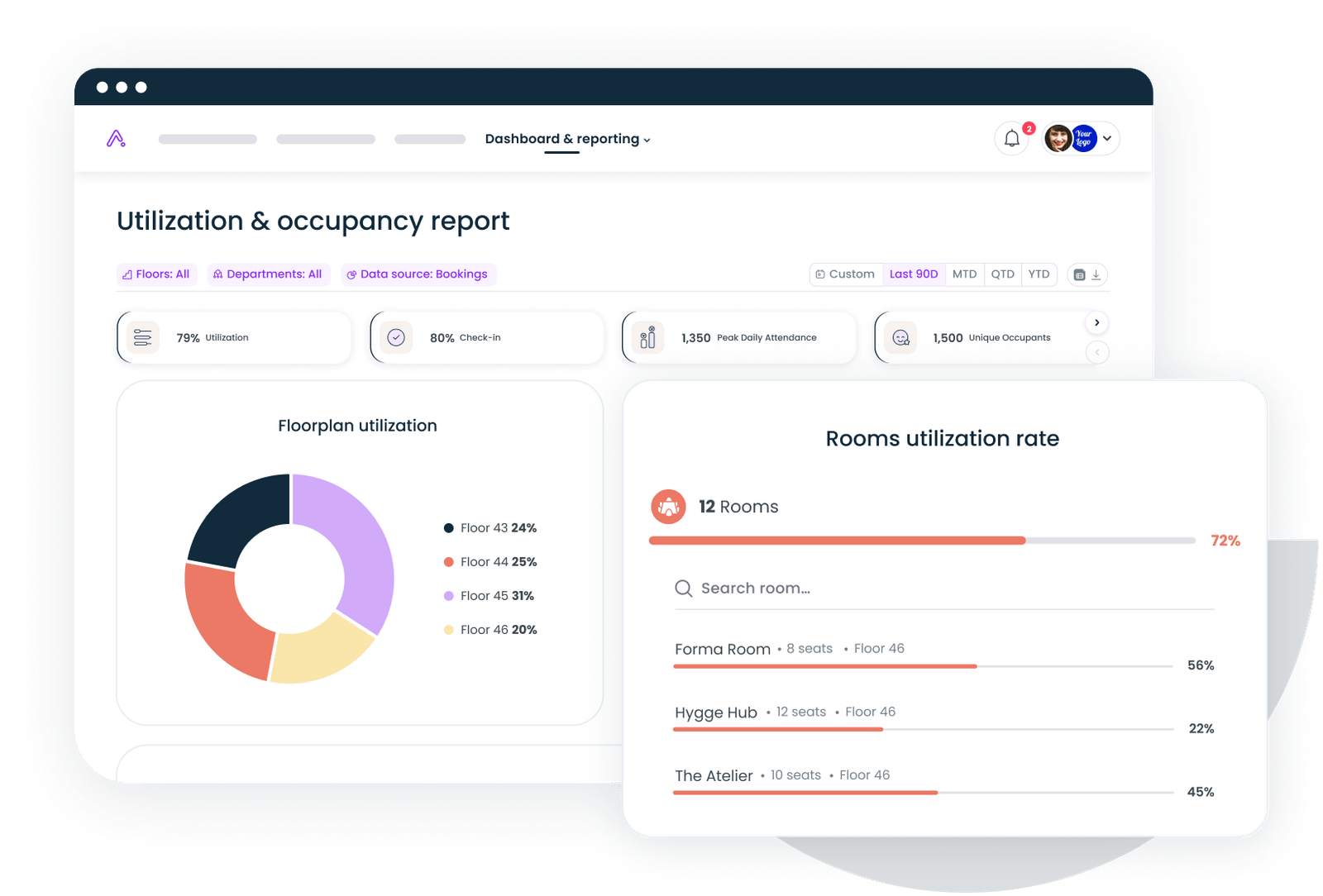
Phase 5: Measure and iterate on a six-month cadence (month 12+)
This is where most roadmaps end and most transformations quietly fail. Leadership declares the project "done," the steering committee disbands, and within six months the new model has drifted back toward the old one.
Don't let that happen. Transformation isn't a project with a completion date. It's an operating rhythm.
90-day checkup. Three months after full rollout, review your core metrics: utilization rate by location, cost per seat versus target, booking adoption rate, and employee engagement scores. Compare these to your Phase 1 baseline and your Phase 3 pilot results. Are you on track? If utilization is below target, dig into which locations or teams are lagging and why.
Six-month review. This is the big one. Bring your executive sponsor and all stakeholder leads together for a half-day session. Review every KPI. Discuss what's working and what isn't. Make decisions about the next phase of optimization: Should you consolidate another location? Expand flex space access? Adjust attendance policies? For the metrics framework, workplace ROI metrics covers the five numbers every leader should track.
Quarterly policy sprints. Between six-month reviews, run small experiments. Maybe you test a new booking window length. Maybe you add a fourth anchor day for one team and measure the impact. These sprints keep the model evolving without requiring a full redesign.
Annual reset. Once a year, go back to Phase 1. Not the full assessment, but a refresh: updated utilization data, a new sentiment survey, refreshed financial projections. The workplace changes. Your roadmap should change with it.
Phase 5 exit gate: There isn't one. That's the point.
The stakeholder responsibility matrix
A roadmap without clear ownership is just a document. Here's who owns what across the five phases.
Two notes on this matrix. First, "Accountable" means one person makes the final call. If two people are accountable, nobody is. Second, this matrix should be shared at your kickoff meeting and revisited quarterly. Roles shift as the transformation matures. For a deeper dive on governance structures, see our workplace governance guide.
Common failure modes (and how to avoid them)
After watching dozens of these transformations play out, the failure patterns are remarkably consistent.
Designing without data. This is the most common mistake. Someone in leadership "knows" that employees want three days in office, so the team skips the sentiment survey and utilization analysis. Then the new model launches and nobody shows up on the designated days. The fix is simple: Phase 1 is non-negotiable. Collect the data even if you think you already know the answer.
Skipping the pilot. The second most common mistake, usually driven by impatience. "We don't have time for a pilot; we need to move fast." Moving fast without a pilot means moving fast toward problems you could have caught in 90 days. The pilot isn't a delay. It's insurance.
Underinvesting in change management. Companies routinely spend 80% of their transformation budget on technology and real estate, and 20% on helping people actually adopt the new model. Flip that ratio closer to 50/50. The best booking platform in the world doesn't matter if managers are telling their teams to ignore it.
Leadership not modeling the behavior. If your CEO mandates three days in office but is never seen in the office on those days, the message is clear: this policy is for everyone else. Executive visibility during the first six months of rollout is critical. Schedule your C-suite's anchor days and make them visible on the booking system.
No measurement after launch. "We launched the new model" is not the same as "the new model is working." Without a measurement cadence, you'll never know whether the transformation delivered value, and neither will your CFO when budget season comes around.
Fragmented technology. Desk booking in one system, visitor management in another, analytics in a third. No single source of truth. Every report requires manual data stitching. By month three, nobody trusts the numbers. Pick an integrated platform from the start.
Your roadmap timeline at a glance
Here's what a realistic 14-month timeline looks like for a mid-size company (2,000-10,000 employees):
This timeline assumes you have executive sponsorship and budget approval before month 1. If you don't, add 2-3 months for the business case. Our guide on building a workplace technology business case can help you get that approval faster.
The transformation is the easy part; sustaining it is the work
Building a workplace transformation roadmap isn't complicated. The five phases are logical, the dependencies are clear, and the stakeholder roles are well-defined. The hard part is discipline: collecting data when you think you already know the answer, running a pilot when leadership wants to move faster, measuring outcomes when everyone wants to move on to the next initiative.
The companies that succeed at this treat transformation as an operating rhythm, not a project. They build measurement into the cadence of how they manage the workplace. They revisit their assumptions every six months. They adjust policies based on data, not opinions.
Your roadmap is a living document. Print it, share it, argue about it, and update it. That's how it works.
Walk through how Gable supports each phase of your workplace transformation, from occupancy analytics to desk booking to flex space management, in a live demo.
Get a demo