.svg)


.svg)
- Smart office sensors fall into four categories: occupancy, environmental, desk-level, and building-level
- Sensors only deliver ROI when they feed into a workplace platform, not when they sit alone
- Most offices recoup sensor costs in 12 to 24 months through space and energy savings
- Skip sensors if your office is under 5,000 sqft or you have no integration plan
- Privacy-first sensor types (thermal, PIR) avoid the employee trust problems cameras create
Smart office sensors measure how your spaces are actually used, not how you think they're used. They fall into four categories: occupancy and presence sensors, environmental sensors, desk-level sensors, and building-level sensors. If you're evaluating a sensor procurement in 2026, the question isn't whether the technology works. It does. The question is whether the data will connect to your workplace systems in a way that justifies the spend.
Why smart office sensors matter now
Hybrid work created a measurement problem. When everyone came in five days a week, you could eyeball utilization. Walk the floor at 2 PM, count empty desks, adjust. That doesn't work when occupancy swings from 30% on Monday to 75% on Wednesday.
The numbers back this up. The office sensor market hit $342.7 million in 2025 and is projected to reach $621.4 million by 2034. That growth isn't hype; it's facilities teams realizing they can't manage dynamic spaces with static assumptions.
Here's the core tension: you're paying for space based on headcount, but actual usage follows patterns that headcount doesn't predict. Sensors close that gap. They tell you which floors are ghost towns on Fridays, which meeting rooms get booked but never used, and which neighborhoods are consistently over capacity. That data feeds directly into decisions about right-sizing office space, renegotiating leases, and redesigning floor plans.
But sensors aren't a magic fix. They're infrastructure. And like any infrastructure investment, the value depends entirely on what you build on top of it.
Category 1: Occupancy and presence sensors
Occupancy sensors are the category most workplace teams evaluate first, and for good reason. They answer the most expensive question in corporate real estate: how many people are actually in this space right now?
Passive infrared (PIR) sensors detect heat signatures from human bodies. They're the most common type because they're cheap ($50 to $150 per unit), easy to install, and privacy-friendly. PIR sensors can't identify individuals; they only register presence or absence. The limitation: they struggle with stationary occupants. If someone sits perfectly still for 20 minutes, a PIR sensor might register the space as empty.
Thermal sensors work similarly but capture heat maps rather than binary presence/absence signals. They can count the number of people in a room without capturing identifiable images. This makes them a strong fit for meeting rooms where you need headcount accuracy without the privacy concerns of cameras.
Bluetooth Low Energy (BLE) beacons track devices rather than bodies. They require employees to carry a beacon or use a mobile app, which introduces friction. Accuracy depends on adoption rates. If 30% of your team doesn't carry the beacon, your data has a 30% blind spot.
Computer vision (camera-based) sensors offer the highest accuracy. They can count people, track movement patterns, and even detect whether someone is actively working or just left a jacket on a chair. The trade-off is obvious: cameras in the workplace raise serious privacy and trust concerns. Even when the system anonymizes footage in real time, employees often don't believe it does.
Radar and time-of-flight sensors sit between thermal and camera-based options. They detect presence and count occupants without capturing images. They handle stationary detection better than PIR sensors and cost less than camera systems.
For most hybrid offices, the practical choice comes down to PIR or thermal for desks and small rooms, and radar or thermal for larger meeting spaces. Camera-based systems make sense only when you need behavioral analytics and have the organizational trust to deploy them transparently.
Category 2: Environmental sensors
Environmental sensors measure air quality, temperature, humidity, noise levels, and light. They're less glamorous than occupancy sensors, but they directly affect whether employees want to come back to the office.
The science here is clear. Harvard research found that a 500 ppm increase in CO2 concentration slows cognitive response times by 1.4% to 1.8%. In a meeting room with eight people and poor ventilation, CO2 levels can exceed 1,500 ppm within 45 minutes. That's not a comfort issue; it's a productivity issue.
ASHRAE Standard 62.1 requires CO2 sensors for demand-controlled ventilation to be accurate within ±75 ppm. If you're installing environmental sensors, make sure they meet this threshold. Cheap CO2 sensors drift over time and give you data that's worse than no data at all.
What to monitor and why:
- CO2: The single best proxy for ventilation quality. High CO2 means the HVAC system isn't keeping up with occupancy. Connecting CO2 sensors to your building management system (BMS) enables demand-controlled ventilation, which adjusts airflow based on actual occupancy rather than a fixed schedule.
- Temperature and humidity: Thermal comfort complaints are the number one facilities ticket in most offices. Sensors let you identify hot spots and cold zones before employees complain. Humidity below 30% causes dry eyes and respiratory irritation; above 60% promotes mold growth.
- Noise levels: Open offices live and die by acoustics. Noise sensors help you identify zones that consistently exceed 55 dB (the threshold where focused work becomes difficult) and make the case for phone booths or acoustic treatments.
- Light levels: Less commonly deployed, but useful in offices with inconsistent natural light. Sensors can trigger automated blinds or supplemental lighting.
Environmental sensors pay for themselves fastest when they're connected to HVAC automation. Running full ventilation on a floor with 15% occupancy wastes energy. Demand-controlled systems cut that waste significantly, and the sensor data also feeds into ESG reporting requirements that many companies now face.

Planning a sensor rollout? Our implementation guide covers hardware selection, network requirements, phased deployment, and change management.
Read the guide
Category 3: Desk-level sensors
Desk-level sensors answer a more granular question than room-level occupancy: is this specific desk being used right now?
Under-desk sensors are the most common type. They mount beneath the desk surface and use PIR or thermal detection to register whether someone is sitting there. Battery-powered versions last 3 to 5 years and require no wiring, which makes them easy to deploy at scale. Hardwired versions are more reliable but cost more to install.
Chair-based sensors detect weight on the seat. They're more accurate than under-desk PIR for detecting stationary occupants but add complexity (what happens when someone puts a bag on the chair?).
The real value of desk-level sensors isn't knowing whether desk 47B is occupied at 2:15 PM. It's the patterns that emerge over weeks and months. You discover that the east wing runs at 85% on Tuesdays but 20% on Thursdays. You find that teams cluster near windows regardless of their assigned neighborhoods. You learn that 35% of "reserved" desks never get used, which means your desk booking system needs auto-release rules.
This is where desk sensors and booking platforms intersect. A sensor detects that a booked desk has been empty for 30 minutes. The platform automatically releases the reservation and makes it available to someone else. Without the sensor, that desk sits "booked" all day. With it, you recapture 10% to 15% of ghost-booked capacity.
Desk sensors also trigger operational workflows. Cleaning teams get notified when a desk has been vacated, so they clean used desks rather than following a fixed schedule. Energy systems power down monitors and task lighting at unoccupied workstations.
Category 4: Building-level and predictive sensors
Building-level sensors operate at a higher altitude than desk or room sensors. They measure flow, count entries and exits, track assets, and feed long-term planning models.
People counters at entrances and floor transitions give you total building and floor-level occupancy in real time. They're essential for fire safety compliance (knowing how many people are on each floor) and for validating badge data, which only captures entry, not exit.
Flow analysis sensors track movement patterns through corridors, lobbies, and common areas. They reveal bottlenecks (the coffee station that creates a 10-minute queue at 9:30 AM), underused pathways, and natural gathering points. This data is gold for space planning and floor layout redesigns.
Asset tracking sensors (BLE tags on equipment, AV carts, or shared devices) solve the "where's the projector?" problem. They're niche but valuable in large campuses.
Predictive sensors combine occupancy data with machine learning to forecast future usage. After 8 to 12 weeks of data collection, these systems can predict next Tuesday's occupancy within 10% to 15% accuracy. That prediction feeds into HVAC pre-conditioning, cleaning schedules, and catering orders.
Most organizations don't need building-level sensors on day one. Start with occupancy and environmental sensors. Add building-level data when you're ready to move from reactive space management to predictive workplace analytics.
When smart office sensors are worth the cost
Sensors aren't cheap. A mid-size office (50,000 sqft, 300 desks, 20 meeting rooms) might spend $75,000 to $200,000 on hardware, installation, and integration, plus $15,000 to $40,000 annually for software and maintenance. Here's when that investment makes sense.
Your utilization is volatile. If occupancy swings more than 30 percentage points between your busiest and quietest days, you're either over-provisioning space or under-serving peak demand. Sensors quantify the swing so you can right-size.
You're in a high-cost market. When you're paying $80+ per square foot annually (San Francisco, New York, London, Singapore), even a 10% reduction in leased space saves six figures. Sensors provide the evidence to make that reduction confidently. Understanding your cost per desk is the starting point.
You have sustainability commitments. The IoT workplace market is estimated at $50 billion in 2025, driven partly by companies needing granular energy and occupancy data for carbon reporting. Sensors connected to BMS systems enable demand-controlled HVAC and lighting, which typically cuts energy consumption by 20% to 30%.
You're planning a lease event. Renewal, consolidation, or expansion decisions are too expensive to base on anecdotal evidence. Three to six months of sensor data gives you the utilization baseline to negotiate from a position of knowledge.
You have an integration plan. This is the most important criterion. Sensors that dump data into a standalone dashboard create interesting charts. Sensors that feed into your office management software, BMS, and cleaning systems create operational value. If you don't have a workplace platform that can ingest sensor data, buy the platform first.
Gable Offices unifies occupancy sensors, desk and room booking, and badge data into a single platform, so sensor investments actually drive decisions.
Learn more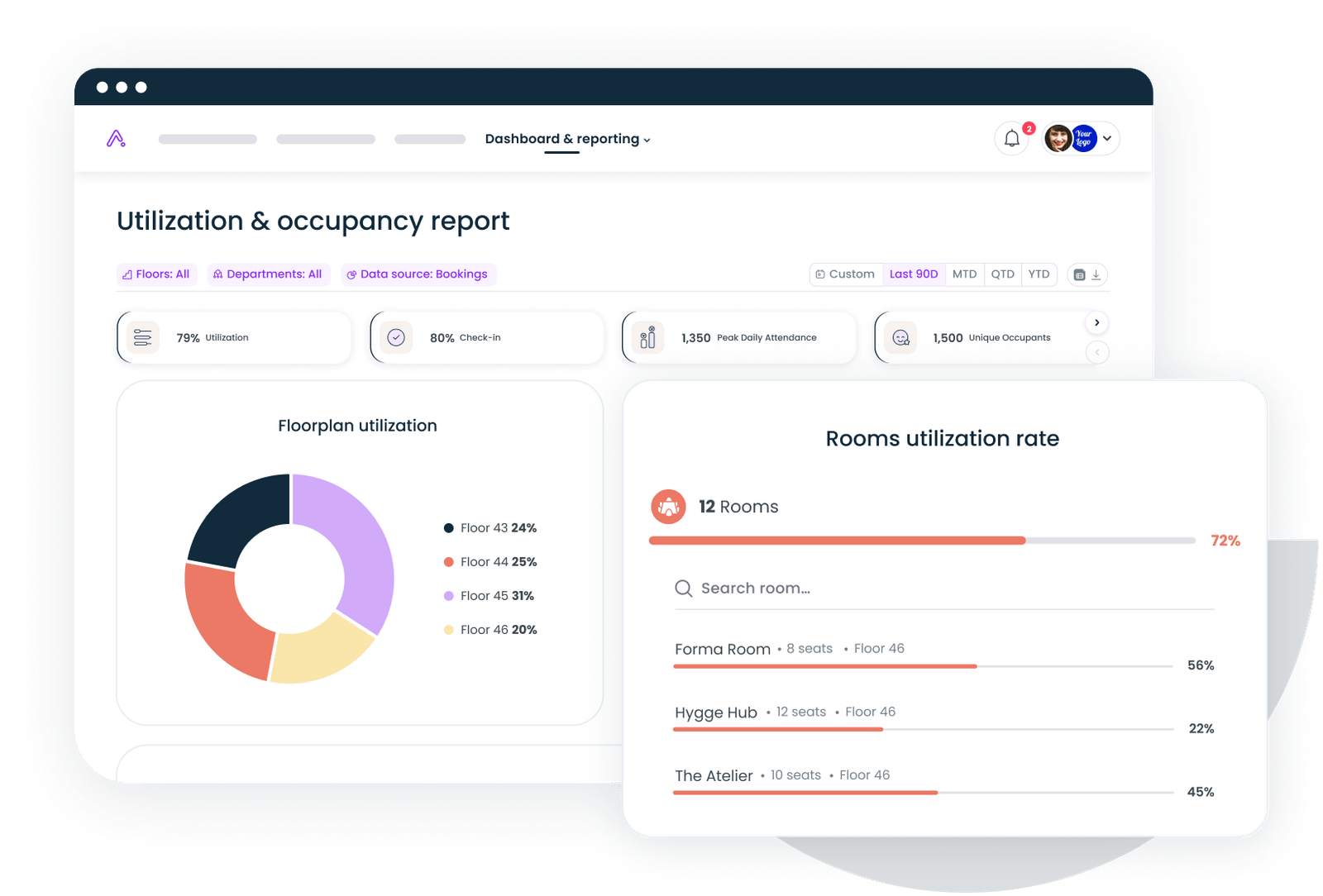
When sensors aren't worth it
Honesty matters here. Sensors aren't always the right call.
Your office is under 5,000 sqft. In a small office, you can observe utilization patterns by walking the floor. The cost of sensor hardware and integration won't pay back when you're managing 30 desks.
Occupancy is consistently below 30%. If your space is clearly underutilized, you don't need sensors to tell you that. You need a lease renegotiation or a consolidation strategy. Sensors help optimize; they don't help when the answer is obviously "too much space."
You have no integration plan. Standalone sensor dashboards become shelfware within six months. If your workplace platform can't ingest sensor data via API, or if you don't have a platform at all, the data will sit in a silo. Fix the platform gap first.
Your building can't support the network. Older buildings with thick concrete walls, limited WiFi coverage, and no PoE infrastructure make sensor deployment expensive and unreliable. Battery-powered sensors help, but you still need reliable wireless connectivity for data transmission.
Budget is tight and payback needs to be under 12 months. Sensor ROI typically takes 12 to 24 months to materialize. If your CFO needs faster returns, focus on software-based utilization tracking (badge data, booking analytics) before adding hardware.
Sensor vendor landscape in 2026
The sensor market has matured significantly. Rather than recommending specific vendors (your needs will vary), here's how the major categories break down.
AI-powered vision platforms (e.g., VergeSense) combine cameras or optical sensors with computer vision to provide occupancy counts, space type classification, and behavioral analytics. VergeSense covers 200M+ sqft across 200+ enterprises, making their benchmark data valuable even beyond the hardware. Best for organizations that want deep analytics and have the privacy framework to support optical sensors.
Radar-based platforms use millimeter-wave radar to detect presence and count occupants without capturing images. They offer strong accuracy with fewer privacy concerns than camera systems. Best for organizations where employee trust is a priority.
Thermal and privacy-first sensors (e.g., Butlr, Disruptive Technologies) detect heat signatures without any ability to identify individuals. They're GDPR-friendly by design, since there's no image data to protect. Best for European deployments or privacy-sensitive cultures.
Environmental sensor specialists (e.g., Milesight, EnOcean ecosystem) focus on air quality, temperature, humidity, and noise. Many use LoRaWAN or Zigbee protocols for low-power, wide-area coverage. Best as a complement to occupancy sensors, not a replacement.
Evaluation criteria that matter:
- API-first architecture (can the data flow into your workplace platform?)
- Sensor accuracy in real-world conditions (ask for pilot data, not lab specs)
- Battery life and maintenance burden at scale
- Data ownership (do you own the raw data, or just access a dashboard?)
- Deployment flexibility (ceiling mount, desk mount, adhesive, magnetic)
Integration requirements: The make-or-break factor
A sensor without integration is an expensive thermometer. The value chain looks like this: sensor captures data → data flows to workplace platform → platform triggers actions → actions save money or improve experience.
Workplace platform integration is the first priority. Your booking system needs to know when a reserved desk is actually empty. Your analytics dashboard needs to combine sensor data with badge swipes and booking records to calculate true utilization, not just "someone was detected." This is where space utilization metrics become actionable rather than theoretical.
Building management system (BMS) integration is the second priority. Sensor data should trigger HVAC adjustments (reduce cooling on empty floors), lighting changes (dim unoccupied zones), and elevator scheduling (prioritize active floors). Most modern BMS platforms accept data via BACnet, Modbus, or REST APIs.
Cleaning and facilities integration is the third priority. Sensor-triggered cleaning replaces fixed schedules. Instead of cleaning every desk every night, your team cleans desks that were actually used. This reduces labor costs by 15% to 25% and improves hygiene by focusing effort where it matters.
Analytics and reporting integration ties everything together. The goal is a single dashboard where your workplace team can see occupancy trends, environmental conditions, booking patterns, and cost-per-seat calculations in one view. Fragmented data across five vendor dashboards defeats the purpose.
When evaluating sensors, ask vendors three questions: What APIs do you expose? What data formats do you support? Can you show me a live integration with my workplace platform? If the answer to any of these is vague, keep looking.
Privacy, employee communication, and compliance
Sensors fail when employees don't trust them. And employees won't trust what they don't understand.
The good news: most sensor types don't collect personally identifiable information. PIR sensors detect heat. Thermal sensors create anonymous heat maps. Radar sensors measure presence. None of these can tell you that Sarah from marketing was at desk 12 from 9:07 AM to 4:32 PM. Camera-based systems are the exception, and they require significantly more governance.
GDPR and privacy regulations apply to sensor data when it can be combined with other data to identify individuals. A desk sensor alone is anonymous. A desk sensor linked to a booking system that records who reserved the desk is potentially identifiable. Your workplace data privacy framework needs to address this combination, not just the sensor in isolation.
What to communicate to employees:
- What sensors are being installed and where (no surprises)
- What data is collected (presence/absence, not identity)
- What data is NOT collected (no video, no audio, no individual tracking)
- Why the data matters (better space, better air quality, less wasted money)
- How the data will be used (aggregate trends, not individual monitoring)
- Who has access to the data (facilities team, not managers)
What not to do:
- Don't install sensors quietly and hope nobody notices. They will notice, and they'll assume the worst.
- Don't use sensor data for performance monitoring. Even if you could, the trust damage isn't worth it.
- Don't deploy camera-based sensors without explicit employee consultation. A town hall or survey before deployment prevents backlash after.
The organizations that deploy sensors successfully treat the rollout as a change management exercise, not a facilities project. The technology is the easy part. The communication is what determines whether employees see sensors as "the company is spying on us" or "the company is investing in making this office better."
The bottom line on smart office sensors
Smart office sensors solve a real problem: you can't manage what you can't measure, and hybrid work made measurement harder. The technology is mature, the costs are reasonable, and the ROI is well-documented for organizations that deploy sensors as part of an integrated workplace system.
The key word is "integrated." Sensors that feed into your workplace platform, BMS, and operational workflows deliver compounding value. Sensors that sit in a standalone dashboard deliver a few interesting charts and a lot of buyer's remorse.
Start with the business question, not the technology. Are you trying to reduce lease costs? Improve air quality? Validate a floor consolidation? Match cleaning schedules to actual usage? The answer determines which sensor categories matter, how many you need, and what integration work comes first.
And if you're not ready for sensors yet, that's fine too. Badge data, booking analytics, and manual observation can get you surprisingly far. Sensors are the next step, not the first one.
From desk booking to occupancy analytics, Gable gives you the platform layer that makes sensor investments pay off.
Get a demo