.svg)


.svg)
- CAFM handles day-to-day facility ops; IWMS adds strategic portfolio management on top
- CAFM deploys in weeks for under $50k; IWMS takes 6-18 months and costs 5-10x more
- Most mid-market hybrid teams are overbuying with IWMS when CAFM (or a workplace platform) fits better
- Feature overlap is real, but the gap widens at 50+ locations
- Start with the problem you're solving today, not the one you might have in three years
If you're comparing IWMS vs CAFM, you're really asking one question: how much of a system do I need? An integrated workplace management system covers everything from lease accounting to capital planning across a global portfolio. A CAFM platform focuses on the operational side: space management, maintenance scheduling, floor plans, and day-to-day facility coordination. The right choice depends on your portfolio size, your team's capacity, and whether your biggest pain is strategic visibility or tactical execution.
The scope difference is the whole ballgame
CAFM and IWMS aren't competing products. They're different scopes of ambition.
CAFM (computer-aided facility management) was built for facility managers running buildings. It handles space allocation, preventive maintenance, asset tracking, and move management. Think of it as the operating system for a building or a small cluster of sites. It's tactical, operational, and designed to make the people managing physical space more efficient.
IWMS wraps all of that in a strategic layer. Lease administration, capital project planning, real estate portfolio analytics, sustainability reporting, and enterprise-wide compliance. It connects facilities data to finance, HR, and IT systems. IBM's overview of IWMS describes it as a platform where real estate, infrastructure, and facility management converge into a single decision-making layer.
Here's the practical difference: if your biggest problem is knowing which desks are booked on Tuesday, CAFM solves that. If your biggest problem is deciding whether to renew a lease in Munich based on occupancy trends across 80 offices, that's IWMS territory.
Where each system wins (and where they overlap)
The overlap between CAFM and IWMS is bigger than most vendor comparison pages admit. Both handle space management. Both do maintenance scheduling. Both track assets. If you're evaluating features in a spreadsheet, you'll find a lot of checkboxes that both systems fill.
The differences show up in depth and integration.
CAFM wins on space operations. Interactive floor plans, CAD integration, seat assignments, and desk booking workflows are where CAFM platforms shine. They're purpose-built for the facility manager who needs to know what's happening on the ground floor right now. Implementation is fast because the scope is contained.
IWMS wins on portfolio strategy. Lease accounting that complies with IFRS 16 and ASC 842, capital expenditure forecasting, multi-currency real estate reporting, and cross-departmental data flows. If your CFO needs a single view of real estate obligations across 12 countries, CAFM won't get you there.
Maintenance is a draw, mostly. Both handle work orders and preventive maintenance scheduling. IWMS adds compliance automation and risk management layers that matter in regulated industries (healthcare, manufacturing, government). For a typical office environment, CAFM's maintenance module is more than sufficient.
Integration is where the gap gets real. CAFM platforms integrate with ticketing systems and basic finance tools, but the connections tend to be one-directional. IWMS platforms are designed as enterprise backbones with two-way sync to ERP, HRIS, and building management systems. The 2026 FM software matrix from Baachu Rain highlights that IWMS implementation complexity and governance requirements scale significantly with integration depth.
When CAFM is the right call
CAFM fits when your problems are operational and your portfolio is manageable.
You're running 1-10 locations. A single headquarters, a handful of regional offices, or a hub-and-spoke model. You don't need portfolio-level analytics because you can see the whole picture without them. Your facility planning needs are straightforward.
Your team is small. You have a facilities manager, maybe a small team, but not a dedicated real estate department with analysts and project managers. CAFM gives that team leverage without burying them in configuration.
Speed matters. CAFM goes live in 4-8 weeks with minimal customization. If you're moving into a new office next quarter and need booking and space management running on day one, an 18-month IWMS implementation isn't an option.
Budget is constrained. Cloud-based CAFM for mid-market teams typically runs $3-$10 per user per month. That's a fraction of what enterprise IWMS platforms cost, and the ROI timeline is measured in weeks, not years.
Hybrid coordination is the primary pain. If your core challenge is getting people into the right spaces on the right days, CAFM's booking and occupancy features solve that directly. You don't need lease accounting to fix a desk utilization problem.

Understand what CAFM systems do, who they're built for, and how to evaluate them before you buy.
Read the guide
When IWMS makes sense
IWMS earns its complexity when the portfolio demands it.
You manage 50+ properties across regions or countries. At this scale, you need centralized visibility into lease obligations, occupancy patterns, and capital expenditure across the entire portfolio. Spreadsheets break. CAFM systems weren't designed for this.
Lease administration is a board-level concern. If your organization carries hundreds of millions in lease obligations, you need IFRS 16/ASC 842 compliance baked into the system, not bolted on. IWMS platforms handle lease auditing and accounting natively.
ESG reporting is mandatory, not aspirational. Investor-grade sustainability reporting requires data flowing from building management systems through a centralized platform. IWMS connects energy consumption, carbon tracking, and compliance reporting in ways CAFM can't.
You have the team and timeline for it. IWMS implementations are consulting-heavy projects. Enterprise IWMS licensing runs $100-500 per user per month plus $100k-$500k or more in implementation consulting. You need a dedicated project team, executive sponsorship, and patience measured in quarters, not weeks.
Cross-departmental data integration is non-negotiable. When Finance needs real estate cost data in SAP, HR needs headcount-to-space ratios in Workday, and Facilities needs maintenance data tied to capital planning, IWMS is the connective tissue.
The third option: Workplace platforms that split the difference
Here's what the IWMS vs CAFM framing misses. A growing number of organizations don't fit neatly into either camp.
You've got 3-15 offices. You need desk booking, room scheduling, visitor management, and occupancy data. You want multi-site visibility without a year-long implementation. You don't have lease accounting needs that justify a six-figure platform, but you've outgrown spreadsheets and standalone point solutions.
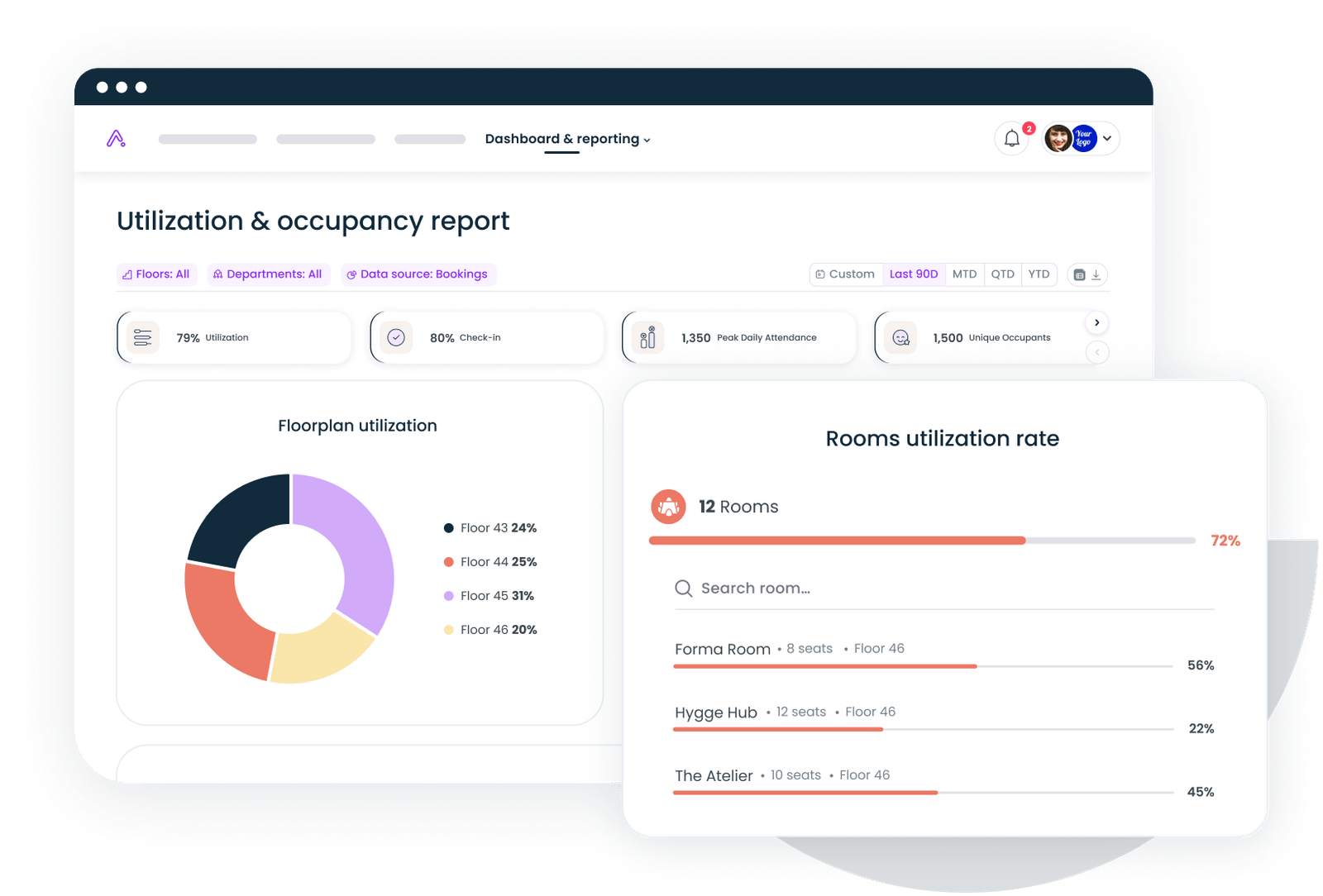
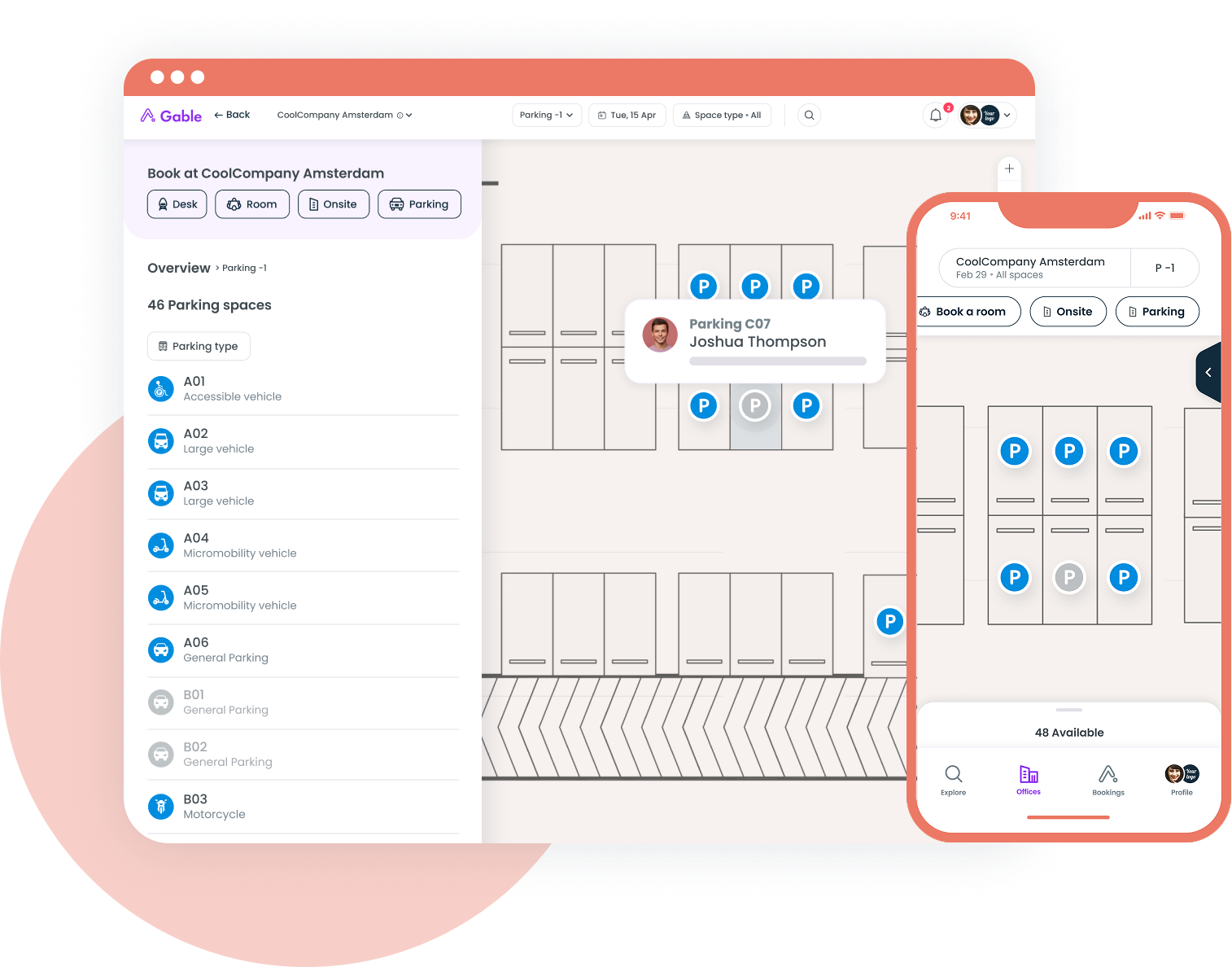
This is where workplace operating systems have carved out a real category. They combine CAFM's spatial intelligence (booking, floor plans, occupancy tracking) with the cross-site analytics that used to require IWMS, minus the enterprise overhead. Gable's office management software is built for exactly this scenario: desk and room booking, visitor management, and utilization data across multiple locations, with implementation measured in days rather than months.
The question isn't always "CAFM or IWMS?" Sometimes it's "do I need either of these legacy categories, or has the problem changed?"
Desk booking, room scheduling, visitor management, and occupancy analytics in one platform, without the IWMS implementation timeline.
Learn more
Integration and data architecture: The hidden decision driver
The system you choose determines your data architecture for years. That's worth thinking about carefully.
CAFM creates a facilities data silo. It's a good silo, well-organized and useful, but it's still a silo. Your space data lives in CAFM, your finance data lives in your ERP, your people data lives in your HRIS, and someone (usually a facilities analyst with too many browser tabs) stitches them together manually. For smaller organizations, this is fine. The manual work is manageable.
IWMS promises a single source of truth. In theory, it connects everything. In practice, achieving that integration requires significant custom development, ongoing maintenance, and a governance model that keeps data clean across departments. The promise is real, but so is the effort.
API maturity varies wildly. Before you commit to either category, audit the vendor's API documentation. Can you pull occupancy data into your BI tool? Can you push headcount changes from your HRIS into space assignments? The answers matter more than the feature list. If you're evaluating workplace technology, put integration requirements in your RFP before feature requirements.
Vendor lock-in is the real risk. IWMS platforms in particular create deep dependencies. Your lease data, maintenance history, space configurations, and compliance records all live in one system. Migrating away from an IWMS is a project measured in years and millions. CAFM's narrower scope makes switching less painful, but it's still not trivial.
Implementation timeline and cost reality
Let's talk numbers, because this is where the decision often gets made.
CAFM implementation:
- Timeline: 4-8 weeks for standard deployment
- Upfront cost: $20k-$50k (implementation, data migration, training)
- Ongoing: $3-$10 per user per month (cloud SaaS)
- Total 3-year cost for a 500-person org: roughly $70k-$230k
IWMS implementation:
- Timeline: 6-18 months (sometimes longer for global rollouts)
- Upfront cost: $100k-$500k+ (consulting, customization, integration, change management)
- Ongoing: $100-$500 per user per month (enterprise licensing)
- Total 3-year cost for a 500-person org: roughly $700k-$3M+
The sticker price isn't the whole story. IWMS implementations require change management across multiple departments. You'll need a project manager, executive sponsor, department liaisons, and probably an external systems integrator. CAFM implementations are typically handled by the facilities team with vendor support.
Here's the question that matters: what's the cost of the problem you're solving? If you're hemorrhaging $2M a year on underutilized space across a global portfolio, a $500k IWMS implementation pays for itself in months. If you're trying to get 200 people to book desks instead of wandering the office, spending $500k is absurd.
A decision framework that actually helps
Skip the feature matrix. Start with these five questions:
1. How many locations do you manage?
Under 10: CAFM or workplace platform. Over 50: IWMS. In between: it depends on the next four questions.
2. Do you have lease accounting requirements?
If your finance team needs IFRS 16/ASC 842 compliance in a dedicated system, you're in IWMS territory. If your leases are managed in a spreadsheet or your ERP's real estate module, CAFM is fine.
3. What's your implementation runway?
If you need something live in 60 days, IWMS is off the table. Period.
4. Who's going to own this system?
A facilities team of 2-5 people? CAFM. A cross-functional team spanning RE, facilities, IT, and finance? IWMS. A workplace ops team that needs workplace analytics without enterprise complexity? Workplace platform.
5. What's your 3-year total budget?
Under $250k: CAFM or workplace platform. Over $500k with executive sponsorship: IWMS is viable.
The real answer is to match the system to the problem
The IWMS vs CAFM debate is really a question about organizational complexity. CAFM solves facility operations. IWMS solves portfolio strategy. Workplace platforms solve the hybrid coordination problem that's driving most of the buying activity in 2026.
Don't buy an IWMS because you might need it someday. Don't settle for a CAFM that can't grow with you. Match the system to the problem you have right now, with a clear-eyed view of where you'll be in three years. The organizations getting this right aren't choosing the most powerful system; they're choosing the one their team will actually use.
Book a 30-minute demo to see how Gable handles desk booking, visitor management, and occupancy analytics across multiple locations.
Get a demo