.svg)


.svg)
- Facility planning is a four-phase cycle, not a one-time project
- Hybrid work broke traditional space assumptions; real-time data fixes them
- Most companies overestimate the space they need by 30% or more
- Technology enables planning but doesn't replace cross-functional alignment
- Start with utilization data you already have, not a six-month consulting engagement
Facility planning used to mean a five-year master plan locked in a binder that nobody opened until the lease was up. That era's over. Growing companies now face a planning environment where headcount projections shift quarterly, office attendance fluctuates by the day, and the cost of getting space wrong (either too much or too little) compounds faster than most finance teams realize.
What facility planning actually means in 2026
The global facilities management market has crossed the trillion-dollar mark and continues to grow at a double-digit pace through 2034. That's not janitorial services and HVAC contracts driving growth. It's the strategic layer: aligning physical space with business objectives, workforce patterns, and financial constraints.
Facility planning encompasses everything from how many square feet you lease to how you configure individual desks on a floor. It's the bridge between your real estate portfolio and your people strategy. At its best, it gives you the right amount of space, in the right locations, designed for the work people actually do, at a cost that doesn't make your CFO flinch.
The distinction from workplace management matters here. Workplace management is the day-to-day operation of your spaces. Facility planning is the strategic framework that determines what those spaces should be in the first place. One is running the train. The other is laying the track.
Where traditional planning falls apart is in its assumptions. Pre-2020 models assumed consistent, predictable occupancy. You'd lease based on headcount, apply a growth factor, and revisit in three to five years. But when nearly half of businesses are transitioning to activity-based workspaces and average office attendance hovers around 3.1 days per week, those static models produce expensive mistakes.
The four phases of the facility planning process
Every facility plan, whether you're opening your second office or restructuring a global portfolio, follows the same four-phase cycle. The phases aren't linear. They loop. But skipping any one of them is how companies end up with beautiful offices nobody uses.
Phase 1: Understand
Start with business context, not floor plans. What are the company's growth projections for the next 12, 24, and 36 months? Which teams are growing? Which are distributed? What does leadership believe about in-person collaboration, and does the data support those beliefs?
This phase also requires workforce demographics. A 200-person engineering team that's 70% remote needs fundamentally different space than a 200-person sales team that's in-office four days a week. Map your teams by function, location, work mode, and growth trajectory before you touch a single space requirement.
Phase 2: Analyze
Gap analysis is where most facility plans either earn their keep or collapse under bad data. You're comparing what you have against what you need.
Pull utilization data from every source available: badge swipes, WiFi connections, booking system records, even manual headcounts if that's what you've got. The goal is understanding not how many people come in, but when they come in, where they sit, how long they stay, and what types of spaces they use.
Common finding at this stage: meeting rooms are booked at 80% capacity but only physically occupied 50% of the time. Ghost bookings. Fifteen-minute "placeholder" meetings that block a room for two hours. This kind of granularity changes your space requirements dramatically.
Phase 3: Plan
Scenario modeling separates reactive facility management from strategic facility planning. Build at least three scenarios: baseline (current trajectory), growth (aggressive hiring), and contraction (budget tightening or attrition). Each scenario should produce a different space requirement, cost projection, and timeline.
This is where budgeting gets real. Cost per square foot varies wildly by market, but the real variable is cost per employee. A company paying $15,000 per employee per year in real estate costs with 40% average utilization is effectively paying $37,500 per occupied seat. That math gets attention in budget reviews.
Phase 4: Act
Implementation works best as a rolling process of executing changes, measuring impact, and adjusting. The companies that get this right treat facility planning as a continuous loop rather than an annual exercise.
Set review cadences. Monthly for utilization metrics. Quarterly for space allocation adjustments. Annually for strategic portfolio reviews. Without this rhythm, even the best plan drifts.

Our complete guide to office space planning breaks down the tactical steps for configuring and optimizing your physical workspace.
Read the guide
Space planning and optimization: the centerpiece of facility planning
Office space optimization is where strategy meets geometry. You've defined your requirements in the planning phases. Now you need to translate them into actual floor configurations that support how people work.
Defining your space categories
Not all square footage is equal. A modern facility plan categorizes space by function:
- Focus space: Individual desks, quiet zones, phone booths
- Collaboration space: Meeting rooms, huddle rooms, team neighborhoods
- Social space: Cafeterias, lounges, informal gathering areas
- Specialized space: Labs, studios, training rooms, executive suites
- Support space: IT closets, storage, mailrooms
The ratio between these categories should reflect your workforce's actual work patterns, not an architect's aesthetic preferences. If your teams spend 60% of their time in collaborative work, but your floor plan allocates 70% to individual desks, you've got a mismatch that no amount of furniture rearranging will fix.
Utilization metrics that matter
Three metrics form the foundation:
Occupancy rate measures how many people are in a space versus its maximum capacity. A 100-seat floor with 40 people on it is at 40% occupancy. Simple enough.
Utilization rate is more nuanced. It measures how much a space is used relative to its availability. A meeting room available 10 hours a day but booked for 3 hours has 30% utilization. If it's only physically occupied during 2 of those 3 booked hours, true utilization drops to 20%.
Dwell time tracks how long people use a space. Short dwell times in large meeting rooms suggest you need more small huddle rooms instead. Long dwell times at individual desks in a hot-desking environment might signal that people want assigned seating.
Common pitfalls
Inaccurate floor plans are the silent killer. Most companies maintain floor plans in PDF or CAD files that were last updated when the space was built out. Desks have been added, walls moved, furniture reconfigured. When your planning data doesn't match physical reality, every decision built on it is wrong.
Data drift is the second problem. You run a utilization study in January, make decisions in March, and by September the data's stale. Seasonal patterns, team restructures, and policy changes all shift utilization. Point-in-time studies give you a snapshot. Continuous data gives you a movie.
Aligning facility planning with hybrid and flexible work
The hybrid work schedule changed facility planning more than any trend in the last fifty years. It didn't reduce average occupancy alone. It made occupancy variable and unpredictable.
Tuesday through Thursday are peak days in most hybrid offices. Monday and Friday often see 30-50% lower attendance. But that's an average. Individual teams have their own patterns. Marketing might cluster on Mondays and Wednesdays. Engineering might come in Tuesday and Thursday. Sales might be scattered across the week.
This variability creates a coordination problem that floor plans alone can't solve. When a team lead doesn't know which teammates will be in the office on a given day, they can't plan collaborative sessions effectively. When a facilities team doesn't know how many people to expect, they can't allocate resources efficiently.
The solution is real-time visibility. Employees need to see when their colleagues plan to be on-site. Facilities teams need to see actual versus expected occupancy across floors and buildings. Managers need to know which days their teams naturally cluster so they can align in-person activities accordingly.
This is where booking systems become planning tools instead of simple reservation engines. Every desk booking, every room reservation, every team coordination event generates data. Over weeks and months, that data reveals patterns that no survey or assumption-based model can match.
The desk ratio question
Most hybrid companies don't need a 1:1 desk-to-employee ratio. But the right ratio depends on your specific attendance patterns. A company with an average of 60% daily attendance might target a 0.7:1 ratio, keeping some buffer for peak days. A company at 40% average attendance could go as low as 0.5:1.
The risk of going too lean is obvious: people show up and there's nowhere to sit. The risk of going too generous is less visible but more expensive: you're paying for space that sits empty most of the time. Data-driven planning eliminates the guesswork from this decision.
Sustainability, compliance, and operational excellence
Facility planning intersects with ESG goals in ways that are increasingly hard to ignore. Buildings account for roughly 40% of global carbon emissions. Your real estate decisions are, by default, sustainability decisions.
Sensor technology can cut energy expenditures by up to 20% in office buildings, primarily by reducing HVAC and lighting in unoccupied zones. But you can't implement occupancy-based energy management without first understanding your occupancy patterns. Facility planning provides the framework; technology provides the execution.
Compliance requirements are expanding too. ADA accessibility, fire safety egress planning, local building codes, and emerging ESG reporting mandates all require accurate, up-to-date facility data. A company that can't produce a current floor plan with accurate seat counts is going to struggle with any of these.
Preventive versus reactive maintenance
Industry research consistently shows that predictive maintenance and historical data use can cut maintenance costs by 25 to 30%. That's a compelling number, but it requires the planning infrastructure to support it. You need asset inventories, maintenance schedules, condition assessments, and a system to track it all.
The shift from reactive ("fix it when it breaks") to preventive ("fix it before it breaks") is a direct output of better facility planning. When you know exactly what equipment serves which spaces, and how those spaces are being used, you can prioritize maintenance budgets where they matter most.
Tools and technology that drive modern facility planning
More than 60% of FM leaders now say digitizing their operations is critical to their strategic goals. That tracks. You can't manage a hybrid workplace with spreadsheets and quarterly headcounts.
The technology stack for modern facility planning typically includes:
Integrated Workplace Management Systems (IWMS) handle the portfolio-level view: lease management, capital planning, maintenance workflows. These are enterprise systems, often expensive and complex to implement.
Space management software focuses on the floor-level: interactive floor plans, desk and room booking, utilization dashboards. This is where most growing companies start because the ROI is immediate and visible.
Occupancy sensors and IoT provide the ground-truth data layer: badge swipes, WiFi connections, infrared counters, desk sensors. The data quality from these sources far exceeds manual surveys or booking data alone.
AI and predictive analytics sit on top of everything else, turning raw data into forecasts and recommendations. When your AI can tell you that Floor 3 will hit 15% occupancy next Friday based on historical patterns and current bookings, you can proactively adjust HVAC schedules, cleaning rotations, and team assignments.
The key integration point that most companies miss is connecting HR data with space data. When your facility planning tools know which teams are growing, which employees are in which locations, and what the hybrid policy says about required in-office days, the planning recommendations get dramatically more accurate. Gable Offices handles this by connecting interactive floor plans, booking, and occupancy analytics with HRIS, calendar, and access control data, so the planning layer and the operational layer share a single source of truth.
Gable Offices brings together desk booking, room scheduling, floor plans, and occupancy insights in one platform built for hybrid teams.
Learn more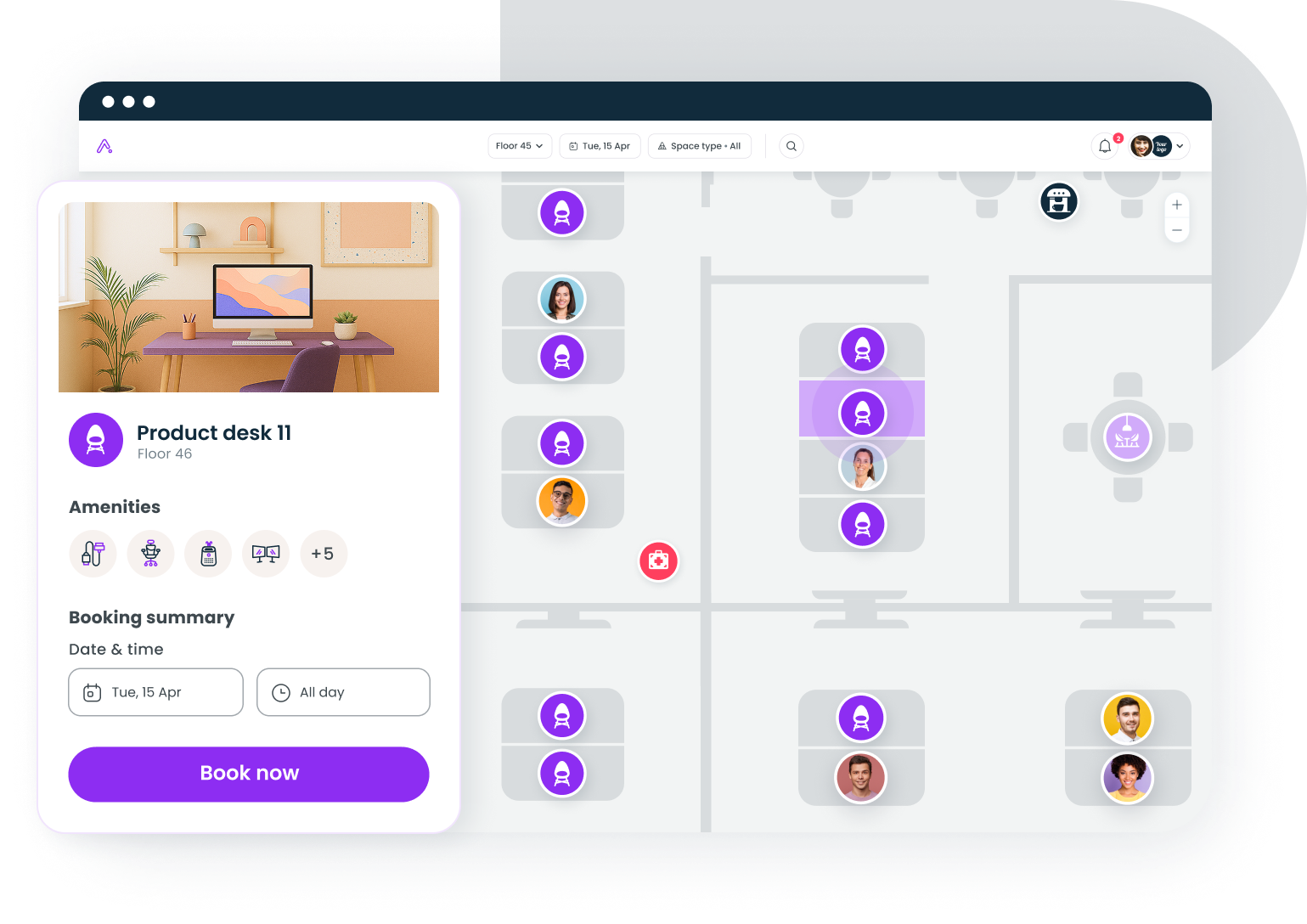
Real-world facility planning challenges and how to solve them
Challenge 1: Your space data is wrong
Every facility manager I know has inherited a floor plan that doesn't match reality. Desks that were removed six months ago still show up. A conference room that was split into two huddle rooms is still listed as one. The "quiet zone" has been a storage area since last quarter.
A one-time audit won't solve this. You need a system that keeps data current by design. When every desk booking, every room reservation, and every floor plan change flows through a single platform, your data stays accurate without manual reconciliation.
Challenge 2: Budget constraints versus growth needs
You need more space to support a growing team, but the CFO is cutting real estate costs by 15%. This is the fundamental tension of facility planning at a growing company.
The lever most people miss: utilization improvement. If your current space is at 55% average utilization, you may not need more square footage. You need better-utilized square footage. Reconfiguring underused areas, adjusting desk ratios, and implementing activity-based zones can effectively "create" space without signing a new lease.
Challenge 3: Cross-departmental buy-in
Facility planning fails when it's treated as a Facilities-only problem. HR cares about employee experience. IT cares about infrastructure. Finance cares about cost per seat. Leadership cares about culture. Operations cares about efficiency.
The solution is a shared data set. When every stakeholder can see the same utilization dashboards, cost breakdowns, and occupancy trends, the conversation shifts from opinions to evidence. Nearly half of real estate and facilities directors rate improving occupant comfort as a top priority, which means HR and Facilities are often aligned but don't realize it because they're looking at different data.
Challenge 4: Proving ROI
"We saved money on real estate" is the obvious metric. It's far from the only one worth tracking.
Build your ROI case across four dimensions:
- Real estate cost reduction: Lease savings, avoided expansion
- Operational efficiency: Reduced admin time, lower maintenance costs
- Employee experience: Satisfaction scores, retention rates
- Environmental impact: Energy reduction, carbon footprint
The companies that secure ongoing budget for facility planning are the ones that report across all four dimensions, not only the first.
Getting started: your facility planning roadmap
Week 1-2: Audit what you have
Pull every data source available. Badge data, WiFi logs, booking records, lease terms, floor plans. Don't worry about perfection. You're establishing a baseline. If your current data is "we have 3 floors, roughly 200 desks, and people seem to come in on Tuesdays," that's a starting point.
Month 1: Align stakeholders
Schedule a 90-minute working session with representatives from HR, Finance, IT, and Facilities. Share the baseline data. Ask three questions: What are the biggest pain points with our current space? What changes do we anticipate in the next 12 months? What would success look like?
Document the answers. You now have a shared brief that every stakeholder helped write.
Month 2-3: Implement measurement
Deploy the tools needed to capture continuous utilization data. This might be a booking system, occupancy sensors, or integration with existing badge and WiFi infrastructure. The goal is moving from point-in-time snapshots to continuous measurement.
Month 3-6: Analyze and model
With 60-90 days of continuous data, you can build meaningful utilization models. Identify peak and trough patterns. Calculate actual desk ratios needed. Model scenarios for team growth, contraction, and restructuring.
Month 6+: Execute and iterate
Implement your first round of changes. Reconfigure a floor, adjust desk ratios, pilot a new booking policy. Measure the impact. Adjust. Repeat.
Companies that treat facility planning as a continuous discipline rather than a project with a completion date consistently spend less on real estate, score higher on workspace satisfaction surveys, and adapt faster when headcount or policy shifts.
The bottom line on facility planning
Every square foot you're paying for that nobody uses is a line item that could fund another hire, another team offsite, or another quarter of runway. The FM software market is on track to reach multi-billion-dollar scale, a clear signal of how many organizations are betting on data-driven facility planning.
The gap between companies that plan their facilities strategically and those that wing it grows wider every quarter. It shows up in real estate costs that are 20-30% higher than necessary, in employee satisfaction scores that lag peers, and in executive frustration when the "return to office" mandate produces a half-empty building.
Start with data. Align your stakeholders. Build a system that measures continuously, not annually. Those three steps create the foundation for every facility decision that follows.
See how Gable helps workplace leaders optimize space, coordinate hybrid teams, and make real estate decisions backed by real data.
Get a demo