.svg)


.svg)
- Most commercial lease reconciliations contain billing errors worth recovering
- Five signals tell you it's time to audit: post-renewal, occupancy shifts, CAM spikes, vague statements, closing windows
- Triple-net, gross, and modified-gross leases each have different audit priorities
- Professional auditors typically work on contingency, so there's no cost if they find nothing
- Occupancy data from your own systems is your strongest evidence in a dispute
A lease audit is a line-by-line review of what your landlord charges you versus what your lease actually requires them to charge. If you manage commercial real estate and you haven't audited your leases recently, you're almost certainly overpaying. 40% of CAM reconciliations contain errors, and the average recovery runs 15-20% of annual CAM billed. This guide walks you through when to trigger an audit, what to check for each lease type, what recovery looks like in practice, and when it makes sense to bring in a professional.
Why lease audits matter for CRE teams
Real estate is typically the second or third largest line item on a company's P&L. Yet most organizations treat their landlord's annual reconciliation statement like a utility bill: it arrives, finance pays it, nobody questions the math.
That's a problem. Landlords aren't trying to defraud you (usually). But property management accounting is complex, error-prone, and stacked with judgment calls that tend to break in the landlord's favor. Management fee calculations, pro-rata share denominators, capital versus operating expense classifications, gross-up methodologies: each one is a place where a reasonable interpretation can cost you tens of thousands of dollars.
The math gets worse at scale. If you're managing a corporate real estate portfolio across multiple locations, small per-lease errors compound into serious money. A 3% overcharge on a single 50,000 SF lease at $25/SF in CAM equals $37,500 per year. Multiply that across five or ten locations and you're looking at six figures walking out the door annually.
A lease audit catches those errors. It also creates leverage for your next renewal negotiation and establishes a pattern of accountability that tends to reduce future overcharges. Think of it as preventive maintenance for your corporate real estate strategy.
5 signals you should audit your lease right now
Not every lease needs an audit every year. But certain triggers should move an audit from "someday" to "this quarter." Here are the five most reliable signals.
1. You just renewed or renegotiated
Post-renewal is the single best time to audit. New terms create new baselines, and landlords sometimes carry forward old calculation errors into the new lease period. If your base year changed, your escalation caps shifted, or your square footage was remeasured, every downstream number needs to be rechecked.
2. Building occupancy or ownership changed
When a building changes hands or loses a major tenant, landlords recalculate pro-rata shares and may apply vacancy-based gross-ups. These recalculations are where some of the largest errors hide. If you're tracking office occupancy rates in your own spaces, you already have data that can validate or challenge the landlord's occupancy assumptions.
3. CAM or operating expenses jumped 20%+ year over year
A sudden spike in pass-through charges deserves scrutiny. Sometimes it's legitimate (new roof, insurance market hardening). Sometimes it's a capital expense that should have been amortized over its useful life instead of expensed in a single year. You won't know which until you look.
4. Your reconciliation statement lacks itemization
If your annual reconciliation arrives as a single number with minimal backup, that's a red flag. Lease audit clauses typically entitle you to detailed general ledger support. A landlord who provides only summary-level data may be hoping you won't ask questions.
5. Your audit window is about to close
This is the most urgent trigger. Most leases allow audits of 2-4 prior years, and that window is a hard contractual deadline. Once it closes, overcharges from those years are gone forever, no matter how large. Check your lease's audit clause now. If you're within six months of losing a year, start immediately.
Audit checklist by lease type
The specific items you audit depend on your lease structure. Here's what to prioritize for each type.
Triple-net (NNN) leases
Triple-net leases pass through CAM, real estate taxes, and insurance. They're the most audit-intensive because you're paying for nearly everything.
Priority checklist:
- Pro-rata share calculation. Verify the denominator (total leasable area) matches the building's actual GLA. Landlords sometimes use inconsistent measurements.
- CAM exclusion list. Your lease likely excludes certain costs from the CAM pool (leasing commissions, capital improvements, landlord's corporate overhead). Confirm none of those appear in the reconciliation.
- Management fee cap. Most NNN leases cap management fees at 3-5% of operating expenses. Verify the fee is calculated on the correct base and doesn't exceed the cap.
- Capital vs. operating expense classification. A new HVAC system is a capital expense that should be amortized. If it shows up as a single-year operating expense, you're overpaying.
- Real estate tax appeals. If the landlord won a tax appeal and received a refund, your pro-rata share of that refund should appear as a credit.
- Insurance allocation. Confirm you're not paying for coverage on areas outside your pro-rata share (landlord's office, vacant space).
If you're evaluating whether your current lease structure still makes sense, comparing office lease vs. coworking costs can help frame the total cost picture.
Gross leases
Gross leases bundle most operating costs into base rent, but they typically include escalation clauses tied to a base year.
Priority checklist:
- Base year definition. The base year establishes the landlord's cost baseline. If the building was partially vacant during the base year, the landlord may have "grossed up" expenses to simulate full occupancy. Verify the gross-up methodology matches the lease terms.
- Escalation calculations. Confirm year-over-year increases are calculated correctly against the base year, not compounded.
- Expense stop accuracy. If your lease uses an expense stop instead of a base year, verify the stop amount and confirm only eligible expenses count toward the overage.
- CPI adjustments. If rent escalations are tied to CPI, verify the index used, the measurement period, and the math.
Modified-gross leases
Modified-gross leases split costs between landlord and tenant in ways that vary by deal. They're the trickiest to audit because there's no standard allocation.
Priority checklist:
- Allocation methodology. Confirm which expenses are your responsibility and which are the landlord's. Ambiguity here is where errors breed.
- Hybrid calculations. Some modified-gross leases pass through certain categories (utilities, janitorial) while bundling others into base rent. Verify each category is handled per the lease.
- Utility submetering. If you're paying for utilities directly, confirm the submeter readings match your actual consumption. If you're paying a pro-rata share, verify the allocation method.
Regardless of lease type, having accurate space utilization data strengthens your position. When you can show your actual occupancy patterns, you have evidence to challenge inflated gross-up assumptions or pro-rata calculations that don't reflect reality.

Lease audits are one piece of the puzzle. This guide covers the full spectrum of strategies for reducing CRE spend while maintaining a workplace people actually want to use.
Read the guide
Common overcharges and typical recovery amounts
Knowing what to look for is half the battle. Here are the error categories that show up most often, ranked roughly by frequency and dollar impact.
Management fee overcharges
This is the single most common error. Landlords calculate management fees as a percentage of total operating expenses, but they sometimes include items in the base that should be excluded (capital costs, above-standard tenant services). A seemingly small percentage-point error on a large expense base adds up fast.
Pro-rata share denominator errors
Your pro-rata share is your leased square footage divided by the building's total leasable area. If the landlord uses the wrong denominator (say, 95,000 SF instead of 100,000 SF), every pass-through charge is inflated by roughly 5%. This error persists year after year until someone catches it.
Gross-up violations
Gross-up clauses let landlords adjust variable expenses to reflect hypothetical full occupancy. The problem: some landlords gross up fixed costs (real estate taxes, insurance) that don't actually vary with occupancy. If your lease limits gross-ups to variable expenses only, this is recoverable.
Capital expenses incorrectly expensed
A new parking lot, roof replacement, or elevator modernization is a capital improvement. It should be amortized over its useful life (typically 10-15 years), not charged to tenants as a single-year operating expense. This is one of the highest-dollar errors when it occurs.
Non-allowable or ownership expenses
Landlord's legal fees for lease disputes with other tenants. Marketing costs to attract new tenants. Executive compensation. These are ownership expenses that most leases explicitly exclude from the CAM pool. They show up in reconciliations more often than you'd expect.
What recovery actually looks like
Tenants typically recover 3-5% of annual occupancy costs through professional CAM audits. On a lease with $500,000 in annual occupancy costs, that's $15,000-$25,000 per year. Over a 10-year lease term with a 3-year lookback, a single audit can recover $45,000-$75,000.
The recovery isn't always a check. Sometimes it's a credit against future rent. Sometimes it's a correction to the base year that reduces every future escalation. The compounding effect of a base-year correction can be worth more than the direct recovery.
When to hire a third-party auditor
You can audit a lease yourself if you have the accounting expertise and the time. But for most CRE teams, the question isn't whether to hire a professional; it's when the ROI justifies it.
The cost structure
Professional audit firms charge $2,000-$5,000 upfront plus 25-33% of recoveries. Contingency-only firms charge nothing upfront but take 30-50% of whatever they recover. If they find nothing, you pay nothing.
For leases with annual CAM above $15,000, the math almost always works. Even at a 50% contingency split, recovering $20,000 puts $10,000 back in your pocket for zero upfront cost.
DIY Vs. professional: When each makes sense
DIY works when:
- You have in-house CRE or accounting staff with lease audit experience
- The errors are obvious (excluded expenses appearing in reconciliation, wrong square footage)
- You have a single location with a straightforward NNN lease
Hire a professional when:
- You manage multiple locations (the complexity multiplies)
- Your lease has unusual provisions (percentage rent, TI reconciliations, complex gross-up formulas)
- You need negotiation leverage (professional auditors carry credibility landlords respect)
- You've never audited before (the first audit on a long-running lease almost always finds something)
What auditors need from you
Professional auditors will ask for lease abstracts, reconciliation statements, general ledger detail, and occupancy records. The faster you can provide these, the faster the audit moves. If you're using office management software to manage desk booking and space utilization, you already have structured occupancy data that auditors can use to validate pro-rata calculations and challenge gross-up assumptions. That saves them time and focuses the engagement on high-impact errors.
Accurate occupancy data strengthens your position in lease audits and renewal negotiations. Gable Offices gives you desk booking, room scheduling, and utilization analytics in one platform.
Learn more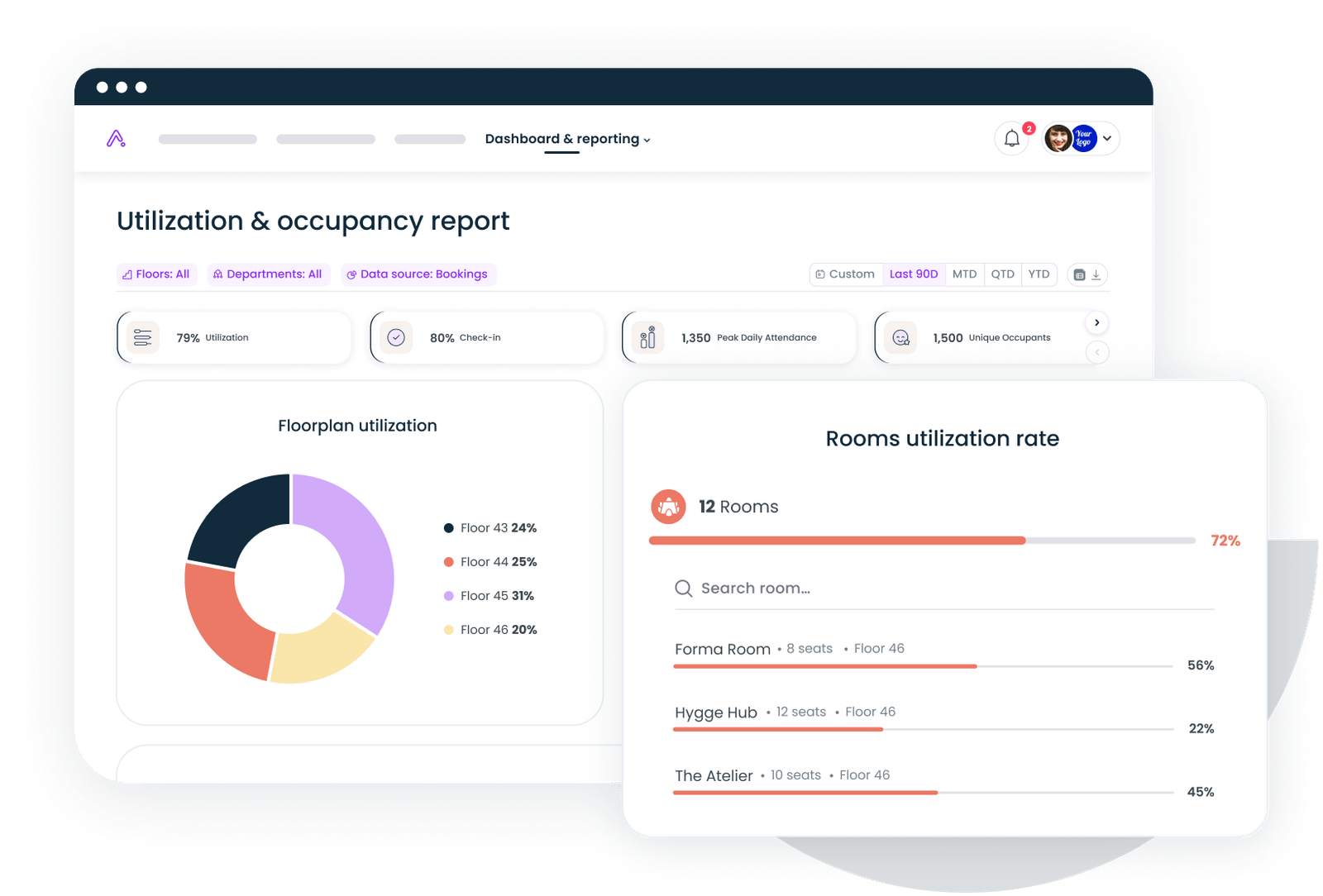
Step-by-step audit process and timeline
A lease audit isn't a weekend project. Comprehensive audits take 3-6 months from kickoff to resolution, depending on document availability and how cooperative the landlord is. Here's the typical sequence.
Step 1: Review your audit clause (week 1)
Before you do anything else, read your lease's audit clause. It specifies:
- Who can audit. Some leases require a CPA. Others allow any representative.
- Notice requirements. Most leases require written notice of intent to audit, typically 30-60 days before the audit begins.
- Timing window. You usually have 30-180 days from receiving the reconciliation statement to initiate a dispute.
- Lookback period. How many prior years you can audit (typically 2-4).
- Confidentiality. Some clauses restrict you from sharing findings with other tenants.
Step 2: Send formal audit notice (week 2-3)
Draft and send a written notice per your lease requirements. Be specific about which reconciliation years you're auditing. Keep the tone professional; this is a contractual right, not an accusation.
Step 3: Request records (week 3-6)
Request the landlord's general ledger detail, invoices, contracts with service providers, tax bills, insurance policies, and any other supporting documentation for the reconciliation years in question. Landlords are required to provide this, but they don't always move quickly. Follow up in writing.
Step 4: Desk audit (week 6-12)
This is the analytical phase. Your auditor (or your team) reviews every line item against the lease terms. They're looking for the error categories described above: management fee overcharges, pro-rata errors, capital misclassifications, non-allowable expenses, gross-up violations.
If you're managing a right-sizing initiative alongside the audit, the utilization data you've gathered for space planning doubles as evidence for challenging occupancy-based charges.
Step 5: Field audit (if needed, week 12-16)
For complex audits, the auditor may visit the property to verify physical conditions: actual square footage, condition of common areas, capital improvements claimed. This step isn't always necessary but can be decisive for large-dollar disputes.
Step 6: Findings report and negotiation (week 16-24)
The auditor presents findings to the landlord's property management team. Negotiation follows. Most disputes settle without litigation. The landlord either issues a credit, adjusts the base year, or corrects the methodology going forward. Sometimes all three.
Timing matters
January through May is peak reconciliation season, with 80-90% of annual reconciliation statements arriving during that window. If you're going to audit, start planning in Q4 so you're ready to act when statements arrive. Waiting until summer means you've already lost months of your dispute window.
How to maximize recovery and protect your audit rights
Running an audit is one thing. Getting the most out of it requires some strategic thinking.
Audit before you renew
The best time to audit is 6-12 months before your lease renewal. Audit findings give you concrete negotiation leverage: "Your reconciliation overcharged us by $47,000 over three years. Let's discuss how the new lease prevents that." This approach turns a backward-looking exercise into forward-looking savings.
If you're preparing for lease negotiations, an audit gives you data that shifts the conversation from opinions to facts.
Don't let audit windows expire
This bears repeating. Your lease gives you a finite window to challenge each reconciliation year. Mark those deadlines in your calendar the day each reconciliation statement arrives. If you manage multiple locations, build a tracking system. Missing a deadline by one day means that year's overcharges are permanently unrecoverable.
Use findings to fix the methodology, not just recover cash
A one-time credit is nice. A corrected base year or calculation methodology saves you money every year for the remaining lease term. Always push for systemic corrections alongside direct recovery.
Document everything
Keep copies of every notice, request, response, and finding. If the same errors recur in future years, your documentation establishes a pattern that strengthens your position. It also protects you if the dispute escalates.
Build audit into your annual CRE calendar
Lease audits shouldn't be reactive. Build them into your annual workplace analytics rhythm alongside occupancy reviews, budget planning, and renewal timelines. The organizations that audit consistently recover more over time because landlords know they're paying attention.
Making lease audits part of your CRE operating rhythm
A lease audit isn't a one-time project. It's a recurring discipline that belongs in the same category as financial close, budget review, and portfolio optimization. The companies that treat it that way consistently spend less per square foot than those that don't.
The core ingredients are straightforward: know your lease terms, track your deadlines, maintain clean occupancy data, and don't accept reconciliation statements at face value. Whether you do the work in-house or hire a professional, the ROI is almost always positive. The only lease audit that doesn't pay for itself is the one you never run.
From occupancy tracking to utilization analytics, Gable gives you the workspace data that strengthens lease audits, renewal negotiations, and portfolio strategy.
Get a demo