.svg)


.svg)
Corporate real estate strategy has evolved from a back-office function into a critical driver of competitive advantage. In 2026, with demand for office space projected to be 20% lower than 2019 levels and workplace flexibility becoming a baseline requirement, organizations need a strategic, data-driven approach to managing their real estate portfolios.
This guide covers everything you need to build a corporate real estate strategy that reduces costs, supports hybrid work, and aligns with broader business objectives.
What is corporate real estate strategy?
Corporate real estate strategy is the systematic approach to managing, optimizing, and aligning an organization's physical assets with its business goals. This encompasses owned and leased properties used for business operations, including offices, warehouses, data centers, manufacturing facilities, retail spaces, and laboratories.
Unlike commercial real estate, which focuses primarily on generating income through rental revenue or property appreciation, corporate real estate management emphasizes how effectively spaces support business functions, employee productivity, and organizational objectives.
A comprehensive corporate real estate plan addresses property acquisition, space utilization, facilities management, lease management, portfolio management, operational efficiency, and long-term strategic planning. Effective corporate real estate portfolio management requires blending strategic planning, financial acumen, and operational efficiency with a deep understanding of how workplace strategy impacts business outcomes.
Why corporate real estate strategy is important
The landscape has fundamentally changed. Organizations with rigid, long-term lease commitments struggled to adapt during the pandemic, while those with flexible portfolio strategies pivoted quickly to meet evolving needs. Today, corporate real estate can save companies up to $11,000 per employee annually through optimization enabled by hybrid work models, according to research from Global Workplace Analytics.
Workplace flexibility is now a baseline requirement, with offices designed to support collaboration and well-being rather than simply providing desk space. Many organizations find they can reduce their real estate footprint by 20-30% without impacting employee experience by aligning space supply with actual demand. The key is using data-driven insights to make informed decisions about portfolio composition, space allocation, and workplace design.
Forward-thinking firms are reallocating portfolios toward high-growth sectors like data centers and advanced manufacturing hubs to align with global AI and supply chain demand. Organizations are creating "curated experiences" in workplaces to enhance employee engagement and loyalty while achieving cost savings. An agile corporate real estate strategy allows companies to pivot quickly for market entries or divestments without being hindered by rigid property holdings.
Core components of a strategic corporate real estate plan
Aligning real estate strategies with business objectives
Your corporate real estate plan must start with a clear understanding of your organization's broader business objectives. Whether your focus is rapid market expansion, innovation, cost reduction, or operational efficiency, real estate decisions must support the organization's broader mission. This alignment requires ongoing collaboration with executive leadership, finance teams, and operational managers to ensure your real estate portfolio enables rather than constrains business strategy.
High-quality, well-located workspaces in talent clusters reduce costs associated with employee turnover, which can be up to 20% of annual salary. Companies creating flexible, attractive office environments see employee satisfaction increase by 65%, with work-life balance cited as a primary driver of retention, according to research from McKinsey.
Space utilization and portfolio optimization
Corporate real estate portfolio optimization is essential for identifying and addressing underperforming assets. Space optimization involves analyzing occupancy data, usage patterns, and employee preferences to right-size the portfolio. Leading organizations are adopting dynamic "elastic portfolios" that can be scaled according to real-time data, enabling faster capital redeployment.
Workplace analytics tools provide real-time visibility into how spaces are actually used, moving beyond assumptions to data-driven decision making. Many organizations discover significant portions of their office space remain underutilized, particularly conference rooms and individual workstations in traditional layouts. Continuous monitoring and optimization of corporate real estate assets ensure alignment with evolving business needs.

Learn how workplace analytics, flexible seating arrangements, and data-driven space optimization strategies help companies align supply with demand while improving collaboration and cutting costs.
Read more
Technology integration for operational efficiency
Technology plays a pivotal role in commercial real estate management optimization by streamlining operations, enhancing data accuracy, and enabling data-driven decision-making. Integrated workplace management systems (IWMS), Internet of Things (IoT) sensors, and artificial intelligence (AI) are revolutionizing how companies manage their real estate portfolios.
The integration of Wi-Fi tracking, Internet of Things (IoT) devices, and temperature sensors is improving office space management by enabling real-time monitoring of conference rooms and hybrid spaces. Advanced software solutions facilitate efficient lease management, financial reporting, and property maintenance. Data analytics platforms provide insights into market trends and asset performance, aiding in strategic planning.
Technology such as property management software can automate lease administration, financial reporting, and tenant communication, reducing administrative overhead while improving accuracy. Data-driven insights enable proactive maintenance, leading to improved operational efficiency and reduced downtime in corporate real estate management.
Financial metrics and cost savings
A robust corporate real estate plan requires clear financial objectives that define the role of the real estate portfolio in achieving profit goals. This includes evaluating costs, identifying opportunities for consolidation, and optimizing lease terms. Organizations should track net operating income, capital expenditures, occupancy rates, cost per square foot, and other key performance indicators.
Monitoring lease expiration dates across the portfolio helps plan for renewals, relocations, or consolidations. Analyzing market value against current rental rates reveals opportunities for cost reduction. Effective space management and strategic planning for corporate real estate investment are crucial for optimizing returns and minimizing risks. Companies must also consider cash flow implications, tax advantages, and how portfolio decisions impact the balance sheet.
Sustainability practices and ESG considerations
Sustainability has become a key consideration in corporate real estate management. Adopting sustainable practices reduces carbon footprint and enhances brand reputation while contributing to long-term cost savings. Sustainable strategies such as energy-efficient building designs, improved air quality systems, and reduced waste directly impact operational costs.
Sustainability practices are gaining traction in corporate real estate, focusing on energy consumption and green building certifications. Organizations implementing sustainability initiatives position themselves favorably with investors, customers, and employees who increasingly prioritize environmental responsibility. Companies must balance sustainability goals with operational requirements and financial constraints.
Lease management and flexible lease agreements
Effective lease administration is crucial for corporate real estate portfolio management. Organizations must analyze lease terms for options related to expansion, termination, and capacity for growth. Flexible lease agreements allow businesses to adjust their footprint quickly in response to market conditions or workforce changes.
Organizations are using adaptive reuse strategies, such as retail-to-medical retrofits, to enter high-demand markets faster and with lower capital outlay. Understanding rental income potential, lease negotiation strategies, and market dynamics enables better decisions about whether to own or lease specific properties. Monitoring lease expiration dates and planning proactively prevents costly last-minute decisions.
Building your corporate real estate strategic planning process
Assembling the right team
Successful corporate real estate management requires collaboration across various stakeholders, including finance, operations, human resources, and IT. This cross-functional team ensures real estate strategies align with broader business objectives and consider all relevant factors from technology infrastructure to employee needs.
Include representatives who understand both current operations and future business projections. This team should meet regularly to review portfolio performance, discuss emerging needs, and adjust strategy based on changing market conditions or business priorities. External expertise from tenant representation brokers or real estate consultants can provide valuable market insights and negotiation leverage.
Conducting comprehensive assessments
Begin with a thorough audit of your current real estate portfolio. Document all owned and leased properties, including location, size, lease terms, operating costs, market value, and current utilization rates. Analyze occupancy data to understand how spaces are actually being used versus allocated capacity.
Assess the functional appropriateness of each property for current business operations. Does the layout support collaboration? Are conference rooms sized appropriately? Do locations align with where employees actually live? This assessment should also evaluate physical condition, technology infrastructure, and compliance with safety, accessibility, and environmental standards.
From flexible seating to conference room scheduling, Gable helps you create offices people want to visit while reducing real estate costs by up to 30%. Discover how companies like Snowflake and Upwork are reimagining their corporate real estate strategies.
Learn more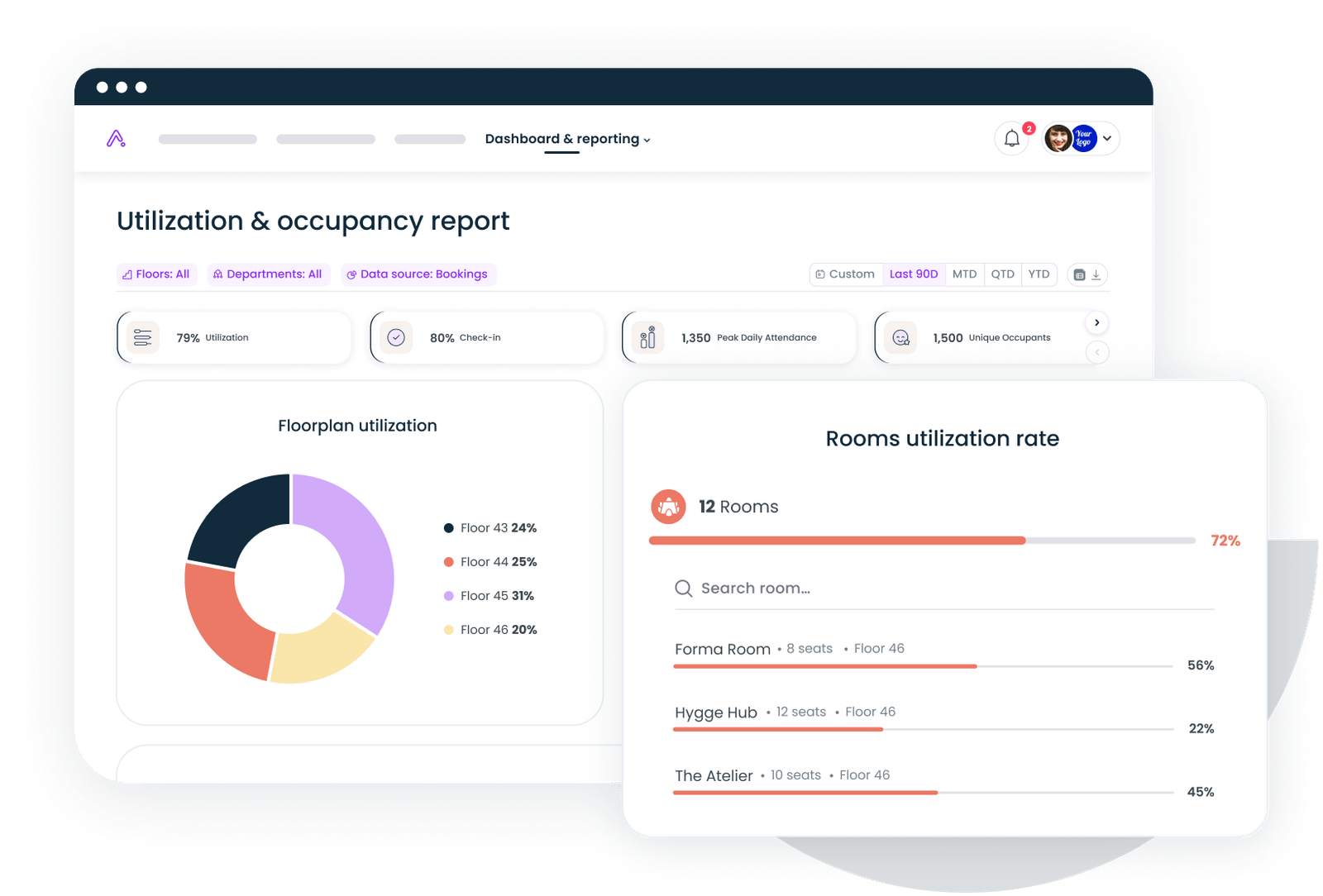
Benchmarking key performance indicators
The strategic planning process must include thorough benchmarking of key performance indicators against market and competitive standards. Compare your lease rates to market rates, analyze space efficiency per person, evaluate the current market value of owned facilities, and assess energy efficiency across locations.
Effective data-driven insights can paint a clear picture of space utilization, operational efficiency, and energy performance. Use this information to identify properties that may be candidates for disposition, consolidation, or renovation. Organizations should also benchmark amenities, technology infrastructure, and workplace design against competitors to ensure they can attract and retain talent.
Setting clear objectives and financial targets
Based on your assessment and benchmarking, establish specific, measurable objectives for your corporate real estate strategy. These should focus on reducing occupancy costs, achieving environmental sustainability, and fostering a flexible work environment that supports both in-office and remote work models.
Develop financial summaries that outline the implications of your plan over five years, including costs by location and year, with adjustments for inflation and market volatility. Create detailed project plans with timelines, budgets, and specific actions for major initiatives like office consolidations, lease renewals, and facility upgrades.
Implementing corporate real estate best practices for hybrid work
Designing for flexibility and collaboration
In 2026, employees value work-life balance above almost everything else, with 65% citing it as a primary driver of retention. Organizations must design workplaces that employees actually want to visit rather than requiring attendance through rigid mandates. This means creating "commute-worthy" offices with spaces optimized for collaboration, innovation, and connection rather than individual-focused work that can happen anywhere. Learn more about implementing hybrid work models that balance flexibility with purposeful in-office experiences.
Consider implementing activity-based working environments where different space types support different work modes. Provide quiet focus areas, collaborative zones, social spaces, and technology-enabled meeting rooms. Many organizations are reducing assigned seating in favor of hotel desking or hoteling systems that let employees book the workspace they need for that day.
Leveraging workplace analytics and AI
Data analytics platforms provide insights into market trends and asset performance, aiding in strategic planning. Real-time occupancy monitoring, space utilization analysis, and predictive analytics enable portfolio managers to make informed decisions about space allocation and future real estate needs.
Organizations using workplace analytics tools provide real-time visibility into how spaces are actually used, moving from assumptions to evidence-based decision making. These platforms track occupancy patterns, space booking trends, peak usage times, and employee preferences to identify optimization opportunities. Machine learning algorithms can predict future space needs based on historical patterns and business projections.
Managing distributed portfolios strategically
Organizations with diversified portfolios across multiple markets face unique challenges in corporate real estate portfolio management. Each market has different dynamics regarding availability, pricing, talent density, and business opportunity. Your strategy must account for these variations while maintaining consistent standards and practices.
Consider a hub-and-spoke model where major offices serve as anchors while satellite locations or flexible workspace partnerships provide presence in secondary markets. Many organizations are shifting from large headquarters to distributed networks of smaller offices closer to where employees actually live, reducing commute times and improving work-life balance.
Optimizing the tenant experience
The employee experience in your facilities directly impacts productivity, satisfaction, and retention. Beyond basic functionality, consider what amenities, services, and design elements make your workplaces attractive destinations. This might include quality food options, fitness facilities, outdoor spaces, natural light, ergonomic furniture, and technology that actually works.
Facilities management responsibilities extend beyond maintenance to creating environments that support well-being and enable great work. Organizations that invest in workplace experience see measurable returns through improved employee engagement, reduced turnover, and enhanced ability to attract top talent.
The future of CRE strategy
Emerging trends and market dynamics
The shift to hybrid work has permanently changed corporate real estate needs, with demand for office space expected to be 20% lower by 2030 compared to 2019, according to McKinsey research. However, this doesn't mean real estate becomes less important. Instead, the focus shifts from quantity to quality, from static portfolios to flexible networks, and from cost centers to strategic enablers.
Market volatility and economic uncertainty require portfolio strategies that can adapt quickly. Organizations with flexible lease agreements, diverse portfolio mixes, and strong data analytics capabilities will navigate these changes more successfully than those locked into long-term commitments in single markets.
Balancing near-term and long-term needs
Corporate real estate decisions often involve multi-year commitments that must balance current operations with future projections. This requires scenario planning that considers different growth trajectories, market conditions, and workforce trends. Build optionality into lease agreements through renewal options, expansion rights, and termination clauses that provide flexibility as circumstances change.
Asset performance should be evaluated regularly using consistent metrics including occupancy rates, cost per square foot, employee satisfaction scores, and contribution to business objectives. Properties that underperform against these metrics may be candidates for disposition or repurposing.
Integrating technology for competitive advantage
Organizations that leverage technology strategically gain competitive advantages through better decision-making, lower operational costs, and improved employee experiences. This includes implementing building automation systems, workplace booking platforms, visitor management solutions, and integrated analytics that connect real estate data with broader business metrics.
Artificial intelligence is revolutionizing how companies manage their real estate portfolios by analyzing patterns, predicting needs, and automating routine tasks. However, effective AI implementation relies on robust data infrastructure, clear use cases, and appropriate governance to manage risks while capturing benefits.
Transform how you manage the workplace with data-driven insights. Whether you're consolidating offices, implementing hybrid work, or optimizing your footprint, Gable provides the tools and analytics you need to make informed decisions.
Get a demo