.svg)


.svg)
- Leases win when occupancy consistently exceeds 60-70%
- Flex space costs more per desk but less per person who shows up
- Most growing companies need a blend, not a binary choice
- Break-even math depends on your headcount volatility, not just price
- Portfolio flexibility is an operating advantage, not just a cost line
Most companies frame the lease vs flex space decision as a cost question. It's not. It's a volatility question.
If your headcount, attendance patterns, and space needs were perfectly predictable for the next five years, a traditional lease would almost always win on unit economics. But nobody's headcount is perfectly predictable. Nobody's attendance patterns hold steady quarter over quarter. And the companies that locked into long-term leases in 2019 learned that lesson the expensive way.
The cost structures are fundamentally different
Before comparing numbers, you need to understand what you're actually buying in each model. A traditional lease is a bet on future demand. Flex space is a hedge against getting that bet wrong.
What a lease actually costs
The sticker price on a lease, your cost per square foot, is just the starting point. A full TCO comparison includes buildout costs (often $50-150 per square foot even with a tenant improvement allowance), furniture, IT infrastructure, maintenance, insurance, and the operational staff to keep it all running.
CBRE's 2025 occupier survey found that total occupancy costs for traditional leases in major U.S. metros averaged $72 per square foot annually, but the all-in cost per usable seat often landed between $12,000 and $18,000 per year once you factor in common area ratios, vacancy buffers, and operating expenses.
Then there's the commitment itself. Most office leases run 3-7 years. That's a fixed obligation regardless of whether your team grows, shrinks, or shifts to a different city. Breaking a lease early typically costs 6-18 months of remaining rent, plus forfeiture of any unamortized TI allowance.
What flex space actually costs
Flex space pricing looks higher on a per-desk basis. A dedicated desk in a coworking space might run $400-800 per month in a mid-tier market, while hot desks or on-demand access can range from $200-500. That translates to roughly $2,400-$9,600 per seat annually.
But here's what you're getting for that premium: zero buildout cost, no furniture procurement, no IT infrastructure investment, no facilities team, and the ability to scale up or down monthly. JLL's flex space research shows that flex space now accounts for roughly 15% of all office absorption in gateway cities, up from 5% in 2019.
The per-desk number is higher. The per-person-who-actually-shows-up number is often lower. That distinction matters enormously in a hybrid world where office occupancy rates hover around 40-60% on peak days.
The break-even math most people get wrong
Here's where the lease vs flex space comparison gets interesting. The break-even point isn't a fixed number. It shifts based on three variables that most spreadsheet models ignore.
Variable 1: Actual utilization, not capacity
A 50-person lease for a team of 50 sounds efficient. But if your hybrid team averages 60% attendance, you're paying for 50 seats and using 30 on any given day. Your effective cost per used seat just jumped 67%.
Flex space charges you closer to what you use. If 30 people need desks on Tuesday, you pay for 30 desks. If 15 show up on Friday, you pay for 15. The math flips when you stop measuring cost per seat and start measuring cost per desk actually occupied.
The typical break-even sits around 60-70% consistent utilization. Below that threshold, flex space usually wins. Above it, a lease starts pulling ahead, assuming you've negotiated well and your space utilization metrics confirm the pattern holds.
Variable 2: Headcount volatility
A Series B startup expecting to double headcount in 18 months faces a different calculation than a stable 500-person company with 3% annual turnover. The startup either leases for current size (and outgrows it) or leases for projected size (and pays for empty space during the ramp).
Flex space absorbs that volatility. You add desks as you hire. You drop them if a round doesn't close. Companies scaling quickly often find that a fast-growing company office strategy blending a small HQ lease with flex space overflow gives them the best of both models.
Variable 3: Geographic distribution
If your team is concentrated in one city, a single lease can work. If you've got clusters of 5-15 people across six metros, leasing six small offices is operationally painful and financially inefficient. Flex space was built for this exact scenario.
Managing multiple office locations through traditional leases means six landlords, six buildouts, six sets of maintenance contracts, and six spaces that might be half-empty on any given day. A flex network gives you presence in all six cities with a single vendor relationship and usage-based billing.

Our detailed TCO comparison breaks down the numbers across 12 cost categories, from buildout to breakage penalties, so you can model the right mix for your portfolio.
Read the full comparison
When a lease wins
Leases aren't dead. They're just not the default anymore. Here are the scenarios where signing a traditional lease still makes clear financial and operational sense.
High, consistent occupancy
If your data shows 70%+ utilization five days a week, a lease will almost certainly cost less per seat than flex. This is common in industries with in-person requirements: trading floors, labs, manufacturing-adjacent offices, regulated environments where compliance standards require controlled access.
The key word is "consistent." A spike to 80% on Tuesdays and Wednesdays with 30% on Fridays doesn't count. You need sustained, predictable demand across the week.
Brand and culture anchoring
Some companies need a physical headquarters that reflects their identity. A law firm's mahogany-paneled office communicates something different than a hot desk at a coworking space. If your workplace experience strategy depends on a curated, branded environment, a lease gives you full control over design, layout, and atmosphere.
This isn't vanity. Talent attraction research consistently shows that physical workspace quality influences candidate decisions, particularly for senior hires and client-facing roles.
Long-term cost optimization
Over a 5-7 year horizon with stable headcount, a well-negotiated lease with a strong tenant improvement allowance will typically cost 20-40% less than equivalent flex space. The savings compound when you amortize buildout costs over the full term and negotiate rent escalation caps.
The catch: you need confidence in that 5-7 year projection. If there's a meaningful chance you'll need to right-size your office space before the lease expires, those savings evaporate fast.
When flex space wins
Flex space isn't just for startups who can't afford a lease. It's increasingly the strategic choice for companies managing uncertainty, which in 2026 means most companies.
Distributed or rapidly shifting teams
If you hired 40 people in Austin last year and might hire 40 in Denver next year, flex space lets you follow your talent instead of forcing your talent to follow your real estate. Distributed workforce models depend on this kind of geographic flexibility.
Testing before committing
Opening a flex space presence in a new market costs almost nothing compared to signing a lease. You can validate demand, test commute patterns, and measure attendance for 6-12 months before deciding whether a permanent location makes sense. Think of it as a workplace pilot program for real estate.
Absorbing hybrid volatility
Hybrid work schedules create inherently uneven demand. Monday might see 25% attendance while Wednesday hits 75%. A lease sized for Wednesday wastes money Monday through Tuesday. Flex space, particularly on-demand models, matches cost to actual demand curves.
Cushman & Wakefield's 2025 office noted that companies using flex space for overflow capacity reduced their total real estate spend by 15-25% compared to those who leased for peak demand.
Gable's on-demand network gives your team access to thousands of workspaces across 40+ cities, with usage-based billing and zero long-term commitments.
See how on-demand works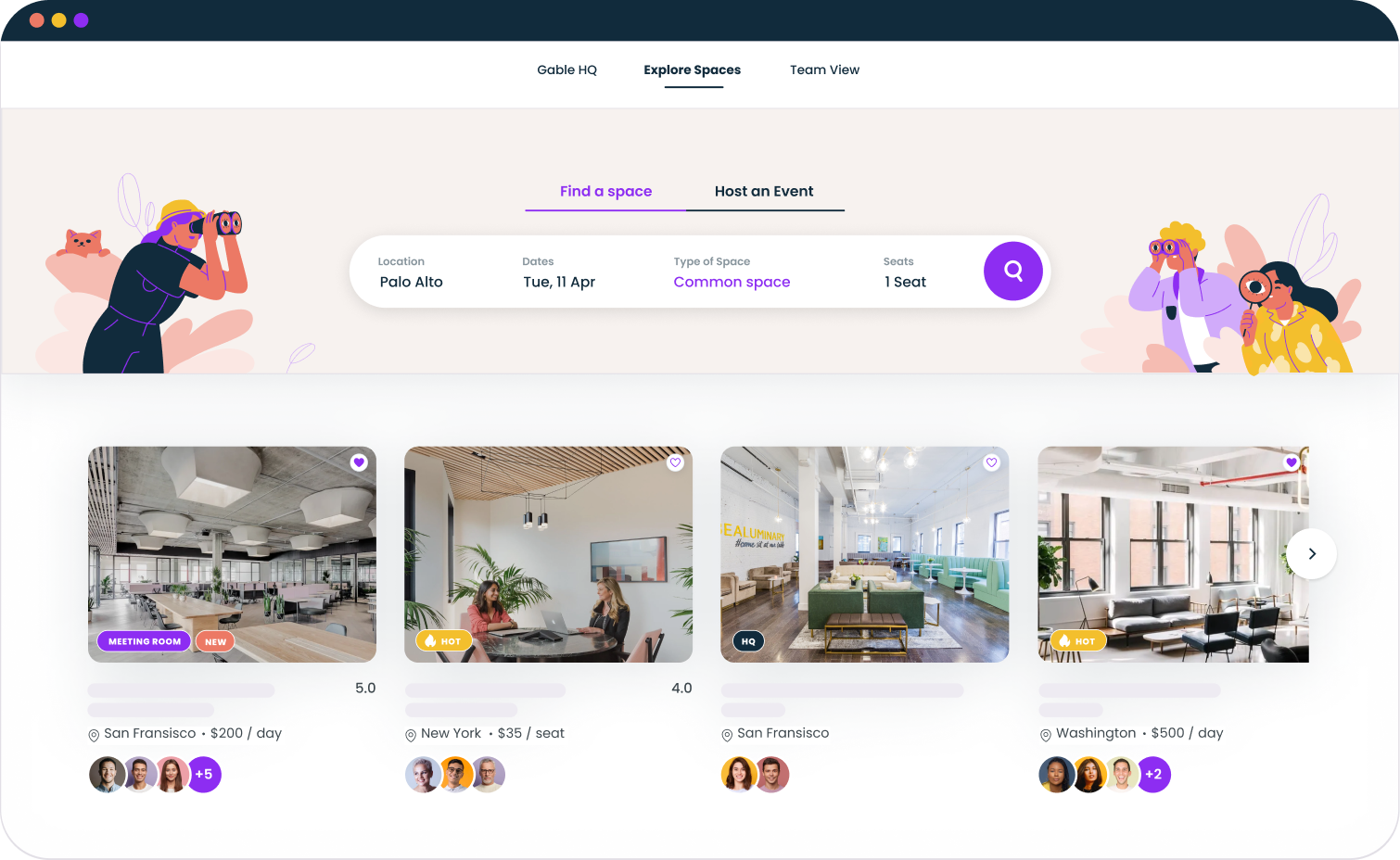
The hybrid portfolio: Why most companies need both
The lease vs flex space debate is a false binary for most organizations. The smartest workplace leaders are building blended portfolios that use each model where it performs best.
The hub-and-spoke model
A common pattern: one or two leased headquarters for your largest employee concentrations, supplemented by flex space in secondary markets. The HQ handles your anchor days, all-hands meetings, and culture-building events. Flex space covers everything else.
This model works particularly well for companies with 200+ employees spread across 3-5 metros. The leased HQ provides stability and identity. The flex network provides reach and adaptability.
Portfolio allocation rules of thumb
Based on what's working for mid-market and enterprise companies in 2026:
If 80%+ of your team is in one metro, lean toward 70% leased / 30% flex. If you're spread across 3-5 cities with no dominant hub, consider 40% leased / 60% flex. If you're fully distributed with no city exceeding 15% of headcount, flex-first (or flex-only) usually makes more sense.
These aren't rigid formulas. They're starting points. Your corporate real estate strategy should be driven by your actual utilization data, not industry averages.
The financial flexibility premium
Here's something CFOs are starting to quantify: the option value of flex space. A company with 30% of its portfolio in flex arrangements can respond to a downturn in weeks instead of months. It can enter a new market in days instead of quarters. It can absorb an acquisition's headcount without scrambling for space.
That flexibility has a dollar value. It shows up in faster scaling, lower restructuring costs, and reduced write-offs on abandoned leases. Workplace analytics platforms can help you model this option value against your specific growth scenarios.
How to make the decision
Stop debating lease vs flex space in the abstract. Run the numbers for your specific situation using these five inputs.
Step 1: Audit your current utilization
You can't make this decision without data. Pull badge swipe data, desk booking records, WiFi connection logs, whatever you have. Calculate your average daily utilization rate across a full quarter, not just peak days. If you don't have this data, that's your first problem to solve.
Step 2: Model three headcount scenarios
Build projections for base case, growth case, and contraction case over 3 years. For each scenario, calculate the total cost of a lease-only approach, a flex-only approach, and a blended model. Include buildout, operating costs, and early termination penalties in the lease scenarios.
Step 3: Map your geographic distribution
Plot where your employees actually live, not where your offices are. If you've got 12 people in Chicago and 8 in Miami, those clusters might justify flex space even if your HQ is in New York. Office consolidation strategy often reveals that fewer, better-used leased spaces plus flex coverage outperforms a scattered lease portfolio.
Step 4: Calculate your break-even utilization
For each location, determine the occupancy rate at which a lease becomes cheaper than flex. If your current utilization is well above that threshold and trending stable, lease. If it's near or below, flex. If it fluctuates seasonally, consider a smaller lease supplemented by flex for peak periods.
Step 5: Build in review triggers
Whatever you decide, set quarterly checkpoints. If utilization drops below your break-even for two consecutive quarters, trigger a portfolio review. If headcount growth exceeds projections, evaluate whether it's time to convert flex locations to leased space. Treat your real estate portfolio like a product: ship it, measure it, iterate.
Whether you're running leased HQs, flex spaces, or both, Gable gives you one platform to book, measure, and optimize every location your team uses.
Request a demo