.svg)


.svg)
- Most offices still run at 40-60% utilization; you're paying for space nobody uses
- A structured consolidation can cut total occupancy costs by 20-40%
- Clean data is the prerequisite; you can't consolidate what you can't measure
- Change management matters as much as the real estate math
- Consolidation isn't downsizing; it's redesigning your portfolio around how people actually work
Office consolidation strategy is the process of reducing your real estate footprint by combining multiple locations, shrinking existing spaces, or both, so your portfolio matches how your organization actually operates. Most companies that went hybrid between 2020 and 2024 are still carrying space designed for a workforce that showed up five days a week. That gap between what you're paying for and what you're using is the entire business case for consolidation.
What office consolidation means in 2026 (and why it's not just cost-cutting)
Consolidation used to be a recession move. You lost revenue, you shed offices. Simple. In 2026, the calculus is different. Companies are consolidating not because they're shrinking, but because hybrid work permanently changed how space gets used.
Global office utilization hit 53% in Q1 2026, the highest since the pandemic. That sounds like recovery until you realize it means nearly half of all office space still sits empty on any given day. For companies with multiple locations, the math is worse: some offices peak at 70% on Tuesdays while others barely crack 30% all week.
The goal isn't to spend less on real estate for its own sake. It's to redirect that spend toward spaces that actually drive collaboration, culture, and productivity. A company with three half-empty offices and one well-designed hub isn't just saving money; it's creating a better experience for the people who show up.
This is why consolidation has moved from a facilities conversation to a strategic one. 54% of CRE leaders plan or significant lease reductions, and the driver isn't panic. It's the recognition that your corporate real estate strategy needs to reflect a workforce that's fundamentally more distributed than it was five years ago.
Signs your organization should consider consolidation
Not every company needs to consolidate. But if three or more of these describe your situation, you're probably overdue.
Your utilization is stuck below 60%. If your average daily occupancy hasn't climbed above 60% for six consecutive months, you're subsidizing empty space. Pre-pandemic utilization often sat at, and many organizations haven't moved the needle since.
You have overlapping geographic coverage. Two offices within 15 miles of each other made sense when everyone commuted daily. In a hybrid model, one well-located hub usually serves the same talent pool better than two mediocre ones.
Lease expirations are clustering. If multiple leases expire within the next 18-24 months, you have a natural consolidation window. Missing it means locking into another 5-10 year cycle with the same inefficiencies.
Your hybrid policy has matured. Early in the hybrid transition, companies kept extra space as a hedge. If you've been running a stable hybrid work schedule for over a year, you have enough behavioral data to right-size with confidence.
Meeting rooms tell the story. 40% of booked meetings are, and 80% of meetings that do happen use rooms designed for six or fewer people. If your conference rooms are either empty or oversized, your space allocation is misaligned with actual work patterns.
Headcount has shifted, not shrunk. You may have the same number of employees but more of them are remote or distributed. The headcount didn't change; the geography did. Your portfolio should follow.
The five-step framework for consolidation success
Consolidation fails when it's treated as a real estate transaction instead of an operating model change. Here's the framework that works.
Step 1: Audit your portfolio and utilization data
You can't consolidate what you can't see. Start by building a single view of every lease, every location, every cost line, and every utilization signal across your portfolio.
This means pulling together lease terms, expiration dates, square footage, and total cost of occupancy for each location. Layer in utilization data: badge swipes, booking system usage, WiFi connections, sensor data. The goal is to understand not just how much space you have, but how it's actually being used, by whom, and when.
CBRE calls clean data "the for portfolio optimization, and they're right. Most CRE teams I talk to have the data scattered across five or six systems: a lease management tool, a badge system, a desk booking app, maybe some manual headcounts. Consolidating your data is, ironically, the first step to consolidating your space.
If you're tracking space utilization metrics already, you have a head start. If not, start collecting now. You need at least 90 days of reliable occupancy data before making consolidation decisions.
Step 2: Define your workplace vision and hybrid operating model
Before you touch a lease, get clear on what your office is for. This sounds philosophical, but it's deeply practical. A company that wants offices primarily for collaboration will design very differently than one that needs space for focused individual work.
Define your anchor day strategy. Map which teams need to overlap in person and how often. Decide whether you're running a hub-and-spoke model, a single HQ, or a distributed network with on-demand space. Your hybrid work policy should inform your consolidation plan, not the other way around.
The mistake I see most often: CRE teams consolidate based on lease economics alone, then hand the result to HR and say "make it work." That's backwards. The workplace vision comes first. The portfolio follows.
Step 3: Model consolidation scenarios
Build at least three scenarios: conservative (minimal change), moderate (consolidate underperformers), and aggressive (maximum footprint reduction). For each, model:
- Total cost of occupancy before and after
- Cost per seat at each remaining location
- Commute impact on employees who'd need to change locations
- Collaboration impact on teams that currently share a building
- Sublease or termination costs for locations you'd exit
The financial case usually makes itself. 20-40% cost savings are achievable when you're consolidating from low-utilization locations. But the non-financial factors, talent retention, team cohesion, commute burden, are what determine whether the consolidation actually succeeds.
Run each scenario past HR, Finance, and department leads before committing. Consolidation decisions made in a CRE silo tend to create problems that cost more than the savings.
Step 4: Design your consolidated space for how people actually work
The space you consolidate into shouldn't look like the space you left. If you're moving from 150 square feet per person to 100, you can't just remove desks and call it done. The layout, the room mix, the technology infrastructure all need to change.
Prioritize collaboration zones over individual workstations. Most people coming into a consolidated office are there to work with other people; they can do solo work from home. Invest in a range of meeting space types: huddle rooms for 2-4 people, medium conference rooms for 6-8, and a few large spaces for all-hands or workshops.
Build in flexibility. Hot desking or desk sharing isn't optional in a consolidated footprint; it's structural. You need a booking system, clear wayfinding, and enough variety in workspace types that people can find the right setting for the task at hand.
Step 5: Execute with a change management plan
This is where most consolidations stumble. The real estate math works. The design is smart. But nobody told the employees what's happening, why, or how their daily experience will change.
Start communicating early, ideally 6+ months before any physical move. Be transparent about the rationale. Acknowledge that change is disruptive. Provide specifics: here's your new location, here's how to book a desk, here's what the commute looks like, here's what we're investing in to make the new space better than the old one.
Assign transition teams for each affected location. These aren't just project managers; they're culture translators who help teams adapt to new norms. The first 90 days after a consolidation move are critical. If people have a bad experience, they'll vote with their feet and stop coming in entirely.

Consolidation is one lever in a broader cost strategy. This guide covers the full toolkit for CRE leaders managing hybrid portfolios.
Read the guide
Consolidation vs. rightsizing: Which strategy fits
These terms get used interchangeably, but they're different moves.
Consolidation means combining multiple locations into fewer ones. You close Office B and Office C, move those teams into Office A (or a new location), and exit the leases. It's a portfolio-level decision.
Rightsizing means reducing the footprint of an existing location without necessarily closing it. You give back two floors of a five-floor lease, redesign the remaining space, and stay put. It's a location-level decision.
Most companies end up doing both. You consolidate where you have geographic overlap, and you rightsize where a single location is simply too large for its current population.
The key distinction: consolidation forces people to change where they go. Rightsizing changes the space around them. Consolidation carries higher change management risk but usually delivers bigger savings. Rightsizing is less disruptive but may not solve the fundamental problem of too many locations.
For organizations running a hub-and-spoke model, the answer is often consolidation at the spoke level (fewer satellite offices) combined with rightsizing at the hub (smaller, better-designed HQ).
Designing consolidated spaces for modern work
A consolidated office that feels cramped will fail. The whole point is to create a space that's smaller but better.
Shift the ratio. Traditional offices allocated 70% of space to individual workstations and 30% to shared spaces. In a consolidated hybrid office, flip that closer to 40/60. Most in-office days are collaboration days. Design accordingly.
Right-size your meeting rooms. The data is clear: most meetings involve six or fewer people, but most conference rooms seat 10+. When you consolidate, build more small rooms and fewer large ones. Add phone booths and focus rooms for the solo work that still happens on-site.
Invest in technology. Consolidated spaces need to work harder. That means reliable video conferencing in every room, a booking system that shows real-time availability, and wayfinding that helps people navigate an unfamiliar floor plan. Gable's platform handles the booking, coordination, and analytics across this entire stack, giving workplace teams a single view of how consolidated space is actually performing.
Plan for peak days. Tuesday occupancy peaks at 58.6% while Friday drops to 34.5%. Your consolidated space needs to handle Tuesday without feeling overcrowded and Friday without feeling like a ghost town. Flexible furniture, bookable neighborhoods, and clear anchor-day policies help manage the swing.
Managing people through consolidation
Consolidation is a people problem disguised as a real estate problem. Get the people side wrong and the savings evaporate through attrition, disengagement, and resistance.
Start with empathy, not efficiency. Telling someone their office is closing and they need to commute to a new location is a big ask. Lead with why, acknowledge the disruption, and be specific about what you're doing to make the transition easier.
Involve HR from day one. This isn't a facilities project that HR gets briefed on later. Talent retention, commute analysis, team cohesion, and culture integration are all HR concerns. The best consolidation teams I've seen have a CRE lead and an HR lead as co-owners.
Watch the commute data. If consolidation adds 30 minutes to someone's commute, you've effectively changed their compensation. Model commute impact by employee before finalizing locations. Some companies offer transit subsidies, flexible schedules, or additional remote days to offset the change.
Measure engagement, not just attendance. Post-consolidation, track employee satisfaction, voluntary attrition, and collaboration frequency alongside utilization. A full office where people are unhappy isn't a success. Tools that help you measure hybrid work outcomes are essential during the transition period.
Give it time. Behavioral patterns take 3-6 months to stabilize after a move. Don't panic if utilization dips in month one. Don't declare victory if it spikes. Watch the trend over a quarter before making adjustments.
Gable gives workplace teams real-time visibility into occupancy, utilization, and cost per seat across every location in your portfolio.
Learn more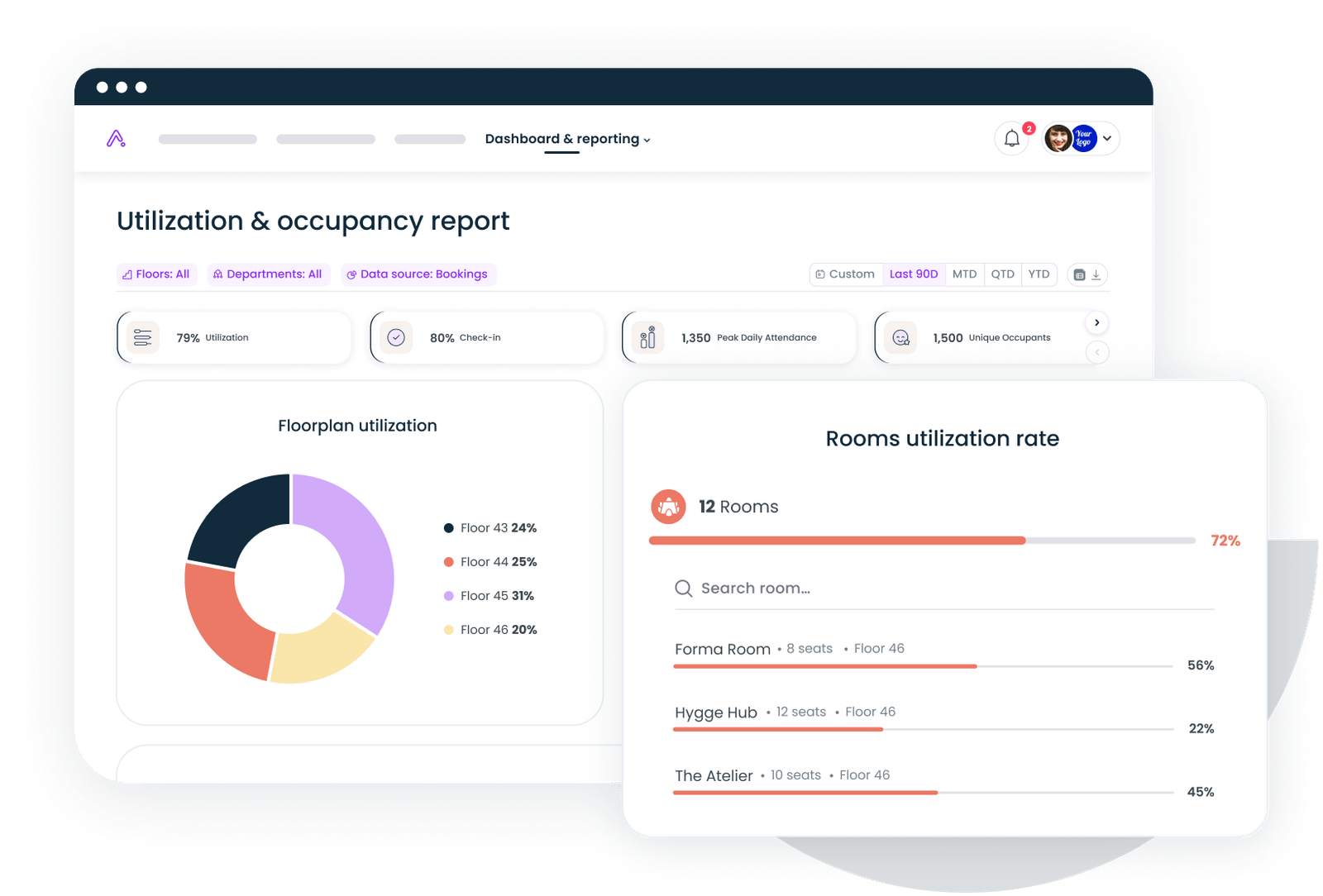
Measuring consolidation ROI: the metrics that matter
Consolidation is an investment. Lease termination fees, build-out costs, moving expenses, and productivity disruption all hit the P&L before savings materialize. You need a clear measurement framework to track whether the investment pays off.
Cost per seat. The single most important metric. Calculate total occupancy cost (rent, utilities, maintenance, technology, services) divided by the number of employees the space serves. Compare pre- and post-consolidation. A well-executed consolidation should reduce cost per desk by 20-40%.
Utilization rate. Average daily occupancy as a percentage of capacity. Pre-consolidation, you're probably at 40-60%. Post-consolidation, you should target 65-80%. Below 65% means you may have over-built. Above 85% means you're running too tight and people will start complaining about availability.
Collaboration frequency. How often do teams that are supposed to work together actually overlap in the office? This is the metric that tells you whether consolidation is achieving its purpose beyond cost savings.
Employee satisfaction. Run pulse surveys at 30, 90, and 180 days post-move. Ask specifically about the new space, commute impact, ability to find the right workspace, and overall experience. Declining satisfaction is an early warning signal.
Break-even timeline. Most consolidations break even in 18-36 months, depending on lease termination costs and build-out investment. Model this upfront and track actual vs. projected savings monthly.
Sublease income. If you're subleasing vacated space rather than terminating leases, track the income against your projections. Sublease markets have softened in many cities, so conservative assumptions are wise.
Real-world consolidation patterns worth studying
I won't name specific companies here, but the patterns from recent consolidations are instructive.
The two-hub model. A large financial services firm consolidated from seven offices in a metro area to two: a downtown hub for client-facing teams and a suburban hub for operations. Total footprint reduction: 50%. They kept both hubs because commute data showed two distinct employee clusters. Forcing everyone downtown would have triggered attrition in the operations team.
The event-based office. A professional services firm reduced its footprint by 45% and redesigned the remaining space around events: team weeks, client workshops, training sessions, and social gatherings. Day-to-day individual work happens remotely. The office exists for moments that matter. It's a bold model, but their utilization on event days exceeds 90%, and employee satisfaction scores are higher than pre-consolidation.
The distributed-to-hub transition. A tech company that went fully remote in 2020 realized by 2024 that some teams needed regular in-person time. Instead of reopening offices everywhere, they opened two strategic hubs and supplemented with on-demand coworking for employees outside those metros. Total real estate spend: 60% less than their pre-pandemic portfolio, with higher reported collaboration quality.
The common thread: none of these companies consolidated blindly. They used occupancy data, employee surveys, and scenario modeling to make decisions. And they all treated the move as a multi-quarter change management effort, not a one-time real estate transaction.
The consolidation timeline: What to expect
Rushing consolidation is the most expensive mistake you can make. Here's a realistic timeline.
Months 1-3: Discovery and data collection. Audit your portfolio. Collect utilization data. Survey employees on work patterns and preferences. Build your baseline.
Months 3-6: Strategy and scenario modeling. Define your workplace vision. Model consolidation scenarios. Pressure-test with Finance, HR, and department leads. Select your preferred scenario.
Months 6-9: Planning and design. Negotiate lease exits or modifications. Begin space design for consolidated locations. Develop your change management and communication plan.
Months 9-15: Build-out and communication. Construct or renovate consolidated spaces. Launch employee communication. Run transition team training. Begin phased moves for early adopter teams.
Months 15-18: Full migration. Complete all moves. Decommission vacated spaces. Ramp up sublease marketing if applicable.
Months 18-24: Optimization. Monitor utilization, satisfaction, and cost metrics. Adjust space allocation, policies, and technology based on actual behavior. This phase never really ends; it just becomes ongoing workplace optimization.
An 18-24 month planning timeline is the industry standard for a reason. Shorter timelines are possible for single-location rightsizing, but multi-site consolidation needs the full runway.
Making consolidation stick
The hardest part of consolidation isn't the move. It's the 12 months after.
Consolidated spaces only work if people use them well. That means ongoing investment in the systems, policies, and culture that make a smaller footprint feel intentional rather than cramped. It means watching the data, listening to employees, and adjusting when something isn't working.
The companies that get consolidation right treat it as the beginning of a new operating model, not the end of a cost-cutting exercise. They use the savings to invest in better space, better technology, and better employee experiences. They measure what matters and they stay flexible.
Your portfolio should be a reflection of how your organization works today, not a monument to how it worked five years ago. If there's a gap between the two, consolidation is how you close it.
See how Gable helps workplace teams plan, execute, and measure office consolidation with real-time occupancy data and unified space management.
Get a demo