.svg)


.svg)
- Hub and spoke blends a central HQ with smaller satellite "spokes" near where employees live
- Companies using this model have cut real estate costs by 65-80% in documented cases
- Spokes don't have to be leased offices; on-demand flex space makes piloting nearly risk-free
- The model fails without unified data across every location
- 77% of Fortune 100 companies already operate some version of hybrid, and hub and spoke is the most structured path forward
The hub and spoke office model gives distributed companies something that "work from anywhere" alone can't: intentional structure. Instead of choosing between a single headquarters and total decentralization, organizations place a central hub for high-stakes collaboration alongside smaller spoke locations closer to where their people live. This guide breaks down how the model works, where it breaks, what it costs, and how to implement it without duct-taping five different tools together.
What is the hub and spoke office model?
Airlines invented this. Delta routes 1,000+ daily flights through Atlanta. United funnels through Chicago O'Hare. The logic is simple: a single coordination point creates efficiency that point-to-point networks can't match.
Workplace strategists borrowed the concept around 2018, but the pandemic turned it from a fringe idea into the default playbook for companies with 200+ employees spread across multiple metros. The "hub" is your primary office, typically in a major market, designed for cross-functional collaboration, culture-building events, and leadership visibility. "Spokes" are smaller, closer to clusters of employees, and optimized for focused work, local team syncs, and client meetings.
Three categories of spokes show up in practice:
| Spoke type | Description | Best for |
|---|---|---|
| Satellite offices | Company-leased spaces with 10-50 desks | Teams of 15+ in a single metro |
| On-demand flex spaces | Coworking day passes or bookable rooms | Distributed employees across many cities |
| Home offices | Employee residences with stipend support | Roles requiring deep focus, minimal collaboration |
Most companies blend all three. A 400-person SaaS company might run a 15,000 sq ft hub in San Francisco, lease a small satellite in Austin where 30 engineers cluster, and give everyone else access to on-demand workspaces in 900+ cities. That layered approach is what separates hub and spoke from the older "open another regional office" playbook.
The coordination logic is what makes hub and spoke work: every spoke connects back to the hub for culture, strategy, and cross-team work, while day-to-day productivity happens wherever makes the most sense for each employee.
How the hub and spoke model works
The hub: more than the biggest office
Treating the hub as a regular office that happens to be larger misses the point entirely. The hub exists to do three things no spoke can replicate.
First, it anchors culture. Quarterly all-hands, new-hire orientations, leadership town halls, annual planning sessions: these need a physical home base where the experience feels consistent and intentional. Second, the hub houses resources that don't scale economically across locations (specialized AV studios, executive briefing centers, or R&D labs). Third, it serves as the coordination brain. Workplace teams monitor utilization patterns across every location from the hub, making decisions about which spokes to expand, shrink, or close.
What the hub shouldn't be is a place people commute to daily out of obligation. If your hub is pulling people 45 minutes each way for work they could do from a spoke three miles from home, you've built a traditional office and slapped a new label on it.
Spokes: flexibility is the entire point
The spoke's job is proximity. When a product designer in Denver can walk ten minutes to a bookable workspace instead of flying to headquarters in New York, you've eliminated a commute that was slowly eroding their engagement.
Spoke design varies wildly based on team size and geography. A cluster of eight employees in Portland might share access to a coworking space where they book desks two or three days a week. A group of 25 in Chicago might justify a dedicated floor in a flex office with their company's branding on the wall. Both are spokes. The economics differ.
The spoke question that trips up most workplace teams: should we lease or go on-demand? The answer depends on density. Twelve or more employees booking at least three days a week in the same city starts to justify a dedicated space. Below that threshold, on-demand flex access costs a fraction of a lease and requires zero long-term commitment.
The connective tissue: technology and rituals
Neither hubs nor spokes work without two things binding them together.
The technology layer needs to handle desk booking across every location, room scheduling with cross-site video, visitor management for client-facing spokes, and a single analytics dashboard that shows utilization whether someone books a desk in the hub or a coworking day pass in Raleigh. Stitching together four or five point solutions to cover this creates data silos that make optimization impossible.
The ritual layer is equally non-negotiable. Companies that succeed with hub and spoke build predictable rhythms: monthly spoke-to-spoke virtual socials, quarterly hub gatherings, annual company-wide events. Without these, spokes drift into isolation. The hub becomes a ghost town. And someone on the leadership team starts whispering about a full return-to-office mandate.
Key benefits of adopting a hub and spoke workplace strategy
Real estate cost reduction that compounds over time
The numbers here aren't theoretical. Search for Common Ground, a nonprofit with 500+ global employees, reduced office space by 65% after shifting to hub and spoke in 2018. T-Mobile replaced three regional offices with flex workspace access and cut real estate spend by roughly 80%.
Those are headline figures. The compounding effect matters more. A company paying $72 per square foot annually for a 50,000 sq ft headquarters can downsize to 25,000 sq ft hub space and redirect $1.8M per year into spoke access, employee stipends, and better collaboration technology. Year one savings fund year two's spoke expansion without new budget requests.
Pre-pandemic research from Global Workplace Analytics found that companies saved an average of $11,000 per year for every employee working remotely half the week. Scale that across 300 employees using spokes instead of commuting to a central office, and you're looking at $3.3M in annual savings before you even factor in the real estate reduction.
Talent retention and geographic reach
Companies embracing workplace flexibility report up to 31% lower turnover. That's not surprising when you consider what hub and spoke offers employees: a senior engineer in Nashville doesn't have to relocate to your hub city, and a mid-career product manager in Denver doesn't have to choose between career growth and proximity to family.
The recruiting math changes dramatically. Instead of competing for talent within a 30-mile radius of your headquarters, you're drawing from every metro where you've placed a spoke or activated on-demand access. For a 300-person company hiring 40 roles this year, widening the talent pool even modestly can shave two to three weeks off average time-to-fill. At a loaded cost of $500/day per open role, that's $140,000-$210,000 in avoided vacancy costs.
Owl Labs data shows 82% of employees report feeling happier with hybrid or remote arrangements that offer genuine flexibility. Happier employees stay longer, and retention is cheaper than recruiting.

Designing a hub and spoke model without a clear strategy framework leads to half-measures and wasted leases. Our guide to data-driven workplace strategy walks through the planning process step by step.
Read the guide
Collaboration that's intentional, not accidental
The paradox of hub and spoke: teams collaborate more effectively with structured in-person time than they did with five days a week in the same building.
This sounds counterintuitive until you examine what "collaboration" looked like in the old model. People sat near each other and exchanged pleasantries. Meetings filled calendars because proximity made them frictionless, not because they were necessary. Deep collaboration, the kind where a cross-functional team locks in a room for three days to redesign the onboarding flow, rarely happened because everyone assumed they could "do it next week."
Hub and spoke forces intentionality. When a team gathers at the hub for two days, those days get planned. Agendas exist. Outcomes get defined. The flight or drive to the hub creates enough friction that people don't waste the time once they arrive. Companies running this model well report noticeable increases in meaningful team collaboration, not because people spend more time together, but because the time they do spend carries more weight.
Environmental impact that's measurable, not aspirational
Reducing the average employee commute at scale delivers measurable carbon reductions. If 200 employees cut their average commute from 28 miles round trip to 6 miles (home to local spoke), that's roughly 1.1 million fewer miles driven per year. At 0.9 lbs of CO2 per mile, that's nearly 500 tonnes of carbon eliminated.
ESG reporting teams love this because it's quantifiable and directly tied to an operational decision rather than an offset purchase.
Scalability without capital expenditure spikes
Opening a traditional office in a new city takes 6-9 months and a six-figure buildout budget. Activating spoke access through on-demand flex spaces takes a week and costs nothing until someone books a desk.
That asymmetry matters enormously for growing companies. A Series C startup expanding from 150 to 400 employees over 18 months can scale spoke access city by city as it hires, without committing to leases in markets where headcount might plateau. If the Austin team grows from 5 to 20, upgrade from on-demand passes to a dedicated space. If the Boston team shrinks after a reorg, scale back to flex access without carrying a five-year lease.
Real challenges and how to overcome them
Communication fragmentation across locations
This is the most common failure mode. When the hub team discusses strategy in a hallway conversation that never gets documented, spoke employees are working from outdated context within 48 hours.
More Slack channels won't solve this. A hard rule will: no decision is final until it's written down in a shared, searchable system. Companies that succeed here assign a "remote advocate" in every hub meeting whose job is to summarize decisions, flag action items, and post them where spoke teams can access them. Redundant? Yes. Necessary? Absolutely.
Async communication norms matter too. A workplace team managing five spoke locations can't hold synchronous standups across three time zones without someone logging in at 6 AM. Default to async updates with weekly sync touchpoints, and reserve real-time meetings for decisions that genuinely need live debate.
Culture drift between hub and spokes
Spoke employees start referring to themselves as "remote" employees. Hub employees start calling the spokes "satellite people." Language like that signals a two-tier culture forming, and it happens faster than most workplace leaders expect.
Prevention starts with how you design the employee experience. Every company ritual that happens at the hub needs a spoke-inclusive version. Town hall at the hub? Livestream it with a moderated chat where spoke employees can ask questions that get answered live. Birthday celebrations? Send a spoke-specific kit so it doesn't feel like an afterthought. Promotion announcements? Announce them company-wide before the hub team hears through the grapevine.
A strong lever is cadence. Quarterly hub gatherings where every spoke employee travels in create a shared experience that sustains cultural cohesion for the next 90 days. Event logistics get complex at scale, but that's a planning problem with known solutions, not a fundamental barrier.
Over-reliance on the hub
Some organizations implement hub and spoke and then schedule every important meeting, decision, and event at the hub. Spokes become glorified coworking memberships that nobody takes seriously.
Guarding against this requires distributing meaningful work across locations. Rotate which spoke hosts the next cross-team planning session. Let the Chicago spoke own a product launch event. Give the Austin team responsibility for a client workshop. When spoke locations generate business value that's visible to leadership, they stop being afterthoughts.
Data silos across locations
A facilities manager tracking desk utilization at the hub using one tool, coworking spend through a separate vendor portal, and event attendance in a spreadsheet has three data sources that never talk to each other. Asking "how much does it cost per employee per month to support our workplace across all locations?" becomes a two-day research project instead of a dashboard click.
Unified workplace analytics that span owned offices and flex spaces are table stakes for hub and spoke at scale. Without them, you're making million-dollar real estate decisions based on gut feel and incomplete data.
Gable connects your owned offices and 20,000+ on-demand workspaces in a single dashboard, giving you desk booking, room scheduling, visitor management, and unified analytics across every location in your portfolio.
Learn more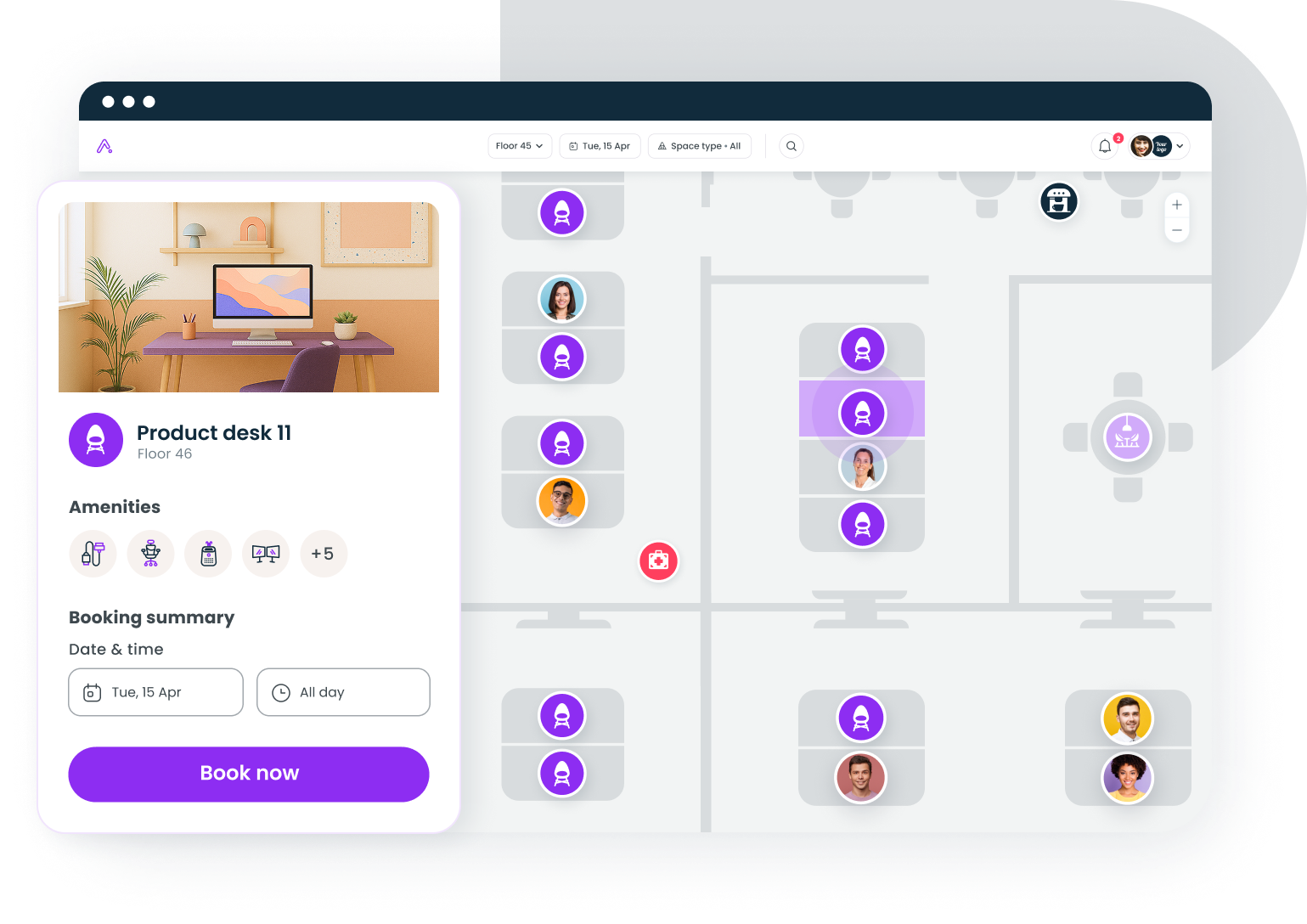
Hub and spoke vs. other workplace models
The model comparison gets muddied by overlapping terminology. Here's a clear breakdown:
| Model | Structure | Best for | Biggest risk |
|---|---|---|---|
| Traditional single office | One location, everyone commutes | Small teams (<50) in one metro | Limits talent pool to commuting radius |
| Hub and spoke | Central HQ + distributed satellite/flex locations | Companies with 100+ employees across 3+ metros | Coordination complexity if tech and rituals aren't in place |
| Fully distributed (remote-first) | No central office, everyone works from anywhere | Async-first companies with strong documentation culture | Culture erosion, loneliness, onboarding challenges |
| Unstructured hybrid | Office exists, attendance is optional and uncoordinated | Nobody, honestly | Empty offices on Fridays, packed on Tuesdays, no predictability |
The critical distinction between hub and spoke and unstructured hybrid: coordination. Unstructured hybrid says "come in when you want." Hub and spoke says "here's where your team gathers, here's when, and here's why." That structure is why 77% of Fortune 100 companies have moved toward hybrid models with defined location strategies rather than leaving attendance to chance.
Fully distributed works for specific company cultures (GitLab is the canonical example), but most organizations find that zero physical touchpoints make onboarding slower, cross-team trust harder to build, and spontaneous innovation nearly impossible to spark. Hub and spoke preserves those benefits while eliminating the daily commute that makes traditional offices feel punitive.
When hub and spoke is the wrong choice
Two scenarios where this model doesn't fit. First, companies with fewer than 30 employees concentrated in a single metro: the coordination overhead of managing multiple location types outweighs the benefit. Get a flexible office lease. Second, organizations where 90%+ of employees live within 20 minutes of the same location: you've got a hub with no need for spokes. Don't add complexity that doesn't serve your workforce geography.
Step-by-step implementation guide
Phase 1: Map your workforce geography (weeks 1-3)
Every hub and spoke strategy starts with a question that's embarrassingly simple: where do your employees live?
Pull home address data from your HRIS (zip code level is sufficient; you don't need street addresses). Plot employee density by metro area. You're looking for clusters: groups of 5+ employees within a 30-minute radius of a central point. Those clusters are your spoke candidates.
A 500-person company typically discovers 4-8 meaningful clusters outside their hub city. A 2,000-person company might find 15-20. Run a supplemental survey asking employees two questions: "How far are you willing to commute to an office or workspace?" and "How many days per week would you use a local workspace if one were available?" Those two data points, combined with address mapping, create the foundation of your spoke strategy.
Phase 2: Right-size the hub (weeks 2-4, parallel)
Your hub is almost certainly too large for a hub and spoke model. If 40% of your employees will primarily use spokes, you don't need a hub designed for 100% occupancy.
Calculate your target hub capacity by multiplying hub-primary employees by your expected peak attendance rate. For most hybrid companies, peak day attendance is 60-70% of the hub-assigned population. A company with 200 hub-primary employees needs 120-140 desks, not 200.
Space utilization data from your existing office helps here. If Floor 3 averaged 18% occupancy over the past quarter, that's your strongest evidence for right-sizing. Facilities teams that track this granularly can make the real estate reduction case in a single slide.
Phase 3: Activate spokes incrementally (weeks 4-8)
Start with on-demand flex access, not leases. Give employees in your top three spoke clusters access to bookable workspaces and measure adoption for 60-90 days before committing to anything permanent.
What you're measuring during the pilot:
- Booking frequency: Are employees in each cluster booking at least 2x per week?
- Space type preference: Day passes vs. meeting rooms vs. private offices?
- Spending per employee per month: Is it tracking below what a lease would cost?
- Collaboration patterns: Are spoke employees booking together or individually?
If a cluster hits 15+ employees booking 3+ times per week, that's your signal to evaluate a dedicated satellite space. Below that threshold, on-demand access remains more cost-effective.
Phase 4: Build the technology foundation (weeks 4-6, parallel)
The minimum viable tech stack for hub and spoke includes:
- Desk and room booking that works across hub and spoke locations
- On-demand workspace access with budget controls and approval workflows
- Visitor management for client-facing spoke locations
- Unified analytics showing utilization, spend, and collaboration patterns across all locations
- Calendar and chat integrations (Google Calendar, Outlook, Slack, Teams) so booking doesn't require switching apps
A unified workplace management platform that covers all five eliminates the integration headaches of stitching together separate tools. When your desk booking tool doesn't talk to your coworking vendor portal, and neither feeds into your analytics dashboard, every utilization report becomes a manual data merge.
Phase 5: Establish coordination rituals (weeks 6-8)
Define these before you launch, not after:
Weekly: Each team has one designated "collaboration day" where members gather at their local spoke or the hub. The day is consistent so teams can plan around it.
Monthly: Cross-spoke virtual events (AMAs with leadership, skill-sharing sessions, social hours) keep distributed teams connected between hub gatherings.
Quarterly: Full-company or department-level hub gatherings. Budget for travel, accommodation, and a structured agenda that makes the trip worthwhile. A "mandatory fun" day with no planned outcomes is a waste of everyone's airfare.
Annually: Company-wide offsite or on-site event at the hub. This is the cultural reset button, the event that reinforces shared identity across every spoke.
Phase 6: Measure, adjust, repeat (ongoing)
Hub and spoke isn't a set-it-and-forget-it model. Employee distribution shifts as you hire and people relocate. Spoke utilization fluctuates seasonally. The hub might need reconfiguration as collaboration patterns evolve.
Build a quarterly review cadence where your workplace team examines:
- Hub peak-day utilization (target: 65-80%)
- Spoke booking frequency by cluster
- Cost per employee per month across all locations
- Employee satisfaction scores by location type
- Collaboration event attendance rates
When the data shows a spoke cluster declining (say, four employees left the Austin team and utilization dropped below the threshold), scale back to on-demand access. When a new cluster emerges in Atlanta because you hired 12 people there in Q3, activate spoke access immediately. The model's strength is its responsiveness, but only if you're watching the data.
Real-world examples of hub and spoke in action
T-Mobile: from three offices to thousands of flex locations
T-Mobile's approach was aggressive. Rather than downsizing gradually, they replaced three regional offices entirely with on-demand workspace access across thousands of locations. The result: an 80% reduction in real estate costs and employee flexibility to choose where they work on any given day. The key insight from their rollout was that employee adoption of flex spaces was higher than projected because the booking friction was lower than commuting to a fixed office.
Search for Common Ground: proving the model at nonprofit scale
A 500+ employee global nonprofit, Search for Common Ground adopted hub and spoke in 2018, well before the pandemic made it fashionable. They reduced physical office space by 65% while modernizing their communication tools and workspace design. Their experience proves that hub and spoke works just as well for mission-driven organizations operating across dozens of countries with constrained budgets as it does for tech companies.
Google: flagship campuses as hubs, flex offices as spokes
Google's implementation is instructive because of its scale. Large flagship campuses (Mountain View, New York, London) serve as hubs for culture, R&D, and cross-functional collaboration. Smaller coworking-style satellite offices in secondary cities give teams local workspace without the overhead of building another campus. The model lets Google maintain its in-person culture while acknowledging that not every engineer needs to live within 20 minutes of a campus.
Dropbox: "Virtual First" with studios
Dropbox rebranded their approach as "Virtual First," designating existing offices as collaboration "studios" rather than daily workspaces. Employees work remotely by default and come to studios for planned team gatherings. It's hub and spoke with different vocabulary, and it signals something important: the model's flexible enough to accommodate different branding and cultural framings while maintaining the same structural logic.
BP and EY: enterprise-scale adoption
BP restructured its workplace portfolio around hub offices in major energy centers (Houston, London) with satellite and flex workspace access for field teams and support functions. EY similarly operates large hub offices in financial centers while providing client-facing spokes and flex access in secondary markets. Both demonstrate that hub and spoke scales to tens of thousands of employees across global portfolios.
The technology layer that makes or breaks the model
Running hub and spoke without integrated workplace technology is like managing a supply chain on spreadsheets. It works at small scale. It collapses at 200+ employees across five locations.
The specific pain points that surface without unified tooling:
Booking fragmentation. Employees at the hub book desks through one system. Spoke employees book coworking through another. Neither system knows about the other, so the workplace team can't answer "how many of our people are working in a physical workspace today?" without checking two dashboards.
Budget opacity. Hub costs sit in the facilities budget. Spoke coworking costs sit in the people or perks budget. Event travel costs sit somewhere else entirely. Tracking total workplace spend across all location types requires manual consolidation that's always two weeks behind.
Collaboration blindness. Without a live view showing which team members are in which location on which day, employees can't coordinate in-person time. They book a spoke desk on Tuesday, arrive, and find none of their teammates there. After three experiences like this, they stop booking.
The common thread: data has to flow across every location type. Desk booking at the hub, on-demand reservations at spokes, room scheduling, visitor check-ins, event RSVPs, all of it feeding into a single analytics layer. When the facilities team at a 500-person company sees Floor 3 hitting 12% occupancy every Friday, they don't need a consultant to tell them what to do. But they need to see that number, in real time, alongside spoke utilization data that shows where those employees are working instead.
Platforms like Gable can synthesize this cross-location data into actionable recommendations, turning what used to be a quarterly manual analysis into something a workplace team can query on demand.
Getting organizational buy-in for hub and spoke
The CFO conversation
Lead with real estate cost reduction. Show the current cost per employee per month (total facilities spend divided by headcount), then model the post-transition number. For a company spending $1,200 per employee per month on a single headquarters, hub and spoke typically brings that to $700-$900 depending on spoke mix. Multiply the delta by headcount and you've got the annual savings figure that gets finance teams to lean forward.
The CHRO conversation
Lead with retention data. The 31% turnover reduction stat paired with your company's current turnover cost (typically 50-200% of annual salary per departure) frames hub and spoke as a talent strategy, not a real estate play. If you're losing 15 employees per year who cite commute or location inflexibility as a factor, and average replacement cost is $85,000, that's $1.275M in avoidable attrition costs.
The CEO conversation
Lead with competitive positioning. In a market where 77% of Fortune 100 companies operate hybrid models, not offering location flexibility puts you at a recruiting disadvantage against every competitor that does. Hub and spoke is the structured version of hybrid that gives leadership the coordination and culture benefits they want while giving employees the flexibility they increasingly demand.
Making hub and spoke work long-term
Companies that sustain this model beyond the initial excitement tend to share three traits. They treat the hub as a magnet, not a mandate, designing it to be worth visiting rather than requiring attendance. They invest in spoke experience parity, ensuring that booking a desk in Omaha feels as smooth as booking one at headquarters. And they let data drive evolution, closing underperforming spokes without sentimentality and opening new ones as employee geography shifts.
Hybrid work best practices evolve quarterly as companies learn what works. The hub and spoke model's greatest strength is its built-in adaptability: you can adjust the ratio of hub to spoke investment, shift from leased to flex spoke space, and reconfigure the hub's floor plan as collaboration patterns change. That adaptability only works if your measurement infrastructure keeps pace.
India's flex leasing market grew roughly 65% year over year in Q2 2026, with tech companies driving more than half of demand. That growth signal isn't limited to one geography. The global trend toward flexible spoke access is accelerating, and companies that build their hub and spoke infrastructure now will have a structural advantage over those scrambling to catch up in 18 months.
From desk booking at your hub to on-demand spoke access in 900+ cities, Gable's unified platform gives your workplace team the tools and data to manage every location from a single dashboard.
Get a demo