.svg)


.svg)
- Most offices run at roughly half capacity; you're paying for space nobody uses
- Four options: sublease, consolidate, blend-and-extend, or terminate early
- Occupancy data, not gut feel, should trigger and guide every downsize decision
- The right move depends on lease term remaining, market conditions, and growth outlook
- How you communicate the change matters as much as the financial math
Your office is too big. You probably already know this. The badge data confirms it, finance keeps flagging the per-desk cost, and entire neighborhoods sit empty three days a week.
You're not alone. Global office occupancy averages 53%, which means roughly half of leased office space sits unused on any given day. That's not a blip. It's the new baseline. And it means the question isn't whether to downsize your office, but how.
There are four primary paths: sublease the excess, consolidate multiple locations, renegotiate your lease for a smaller footprint (blend-and-extend), or exercise an early termination clause. Each has different economics, timelines, and trade-offs. This guide walks through all four so you can pick the right one for your situation.
How to know you have too much space
Before you start calling brokers, you need data. Not a Tuesday walkthrough where the floor "felt empty." Actual numbers, tracked over weeks.
Three metrics matter most. First, average occupancy rate: what percentage of your total capacity is used on a typical day? If you're consistently below 60%, you have a problem worth solving. Second, peak utilization: even on your busiest day (usually Tuesday or Wednesday), how full does the office get? If peak never cracks 70%, you're carrying dead weight. Third, cost per occupied desk: divide your total real estate spend by the number of desks actually used, not total desks. This is the number that makes CFOs wince.
Sensors, badge swipes, and booking data all feed these metrics. If you don't have sensor infrastructure yet, booking and badge data can get you 80% of the picture. The point is to replace anecdotes with evidence before making a multi-million-dollar real estate decision.
One more signal worth watching: growth projections. If your headcount plan shows flat or declining numbers for the next 18 months, the case for downsizing gets stronger. If you're hiring aggressively, you might need a different playbook, like right-sizing for growth rather than shrinking.
Option 1: Sublease the excess space
Subleasing is the most common first move, and for good reason. You keep your lease, stay in your current location, and offset costs by renting out floors or sections you don't need.
When subleasing works
It works best when you have contiguous, separable space (a full floor, a wing with its own entrance), your lease has more than two years remaining, and the local sublease market isn't already flooded. It also helps if your space is in good condition and reasonably well-fitted, since subtenants don't want to spend six months on build-out.
The mechanics
Start with your lease. Most commercial leases require landlord consent for subleasing, and some include recapture clauses that let the landlord take the space back instead. Read the fine print before you get excited about the revenue.
Next, hire a tenant-rep broker who specializes in subleases, not just leasing generally. Sublease pricing, marketing, and deal structures are different from direct leases. Your broker should know the local sublease inventory and be honest about achievable rates.
Pricing strategy matters. Sublease space typically trades at 15-30% below direct lease rates in the same building. That discount is what makes it attractive to subtenants, but it also means you won't fully recover your costs. Run the math on net savings after broker commissions, legal fees, and any tenant improvements you need to make the space sublease-ready.
For a deeper look at the sublease process, including legal considerations and landlord negotiations, check out our office sublease guide.
Timeline
Expect 3-6 months from decision to signed sublease in a healthy market. In a soft market with high vacancy, it could take longer. Plan accordingly.

Before you sublease or consolidate, you need to understand what's actually driving your costs. Our guide breaks down the strategies that move the needle.
Read the cost reduction guide
Option 2: Consolidate multiple locations into one
If you operate two or three offices in the same metro, consolidation can be more powerful than subleasing. Instead of maintaining multiple half-empty spaces, you combine everyone into one location that's right-sized for actual demand.
When consolidation works
Consolidation makes sense when you have overlapping coverage (two offices within 30 minutes of each other), when one lease is expiring soon, or when the operational overhead of running multiple locations is eating into your budget. It's also a strong play after a merger or acquisition, when you've inherited redundant space.
The financial case is straightforward. Two offices at 45% occupancy cost more to operate than one office at 80% occupancy, even if the single office is slightly larger. You eliminate duplicate reception staff, duplicate IT infrastructure, duplicate cleaning contracts, and duplicate everything else.
The hard part
Consolidation is a people problem as much as a real estate problem. Some employees will face longer commutes. Some teams will lose "their" space. The office consolidation playbook covers the logistics in detail, but the short version is: communicate early, involve employees in the new space design, and consider commuter benefits or flexible work policies to soften the transition.
One approach that works well: keep the consolidated HQ for collaboration days and supplement with flex space access for employees who'd otherwise face brutal commutes. This hybrid portfolio model is increasingly common. 55% of global occupiers now as part of their real estate strategy.
Option 3: Blend-and-extend your lease
Blend-and-extend is the quiet option. No sublease marketing, no office move, no employee disruption. You go to your landlord and propose a deal: you'll extend your lease term (giving them certainty) in exchange for a smaller footprint and/or lower rent.
Why landlords agree to this
Landlords hate vacancy. In most markets right now, they'd rather keep a tenant at a lower rate than risk 12-18 months of downtime finding a replacement. That leverage is yours to use.
The typical structure: you give back 20-30% of your space, extend the lease by 3-5 years, and negotiate a blended rate that's lower than your current rent but higher than what you'd pay on a brand-new lease. The landlord gets term certainty. You get immediate cost relief without moving.
When it makes sense
Blend-and-extend works best when you like your current location, your lease has 2-4 years remaining (enough to make the extension meaningful to the landlord), and you don't want the disruption of a move. It's also a good option when the sublease market is soft and you'd struggle to find a subtenant.
The risk is lock-in. You're committing to a longer term, which limits flexibility if your space needs change again. JLL's 2026 analysis shows blend-and-extend deals have surged as companies seek cost relief without relocation, but the best deals include flexibility provisions like contraction options or early termination rights built into the extension.
Negotiation tips
Bring data. Show the landlord your occupancy numbers, your cost-per-desk analysis, and comparable sublease rates in the building. This isn't adversarial; it's a business conversation where both sides benefit. But you need to demonstrate that your current footprint is genuinely oversized, not just that you'd prefer to pay less.
For broader lease negotiation tactics, our lease negotiation guide covers 15 specific strategies.
Gable's office management platform gives you real-time occupancy data, desk booking analytics, and utilization insights so you can make downsize decisions with confidence, not guesswork.
Explore Gable Offices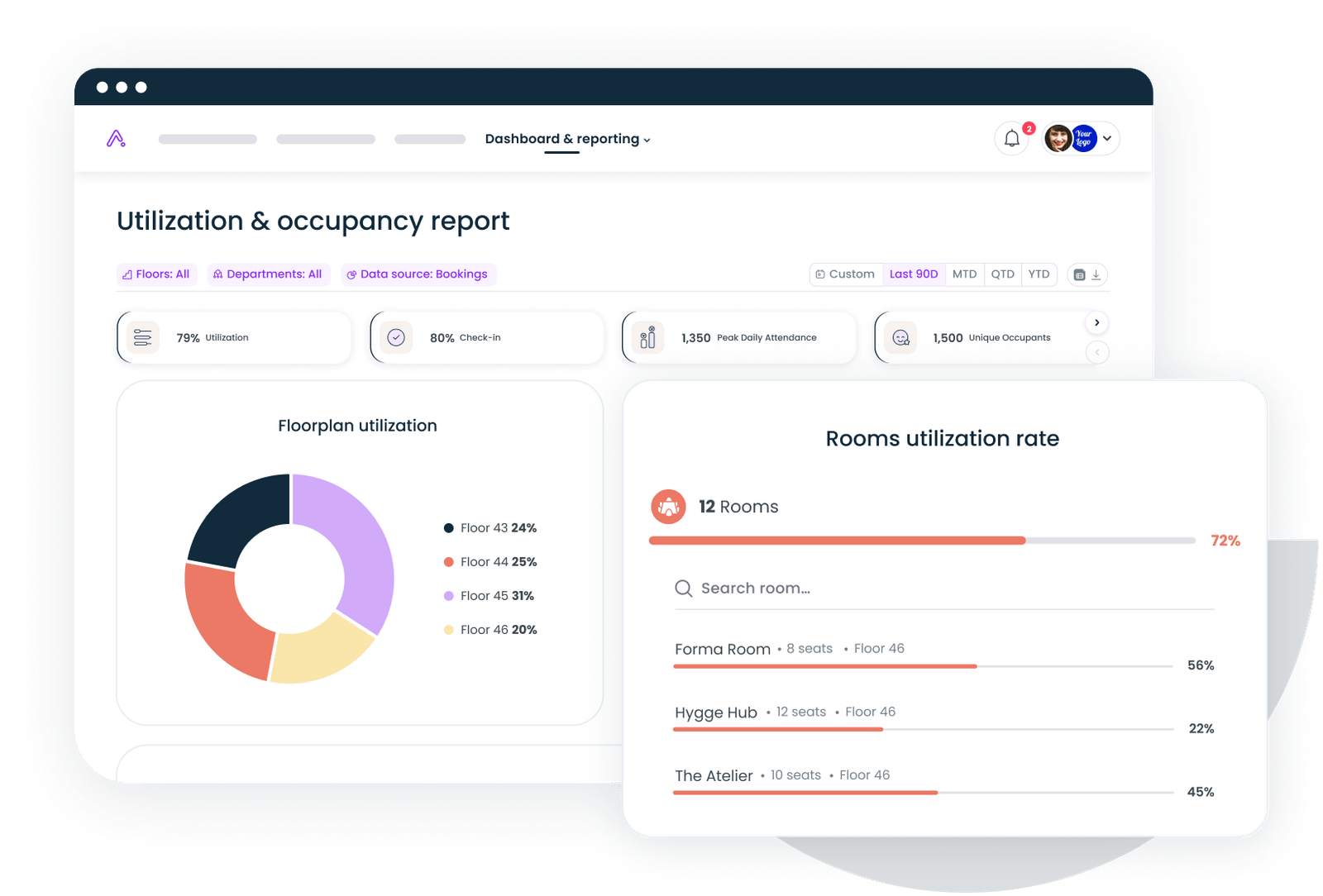
Option 4: Early lease termination
Sometimes the cleanest move is to walk away. If your lease includes an early termination clause (and many do, buried in the fine print), you can exit by paying a predetermined penalty.
When the buy-out math works
Early termination makes sense when the penalty is less than the remaining rent obligation, when you have no realistic sublease prospects, or when the space is fundamentally wrong for your needs (wrong location, wrong layout, wrong size by a wide margin).
Run the numbers carefully. The termination penalty typically includes some combination of unamortized tenant improvement costs, broker commissions the landlord paid, and a fee equal to several months' rent. Compare that total against what you'd spend staying in the space for the remaining term, net of any sublease income you might generate.
If there's no termination clause
You still have options, but they're harder. You can negotiate a lease surrender (essentially paying the landlord to let you out), or you can assign the lease to another tenant. Both require landlord cooperation and usually cost more than exercising a built-in termination right.
Before signing your next lease, make sure early termination and contraction options are part of the negotiation. Our commercial lease guide covers the specific clauses to insist on.
How to choose the right option
There's no universal answer. The right path depends on three variables.
Lease term remaining
If you have less than 18 months left, you're better off riding it out and right-sizing when you renew. If you have 2-4 years, blend-and-extend or subleasing both work. If you have 5+ years, the urgency is higher and early termination or subleasing become more attractive because the carrying cost of doing nothing is enormous.
Market conditions
In a tenant-friendly market (high vacancy, lots of sublease inventory), landlords are more willing to negotiate blend-and-extend deals. Paradoxically, subleasing is harder in the same conditions because you're competing with other sublease space. Check your local market before committing to a strategy.
Business outlook
Growing? Don't lock yourself into a smaller space you'll outgrow in two years. Stable or contracting? Optimize aggressively. Uncertain? Build in flexibility through contraction options, shorter terms, or a hybrid portfolio that mixes owned space with on-demand access.
Here's a quick decision matrix:
The employee communication playbook
This is where most companies fumble. The real estate decision is hard. Communicating it badly makes everything worse.
Lead with the why
Employees aren't stupid. They can see the empty desks. Frame the downsize as a response to how people actually work, not as a cost-cutting exercise (even if that's the primary driver). "We're redesigning our space to match how our team works today" lands better than "we're cutting real estate costs by 30%."
Be specific about what changes
Vague announcements create anxiety. Tell people exactly what's happening: which floors or locations are affected, what the timeline is, and what the new space will look like. If you're consolidating, address commute impacts directly and explain what you're doing to mitigate them.
Involve people in the redesign
If you're moving to a smaller space, the layout matters more. Involve employees in decisions about collaboration zones, quiet areas, and amenities. People accept change better when they've had input.
Communicate early and often
Don't wait until the lease is signed to tell people. Give at least 60-90 days notice for any move, and provide regular updates throughout the process. Silence breeds rumors, and rumors are always worse than reality.
For a deeper framework on managing workplace transitions, our change management playbook covers the full communication arc.
Making the downsize stick
A downsize isn't a one-time event. It's a shift in how you manage space going forward.
After you've right-sized, keep measuring. Track occupancy weekly. Monitor cost per desk against your benchmarks. Set up alerts for when utilization drops below your target threshold. The companies that downsize successfully are the ones that treat space as a product: they ship it, measure it, and iterate.
The worst outcome is downsizing, stopping the measurement, and finding yourself in the same position three years later with a new lease that's too big. Build the data infrastructure now so you never have to make this decision blind again.
Gable helps workplace leaders track occupancy, manage bookings, and right-size their portfolio with confidence. See how it works for your team.
Request a demo