.svg)


.svg)
- National office asking rent sits at $32.55/SF, but true occupancy costs run 40-50% higher
- Class A rents are pulling away from Class B as the flight to quality accelerates
- New construction is at its lowest level ever, which means rents are heading up
- Base rent alone is a terrible way to budget; total cost of occupancy is the metric that matters
- Right-sizing based on actual utilization data is the fastest lever to cut cost per square foot
The CRE cost per square foot you see in a listing is almost never the number you'll actually pay. National office rents averaged $32.55/SF in early 2026, but once you layer in operating expenses, taxes, insurance, and utilities, the real figure can land 40-50% higher. This guide breaks down what office space actually costs across major U.S. markets, how Class A and Class B rates compare, and how to calculate the total cost of occupancy that your CFO actually cares about.
What "cost per square foot" means in CRE
The phrase gets thrown around in every lease negotiation and board deck, but it means different things depending on the lease structure. In a full-service gross lease, the quoted rate includes base rent plus operating expenses. In a triple-net (NNN) lease, you're paying base rent separately from property taxes, insurance, and maintenance. A modified gross lease falls somewhere in between.
This matters because comparing a $40/SF full-service rate in Chicago to a $28/SF NNN rate in Phoenix is comparing apples to engine parts. You need to normalize everything to an all-in number before any market comparison makes sense. That normalization process is what separates a useful benchmark from a misleading one.
When we talk about CRE cost per square foot in this piece, we're focused on the all-in occupancy cost unless otherwise noted. If you're building a broader corporate real estate strategy, getting this number right is step one.
National office rent benchmarks for q1 2026
The national picture is deceptively stable. Same-asset rents climbed 0.8% year over year through Q1 2026, a modest increase that masks wild variation by market. Miami and South Florida led the pack at +4.0%, Orlando followed at +3.0%, and New York posted +2.2%. Meanwhile, several secondary markets saw flat or declining rents as sublease inventory worked through the system.
Vacancy remains elevated nationally, but the story splits sharply by building class. Class A properties absorbed 1.4 million square feet in Q1, while Class B and C buildings stayed essentially flat. The flight to quality isn't a trend anymore. It's the market's default setting.
One stat that should worry anyone planning a lease in the next 18 months: the construction pipeline dropped 86% from its 2020 peak, sitting at just 18.6 million square feet under construction. That's the lowest level ever recorded. Less new supply plus steady demand equals upward pressure on rents, particularly for Class A space.
Class a vs. class b office rent comparison
The gap between Class A and Class B is widening, and it's not subtle. In Manhattan, Class A asking rents hit $83.25/SF in Q1 2026, while Class B space traded at roughly $62/SF and Class C at around $51/SF. That's a 34% premium for Class A over Class B, up significantly from two years ago.
This premium reflects more than just nicer lobbies. Class A buildings tend to offer better HVAC systems, modern floor plates that support hybrid configurations, and amenities that help with talent retention. Companies pursuing office space optimization are increasingly willing to pay more per square foot for less total square footage in a better building, rather than spreading out across cheaper, underutilized Class B space.
The national pattern holds across most major metros. Class A commands a 15-30% premium over Class B depending on the market, with the widest gaps in gateway cities and the narrowest in Sun Belt markets where newer Class B stock competes more effectively.
Top 10 Most expensive U.S. office markets in 2026
Here's where the numbers get specific. These are approximate all-in rates based on Q1 2026 data from JLL and Cushman & Wakefield market reports, blending asking rents with typical operating expense loads.
A few things jump out. Manhattan remains in a league of its own, with trophy buildings commanding rates that make even Class A averages look modest. San Francisco's asking rents are high but flat, reflecting a market still digesting tech-sector sublease inventory. Miami's 4% year-over-year growth is the fastest in the country, driven by financial services relocations and limited new supply.
If you're evaluating a hub and spoke office model, these spreads matter enormously. A satellite office in Phoenix at $31/SF versus a headquarters expansion in Manhattan at $83/SF changes the math on where you put people.

Eight strategies for reducing CRE spend, from lease renegotiation to portfolio consolidation, with real numbers behind each approach.
Read the guide
Most affordable U.S. office markets worth considering
Not every company needs a Manhattan address. These markets offer significantly lower CRE cost per square foot while still providing access to talent pools and infrastructure.
Detroit's $22/SF Class A rate is roughly a quarter of what you'd pay in Manhattan. For companies with distributed teams, placing a regional office in a market like Columbus or Indianapolis can dramatically lower your blended portfolio cost. The tradeoff is usually less prestige and a smaller local talent pool for specialized roles, but for many functions, that tradeoff is worth it.
The key is matching market selection to your actual needs. If you're running a right-sizing exercise, understanding these cost differentials helps you model scenarios where consolidating expensive space and redistributing to cheaper markets saves real money.
What is total cost of occupancy, and why base rent isn't enough
Here's where most CRE benchmarking falls apart. Base rent might represent only half to two-thirds of what you actually spend on a space. The rest hides in line items that don't show up in the listing.
Total cost of occupancy (TCO) includes:
- Base rent: The headline number in your lease
- Common area maintenance (CAM): Lobbies, elevators, shared restrooms, landscaping
- Property taxes: Passed through in NNN and modified gross leases
- Insurance: Building insurance allocated to tenants
- Utilities: Electricity, water, HVAC (sometimes included in full-service, sometimes not)
- Tenant improvements amortization: Build-out costs spread over the lease term
- Furniture, fixtures, and equipment: Often forgotten in per-square-foot calculations
- Technology infrastructure: Network, AV, access control systems
A practical example: you sign a lease at $40/SF base rent. Add $8/SF in CAM and taxes, $3/SF in utilities, and $4/SF in amortized build-out costs. Your true occupancy cost is $55/SF, which is 37.5% higher than the number you negotiated.
Understanding TCO is essential for anyone comparing an office lease vs. coworking cost. Coworking rates look expensive on a per-desk basis until you factor in all the hidden costs that a traditional lease carries.
How to calculate CRE cost per square foot: Formulas that actually work
Three formulas, depending on what you're trying to measure.
Basic rent per square foot:
Annual rent ÷ rentable square feet = rent PSF
Example: $480,000/year ÷ 12,000 SF = $40/SF
Total cost of occupancy per square foot:
(Base rent + CAM + taxes + insurance + utilities + TI amortization + other fees) ÷ usable square feet = TCO PSF
Example: ($480K + $96K + $36K + $48K) ÷ 12,000 SF = $55/SF
Cost per person (the metric your CFO really wants):
Total annual occupancy cost ÷ average daily headcount = cost per person
Example: $660,000 ÷ 85 average daily occupants = $7,765/person/year
Notice that last formula uses average daily headcount, not total employees assigned. In a hybrid environment where only 40-60% of assigned employees show up on any given day, cost per person based on headcount dramatically understates what you're spending per actual occupant. Tracking cost per desk alongside cost per square foot gives you a much clearer picture.
Why CRE cost per square foot is rising
Three forces are converging to push office costs higher, even as vacancy rates remain elevated in some markets.
Supply is drying up. With the construction pipeline at historic lows, the market can't absorb demand spikes the way it could five years ago. Any uptick in leasing activity hits a smaller pool of available space, which pushes rents up faster.
Flight to quality is concentrating demand. Companies aren't just leasing less space; they're leasing better space. Class A absorption is positive while Class B and C absorption is flat or negative. That means the buildings tenants actually want are getting tighter, even as overall vacancy looks soft.
AI is a new demand driver. AI firms leased 415,000 square feet in Q1 2026 alone, compared to 845,000 for all of 2025, according to JLL's market dynamics report. The average AI lease size of 34,500 SF suggests these aren't small startups; they're companies making significant physical footprint commitments.
For workplace leaders, the implication is clear: locking in favorable lease terms now, before the supply crunch fully hits, is a legitimate strategic move. If you're in the middle of office lease negotiations, the window of tenant-friendly leverage is narrowing.
Gable Offices combines desk booking, room scheduling, and occupancy analytics so you can see what your space actually costs per visit, not just per square foot.
Learn more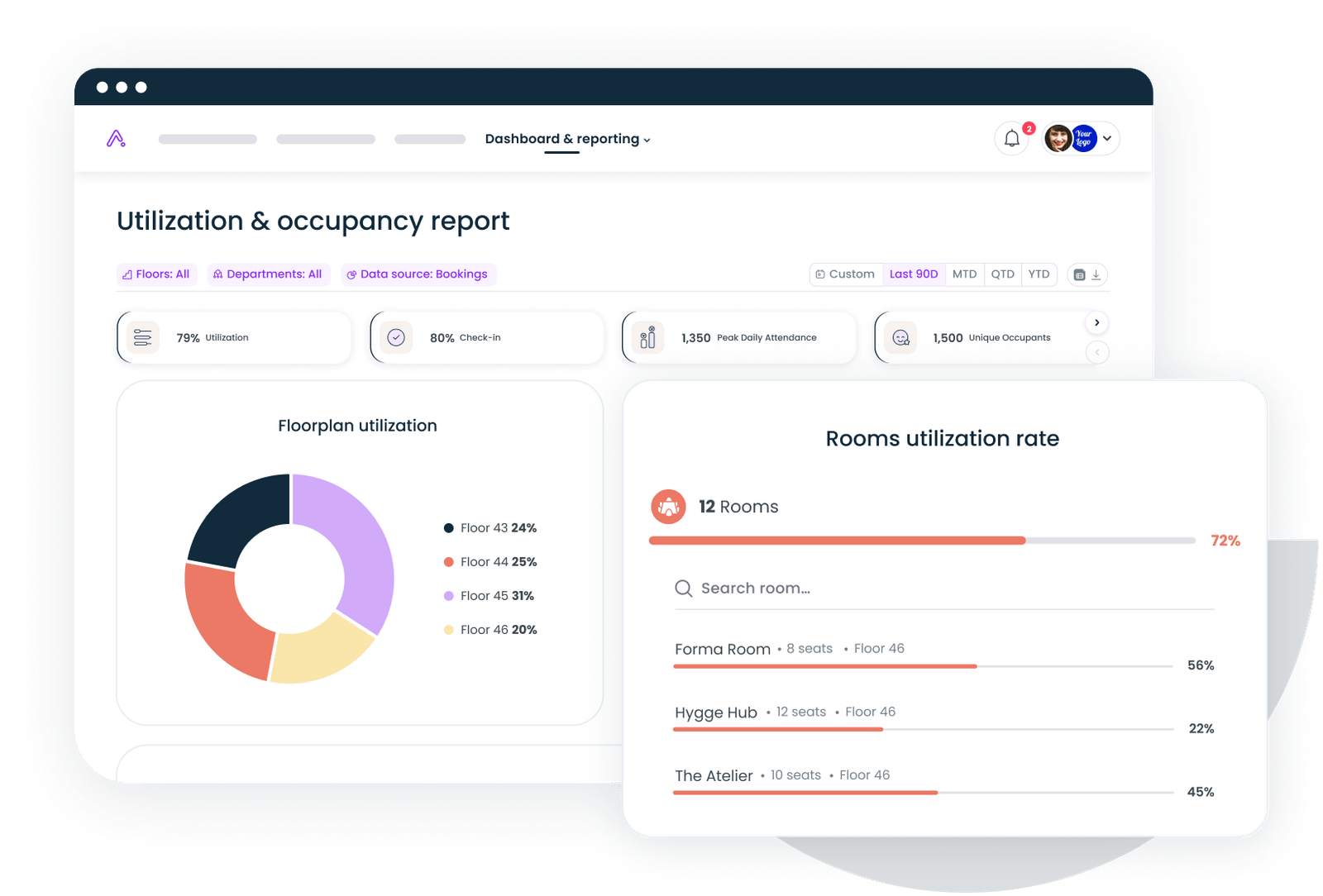
How to reduce your CRE cost per square foot
Benchmarks are useful for context. But the real question is what you do with them. Here are the levers that actually move the number.
Right-size based on utilization, not headcount. If your office runs at 45% average occupancy, you're paying for 55% of nothing. Measuring actual usage through workplace analytics lets you model what happens if you drop a floor, consolidate locations, or shift to a flex arrangement.
Renegotiate or restructure your lease. Sublease inventory is declining, which means landlords have more leverage than they did in 2024. But if you're a reliable tenant with a strong credit profile, there's still room to negotiate TI allowances, rent abatement periods, or contraction options that lower your effective rate.
Shift some footprint to flexible space. For teams that need space two or three days a week, a dedicated lease might not make sense. Blending traditional leases with on-demand office management software lets you match space supply to actual demand rather than peak theoretical capacity.
Consolidate underperforming locations. If you have three offices in a metro and one consistently runs below 30% occupancy, the math on closing it and redistributing those employees is usually compelling. An office consolidation strategy built on real data beats gut-feel decisions every time.
Invest in energy and facilities efficiency. Utility costs are a meaningful chunk of TCO, especially in older buildings. Smart HVAC controls, LED retrofits, and preventive maintenance programs can shave $2-4/SF off your annual operating costs.
Regional trends shaping CRE cost per square foot
Northeast: Still the most expensive region, with Manhattan, Boston, and D.C. anchoring the top of the national rent table. Trophy assets in Midtown East are commanding record-breaking rents. The premium for Class A is widest here.
West Coast: San Francisco remains expensive but is stabilizing after years of sublease-driven softness. Seattle and Los Angeles are seeing modest rent growth. The region's tech-heavy tenant base makes it sensitive to AI-sector expansion.
Sun Belt: Miami, Austin, Nashville, and Phoenix are the growth stories. Miami's 4% year-over-year rent increase leads the nation. These markets offer lower absolute costs but are converging toward national averages faster than most people expect.
Midwest: Chicago, Detroit, Indianapolis, and Columbus remain the value plays. Class A rates in the low-to-mid $20s make these markets attractive for cost-conscious expansions, back-office operations, and regional hubs. If you're planning multi-site expansion, the Midwest deserves a serious look.
The bottom line on CRE cost per square foot
The headline rent number on a listing is a starting point, not an answer. What matters is your total cost of occupancy, how that cost compares to what you're getting in return (productive collaboration, talent retention, client impressions), and whether your space is actually being used enough to justify what you're paying.
The markets are shifting. Supply is tightening. Class A is pulling away from Class B. And the companies that will come out ahead are the ones treating their real estate portfolio like a dynamic asset, measuring it, adjusting it, and making decisions based on data rather than inertia.
Gable gives you real-time occupancy data, cost-per-visit metrics, and scenario planning tools so you can stop guessing and start optimizing.
Get a demo