.svg)


.svg)
- Coworking costs less than leasing in 97% of U.S. cities when you measure total cost of occupancy
- Traditional leases only win at 70%+ consistent daily occupancy, which most hybrid teams never hit
- Fit-out costs alone average $149/sq ft, a hidden expense coworking eliminates entirely
- The smartest move for most teams is a hybrid model: downsized core lease plus flexible overflow
- Measure cost per occupied desk, not cost per provisioned desk
The office lease vs coworking cost debate usually gets framed as a binary choice. It shouldn't be. For most hybrid teams in 2026, the real question isn't which model is cheaper in isolation; it's which combination of the two matches how your people actually work. This guide breaks down total cost of occupancy for a 100-person team across multiple time horizons so you can make that call with real numbers.
Why rent alone is a terrible way to compare costs
Most lease-vs-coworking comparisons start and end with the monthly price tag. That's like comparing car costs by looking only at the sticker price and ignoring insurance, gas, maintenance, and parking. Rent typically represents just 50 to 65 percent of your total cost of occupancy on a traditional lease. The rest hides in line items that don't show up until you're already committed.
Total cost of occupancy (TCO) includes base rent, fit-out and construction, furniture and IT infrastructure, utilities, insurance, property taxes, CAM fees, security deposits, maintenance, and the administrative overhead of managing it all. Coworking folds most of those into a single monthly rate. That's not inherently better or worse, but it does mean you're comparing apples to oranges if you only look at the headline number.
Understanding what drives your cost per desk is the first step toward an honest comparison.
The hidden costs that make traditional leases more expensive than they look
Let's start with the number that surprises most people. Fit-out costs average $149/sq ft across the Americas, up 5.5% year-over-year according to Cushman & Wakefield's 2026 guide. For a 100-person office at 150 square feet per person, that's roughly $2.2 million before anyone sits down.
Then there's furniture and technology. Outfitting each employee with a desk, chair, monitors, and shared infrastructure runs $5,000 to $10,000 per person. For 100 people, that's another $500K to $1M.
Here's what else stacks up on a traditional lease:
- Security deposits: Two to three months' rent, locked up as dead capital
- Utilities and insurance: $3 to $6 per square foot annually, depending on market
- CAM fees: Common area maintenance charges that escalate annually, often unpredictably
- Early termination penalties: Most leases lock you in for three to five years; breaking early is expensive when it's even possible
- Administrative overhead: Someone has to manage vendors, maintenance requests, and compliance
If you're evaluating how to reduce real estate costs, these hidden line items are where the biggest savings hide.
The coworking cost model: What's included and what isn't
Coworking pricing is simpler, but it's not without nuance. The national median membership is ~$220/month per person, and day passes average about $30. That rate typically bundles furniture, WiFi, utilities, cleaning, reception, and shared amenities like kitchens and lounges.
What costs extra varies by operator: dedicated desks (premium over hot desks), private offices (significant premium), meeting room hours beyond a monthly allotment, parking, and printing. For a 100-person team using dedicated desks in a mid-tier market, expect $300 to $450 per person per month all-in.
The real advantage isn't just the price. It's the flexibility. Month-to-month terms mean you can scale up or down without penalty. No three-year commitment. No $2M fit-out. No dead capital sitting in a security deposit.
For a deeper look at what makes coworking compelling beyond cost, see our breakdown of coworking space benefits.

We built a detailed cost comparison framework that walks through the math side by side, including scenarios most guides skip.
Read the guide
Cost breakdown: 100-person team at 1, 3, and 5 Years
Here's where the comparison gets concrete. The table below models a 100-person team in a mid-tier U.S. market (think Austin, Denver, or Raleigh) at 50% average daily occupancy, which is right at the global average of 53% that CBRE reported in 2026.
Traditional lease (15,000 sq ft, 5-year term)
Coworking (dedicated desks, month-to-month)
Two things jump out. First, the lease gets cheaper per month over time because you're amortizing that massive upfront investment. By year five, the monthly gap narrows considerably. Second, the coworking cost stays flat and predictable, which makes budgeting simpler and eliminates capital expenditure risk.
But here's the catch: these numbers assume 50% occupancy. If your team is in the office five days a week at 90%+ utilization, the lease math shifts. Let's look at where that crossover happens.
Break-even utilization: When traditional leases actually win
The break-even point is roughly 70% consistent daily occupancy. Below that, you're paying for empty desks on a lease. Above it, the per-desk economics of a lease start to beat coworking.
Most hybrid teams aren't close to 70%. Friday occupancy averages just 34.5% globally, which means even teams that fill up Tuesday through Thursday are dragging down their weekly average. If your Monday-to-Friday average sits between 40% and 60%, you're in the zone where leases are most wasteful.
Here's a simple framework:
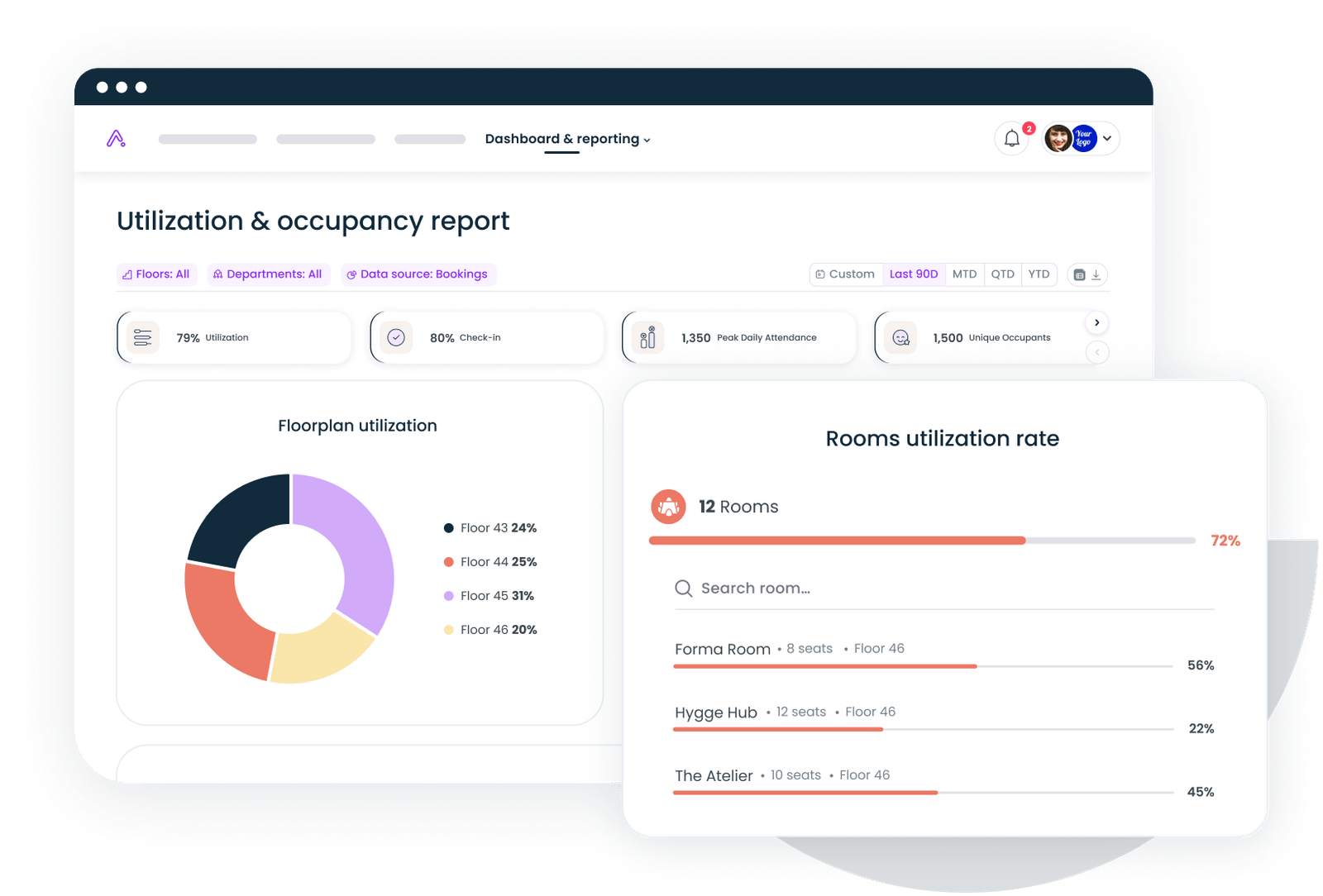
The problem is that most companies don't actually know their occupancy rate. If you're relying on badge swipes or manager estimates, you're probably wrong. Accurate occupancy tracking is the prerequisite for this entire decision.
The hybrid model: Core lease plus coworking overflow
For teams in that 40% to 70% occupancy band (which is most of them), the hybrid model outperforms either pure option. The idea is straightforward: right-size your anchor office for your consistent core, then use flexible space for everything else.
Example: 100-person team, 55% average occupancy
Instead of leasing 15,000 square feet, you lease 8,000 for your 55 to 60 daily regulars. That cuts your base rent from $525K to $280K annually. Fit-out drops proportionally. Then you layer in coworking access for the remaining employees who come in one to three days per week, plus overflow for all-hands weeks.
The savings are dramatic in year one because you're avoiding most of the capital expenditure. By year three, the gap narrows but remains significant. This is the model that hub-and-spoke strategies are built on: a central anchor plus distributed access points.
The operational challenge is managing it. You need visibility into who's booking where, what you're spending across locations, and whether the flex portion is actually being used. That's where Gable On-Demand fits; it gives employees access to 20,000+ coworking spaces globally through a single platform, with consolidated billing and usage data that feeds back into your real estate decisions.
Gable On-Demand connects employees to premium coworking spaces in 900+ cities, with unified billing and occupancy insights built in.
Learn more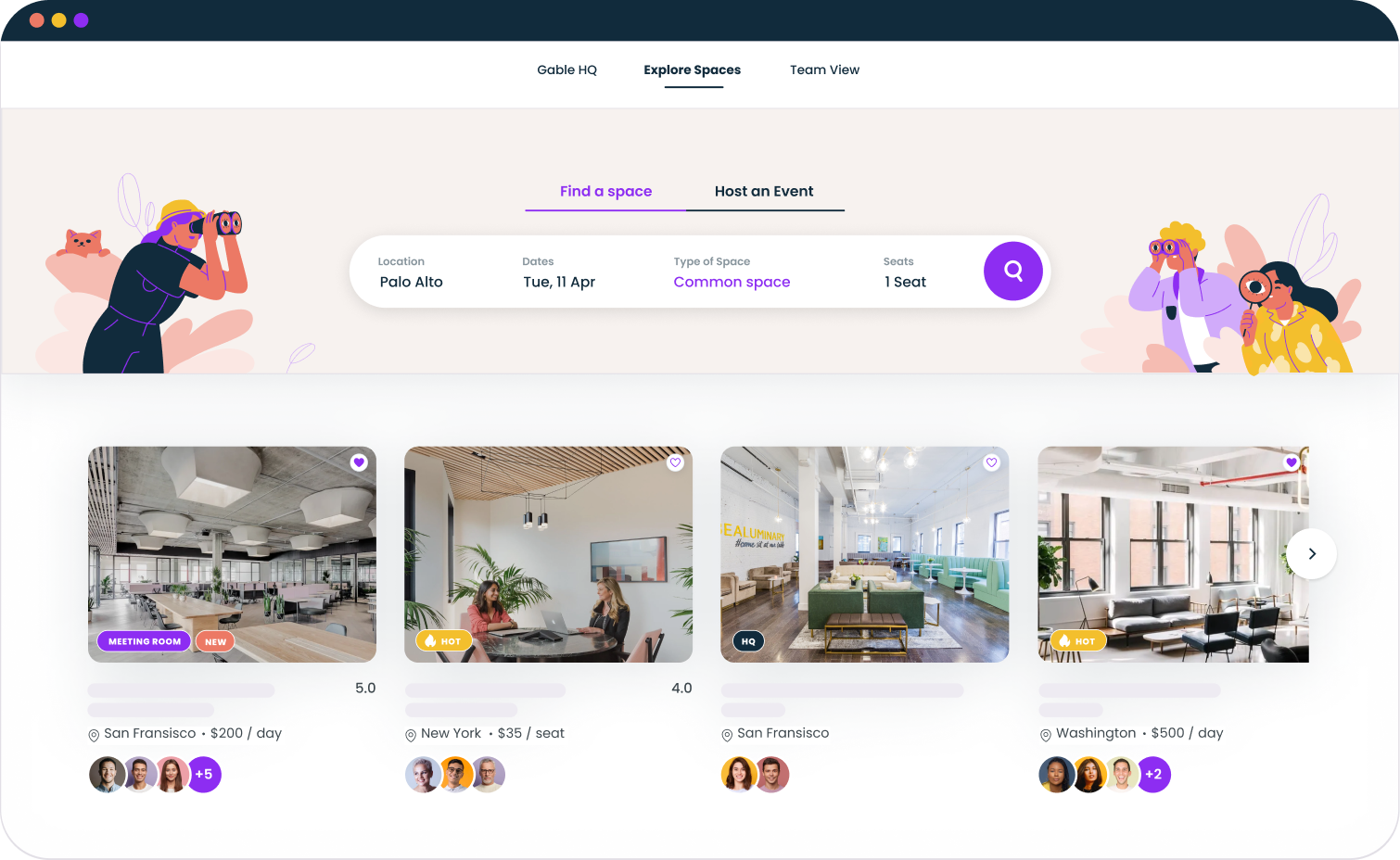
Geographic variance: Where each model wins by the widest margin
The office lease vs coworking cost gap isn't uniform. In expensive gateway markets, coworking's advantage is enormous. In secondary markets, the two models converge.
CoworkingCafe's analysis found that coworking memberships cost less than traditional leases in 97% of U.S. cities studied. But the magnitude varies wildly:
If you have teams distributed across multiple cities, the math gets even more interesting. Leasing satellite offices in three or four markets means three or four fit-outs, three or four security deposits, and three or four sets of vendor relationships. Flexible space eliminates all of that.
For companies managing multiple locations, the operational simplification alone can justify the switch, even before you factor in the direct cost savings.
Decision framework: Matching the model to your business
Not every company should make the same choice. Here's how to think about it based on your actual situation:
Go full coworking if:
- Your headcount is volatile (growing fast, or uncertain)
- You have fewer than 20 people in any single city
- Your team works in-office fewer than three days per week
- You're entering new markets and want to test before committing
Stick with a traditional lease if:
- You have 50+ people in one location using the office five days a week
- Your occupancy consistently exceeds 70%
- You need specialized buildout (labs, studios, secure facilities)
- Your lease terms are favorable and you're locked in anyway
Use the hybrid model if:
- Your occupancy falls between 40% and 70%
- You have a stable core team plus distributed or part-time office users
- You want to reduce capital expenditure without giving up a home base
- You're planning for growth but don't want to over-commit on square footage
Whatever you choose, the decision should be grounded in data, not gut feel. Building a data-driven real estate strategy means starting with actual occupancy numbers, not assumptions about how often people "should" be in the office.
The metric that changes everything: Cost per occupied desk
Here's the shift that makes this whole comparison honest. Stop measuring cost per provisioned desk. Start measuring cost per occupied desk.
If you're leasing 100 desks and only 50 are used on an average day, your real cost per desk is double what your lease math suggests. That $791/month per employee in year five of our model? It's actually $1,582 per occupied desk at 50% utilization.
Coworking doesn't have this problem. You pay for what gets used. A $350/month membership that gets used 15 days a month costs $350. One that gets used 5 days costs $350. But you can also switch to day passes at $30 each, which would cost $150 for those 5 days.
This is why 55% of global occupiers now use flexible office solutions, according to Cushman & Wakefield. The math simply works better when you align spending with actual usage.
The bottom line on office lease vs coworking cost
The lease isn't dead. For high-occupancy, single-location teams, it still makes financial sense over a five-year horizon. But most hybrid teams don't fit that profile. They're running at 50% to 60% occupancy, paying for space that sits empty every Friday (and most Mondays), and carrying capital expenditure risk that coworking eliminates entirely.
The hybrid model, a right-sized anchor office plus flexible overflow, wins for the majority of companies in 2026. It cuts year-one costs by 40% to 60% compared to a full lease, maintains a home base for culture and collaboration, and gives distributed employees workspace access without satellite office overhead.
The key is measuring what matters: cost per occupied desk, not cost per provisioned desk. Once you make that shift, the right model for your team becomes obvious.
Get a walkthrough of how Gable helps workplace teams manage offices and flexible spaces from a single platform, with real cost and occupancy data.
Get a demo