.svg)


.svg)
- Audit both portfolios before making any lease decisions
- Use real utilization data, not headcount, to right-size space
- Consolidate your workplace tech stack early to avoid vendor chaos
- Design shared spaces intentionally to bridge cultural gaps
- Communicate the timeline early, often, and with specifics
Office consolidation after a merger is where the deal's promised synergies either materialize or quietly die. Most integration teams focus on org charts, systems migration, and financial reporting. Real estate gets treated as a facilities problem, not a strategic one, and that's how companies end up paying for two half-empty offices for three years. This playbook walks through seven steps to consolidate workplaces after M&A, from the first portfolio audit to the final communications plan.
Step 1: Audit both portfolios and understand what you're working with
You can't make good decisions about space you don't understand. Before anyone starts talking about which office to close, you need a complete inventory of every lease, location, employee headcount, and utilization rate across both companies.
Start with the basics: lease terms, square footage, annual cost, and expiration dates. Then layer in the data that actually matters. Office utilization averages 54% globally versus targets of 79%, according to JLL. That gap is significant in a single company. In a merger, where you're combining two portfolios that each have their own underutilization problems, the redundancy compounds fast.
Pull badge swipe data, Wi-Fi connection logs, and occupancy sensor readings for the last 12 months from both organizations. If one company has sensors and the other doesn't, you're already seeing the kind of data fragmentation that makes consolidation hard. Look for overlapping geographies, duplicate functions housed in separate buildings, and locations where utilization has been declining.
This audit isn't a one-week exercise. Budget four to six weeks for a thorough CRE portfolio assessment that covers both companies. The output should be a single spreadsheet (or dashboard) that lets you compare every location side by side on cost, utilization, lease flexibility, and employee density.
One thing that trips up integration teams: relying on headcount instead of actual usage. A building assigned to 200 people but used by 80 on any given day isn't a 200-person building. It's an 80-person building with expensive empty space.
Step 2: Decide on your HQ and satellite strategy before making lease decisions
The temptation after a merger is to start canceling leases immediately. Don't. Strategy comes before transactions.
You need to answer a few foundational questions first. Where are your combined talent pools concentrated? Which locations are closest to key clients? What's the cost-of-living differential between markets? And critically, what does your post-merger work model look like?
For most mid-to-large consolidations, a hub-and-spoke model makes the most sense. You keep one or two primary hubs for leadership, client-facing teams, and functions that benefit from density. Then you maintain smaller satellite offices or flexible workspace access in markets where you have clusters of employees but don't need a full floor.
Map every employee by location, role, and team. Overlay that with your hybrid policy. If engineering works remotely three days a week but sales needs to be in-office four days, those two groups have very different space requirements. The strategy should reflect that.
Don't default to keeping the acquirer's HQ and closing the target's. Sometimes the target's location is better positioned for talent, cheaper per square foot, or has a more favorable lease. Let the data decide, not the org chart.
Step 3: Reconcile headcount to space using post-merger hybrid data
This is where most consolidation plans get the math wrong. They take the combined headcount, apply a standard square-footage-per-person ratio, and call it done. That approach ignores how people actually work.
Global occupancy hit 111% in 2025, meaning more people are allocated to buildings than there are physical seats. That's not a crisis; it's a signal that desk-sharing ratios have become the norm, not the exception. Your post-merger space plan should embrace this reality rather than fight it.
Calculate desk-sharing ratios by job function, not by department or legacy company. Engineers who come in twice a week need a different ratio than account managers who come in four days. According to CBRE's workplace insights, sharing ratios should be informed by job functions (83% of respondents), space-utilization data (78%), and supply/demand data (68%).
Build flexible floor plans that accommodate rotation. This means fewer assigned desks, more bookable workstations, and collaboration spaces designed for the days when teams actually come together. If your data shows Tuesday through Thursday as peak days (it almost certainly does), plan for that surge rather than sizing for Monday's ghost town.
One practical tip: run a two-week pilot in one location before rolling out new ratios company-wide. You'll catch problems, like a team that needs adjacent seating for a specific project, before they become grievances.

If you're evaluating which locations to keep, shrink, or close, this guide walks through the data-driven framework for office consolidation strategy.
Read the guide
Step 4: Negotiate lease breaks and subleasing agreements strategically
Now that you know which locations to keep and how much space you actually need, it's time to deal with the leases you don't want.
Start by ranking redundant leases by a simple formula: annual cost multiplied by remaining term, minus utilization value. The highest-cost, lowest-utilization locations go first. CBRE documented a case where sensor-based utilization analysis identified an opportunity to consolidate from eight floors to six, with potential annual savings of £240K. That's one building. Multiply that across a merged portfolio and the numbers get serious.
You have three main options for unwanted space: early termination, subleasing, or negotiating a blend-and-extend on a different property with the same landlord. Each has trade-offs. Early termination fees can be steep, but they're a known cost. Subleasing generates income but leaves you on the hook if the subtenant defaults. Blend-and-extend works when you want to consolidate into fewer, better spaces with the same landlord.
For detailed tactics on lease negotiation approaches, including how to leverage market conditions and tenant-favorable clauses, it's worth building a playbook specific to your portfolio.
Build a financial model for each scenario. Include not just the lease costs but also the move costs, buildout expenses for consolidated space, and productivity impact during transition. The cheapest option on paper isn't always the cheapest option in practice.
One thing to watch: don't let lease expiration dates drive your consolidation timeline. If a lease expires in three months but the team isn't ready to move, you'll create chaos. Negotiate short-term extensions where needed to reduce real estate costs without rushing people.
Step 5: Unify your workplace tech stack to avoid vendor sprawl
Two companies means two of everything: two desk-booking systems, two visitor management platforms, two room scheduling tools, two sets of occupancy data that don't talk to each other. This is the operational chaos that quietly eats integration budgets.
The instinct is to defer tech decisions until the "big" integration items (ERP, CRM, HRIS) are sorted. That's a mistake. Workplace technology is how employees experience the merger every single day. When someone from Company A can't book a desk at Company B's office because they're on different systems, the merger feels broken at a visceral level.
Prioritize a single platform that covers desk and room booking, visitor management, occupancy analytics, and floor plans. Running parallel systems isn't just expensive; it creates data silos that make every subsequent decision harder. You can't compare utilization across locations if the data lives in two incompatible dashboards.
Gable's platform handles exactly this consolidation challenge, bringing desk booking, visitor management, on-demand spaces, events, and analytics into one system so you're not stitching together five vendors while trying to integrate two companies.
When evaluating tools, build a proper workplace technology RFP that accounts for both companies' requirements. The merged entity's needs will be different from either company's pre-merger setup. Don't just pick whichever system the larger company was using; evaluate both, and consider whether either actually fits the combined organization.
Set a hard deadline for tech unification. "We'll get to it later" turns into 18 months of dual systems and duplicate licensing fees.
One platform for desk booking, visitor management, on-demand spaces, and analytics. No more stitching together five vendors across two legacy companies.
Learn more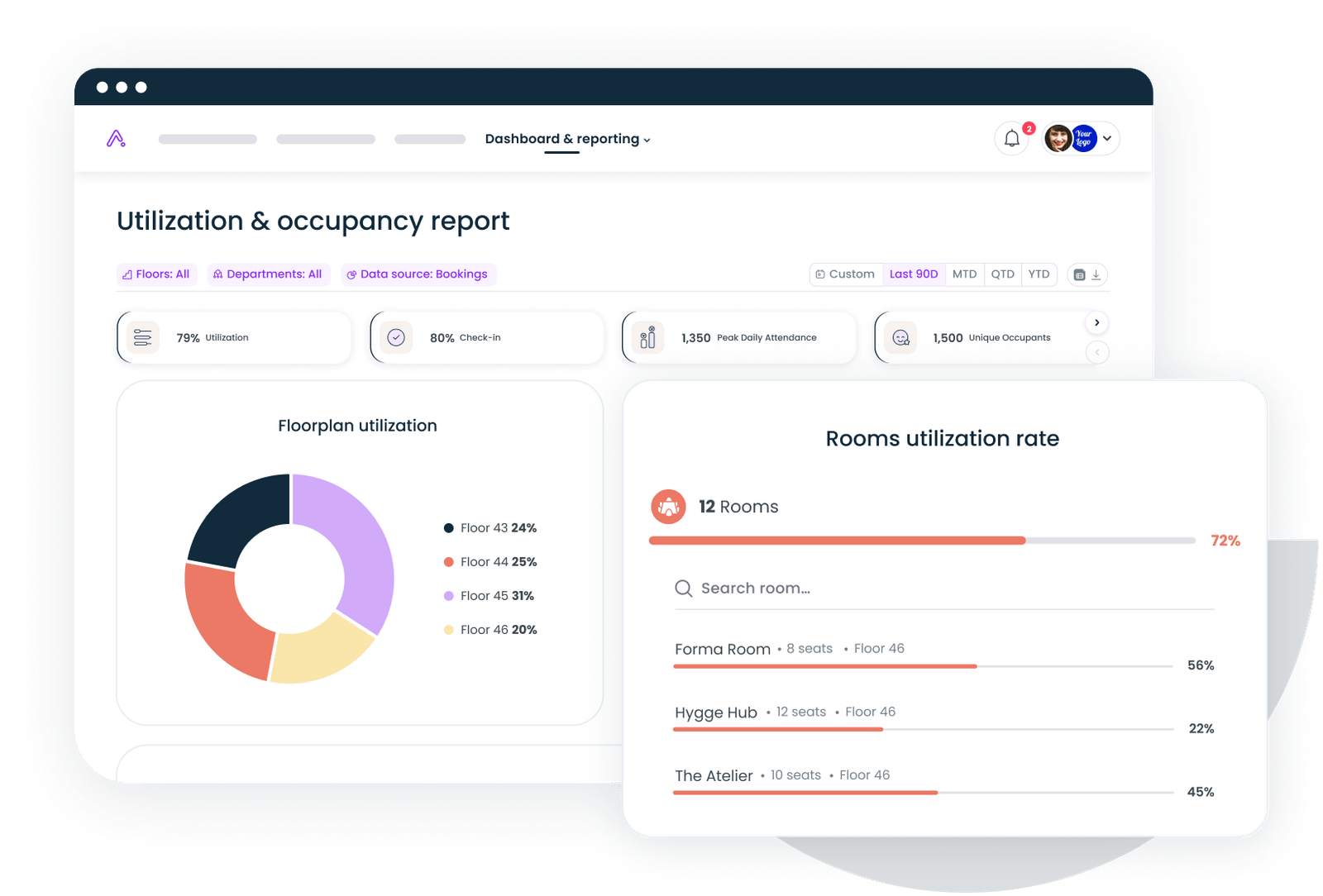
Step 6: Create shared spaces and cultural integration zones
Culture is the thing that kills mergers quietly. Nearly 30% of failed M&As trace back to cultural misalignment, and the physical workspace is where culture becomes tangible. The coffee machine people gather around, the all-hands room, the way desks are arranged; these things signal who the company is.
When you consolidate offices, you're not just combining square footage. You're asking people from two different cultures to share a home. That requires intentional design.
Start by creating "neutral" spaces. If everyone moves into Company A's old headquarters, Company B's employees will feel like guests. Redesign common areas, update signage, and create new collaboration zones that don't belong to either legacy culture. Even small things, like new room names or updated wayfinding, signal that this is a new company, not an acquisition.
Host cross-company events in these shared spaces early and often. Town halls, team lunches, project kickoffs. The goal is to create shared memories in shared places. For teams that are distributed across locations, consider internal events that bring people together with purpose, not just pizza.
Pay attention to the anxiety. Consolidation means some people are losing their office, their commute, their desk near the window. Acknowledge that. Provide choices where possible: let people pick their neighborhoods, choose between focus rooms and open desks, opt into quiet zones. Autonomy reduces the feeling that the merger is something being done to them.
Step 7: Establish a clear communications timeline and change management plan
The single biggest source of employee anxiety during a merger isn't the org chart. It's not knowing what's happening with their physical workspace. Where will I sit? When do I have to move? Will my commute double?
Answer these questions before people start guessing. Guessing is always worse than the truth.
Build a change management plan with specific milestones and dates. Not "Q3" but "September 15." Not "some teams will relocate" but "the product team moves to the downtown office on October 1, and here's the floor plan." Specificity builds trust. Vagueness breeds rumors.
Structure your Integration Management Office (IMO) to include a dedicated workplace workstream. According to DealRoom, IMOs have reduced integration timelines from three to four years to around 18 to 24 months, often unlocking millions in synergies faster. The workplace component of that timeline should include clear phases: audit (months 1 to 2), strategy (months 2 to 3), lease decisions (months 3 to 6), physical moves (months 6 to 12), and optimization (months 12 to 18).
Create feedback loops. Surveys after each phase. Town halls where people can ask uncomfortable questions. A dedicated Slack channel or email alias for workspace concerns. The goal isn't to make everyone happy; it's to make everyone heard.
For guidance on communicating office changes without eroding trust, the key principle is simple: tell people what you know, what you don't know, and when you'll know more.
Bringing it all together
Office consolidation after a merger isn't a facilities project. It's a strategic integration workstream that touches real estate costs, employee experience, cultural identity, and operational efficiency. The companies that do it well treat space decisions with the same rigor they apply to financial integration or systems migration.
The seven steps, audit, strategy, headcount reconciliation, lease negotiation, tech unification, cultural integration, and communications, aren't sequential in practice. They overlap. You'll be negotiating leases while designing floor plans while rolling out new booking software. The key is having a framework that keeps all of those threads connected.
The companies that get this wrong pay for it in duplicate leases, employee attrition, and a culture that never quite gels. The ones that get it right turn consolidation into a genuine competitive advantage: lower costs, better spaces, and a workforce that feels like one company, not two.
Gable helps integration teams unify space management, occupancy data, and employee experience across locations, without the vendor sprawl.
Get a demo