.svg)


.svg)
- Growth-stage companies need a different office playbook than enterprises
- Stay flex-first until you hit roughly 300 people
- When you lease, cap terms at 2-3 years with expansion clauses
- Plan for 1.5x current headcount, not 2x
- Pick workplace tech that scales without retraining or re-platforming
Most advice about office strategy is written for companies that know how many people they'll employ next year. If you're a Series B-D company growing 30%+ annually, that's not you. A fast growing company office strategy has to account for quarterly re-forecasting, capital constraints, and the very real possibility that your headcount doubles before your lease is halfway through. The playbook that works for a 10,000-person enterprise will actively hurt you.
Why growth-stage companies need a different office playbook
Enterprise real estate planning assumes stability. You project headcount five years out, sign a long-term lease, build out the space, and optimize around a known number. Growth-stage companies don't have that luxury. Your Series B forecast said 200 people by Q4; you're at 280 by Q2. Or the market shifts, a round takes longer than expected, and you're suddenly paying for 40 empty desks.
The core tension is this: you need enough space to support collaboration and culture, but you can't afford to lock capital into real estate that might not fit in 18 months. 77% of companies now operate hybrid, which means your space needs fluctuate not just quarter to quarter, but day to day.
Growth-stage workplace decisions also carry outsized cultural weight. At 150 people, the office still shapes how teams interact, how new hires onboard, and whether your culture feels intentional or accidental. Get it wrong and you're either cramming people into a space that screams "we didn't plan for this" or rattling around a half-empty floor that screams "we over-planned for this." Neither is great for morale.
The answer isn't to avoid planning. It's to plan differently. Think in shorter cycles, build in flexibility at every layer, and treat your office strategy like a product: ship, measure, iterate.
The case for staying flex-first until you hit 300 People
Here's a position that might feel counterintuitive: don't sign a traditional lease until you have roughly 300 employees. Before that threshold, flexible and coworking spaces almost always make more sense for growth-stage companies.
The math supports this. 55% of global occupiers use flex, and that number skews even higher among companies under 500 people. For requirements under 50 seats, flex leases are almost always cheaper than traditional ones. And even as you scale past 50, the hidden costs of a traditional lease (buildout, furniture, IT infrastructure, facilities management) often erase the per-seat savings.
Flex space also lets you test markets without betting the balance sheet. Opening a satellite office in Austin or London? A coworking membership lets you validate demand before committing capital. If the team grows, you expand. If it doesn't, you walk away. Our guide to flexible spaces vs. leases breaks down the full cost comparison, but the short version is: flexibility has a price, and at growth stage, it's usually worth paying.
The 300-person threshold isn't magic. It's the point where most companies have enough predictability in headcount, enough density in a single location, and enough operational complexity that a dedicated HQ starts to make financial and cultural sense. Below that, you're better off staying nimble.
What does flex-first actually look like in practice? A few patterns work well:
- One anchor coworking space in your primary city for daily use, team rituals, and new-hire onboarding
- On-demand access in secondary cities where you have clusters of 5-15 people
- Event spaces for quarterly all-hands, sprint planning, and the gatherings that build culture across a distributed team
This isn't about avoiding offices. It's about avoiding premature commitment. The hub-and-spoke model works particularly well here: a central hub (even if it's coworking) with spokes that flex up and down as your team geography shifts.

From Series A through Series C, the decisions change at every stage. Here's how to match your office strategy to your funding stage.
Read the guide
When you do lease, cap at 2-3 years with expansion options
Eventually, you'll outgrow flex. Maybe you need a space that reflects your brand. Maybe you've got 80 people in one city and the per-seat economics finally favor a lease. Maybe your engineering team needs dedicated infrastructure that coworking can't support.
When that moment comes, the single most important thing you can do is keep the term short. Two to three years, with options to expand into adjacent space. Not five years. Definitely not ten.
Growth-stage companies get burned by long leases in two ways. First, you grow faster than expected and the space is too small within 18 months. You're stuck subleasing a new space on top of your existing one, paying double overhead. Second, growth slows (it happens) and you're locked into square footage you don't need, bleeding cash that should be going to product or hiring.
Short-term leases cost more per square foot. That's the trade-off, and it's worth it. The premium you pay for a 3-year term versus a 7-year term is insurance against the volatility that defines your stage. Our lease negotiation guide covers the specific clauses to push for, but the highlights are:
- Expansion rights on adjacent floors or suites, with first right of refusal
- Contraction clauses that let you give back a portion of the space after 18 months
- Sublease and assignment rights so you can offload space if you need to downsize
- Tenant improvement (TI) allowances that front-load your buildout costs; landlords in today's market are often willing to negotiate aggressively here
One more thing: when you build out the space, design for modularity. Movable walls, flexible furniture systems, and infrastructure (power, data) that supports reconfiguration. The space you build for 100 people should be convertible to a space for 150 without a full renovation. This is where collaboration space design matters; build rooms and zones that serve multiple purposes rather than single-use spaces that become obsolete when team structures shift.
Headcount planning: The base, strong, and stretch framework
The biggest mistake growth-stage companies make with office space is planning around a single headcount number. "We'll be 250 people in 18 months, so let's build for 250." The problem is obvious: you won't be exactly 250. You'll be 180 or 320, and neither scenario fits the space you designed.
A better approach is to plan in bands. Growth-stage companies should use headcount bands rather than single forecasts, because startups rarely grow in straight lines. Here's how the framework works:
- Base case (70% confidence): Your conservative hiring plan. If the market softens, a key deal falls through, or fundraising takes longer, this is where you land. Design your core space for this number.
- Strong case (50% confidence): Your board-approved plan. This is the headcount your investors expect. Your expansion options and flex overflow should cover the gap between base and strong.
- Stretch case (20% confidence): Everything goes right. You close the mega-deal, the new product line takes off, hiring is ahead of schedule. You don't build for this; you plan for how you'd handle it (flex space, shift schedules, remote-first for certain teams).
The practical rule: build for 1.5x your current headcount, not 2x. Building for 2x means you're paying for space you might never use. Building for 1.5x gives you breathing room without excessive waste. The delta between 1.5x and 2x is where flex space fills the gap.
This framework also forces you to think about space by function, not just by headcount. Engineering teams that pair-program need different space than a sales team that's on calls all day. Your occupancy planning should account for role-based density, peak days (sprint planning, all-hands, demo days), and the reality that not everyone comes in every day.
How to choose a tech stack that scales without re-platforming
Here's a scenario I've seen play out too many times. A 120-person company picks a desk booking tool that works great for their single office. They grow to 300 people across three locations, add coworking memberships for remote employees, and start running quarterly offsites. Suddenly they've got four different tools, three different logins, and no unified view of how their space is actually being used.
The switching cost isn't just the software license. It's the retraining, the data migration, the lost institutional knowledge, and the three months where nobody trusts the numbers because you're mid-transition. For a company that's re-forecasting every quarter, that disruption is unacceptable.
When evaluating workplace management software, growth-stage companies should optimize for three things:
1. Multi-location from day one. Even if you only have one office today, your platform should handle multiple locations without architectural changes. Adding a second office or a coworking network shouldn't require a new vendor.
2. Unified data layer. Booking data, badge data, utilization metrics, and cost data should live in one place. If your desk booking tool can't talk to your access control system, you're making decisions on partial information.
3. Integration with your existing stack. HRIS, calendar, Slack, SSO. Growth-stage companies already have tool fatigue. Your workplace platform should plug into what you have, not demand that you rebuild around it.
This is where Gable fits for growth-stage teams: a single platform that covers office management, on-demand flex space across thousands of locations, and event coordination, with the integrations and analytics layer that means you're not re-platforming every time you add a location or a hundred people.
From a single office to a global flex network, Gable's On-Demand platform gives growth-stage companies access to 20,000+ workspaces without long-term commitments.
Learn more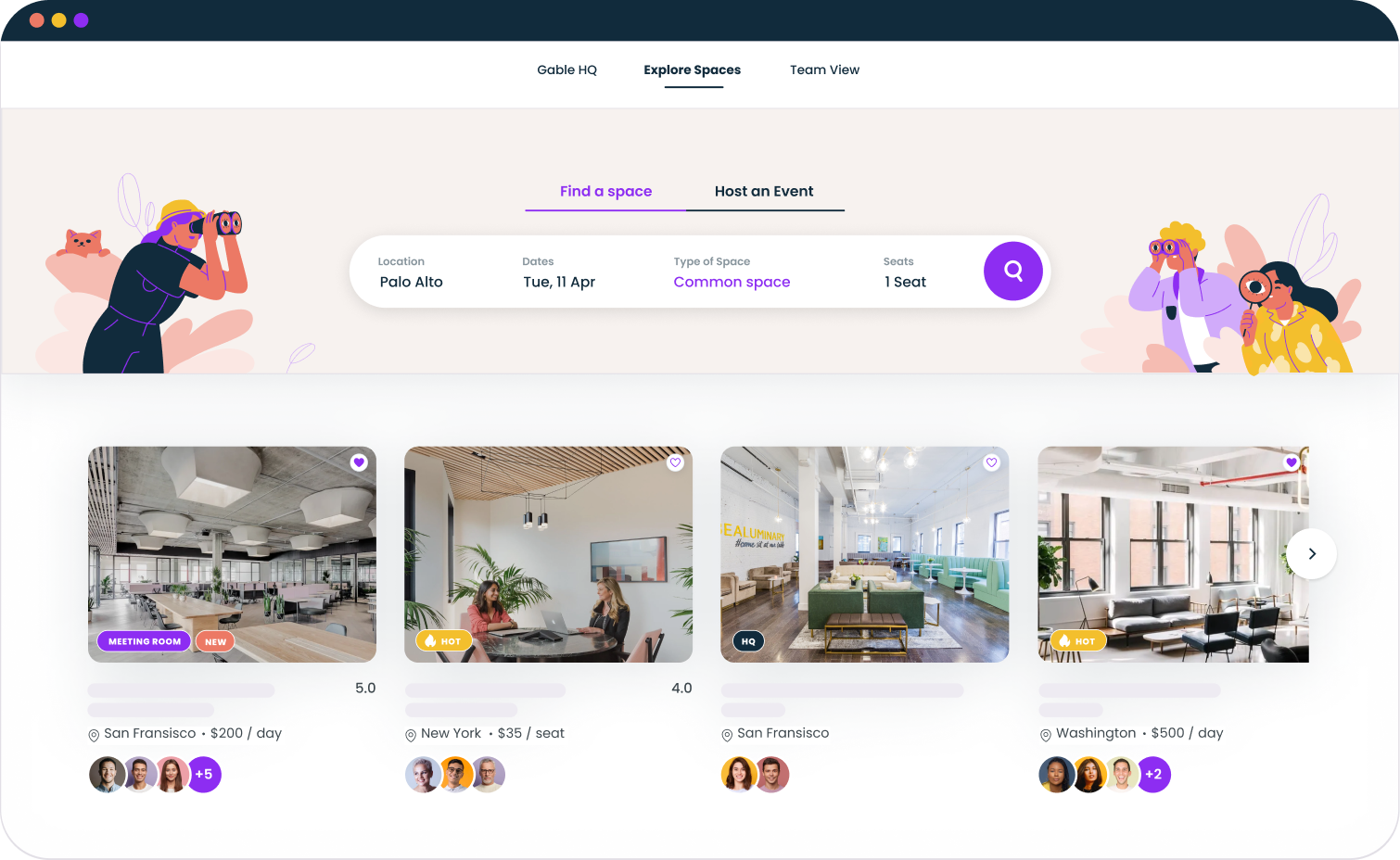
Real estate as a growth lever, not a fixed cost
Most finance teams treat real estate as overhead. It's a line item to minimize. For growth-stage companies, that framing misses the point.
Your office strategy is a recruiting tool. Meeting room bookings surged 22% in the Americas last year, reflecting a clear employee preference for in-person collaboration when the space supports it. Candidates notice whether your office feels like a place where real work happens or a ghost town with a ping-pong table. The companies winning the talent war are the ones using space intentionally: collaboration zones for the days teams come together, quiet focus areas for deep work, and flex access for the days people work closer to home.
Your office strategy is also a market-entry tool. Need to hire five engineers in Denver? Instead of relocating them or waiting until you have enough headcount to justify a lease, give them access to a coworking space and see if the cluster grows. If it does, you've validated the market. If it doesn't, you've spent a fraction of what a lease would have cost. This is the talent attraction angle that most growth-stage companies underestimate.
And your office strategy is a retention tool. The data on this is clear: flexibility matters. But so does belonging. The companies that figure out how to offer both, real spaces for real collaboration combined with the freedom to work where you're most productive, are the ones keeping their best people.
Metrics growth-stage leaders should track
You can't iterate on what you don't measure. But growth-stage companies often either track nothing (relying on gut feel) or track everything (drowning in dashboards nobody reads). Here's what actually matters:
Utilization rate by day and location. Not average utilization, which hides the peaks and valleys. You need to know that Tuesday and Wednesday are at 80% while Friday is at 15%. That pattern should drive your space decisions, your flex overflow strategy, and your team coordination policies.
Cost per employee per month. Total real estate spend (lease, flex, events, facilities) divided by headcount. Track this monthly. If it's climbing faster than revenue, something's wrong. If it's flat while headcount grows, your strategy is working. Workplace spend benchmarks can help you understand where you stand relative to peers.
Seat-sharing ratio. How many employees share each physical seat? Pre-pandemic, the standard was 1.5:1. Today, seat-sharing ratios have reached 3:1 in many hybrid organizations. Knowing your ratio tells you whether you're over-provisioned or under-provisioned, and by how much.
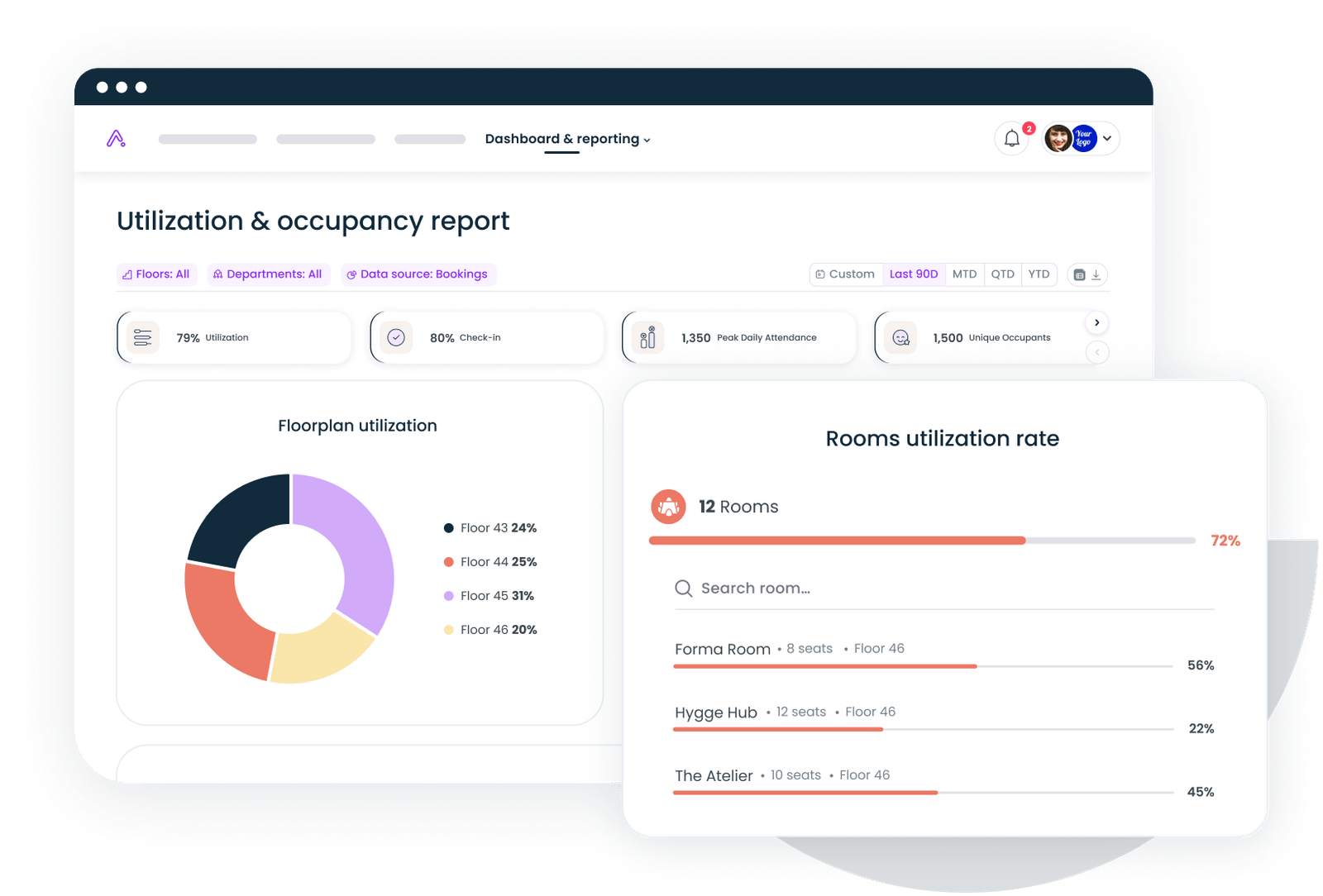
Collaboration density. How often are teams actually gathering in person? This is harder to measure but critical. If you're paying for collaboration space and nobody's using it, the problem might be the space, the policy, or the tools. Workplace analytics can surface these patterns before they become expensive blind spots.
The cadence matters as much as the metrics. Growth-stage companies should review these numbers quarterly, not annually. Your headcount changes too fast for annual planning cycles. Every quarter, ask: does our space still match our team? If the answer is no, adjust. That's the whole point of building flexibility into every layer of your strategy.
The counterargument: Why some growth-stage companies lease early
I should be honest about the other side. There are legitimate reasons to sign a lease before 300 people.
If you're in a market where coworking inventory is thin (some secondary cities still have limited options), a short-term lease might be your only path to dedicated space. If your work requires specialized infrastructure (labs, studios, secure facilities), flex spaces won't cut it. And if your culture is deeply tied to a physical space, like a design studio where the environment is part of the brand, a lease makes sense earlier.
The key is to lease intentionally, not by default. Too many growth-stage companies sign a lease because "that's what you do when you get serious." That's enterprise thinking applied to a growth-stage problem. If you do lease early, apply the same principles: short terms, expansion options, modular buildout, and flex overflow for the inevitable gaps between what you planned and what actually happens.
Putting it all together: The growth-stage office playbook
Here's the framework, compressed:
Stage 1: Pre-product-market fit (under 50 people). All flex, all the time. Don't spend a dollar on real estate that could go to product. Use coworking for daily work and event spaces for team gatherings.
Stage 2: Scaling (50-300 people). Flex-first with intentional gathering. Anchor coworking space in your primary city, on-demand access everywhere else, quarterly offsites to build culture. Start tracking utilization and cost-per-employee.
Stage 3: Establishing roots (300+ people). Short-term lease for your HQ, designed for 1.5x current headcount. Flex overflow for peak days and secondary locations. Unified tech stack across all space types. Quarterly reviews of every metric.
At every stage: Plan in headcount bands, not single numbers. Keep lease terms short. Build modular spaces. Measure relentlessly. And treat your office strategy as a product that ships, gets feedback, and iterates.
The companies that get this right don't just save money on real estate. They move faster into new markets, hire better talent, and build cultures that survive the chaos of rapid growth. The ones that get it wrong spend their Series C cleaning up the real estate mistakes they made at Series B.
From flex space booking to office analytics to team events, Gable gives growth-stage companies one platform that scales with them.
Get a demo