.svg)


.svg)
- Sensors are everywhere, but privacy concerns still block adoption
- Anonymous-at-source sensors beat anonymized-after-collection every time
- Silent deployments destroy trust; transparent communication prevents backlash
- U.S. privacy law is fragmented and tightening fast
- The governance layer around your sensors matters more than the sensors themselves
Workplace sensors privacy isn't a technical problem. It's a trust problem. 56% organizations add sensors or Wi-Fi analytics this year, but most haven't figured out how to deploy them without making employees feel watched. The companies that get this right will unlock real space optimization. The ones that don't will face backlash, legal exposure, and a workforce that quietly resents the office it's being asked to return to.
Why workplace sensors raise privacy concerns
Let's be honest about what's happening. You're putting devices in a room that detect whether humans are present, how many there are, and sometimes how long they stay. Even when the technology is genuinely anonymous, the perception gap is enormous.
54% users cite privacy as their primary hesitation. That number comes from the consumer side, but workplace leaders I talk to see the same dynamic in their offices. Employees hear "sensors" and think surveillance cameras, keystroke loggers, bathroom monitors. The mental model isn't "we're optimizing conference rooms." It's "they're watching us."
This isn't irrational. Employees have seen enough headlines about companies tracking mouse movements and screenshot intervals to be skeptical of any new monitoring technology. The burden of proof sits with the employer, not the employee. If you can't clearly explain what a sensor does, what it doesn't do, and why you need it, you haven't earned the right to deploy it.
The psychological dimension matters too. Research on workplace change management consistently shows that perceived surveillance reduces autonomy, which reduces engagement. Even if your PIR sensor literally cannot identify a person, the feeling of being watched has real consequences for how people experience the office.
The technology trade-offs: Which sensors respect privacy best
Not all sensors are created equal, and the technology choice you make on day one determines your privacy ceiling.
PIR (passive infrared) sensors detect heat signatures from human bodies. They answer one question: is someone here? They can't identify who, can't capture images, can't record audio. They're the privacy gold standard for basic occupancy counting.
Thermal sensors work similarly but offer better accuracy for counting multiple people in a space. They see heat blobs, not faces. Good for conference rooms where you need headcount data without identification.
Radar and LiDAR sensors detect motion and presence through radio waves or light pulses. No visual data captured. Increasingly popular for open floor plans because they cover larger areas without cameras.
Camera-based sensors with edge AI are where it gets complicated. Modern versions process video on-device and output only anonymous count data; no images leave the sensor. Edge AI provides strong privacy by combining optical accuracy with genuine anonymity. But "we have cameras that don't save footage" is a harder sell to employees than "we have motion detectors." The perception problem is real even when the technical privacy is solid.
Wi-Fi and Bluetooth tracking uses existing network infrastructure to estimate occupancy by counting connected devices. It's cheap and easy to deploy. It's also the most privacy-risky option because MAC addresses can, in theory, be linked back to individual devices. If you go this route, MAC address randomization and aggregation are non-negotiable.
The key distinction is between anonymous-at-source and anonymized-after-collection. Anonymous-at-source sensors (PIR, thermal, radar) physically cannot capture personal data. Anonymized-after-collection sensors (cameras, Wi-Fi) capture identifiable data first, then strip it. The second approach creates a window of vulnerability and a much harder compliance story. When you're evaluating workplace technology trends, privacy architecture should be a first-order criterion, not an afterthought.
Four legal and regulatory considerations before you deploy
The legal landscape for workplace sensors in the U.S. is fragmented, evolving, and more aggressive than most facilities teams realize.
1. Federal baseline: the Electronic Communications Privacy Act (ECPA)
The ECPA prohibits intercepting electronic communications without consent, but it was written in 1986 and doesn't directly address occupancy sensors. It's a floor, not a ceiling. Courts have generally allowed employers to monitor shared workspaces where there's no reasonable expectation of privacy, but that interpretation varies by jurisdiction and sensor type.
2. State-level privacy laws are where the real risk lives
California, New York, Connecticut, Illinois, and a growing list of states have enacted or proposed workplace monitoring laws that go well beyond federal requirements. California's CCPA/CPRA framework, for example, gives employees rights over personal data collected in the workplace. If your sensors touch anything that could be classified as personal information (and Wi-Fi tracking data arguably qualifies), you need a compliant data handling process. For organizations operating across states, standardizing global workplace policies becomes essential.
3. The regulatory trend is toward more protection, not less
Federal legislators have proposed bills like the Stop Spying Bosses Act, which would significantly expand workplace privacy protections around electronic monitoring. Whether or not this specific bill passes, the direction is clear. State legislatures are moving faster. If you design your sensor program for today's minimum requirements, you'll be retrofitting for compliance within two years.
4. The NLRA wildcard
The National Labor Relations Act protects employees' right to organize, and the NLRB has taken the position that surveillance (or perceived surveillance) of union activity is an unfair labor practice. If your sensors are in break rooms, common areas, or spaces where employees might discuss working conditions, you're in legally ambiguous territory. This isn't hypothetical; it's the kind of thing that surfaces during organizing campaigns and turns a facilities decision into a labor relations crisis.
The practical takeaway: involve your legal team before you buy sensors, not after. And document everything, including what you chose not to deploy and why.
Building employee trust through transparency
The single biggest predictor of whether a sensor deployment succeeds or fails isn't the technology. It's the communication.
I've seen organizations deploy identical sensor hardware with completely different outcomes. The difference was always the same: one team told employees what was happening and why. The other didn't.
Here's a framework that works:
Explain the "why" before the "what." Start with the business problem. "We're paying for 200 desks but only 80 are used on any given day. We need better data to right-size our space and invest in the areas you actually use." That's a story employees can get behind. "We're installing occupancy sensors" without context is a story employees will write for themselves, and it won't be flattering.
Be specific about what sensors can and can't do. "These PIR sensors detect motion and heat. They cannot identify individuals, capture images, or record audio. They tell us how many people are in a room, not who those people are." Specificity builds trust. Vagueness destroys it.
Define data access and retention upfront. Who can see the data? (Facilities team, not HR managers.) How long is it stored? (90 days, then auto-deleted.) Can it be linked to individuals? (No.) Put this in writing. Make it accessible. Effective communication of policy changes isn't a one-time email; it's an ongoing commitment.
Create a feedback channel. Give employees a way to ask questions and raise concerns after deployment. Monitor it. Respond to it. The organizations that treat sensor deployment as a conversation rather than an announcement avoid the backlash cycle entirely.
Share the results. Show employees what you learned and what you're doing about it. "Based on sensor data, we're converting three underused conference rooms into focus pods because you told us you needed more quiet space." That closes the loop and demonstrates that the data serves employees, not just management.

Sensor deployment is a change management challenge as much as a technology one. This guide covers the communication frameworks that prevent backlash.
Read the guide
Common mistakes that erode trust
The history of workplace sensor deployments is littered with avoidable failures. Here are the patterns I see most often.
Silent rollouts. Installing sensors without telling anyone is the fastest way to destroy trust. Employees notice new hardware on ceilings. They talk about it. Rumors spread. By the time you send the explanatory email, the narrative is already set: "They're spying on us and they tried to hide it." The Daily Telegraph learned this the hard way when reporters discovered tracking devices under their desks in 2016. The backlash was immediate and public.
Over-scoping the data collection. Collecting more data than you need "just in case" is a privacy liability and a trust liability. If you only need to know whether a desk is occupied, you don't need to know for how long. If you only need room headcounts, you don't need individual identification. Data minimization isn't just a GDPR principle; it's a trust principle. Your desk booking data privacy practices should reflect the same restraint.
Combining data sources without disclosure. Sensor data alone might be anonymous. But sensor data combined with badge swipe data, calendar data, and Wi-Fi logs can be re-identified. If you're integrating multiple data streams (and you probably should, for accuracy), you need to be transparent about the integration and ensure the combined dataset remains anonymous at the individual level.
Deploying in sensitive spaces. Sensors in bathrooms, lactation rooms, prayer rooms, or wellness spaces are a hard no. Full stop. Even motion sensors that can't identify anyone. The expectation of privacy in these spaces is absolute, and violating it will cost you more in trust and legal exposure than any utilization data is worth.
Treating compliance as a checkbox. Filing a privacy impact assessment and calling it done isn't enough. Compliance is ongoing. Laws change. Sensor capabilities change. Employee expectations change. Build a review cadence (quarterly is reasonable) and actually follow it.
How to integrate sensors into your workplace management platform
Sensors generate data. Data without context is noise. The value of occupancy sensors comes from integrating them into a system that turns raw counts into actionable decisions about space, scheduling, and investment.
This is where the governance layer matters most. A unified workplace management platform should provide:
Role-based access controls. The facilities team sees utilization trends. Department heads see aggregate data for their floors. Individual employees see whether a room is available. Nobody sees data they don't need. This isn't just good privacy practice; it's good data governance.
Audit logs. Every data access event is recorded. Who looked at what, when, and why. This is your compliance backbone. If an employee or regulator asks how sensor data is being used, you can answer with specifics, not assurances.
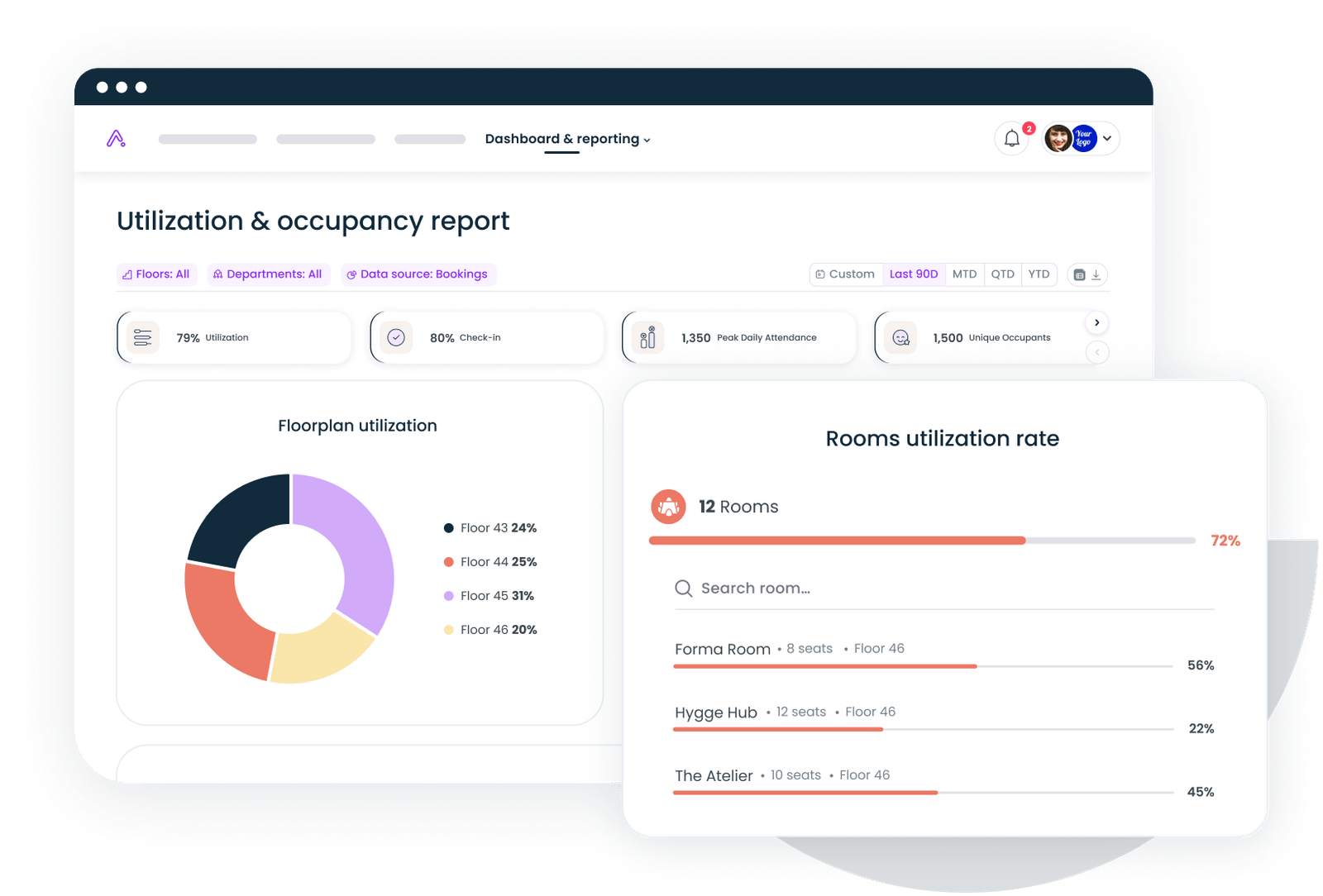
Transparent dashboards. Give employees visibility into aggregate, anonymized utilization data. When people can see the same data that's informing space decisions, the sensor program feels collaborative rather than extractive. This is where Gable Offices fits naturally: it provides the booking, utilization, and visitor management layer that gives sensor data structure, access controls, and transparency.
Automated data retention. Set retention periods and enforce them automatically. If your policy says 90 days, the system should delete data at 90 days without anyone having to remember. Manual deletion policies are policies that eventually get forgotten.
Integration visibility. Employees should be able to understand which systems their data flows through. If sensor data feeds into your booking system, your space planning tools, and your workplace analytics platform, that should be documented and accessible.
The goal isn't to hide the complexity of your data infrastructure. It's to make it legible. Trust comes from transparency, and transparency requires systems that are designed for it.
Gable Offices gives workplace teams the governance layer that makes sensor data trustworthy, with role-based access, audit logs, and transparent dashboards.
Learn more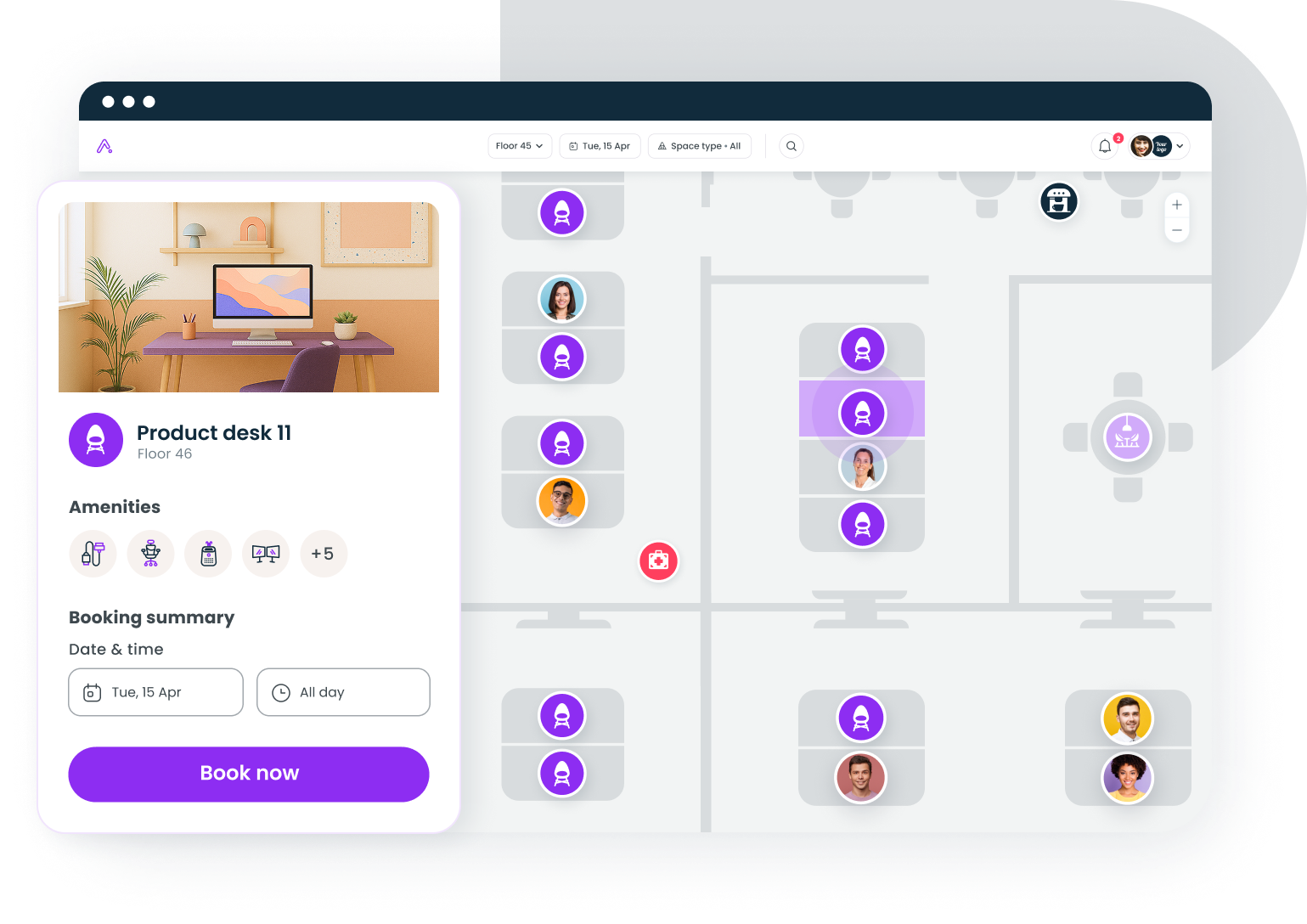
What's coming next: AI, Regulation, and the evolving privacy landscape
The sensor market is growing fast. The desk occupancy sensor market is projected to reach nearly $1.3 billion by 2033, up from about $500 million in 2025. That growth will bring more sophisticated technology, more regulatory scrutiny, and higher employee expectations.
AI-powered sensors are already shifting processing to the edge, meaning data is analyzed on the device itself and only anonymous outputs are transmitted. This is a genuine privacy improvement. But it also means the sensor hardware is getting smarter, which makes the "what can it do?" question harder to answer simply. Communicating the capabilities of AI-enabled sensors requires more nuance than explaining a basic motion detector.
Regulatory expansion is accelerating. More states are passing workplace privacy laws. The EU's AI Act adds new requirements for AI systems used in employment contexts. Even if you're a U.S.-only company, your compliance management framework needs to account for a regulatory environment that's moving toward more protection, more disclosure, and more employee rights.
Employee expectations are rising. The generation entering the workforce now grew up with data privacy as a mainstream concern. They've seen Cambridge Analytica, facial recognition bans, and GDPR enforcement actions. They expect their employer to take privacy seriously, not as a legal obligation but as a cultural value. Companies that treat sensor privacy as a compliance exercise will find themselves out of step with their own workforce.
The organizations that will navigate this well are the ones building privacy into their workplace technology stack now, not as a reaction to regulation but as a design principle. That means choosing anonymous-at-source sensors, implementing governance platforms with real access controls, communicating proactively, and treating employee trust as a metric that matters as much as square footage utilization.
The bottom line on workplace sensors and privacy
Occupancy sensors are genuinely useful. They help you right-size your real estate, design better spaces, and make data-driven decisions about where to invest. The privacy concerns are also genuine. The path forward isn't choosing between optimization and trust. It's building systems where both coexist.
That requires three things: technology choices that minimize data collection by design, legal frameworks that account for a tightening regulatory environment, and communication practices that treat employees as partners rather than subjects. None of this is particularly complicated. But it does require intentionality, and the companies that approach sensor deployment with that intentionality will have a meaningful advantage over those that bolt on privacy protections after the fact.
The sensor is the easy part. The governance, the communication, the trust; that's the actual work.
From desk booking to utilization analytics, Gable gives you the data you need with the governance your employees expect.
Get a demo